

Linghai Medical Files for IPO: A Differentiated Play in the Chronic and Special Disease Management Market
In recent years, the chronic and special disease management industry has gained significant traction.
From the perspective of investment and financing data,According to the “Global Digital Health – Chronic Disease Management Value Trend Report” released by Artery Orange (Dongmaicheng), a total of 62 financing deals occurred globally in the digital health sector for chronic disease management in 2020, with cumulative funding reaching nearly $1.6 billion, representing a 60% year-on-year increase. The average amount per financing round exceeded $25 million, significantly higher than the approximately $18 million recorded in 2019.
From an industry development perspective, since the rise of chronic disease patient management during the “Hundred Glucose Meter Wars” in 2015, intervention scenarios and methods for chronic disease management have gradually evolved from traditional manual interventions to AI-assisted human management, and further to today’s digital chronic disease management platforms. Amidst this wave of industry growth, established players are continuously strengthening their defenses, expanding business boundaries, and exploring viable profitability models, while new entrants are constantly joining the fray to capture share in this blue-ocean market.
However, beneath the surface of this bustling activity, there are many aspects of the chronic and special disease management industry that warrant deep reflection. For instance, do internet-based management models like those of Tencent Health and JD Health have replicable value? How can the costs of chronic and special disease management platforms be controlled and reduced? What is the current state of the grassroots market for chronic and special disease management?
In response, Kong Lingda, founder of Linghai Medical, stated,“Although current market policies have improved significantly compared to the past, and some companies have secured substantial financing or gone public in the last two years, there are still few tangible changes at the operational level, such as in patient care and medication access.”
“Linghai Medical’s healthcare service platform, which is based on the management of chronic and special diseases, leverages the company’s own hospital resources and focuses on grassroots markets in third-tier cities and below. This approach can help reduce and control operational costs to a certain extent and offers high replicability,” said Kong Lingda.
The resume of Kong Lingda, founder of Linghai Medical, is quite impressive.
In 2011, Kong Lingda participated in the national and military key research projects of the Academy of Military Medical Sciences, focusing on the synthesis and production process of oseltamivir.Awarded a First-Class Merit Citation to the Collective by the Chinese People's Liberation Army for the successful development of "Chinese Tamiflu."
Participated in the synthesis research of L-2 inhibitors from 2012 to 2013, and received one internal commendation from the military.
In 2013, leveraging health economics theories and game theory tools in my thesis research on the empirical study of medical consortia under a corporate governance structure in China, I was granted the opportunity to participate in the establishment of the IMS Health Institute. There, I engaged in projects such as health big data research and World Health Organization procurement assistance, earning both individual employee awards and industry collective honors.
In the same year, while studying at Guanghua School of Management, Peking University, Kong Lingda leveraged health big data to conduct multiple pharmacoeconomic evaluations; he was commissioned by the State Council to carry out a national population health research project and was awarded the Chinese Outstanding Young Health Economist Scholarship.
In addition to his repeated participation in key national and military research and reform projects, Kong Lingda has provided services to policy-making and administrative agencies in more than ten provinces and dozens of localities. He has published more than ten high-quality papers in core journals such as Chinese Health Care Management, Chinese Hospital Management, and Health Policy Research, and has contributed to the compilation of monographs including Guidelines for Pharmacoeconomic Evaluation, Health Economics, and the National Census Report on Population Health.
Subsequently, drawing on a solid foundation of industry theory and accumulated practical experience, Kong Lingda chose to embark on his own entrepreneurial venture.
Linghai Medical was officially established in 2019, but its development history can be traced back to 2012.
The founding team established by Kong Lingda in 2012 was the precursor to Haiyu Medical. This team undertook the pharmaceutical benefit management (PBM) business of Hailong in 2012, achieved the highest national market coverage for health insurance custody services in 2015, and facilitated the implementation of the PBM project in Wenzhou, Chongzuo, and Quzhou in 2016.
“At that time, we were in a relatively early stage. Our role was to educate the market and nurture companies that later achieved strong growth,” recalled Kong Lingda. “Although we educated the market, we did not penetrate it deeply. Moreover, as our former company was restructured into a central state-owned enterprise, it was temporarily unable to attend to the detailed work involved in market applications. Therefore, we spun off to establish Linghai Medical.”
According to Kong Lingda,Currently, Linghai Medical is primarily rooted in non-hospital private medical institutions, pharmacies, and pharmaceutical wholesale enterprises, providing continuous out-of-hospital services for grassroots populations and specialized development. “Our core business is still developing towards the direction of health welfare management.”
Why choose chronic and special disease management as the entry point? And why target the primary care market? Kong Lingda stated that there are three main reasons for this:
First, this is a continuation of the business DNA of the original founding team.“We focused on the management of chronic and special diseases as one of the key priorities when we first launched pharmacy benefit or health management projects with Haihong,” said Kong Lingda., this population has its own unique characteristics, including specific medication needs and high adherence, “which makes it easier for us to approach from a commercial perspective.”
Second, this is based on an assessment of the current market size.“In fact, competition for some common medications or OTC drugs is now fierce, with the market significantly squeezed by traditional e-commerce platforms, making it impossible for traditional service-oriented companies to compete,” said Kong Lingda.
Finally, it was developed based on user needs, with chronic and special disease management and the primary care market as entry points.Kong Lingda stated,"The primary healthcare needs of the grassroots population still lie in major diseases or chronic and special diseases. 'Their demand for medical services related to chronic and special diseases is relatively high, which also aligns well with the population we aim to serve.'"
Linghai Medical’s flagship initiative is a medical service platform centered on the management of chronic and special diseases. This project primarily establishes three platforms: smart healthcare, cloud pharmacy, and insurance management. By empowering commercial insurers, pharmaceutical companies, pharmacies, and patients, it integrates online and offline retail channels to build an integrated pharmaceutical benefits platform and ecosystem. Driven by innovative payment models, the project fosters the development of the pharmaceutical ecosystem to better serve patients.
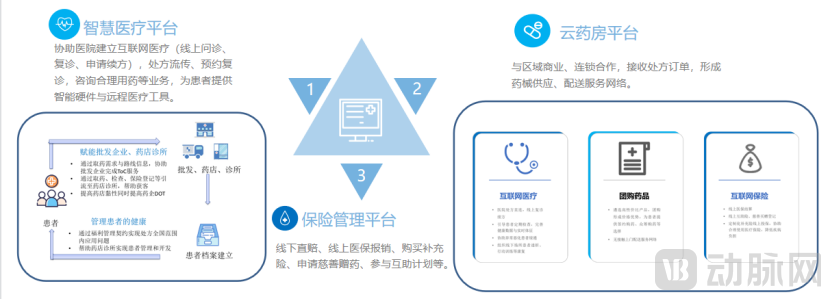
Linghai Medical Chronic and Special Disease Management Platform (Image provided by Linghai Medical)
Specifically, the smart healthcare platform can assist hospitals in establishing internet-based medical services, including prescription circulation, follow-up appointment scheduling, and rational medication consultation, while providing patients with smart hardware and telemedicine tools. The insurance management platform offers functions such as online direct claim settlement, online medical insurance reimbursement, and applications for charitable drug donations. Meanwhile, the cloud pharmacy platform primarily collaborates with regional commercial entities and chain pharmacies to receive prescription orders, thereby forming a supply and distribution network for pharmaceuticals and medical devices.
The platform system established by Linghai Medical enables the creation of patient profiles through pharmaceutical companies, pharmacies, and clinics. It facilitates nationwide application via welfare management contracts and assists pharmacies and clinics in patient management and development. Furthermore, leveraging collected data on patients’ medication needs and routing information, the platform supports pharmaceutical companies in delivering direct-to-consumer (ToC) services through comprehensive disease management. By directing patients to pharmacies and clinics for medication pickup, examinations, day surgeries, and insurance registration, the platform helps healthcare institutions and pharmacies acquire customers. This approach not only enhances user stickiness but also increases the Days of Therapy (DOT) for pharmaceutical companies.
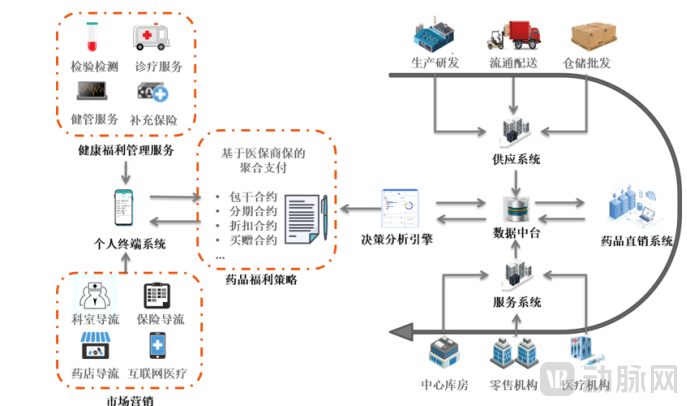
Schematic Diagram of the Core Product Process for Chronic and Special Disease Management (Image provided by Linghai Medical)
“Our greatest advantage is that our service costs are relatively low.”Kong Lingda explained, for example,Other models require building hospitals, acquiring pharmacies, and establishing commercial companies independently, which follows a capital-intensive path. “This model does not integrate well with traditional industries, and its development speed and efficiency lack replicability.”
However,“The platform system established by Linghai Medical does not require us to build our own hospitals, as we have our own off-site medical institutions.”"This way, our operating costs will be relatively much lower," said Kong Lingda. "Currently, there are already three to four thousand commercial partners collaborating with us, including agents.""We are also developing our own proprietary drug portfolio through collaborations with pharmaceutical companies at the national or provincial level, thereby keeping drug costs relatively low."
Additionally,Linghai Medical holds its own internet hospital license.
“Currently, many companies do not actually understand the operational system of the pharmaceutical industry, nor do they hold licenses for internet hospitals. They are more involved in assisting others to build internet hospitals, and after completion, they may only enjoy partial data usage rights or operational rights,” said Kong Lingda.Linghai Healthcare owns its own medical institutions and hospitals and holds an internet hospital license, enabling it to deliver human-centric services through its integrated ecosystem. “We also have a grassroots promotion team and a grassroots service network.”
Kong Lingda further emphasized that most other companies conduct patient conversion under the guise of the public hospitals they serve, where users are only aware of this external facade and remain unaware of the underlying enterprise. In contrast, Linghai Medical can achieve patient conversion through its own grassroots promotion teams and promotional service network.“We have made it clear to the public from the outset that this is Linghai Medical’s service system. This constitutes one of our key differentiators.”
Regarding future development plans, Kong Lingda stated, “Linghai Medical’s next steps for its medical service platform based on chronic and special disease management include expanding coverage to more than 20 provinces across China and integrating various service components. In terms of corporate development, the company aims to establish its own online pharmaceutical service network and leverage its existing physical infrastructure to incubate specialized service centers, thereby providing patients, pharmaceutical companies, and pharmacies with more controllable, efficient, and cost-effective services.