

Riding the Surge: How CD Capital Captures Opportunities in China's Billion-Dollar Dental Market
In 2021, the domestic oral care market in China was nothing short of booming.
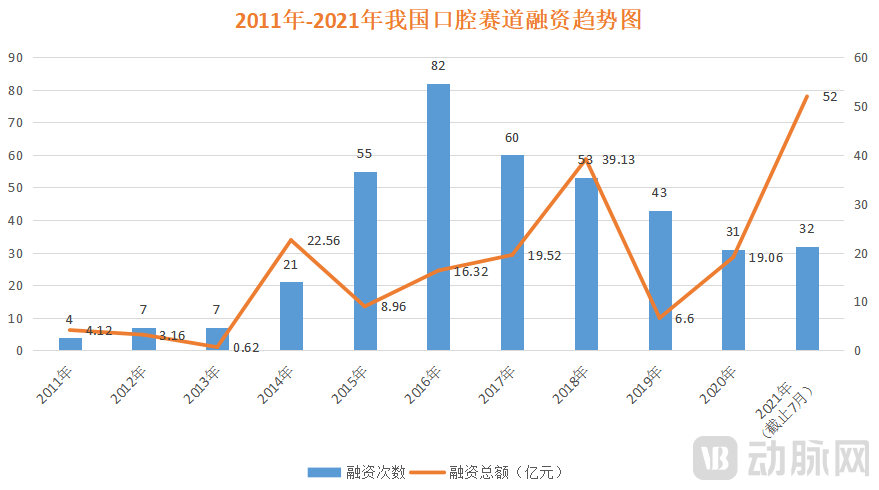
First, in the primary market, according to statistics from the VCBeat Orange Database, starting this year,As of July 27, 2021, a total of 32 investment and financing transactions occurred in China’s oral health sector, with total funding reaching RMB 5.2 billion—nearly three times the full-year total of RMB 1.906 billion recorded in 2020.
The secondary market was equally bustling. On June 16, 2021,AngelalignOfficially listed on the Hong Kong Stock Exchange, it became the first Chinese company to go public in the clear aligner sector, with its stock price surging 173.18% on the first day of trading and its market capitalization reaching HK$78.36 billion. Following closely, Smartee, China’s second-largest clear aligner manufacturer, is also highly anticipated. In addition, several other players in the dental care sector have successively filed their prospectuses.
"Data doesn't lie."Since 2021, the dental sector has attracted significant attention, marking the advent of a new stage of development. However, the emergence of every new market model follows inevitable patterns. What intrinsic drivers are propelling the rapid growth of the dental industry itself? Has the future market direction shifted? From the perspective of investors, why have they chosen to collectively increase their investments in the dental market at this juncture? What is the underlying logic behind this trend?
As an investment institution focused on innovative medical technologies and cutting-edge biotechnology segments, Chende Capital has been strategically positioning itself in the dental sector since 2016. Covering multiple links across the industry chain, it has successfully invested in and incubated several companies in the dental field, including Fussen Technology, a provider of digital dental equipment and solutions; Smartee Denture, a clear aligner service provider; Realint Technology, an enterprise engaged in R&D of chairside 3D printing equipment and materials; and Aidite, a company specializing in the development of new dental materials and equipment. By leveraging its own insights and industrial advantages, Chende Capital has established differentiated competitive strengths.

Zhu Tianji, Managing Director at Chende Capital
To unravel the answers to the aforementioned questions, VCBeat conductedZhu Tianji, Managing Director of Chende CapitalConducted exclusive interviews to gain insights into the development path and future trends of China’s dental sector from the perspective of industry investors, providing an in-depth analysis of investment firms’ entry strategies and underlying logic, and offering guidance to entrepreneurs and investors in the dental field on how to navigate the new market landscape.
I. What Is Driving the “Wind” in the RMB 100 Billion Oral Care Market?
The overall industrial chain of the dental industry can be divided into three segments: upstream, midstream, and downstream, with the upstream segment primarily consisting ofMedical Device and Medical Consumables Manufacturing Industry; the midstream segment isOral Empowerment Platform, which can be broadly categorized into three types of players: the first type comprises enablers represented by traditional large-scale distributors such as Sinopharm Dental; the second type consists of dental laboratory service providers offering processing and manufacturing services to end-users; and the third type includes new cloud platform service providers represented by Fisen Technology and LinkCare. The downstream sector comprisesOral Healthcare Service Institutions, mainly including dental departments in general hospitals, specialized dental hospitals, chain dental clinics, and individual dental practices.
According to industry reports, China's oral care industry reached a scale of 195.2 billion yuan in 2020, a year-on-year increase of 13%, maintaining rapid growth despite the impact of the pandemic.
This is not easy.First, the dental care industry is highly dependent on offline markets. The pandemic “locked” people in enclosed environments, which undoubtedly caused an immediate downturn for the sector. Second, dental care falls under consumer healthcare—market-driven medical services that consumers proactively choose. Unlike serious medical care, which prioritizes treating diseases and saving lives, dental care relies more heavily on consumers’ pursuit of aesthetic enhancement. Finally, dental care involves relatively high expenditure, meaning its industry development must be grounded in overall economic growth.
Despite numerous challenges, the dental industry is ushering in unprecedented opportunities for development, as a favorable wind sweeps across the entire dental market. However, this “wind” does not arise without cause; behind the dental industry’s “overnight surge in popularity” lie inevitable trends.
From Zhu Tianji’s perspective, the pandemic has catalyzed heightened interest across the entire healthcare sector, with dentistry serving as a microcosm of this trend. Nevertheless, it is undeniable that the endogenous dynamics inherent to the dental industry itself have also been a key factor driving its entry into a new stage of development.
Specifically, it includes the following three core elements:
First, it is highly market-oriented.Unlike other medical sectors, the dental industry is relatively “free.” Whether for manufacturers, service providers, dentists, or consumers, its commercial dynamics fully adhere to the logic of organic market development. Decision-making, distribution, pricing, and payment are all highly market-driven, which lends strong logical coherence and predictability to investment analysis in dentistry.
Second, there is enormous market demand.Zhu Tianji stated that, compared with developed countries in Europe and the United States, China’s oral care market remains at a relatively low level of overall development. Taking dental implant penetration as an example, it is estimated that there are currently just over 20 implants per 10,000 people in China, a penetration rate approximately 1/20 that of South Korea and 1/5 that of North America. Similar conditions exist in other segments such as orthodontics and prosthodontics, indicating substantial unmet demand overall.
Third, long-term high certainty.From a phased perspective, the dental market remains to be consolidated, with a relatively fragmented industrial chain and a diversified professional workforce. However, the most noteworthy segments within the dental sector are those driven by non-essential, quality-upgrade applications, which exhibit substantial market size and high growth potential. Therefore, from a long-term viewpoint, macro themes such as overall consumption market growth, shifts in consumption patterns, demographic changes, adjustments in fertility policies, and the rising demand for higher-quality medical care will all provide sustained momentum for these applications. Consequently, the dental market is expected to maintain a high level of prosperity for an extended period in the future.
Unlike many classic healthcare markets, demand in the dental sector has evolved alongside demographic shifts and economic development. It is fair to say that the growth drivers of the current dental market have gradually shifted from disease treatment to functional enhancement and aesthetic improvement at the application level, endowing the dental market with strong consumer-oriented characteristics. Consequently, the dental market holds unique appeal for investors. To some extent, it combines the high entry barriers, competitive moats, and specialized nature typical of the healthcare sector with the large customer base and diverse business models characteristic of consumer markets. As a result, successful dental companies often possess highly comprehensive capabilities. These factors are precisely why Chende Capital favors the dental market.
II. Identifying Investment “Hotspots” Amid Market “Pain Points”
Chende Capital, established in 2013, has consistently focused on investments in the medical device sector. To date, it has invested in more than 60 companies. According to Zhu Tianji, Chende Capital’s portfolio of medical devices can be categorized into two types: those that address life-critical issues and those that embody the attributes of high-quality healthcare.
Oral care is a key focus area for Chende Capital in the high-quality healthcare sector. Currently, its investments are concentrated primarily in the upstream segment, with gradual expansion into the midstream and downstream sectors. Since entering the oral care field in 2016, Chende Capital has invested inFusion Technology, Smartee Dental, Xunshi Technology, Aidite...and other dental companies have all entered the first tier in their respective fields.
In Zhu Tianji’s view, although several representative enterprises have emerged in China’s dental sector, the country remains in the early stage of building foundational infrastructure compared with Europe and the United States. Many basic equipment and platform systems within the industry have yet to be fully established, development across various segments of the supply chain is uneven, and there is significant room for improvement in value chain distribution, creating numerous investment opportunities within the sector.
First, given the current stage of development in China’s dental care sector, digital infrastructure and facilities remain a critical investment theme, harboring substantial opportunities. Second, intense homogenized competition prevails across the industry, with low overall efficiency at certain points in the value chain, creating clear opportunities for consolidation. Third, while a large number of homogeneous enterprises are rapidly accumulating in specific application areas, companies with genuine product and technological barriers remain scarce; truly exceptional products continue to be highly sought after by the market. Fourth, innovative business models that cater to tiered market demands and align with domestic market dynamics are also relatively rare. Furthermore, significant opportunities exist for Chinese dental companies to expand overseas, particularly for those aiming to become global leaders in their respective niches.
Guided by current market demands, Chende Capital has developed a comprehensive theoretical framework focused on the dental sector. According to Zhu Tianji, Chende Capital has established a top-down research model that conducts systematic industry analysis spanning from the industrial chain to the value chain. The firm actively integrates advanced international technologies and concepts to reshape its understanding of the industry. Furthermore, it maintains accurate access to primary industry information, ensuring real-time updates to its industry insights.
Following this mindset, Chende Capital has five criteria for selecting portfolio companies:
The first point is to maintain intense focus., enabling deep and thorough specialization in a specific niche to solidify the company’s “moat”;The second point is a strong product sense., enterprises can innovate in product design and development, achieve substantial breakthroughs in addressing market demands, and more effectively solve critical problems;The third point is to understand and penetrate the market., it is essential to “match the hammer to the size of the nail,” developing holistic solutions driven by actual needs, in alignment with market realities and development trends;4. There must be a clear opportunity to become an industry leader., the company’s development plan, competitive landscape, product portfolio, and team capabilities provide clear support for its emergence as an industry leader, with a relatively specific growth path already mapped out;5. The leadership team must be pragmatic,Possessing a craftsman’s mindset and spirit, along with the ability to seize favorable opportunities. The dental market competition is somewhat disordered, and many enterprises must endure a long-distance race. Throughout their development, companies will encounter various opportunities and noise. This marathon-like environment places exceptionally high demands on teams, yet there is no fixed paradigm for a successful team.
Zhu Tianji told VCBeat, “Compared with interventional implants or active medical devices, the technological implementation and regulatory approval for most oral care products are relatively easier. However, it still takes considerable time to develop best-in-class products. In such a market-driven industry, any advantage built solely on distribution channels or market presence is fragile without outstanding products. Therefore, upstream companies in the oral care industry should strive to establish core competencies in technology and product development, and then translate these strengths into brand advantages. Only in this way can they have a better chance of becoming enduring leaders in the industry.”
III. Targeting the Future of Oral Health: Creating Greater Value Through “Deep Engagement”
The oral care industry is indeed at a pivotal moment, but more important than riding the wave is identifying the underlying logic driving this momentum, enabling sustained, deep engagement with the industry’s growth over the medium to long term.
In the dental industry, Chende Capital has eschewed a broad, extensive investment strategy in favor of leveraging its deep expertise in the medical device sector. It selectively engages in deep investment partnerships with projects that align with its strategic insights and demonstrate high growth potential, actively positioning itself in the upstream segment of the industry chain, seeking opportunities for midstream consolidation and development, while closely monitoring and learning from the downstream market.
In Zhu Tianji’s view, the upstream segment of the future dental industry will present significant opportunities across three dimensions.
First, digitalization and chairside dentistry.In the field of dentistry, digital technology has unlocked greater possibilities for the industry, making it the most prominent buzzword in the past couple of years. We view digitalization more as an inevitable process than an end goal. The agility, efficiency, cost-effectiveness, and enhanced user experience brought by digitalization will significantly elevate the value of dental care, representing a relatively certain direction for development. Moreover, the chairside business model enabled by digitalization presents a substantial opportunity to drive transformative changes in dental services. Therefore, digitalization is undoubtedly a key investment theme that must be seized in the future of oral healthcare. This encompasses both the widespread adoption of digital infrastructure and the emergence of digitally driven products and new business models. Specifically, investment decisions require careful assessment of the product’s stage in its lifecycle, the timing of market initiation, and the extent to which traditional models are disrupted. Overall, while the directional trend toward digitalization is clear, comprehensive investment judgment involves many factors.
Second, product innovation.In the field of dentistry, innovation is not frequently discussed, yet we still believe it is the enduring vitality of the industry. We have observed that China is gradually gaining momentum in materials science, regenerative medicine, and precision manufacturing. “Made in China” within the dental industry has already achieved significant scale, and “Created in China” is beginning to emerge. These foundational breakthroughs will bring revolutionary improvements to many dental products, representing a trend worthy of close attention.
Third, overseas expansion opportunities.China’s historically accumulated advantages in manufacturing and cost control have laid the foundation for Chinese dental companies to expand into overseas markets. With industry development, we are now seeing domestic firms seize opportunities to establish advantages in product performance and quality within emerging applications, thereby opening up new avenues for global expansion. The international distribution and procurement landscape of the dental industry is highly market-driven. Overall, we believe that as the industry advances and more domestically produced products with global competitiveness come to market, overseas expansion will become a significant component of business operations for Chinese dental enterprises.
Standing at a new starting point, Chende Capital has a clear plan for its future layout in the dental field. Zhu Tianji stated, “After a relatively long period of accumulation, we have established a certain level of understanding in dentistry, and these insights and methodologies have guided our several past investments. At the same time, we believe that compared to many other niche industries Chende focuses on, dentistry has stronger predictability, allowing for more systematic investment strategies, with very direct synergies between projects. Therefore, based on historical research, we hope to take increasingly forward-looking actions and explore more flexible approaches. Not limited to typical financial investments, we will also actively seek industry consolidation, product introduction, enterprise incubation, and other forms, with the core aim of providing the industry with more high-quality product offerings and creating greater value.”
In terms of post-investment support, Chende Capital has also made significant efforts. Zhu Tianji told VCBeat, “We devote substantial energy to serving our portfolio companies, integrating ourselves as members of their teams and experiencing the entrepreneurial journey alongside them. We assume multiple roles, including business development, sales, marketing, human resources, and even product management. Furthermore, we maintain close communication with these companies, enhancing our mutual understanding of the industry through collaborative discussions and jointly formulating strategies. In the area of talent development, we provide various types of post-investment empowerment services. These include the ‘Chenxinghui’ Leadership Training Camp, a ‘strong-core’ initiative designed to enhance the management capabilities of mid-to-senior-level executives, and the ‘Chenyinghui’ Future Talent Program, which helps portfolio companies cultivate specialized students tailored to the medical device sector. These programs have gradually established their own brand identities.”
In a sense, the field of dentistry has no boundaries and holds the potential for continuous expansion within the healthcare industry. As one of the most professional and active early-stage investment firms in China’s medical device sector, Chende Capital is committed to working with entrepreneurs to extend business boundaries. We look forward to partnering with innovators in this remarkable era to inject new vitality into China’s dental industry and propel it to new heights.