

Pharma Giant Bayer Doubles Down on iPSC Frontier with BlueRock Therapeutics’ Clinical Acceleration and IPO Filing

BlueRock Therapeutics
Induced Pluripotent Stem Cell (iPSC) Therapy Developer
On July 19, 2021, BlueRock Therapeutics announced that its product DA01 had been granted Fast Track designation by the U.S. FDA for advanced Parkinson’s disease. This stem cell therapy company, co-founded in 2016 by Bayer and Versant Ventures, began to enter a fast track of development.
It is not common for pharmaceutical giants to collaborate with capital firms and invest heavily in establishing new enterprises within the pharmaceutical industry. Bayer’s move clearly demonstrates its high expectations for the transformative impact that iPSC technology will have on the healthcare industry. In particular, in 2019, Bayer further acquired the remaining equity of BlueRock Therapeutics at a $1 billion valuation, making it a wholly-owned subsidiary. This further underscores the promising development prospects demonstrated by BlueRock Therapeutics in less than three years, as well as Bayer’s strong determination to secure a leading position in this cutting-edge field.
The concept of induced pluripotent stem cells (iPSCs) has gained increasing recognition in recent years as products from several leading companies have entered clinical trials. Japanese scientist Shinya Yamanaka rose to prominence for this technology, sharing the 2012 Nobel Prize in Physiology or Medicine with British scientist John B. Gurdon. His seminal paper published in 2006 remains a classic case study in cell biology research.
Given its broad development prospects, the potential for industrialization of iPSC technology has been frequently discussed since its inception.Since 2007, a series of different companies have begun to push for product commercialization based on this technological foundation, such asFate Therapeutics, which is developing allogeneic immune cell therapies; Cynata Therapeutics, which focuses on graft-versus-host disease (GVHD); and Semma Therapeutics, which specializes in diabetes.
In December 2016, Bayer and Versant Ventures jointly established BlueRock Therapeutics, formally entering the iPSC therapy field.At its inception, Bayer and Versant provided up to $225 million in Series A funding to support BlueRock’s development over the next four years. This also represents one of the largest Series A financing rounds in the healthcare industry.
Since its inception, BlueRock Therapeutics has focused its primary efforts on two core areas: cardiovascular diseases and neurodegenerative disorders. The company’s expertise in cardiovascular disease stems largely from its two scientific co-founders, Dr. Gordon Keller and Dr. Michael A. Laflamme. In the realm of cardiovascular therapeutics, BlueRock aims to restore impaired cardiac function through the use of stem cell-derived cardiomyocytes.
In the field of neurodegenerative diseases, BlueRock leverages the expertise of its other scientific co-founder, Dr. Lorenz Studer. Dr. Studer has conducted extensive research on dopaminergic neurons and has identified stem cell-derived dopamine-producing neurons with therapeutic potential for Parkinson’s disease.
Since its inception, BlueRock has laid the groundwork for its future product manufacturing. Its GMP production will be carried out in collaboration with CCRM, headquartered in Toronto. CCRM possesses extensive experience in GMP manufacturing related to stem cells; Merck Millipore and GE Healthcare, both leading global providers of biopharmaceutical process solutions, have previously partnered with CCRM to develop products for stem cell culture.
Scientifically sound, with complete production technology and adequate funding in place, BlueRock has had all the essentials required for future development ready since its inception.
In the following years, BlueRock successively entered into collaborations with Universal Cells, Editas Medicine, Ncardia, and FUJIFILM. The partnership with Universal Cells enabled BlueRock to make significant strides in iPSC generation, while collaborations with the other three companies further expanded its development scope into the currently prominent fields of oncology and ophthalmology.
In July 2019, Bayer announced the acquisition of BlueRock Therapeutics at a $1 billion valuation, thereby fully bringing this company—which it had originally established at substantial cost—back under its ownership through another significant investment.Prior to the acquisition, Bayer held a 40.8% stake in BlueRock Therapeutics; the remaining shares were acquired for approximately $240 million in cash, plus $360 million in milestone payments.
Through this transaction, Bayer has acquired all tangible and intangible assets of BlueRock Therapeutics, including its Cell + Gene platform, iPSC technology, gene engineering technology, and cell differentiation capabilities. Post-acquisition, BlueRock Therapeutics will continue to operate as an independent company, becoming one of Bayer’s future pillars of innovation.
BlueRock’s technology platform can reprogram mature, differentiated cells into induced pluripotent stem cells (iPSCs), and then employ advanced genetic engineering techniques to redifferentiate these cells into mature cells with specific physiological functions. The establishment of a stable master cell bank based on iPSCs enables BlueRock to achieve virtually unlimited expansion and differentiation into any cell type.
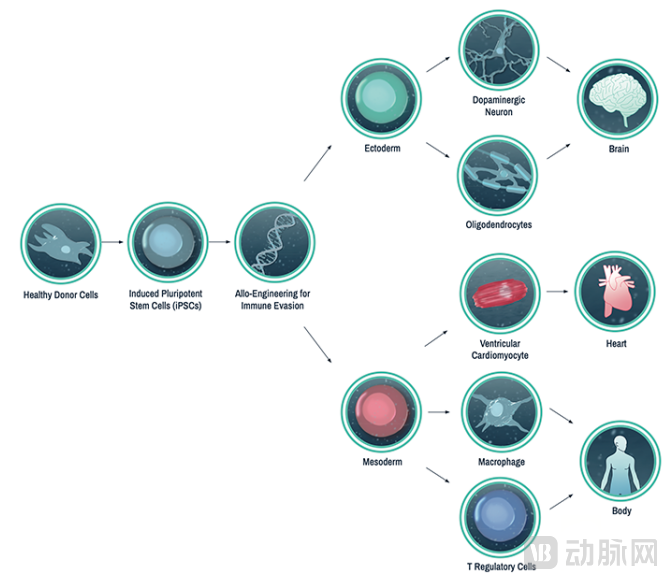
Fueled by years of accumulation, BlueRock Therapeutics achieved a series of positive milestones in 2021.
In January 2021, the U.S. FDA approved DA01 to initiate Phase I clinical trials. This product was jointly developed by BlueRock Therapeutics and Memorial Sloan Kettering Cancer Center, targeting patients with advanced Parkinson’s disease.This clinical study is also the first trial approved in the United States to treat Parkinson’s disease patients with dopaminergic neurons derived from pluripotent stem cells.
The approval of this clinical study marks a major step forward for BlueRock Therapeutics, a significant advancement in the field of Parkinson’s disease treatment, and a substantial leap for the iPSC sector.
Clinical trials promptly commenced. In June 2021, the first patient in the Phase I clinical trial of DA01 received dosing. Subsequently, in July, the FDA granted DA01 Fast Track designation, enabling BlueRock Therapeutics to engage more frequently with the FDA to discuss the development plan for DA01 and better prepare for potential accelerated approval and priority review eligibility in the future.
In fact, in March 2021, Vertex Pharmaceuticals’ VX-880 was also granted Fast Track designation by the U.S. FDA.VX-880 was initially developed by Semma Therapeutics. In 2019, Vertex Pharmaceuticals acquired Semma Therapeutics for $950 million in cash, thereby adding VX-880 to its pipeline.
VX-880 follows a similar technical approach, starting with induced pluripotent stem cells (iPSCs). These iPSCs are differentiated into pancreatic beta cells in vitro, and then transplanted into patients with type 1 diabetes using state-of-the-art cell transplantation technology. The transplanted beta cells, capable of normal insulin secretion, aim to eliminate the patients' dependence on exogenous insulin, thereby providing a potential cure for type 1 diabetes.
It can be said that with the maturation of technical methods, iPSC technology has undoubtedly gradually become a rising star in the field of cell therapy. The pluripotency of iPSCs determines their wide range of applications in the medical field, from differentiating into immune cells to achieve allogeneic immune cell therapy, to inducing the formation of tissue repair patches for repairing damaged organs. Furthermore, with further technological advancements in the future, iPSCs have the potential to directly differentiate into human organs, addressing the shortage of organ supply.
At this stage, the capabilities of iPSCs are still limited to emerging in a few core areas, but their future development holds limitless potential.Moreover, in the iPSC sector, the gap between domestic and international players has been significantly narrowed. Several prominent Chinese companies with core iPSC capabilities, such as Qihan Biotechnology, Hode Biotech, Alpu Regenerative Medicine, and Shize Bio, have advanced their leading product candidates close to clinical stages. Each company focuses on distinct application scenarios, covering several key therapeutic areas.
We may not yet see the iPSC field truly in the spotlight, but the period before the winds rise may well offer the best opportunity to set sail.