

AIMOMICS Submits IPO Prospectus for AI-Powered COVID-19 Eye Test Technology
Recently, an innovative COVID-19 EYE TEST technology for assessing the risk of SARS-CoV-2 infection has emerged in Europe.This technology requires no specialized equipment; users simply need to capture an eye photo using a standard smartphone or any smart hardware equipped with a camera, enabling real-time assessment of COVID-19 infection risk within three seconds.
Europe is currently grappling with the fourth wave of the Delta variant outbreak. Coupled with a lack of public consensus on COVID-19 vaccination and quarantine measures, this innovative COVID-19 risk screening technology has garnered extensive media attention and discussion locally. Although still in its commercial beta testing phase, the technology has attracted significant interest due to its non-invasive, real-time, low-cost, and user-friendly characteristics.
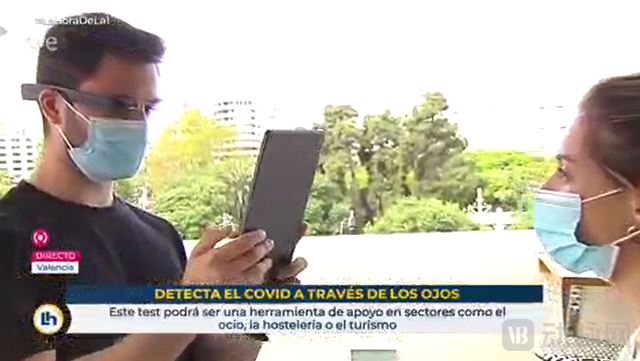
Foreign media reports (Image source: SPAINTV)
Recently, confirmed cases of COVID-19 have been identified in multiple regions across China. As of 24:00 on August 5, there were a total of 1,370 confirmed cases nationwide (including 34 severe cases). A cumulative total of 1,115,176 close contacts have been traced, with 40,990 still under medical observation. Epidemic prevention and control measures have been further intensified. Against this backdrop, the COVID-19 EYE TEST technology can undoubtedly help reduce the risk associated with public movement while ensuring the effectiveness of epidemic control, thereby truly implementing preventive measures at the individual level.
How does the technology work? What do the clinical data show? What is the current status of its productization? Are there any privacy and security concerns? What precautions should users in China take? In response, VCBeat conducted an exclusive interview with Dr. Fu Yanwei, the project’s chief scientist, to provide answers to these questions.
In fact, this technology originated from the “AIMO EYE TEST PROGRAM,” a global project for detecting characteristics of ocular diseases, developed through collaboration between AIMOMICS and the Big Data Sensing Laboratory of the School of Data Science at Fudan University.European companies licensed with this technology have obtained CE certification for their related diagnostic products, secured purchase orders from exclusive distributors in select countries and regions, and successfully raised financing.
According to Dr. Fu Yanwei, the project was officially launched in February 2020 and has since conducted multiple cross-regional, multi-ethnic collaborative studies on detecting ocular manifestations of COVID-19 both within China and abroad.

Photo of Dr. Fu Yanwei
“We are an international joint team composed of experts in machine learning, clinical medicine, and business,” introduced Dr. Fu Yanwei. From the outbreak of the COVID-19 pandemic to the present, after more than ten months of unremitting efforts,The average sensitivity and specificity of this technology in clinical trials across multiple regions worldwide have both exceeded 85%, maintaining a relatively stable level, with an average accuracy rate of 75% for asymptomatic individuals. (variance = +/- 10%, in terms of testing example)
"Furthermore, in clinical trial data from various regions, the model demonstrated optimal performance in Asian populations, particularly East Asians, with average specificity and sensitivity reaching up to 97%. In contrast, the maximum average sensitivity and specificity across racial groups were 75% and 91.6%, respectively."“Dr. Fu Yanwei added.”
What Underlies the Excellent Clinical Data Performance of the Project?
In response, Dr. Fu Yanwei stated,On one hand, in Western medicine, AI-based medical imaging technologies for disease identification and diagnosis through the ocular surface and retinal fundus have become relatively mature, grounded in medical theories related to ocular surface microcirculation and retinal pathology. Beyond common ophthalmic conditions, eye-based detection techniques for various internal diseases, such as diabetes and cardiovascular and cerebrovascular disorders, have gained widespread recognition within the global medical community and have already entered the commercial market.
On the other hand, disease diagnosis through ocular features has a long history in Traditional Chinese Medicine (TCM), with a complete methodology and clinical practice. TCM holds that the eyes contain far more bodily information than any other organ.
“Drawing inspiration from fundus diagnostic technologies, particularly the ocular diagnosis theory in Traditional Chinese Medicine, we have combined machine learning with high-dimensional statistical data analysis to identify and classify subtle, complex, multi-dimensional ocular features that are difficult for the human eye to detect, and correlated them with specific disease characteristics to enable risk prediction.”Dr. Fu Yanwei told VCBeat.
According to Dr. Fu Yanwei, due to joint research confidentiality agreements signed with collaborative medical institutions conducting clinical trials both domestically and internationally, the only related academic findings currently available for public release are two preprint papers. These papers detail the clinical trials on ocular testing for COVID-19 conducted at the Shanghai Public Health Clinical Center and the Fifth People’s Hospital of Shijiazhuang, respectively. Furthermore,It is worth noting that the clinical trial results from Shijiazhuang underwent three rounds of blind testing by a joint team from Wuhan Union Hospital, an independent third party.
One paper pointed out that although an increasing number of clinical studies have reported that many patients who tested positive for COVID-19 exhibited corresponding ocular symptoms, such as conjunctival congestion, edema, epiphora, and increased discharge, “it remains difficult to adequately identify and classify subtle and complex ocular features using routine clinical examination methods, such as naked-eye observation or standard ophthalmic instruments. Consequently, neither frontline clinicians treating COVID-19 nor specialized ophthalmologists can currently provide sufficient evidence to demonstrate a fully positive medical correlation between these ocular symptoms and COVID-19.”
In these two papers, the project team, in collaboration with multiple partners, conducted multiple clinical trials to demonstrate the feasibility of detecting SARS-CoV-2 infection through ocular symptoms.
Specifically, in the clinical trial conducted at the Shanghai Public Health Clinical Center from April to May 2020, the project team enrolled 104 COVID-19-positive patients as the experimental group, and 131 non-COVID-19 pneumonia patients, 68 patients with ophthalmic diseases, and 136 healthy volunteers as control groups.
In a clinical trial conducted at Shijiazhuang Fifth Hospital from January to May 2021, the project team enrolled 66 COVID-19–positive patients as the experimental group, and 44 recovered COVID-19 patients (whose nucleic acid test results converted from positive to negative), 5 patients with liver disease, and 117 healthy volunteers as control groups.
Both clinical trials mentioned above achieved excellent results, with the AUC for each group exceeding 0.94. This substantially demonstrates the feasibility of using ocular images for rapid COVID-19 screening.
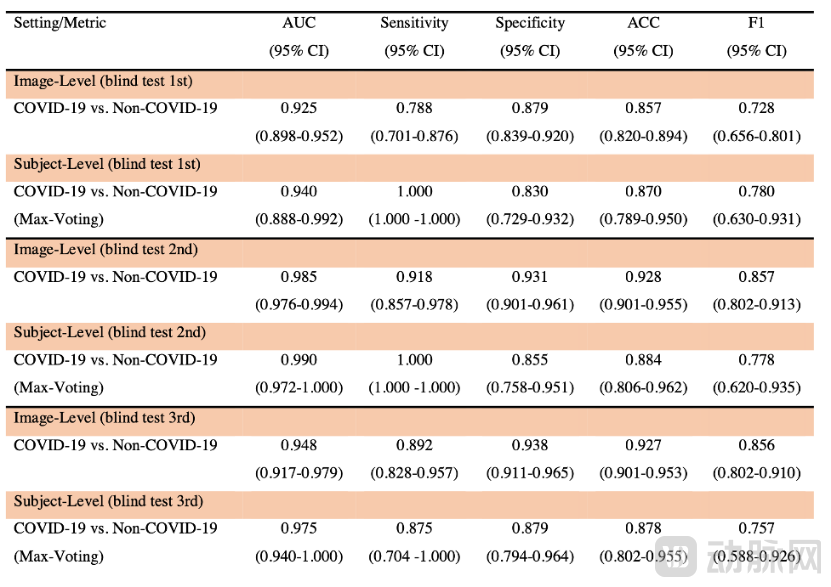
Performance of the Triple-Blind Clinical Trial Results from Shijiazhuang Fifth People's Hospital at the Image and Individual Levels
(Photo provided by the project team)
“By capturing ocular images from patients and performing image segmentation, neural networks and high-dimensional statistical tools are then employed to extract and quantify features from specific ocular regions, thereby enabling disease prediction.”Dr. Fu Yanwei briefly introduced the detection methods of this technology,“In this way, subtle ocular pathological features associated with COVID-19 that are difficult for clinicians to detect with the naked eye and ophthalmic instruments can be identified and predicted by our developed algorithm model.”
“Rapid diagnosis is a critical area requiring urgent advancement in the prevention and control of infectious diseases. This research achievement represents not only the application of AI imaging technology in infectious diseases, but also a deep exploration and development of the theories and practices of Traditional Chinese Medicine,” stated Dr. Zhao Lei, Chief Physician of the Department of Infectious Diseases at Wuhan Union Hospital, who served as the lead medical investigator for this domestic clinical trial and is a co-first author of the paper.
Furthermore, when discussing the clinical research process behind the “COVID-19 EYE TEST,” Dr. Fu Yanwei expressed some heartfelt reflections. All frontline clinical research involving contact with COVID-19 patients is extremely scarce and valuable. This is particularly true for frontline healthcare workers, who, within isolation zones, not only bear immense work pressure but also undertake additional research responsibilities.
“It is easy to imagine the clinical research challenges involved in using ocular examination to assess the risk of SARS-CoV-2 infection,” remarked Dr. Fu Yanwei. “Therefore, the project team extends its sincere gratitude to the team of Liu Yu, a traditional Chinese medicine expert; the team of Dr. Li Feng from Shanghai Public Health Clinical Center; the team of Dr. Zhao Lei from Wuhan Union Hospital; the team of Dr. Zheng Haojie from Shijiazhuang Fifth People’s Hospital; and the team of Dr. Li Hong from Hubei Provincial Hospital of Traditional Chinese Medicine. Despite their arduous efforts on the front lines of the pandemic response, these teams provided substantial support and assistance to this project.”
The project team is currently coordinating with clinical trial partners both domestically and internationally, with plans to consolidate data from multiple domestic and overseas trials for future academic publication.
According to Dr. Fu Yanwei, companies worldwide have been progressively entering the field of ocular-based COVID-19 detection.
For example, SEMIC, a high-tech company founded in Germany in 1986, announced in April 2021 that it had developed a technology for detecting COVID-19 through eye examinations. By capturing a single photograph of the eye, the technology can determine the risk of SARS-CoV-2 infection within 3–5 minutes, with reported sensitivity and specificity both reaching 97%.
Notably, the SEMIC website indicates that this technology has not yet obtained CE marking or other medical certifications. However, reports from other European media suggest that the mobile app developed by SEMIC has entered the commercial beta testing phase and is now charging enterprise users, with a subscription fee of €480 per month.
Regarding the differences between the AIMO EYE TEST PROGRAM and other similar technologies, Dr. Fu Yanwei stated that they are mainly reflected in the technical approach and commercialization strategy:
First, the ocular pathological features detected and analyzed by the AIMO EYE TEST PROGRAM algorithmic model encompass a broader range of morphologies and anatomical areas. These include not only the pupil, cornea (black part of the eye), and sclera (white part of the eye) but also the eyelids and periocular regions. Such comprehensive pathological feature information contributes to enhancing the performance of the detection model.
Secondly, the project team collaborated with multiple parties to conduct several multi-ethnic clinical trials both domestically and internationally. They publicly disclosed the processes and results of these clinical trials through academic papers, providing for the first time globally evidence from cross-regional and multi-ethnic clinical trials that links human ocular pathological features with COVID-19, as well as evidence of the generalizability of this detection model across different regions and ethnic groups.
Finally, the core difference between the AIMO EYE TEST PROGRAM and other similar technologies’ commercialization strategies is that it will not directly develop and operate end-user products such as standalone apps for terminal users.
“For now and for the foreseeable future, our efforts will be focused on continuously expanding the scale of clinical trials and enhancing model performance. Consequently, we will place greater emphasis on providing API data services to third-party enterprises or institutions that are ‘more specialized and closer to end-users.’ Our ultimate goal is to build an open ophthalmic detection data platform that can onboard more partners and facilitate cross-regional, cross-ethnic collaborative R&D,” summarized Dr. Fu Yanwei.
According to Dr. Fu Yanwei, the project team has decided to permanently open-source the COVID-19 detection demo and related API data development interfaces of this technology, free of charge, to users within China and developers for non-commercial purposes.(Demo link and FAQ are attached at the end of the article.)
Regarding the decision to make it free and open-source, Dr. Fu Yanwei stated, “Our core team is rooted in China, and the inspiration and incubation of our core technologies have benefited from traditional Chinese medical theories and the selfless guidance of experts across various fields in China. As China is currently grappling with a new wave of COVID-19 outbreaks, we hope to contribute our efforts in a timely manner during this critical period. We also aim to enable more users and researchers across diverse disciplines to benefit from this technology and facilitate their related research.”
However, as previously mentioned, this technology is still in the internal beta testing phase, and the project team has stated that there is no official product launch at present. Therefore, amid the severe epidemic prevention and control situation in China today, the implementation of this technology has become one of the most closely watched topics in the industry.
In this regard, VCBeat has learned that since May 2021, Dr. Fu Yanwei’s team has collaborated with several large smart hardware and internet technology companies providing global services, both domestically and internationally, to successfully conduct commercial beta testing of API integration.
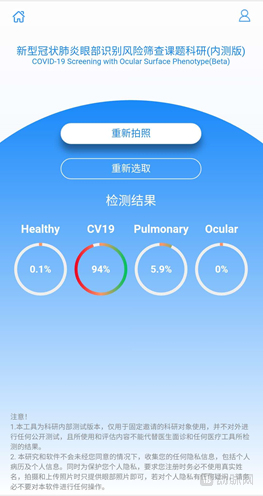
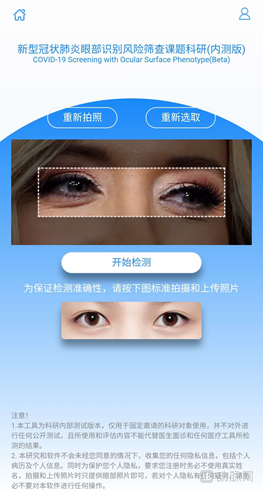
Schematic Diagram of the COVID-19 Eye Test Beta Version (Image provided by the project team)
Internal Beta VersionLink
“This technology enables seamless integration of APIs into various smart hardware devices equipped with standard cameras (such as smartphones and high-definition cameras) and mobile applications. It eliminates the need for specialized equipment or cumbersome procedures, facilitating easy risk detection for multiple diseases, including COVID-19. This approach truly achieves non-invasive, real-time, and lower-cost screening, making it suitable for application scenarios such as personal and home self-testing, telemedicine, and large-scale disease prevention and control.”Dr. Fu Yanwei stated.
It is worth noting that the currently available API data interfaces are solely for risk screening of COVID-19. In the future, API interfaces for detecting various other diseases, such as diabetes, viral pneumonia, liver diseases, and viral influenza, will be gradually rolled out. “We look forward to a near future where a single photo can enable risk prediction for multiple diseases.”
In addition, regarding the free trial of this technology demo, Dr. Fu Yanwei emphasized:
First, this technology is currently available in China solely for free testing and non-commercial research purposes; it does not constitute any form of diagnostic or therapeutic service. Any prompts or content encountered by users during use shall not replace in-person consultations with physicians or the results obtained from any medical devices.
Second, this free trial is exclusively available to users within China. Throughout the testing process, we will strictly adhere to domestic and international data compliance and privacy security standards. Users are not required to register or retain any personal information; they can access the trial immediately upon agreeing to the terms of use. All behavioral data will be promptly destroyed after the test results are generated.
Third, due to its non-commercial, free-to-access nature, the Demo server faces resource constraints. During peak testing periods, detection speeds may slow down, and the number of daily tests may be limited. Our team is currently working diligently on maintenance to provide users with an improved free testing experience.
“Diagnosing or predicting diseases through human ocular feature information is an emerging field in human medicine that is being gradually validated and unraveled, holding immense value for academic research and practical application. Especially today, with the rapid integration of AI technology and human medicine, a considerable number of AI+Healthcare innovative medical imaging tools have emerged. We look forward to the positive advancement and orderly competition of these technologies bringing a better future for humanity,” said Dr. Fu Yanwei.
Appendix:
To access the open-source repository for this free demo, visit the link below, click the FREE DEMO button on the homepage, and accept the FREE DEMO terms of use to instantly try it out for free without registration:
WWW.AIMOMICS.ORG
FAQ:
1. Devices Supported by the Demo
Our current free demo, as a non-commercial test version, only supports cameras with a resolution of over 5 million pixels on Android and iOS smartphones and PDAs; it is not yet compatible with other terminals.
2. Required Environment for Imaging
Please choose an environment with sufficient and even lighting to avoid eye glare caused by strong light and unclear photos due to dim lighting.
The shooting environment and background must not be red.
3. Facial Preparation Before Imaging
Please remove glasses (including contact lenses), wipe off eye makeup, remove false eyelashes, and tie up your hair to ensure no obstruction of the eye area.
4. Adjusting Smartphone Camera Mode
Please use normal mode. Do not enable beauty, soft light, or other special effects. Turn off the flash.
5. Manually align the eye photos according to the legend
Please strictly follow the eye illustrations and text prompts on each page of the DEMO. Use your finger to move and zoom the captured eye photo within the cropping frame on the page until it aligns with the standard eye illustration at the bottom, then click the test button. Pay special attention to avoiding incomplete eye images and excluding the background from the crop.
6. Regarding Test Results
The DEMO test results are categorized into high-risk and low-risk. If your result is high-risk, it is recommended to increase the frequency of testing, opt for the Advanced Test, and capture eye images under different lighting conditions and backgrounds. If multiple tests continue to yield high-risk results, it is advisable to consult a professional medical institution based on your individual health status. You may also contact us via email at service@aimomics.org for in-depth testing.
7. About the Demo Language
You can switch between Chinese and English by clicking the icon in the upper-right corner of the demo homepage to access the Settings page.