

Deepwise Completes Acquisition of Yitu Healthcare, Files IPO Prospectus
VCBeat has exclusively learned that Yitu Healthcare, the medical division of Yitu Technology, has been merged into Deepwise Healthcare. This marks the largest merger and acquisition event in the history of China’s imaging AI sector.
Deepwise Medical and Yitu Healthcare are both leading companies in the medical AI sector. In the VB100 2020 rankings, Deepwise Medical ranked among the top of the digital healthcare list with a valuation of RMB 5 billion. As a subsidiary of Yitu Technologies, Yitu Healthcare was not independently valued; however, its valuation is estimated to be roughly comparable to that of Deepwise Medical. Rumors of large-scale layoffs at Yitu Healthcare emerged in early 2021, but it now appears that acquisition activities may have already begun at that time.
The merger of two leading medical AI companies will bring about a significant shift in the industry landscape. In the past, leading AI firms such as Deepwise, Yitu, Infervision, and Shukun alternated in the lead across metrics including company scale, headcount, financing rounds, and the number of approved Class III medical device registrations. This acquisition signals that the trend toward industry consolidation has officially begun.
The essence of M&A is the combination of value, but only complementary enterprises can achieve a “1+1>2” outcome post-merger.
A review of the roles played by the two companies in the medical AI sector reveals superficial similarities. For instance, both offer robust imaging-assisted diagnostic solutions, operate research platforms, and have made significant strides in natural language processing (NLP). However, a closer examination of their business segments shows that Deepwise and Yitu have pursued markedly different strategic paths.
Deepwise Healthcare adheres to a threefold strategy: prioritizing products, research and development, and connectivity. Specifically, Deepwise has built a medical artificial intelligence ecosystem encompassing intelligent imaging, intelligent research, intelligent services, and intelligent education. Its intelligent imaging module covers multiple domains, including the nervous system, cardiovascular system, respiratory system, musculoskeletal system, digestive system, women’s health, and pediatric care. Notably, Deepwise’s high-throughput AI products for pulmonary nodules and pneumonia received Class III Medical Device Certificates from the National Medical Products Administration (NMPA) in November 2020 and March 2021, respectively, securing a leading position in commercialization within the industry.
Furthermore, Deepwise Medical also places significant emphasis on strengthening the foundational capabilities of hospitals. For instance, Deepwise accelerates medical advancement and disease exploration by empowering physicians’ research capabilities, thereby helping to elevate the scientific research standards of hospitals. Meanwhile, it enhances the diagnostic capabilities of medical consortia through an “AI + Cloud” approach, improving regional medical diagnostic standards.
In contrast, although Yitu Healthcare also offers high-volume AI products for conditions such as pulmonary nodules and pneumonia, survey data since 2019 indicate that the company has placed greater emphasis on specialized fields, with a strategic focus on breast health and pediatrics. Its AI-assisted software for evaluating bone age from pediatric hand X-ray images received approval from the National Medical Products Administration (NMPA) in March 2021. Meanwhile, Yitu Healthcare has engaged in extensive collaboration and exploration with numerous large hospitals in China in areas such as NLP-based intelligent pre-consultation, intelligent triage, and intelligent clinical decision support.
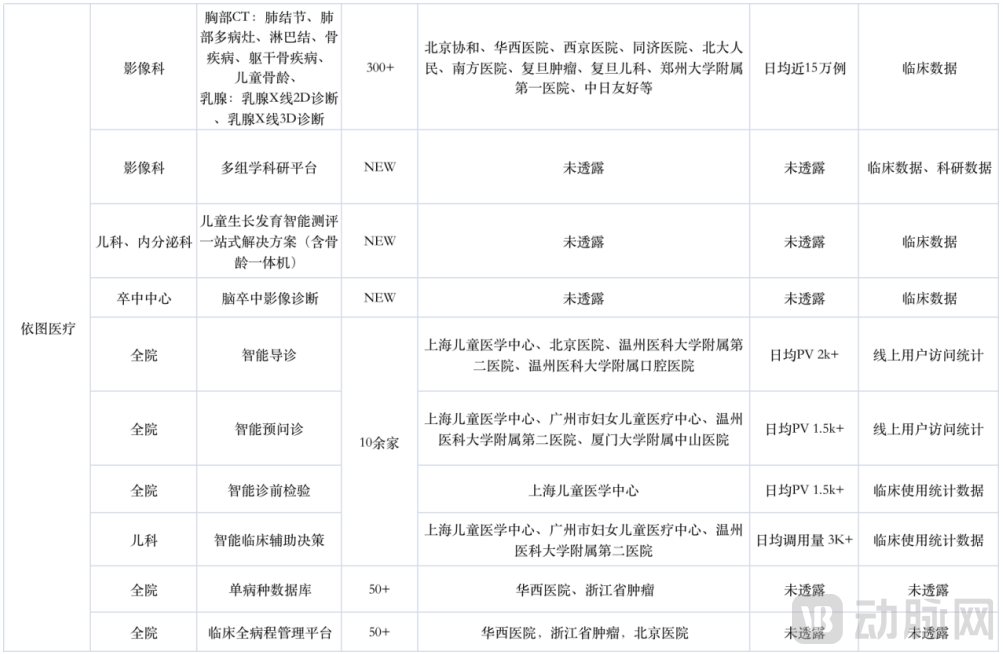
Distribution of Yitu Healthcare Products (Statistics by VCBeat, December 2019)
Secondly, Yitu Healthcare emphasizes the application of “AI + Big Data.” While building a research platform for physicians, it also develops research software for pharmaceutical companies based on deep learning. In addition to leveraging NLP to assist in bone age assessment and decision-making, the company is using this technology to establish an intelligent internet hospital platform. By leveraging big data and information technology tools, it aims to achieve intelligent pre-diagnosis, referral, and auxiliary diagnosis within regional healthcare networks, thereby advancing the evolution of clinical care models.
A comparison of the two companies’ characteristics reveals that the advantages of the merger can be broadly summarized into the following three points:
I. Expansion of Clinical Decision Support Products
From the current state of medical AI, the maximum market size a company can reach depends on the number of medical scenarios it can penetrate. Therefore, after developing a mature AI product for a specific medical scenario, companies will not only promote its commercialization but also invest in the next medical scenario with potential market opportunities, thereby seeking scale expansion and sustainable development.
Following the completion of the merger, Yitu Healthcare’s current products and achievements in NLP-based intelligent pre-consultation, intelligent triage, and intelligent clinical decision support will be directly integrated into Deepwise Medical’s existing product portfolio. Whether through direct product application or underlying technological adaptation and enhancement, this integration will significantly boost the performance of Deepwise Medical’s products across its smart services, smart research, and smart education segments, thereby further refining and enhancing the overall performance of its existing AI ecosystem. Meanwhile, leveraging Deepwise Medical’s consistent emphasis on “connectivity,” the mutual integration and interoperability among its various business segments may well lead to the addition of a “smart decision-making” component to its AI ecosystem in the future.
In June 2021, the Center for Medical Device Technical Evaluation of the National Medical Products Administration issued the “Notice on Publicly Soliciting Comments on the ‘Guiding Principles for Registration Review of Artificial Intelligence Medical Devices (Draft for Comment)’,” which provided a detailed explanation of the types of AI medical devices and placed particular emphasis on the requirements for “decision-support” AI medical products. The healthcare industry’s demand for AI products has evolved from detection, measurement, analysis, and reconstruction toward decision-support functions such as differential diagnosis, characterization, and surgical planning. Consequently, AI medical products are transitioning in role from “tools” to “assistants,” a trend that is likely to define the future direction of AI in healthcare. According to informed sources, Yitu Healthcare had previously conducted in-depth exploration and trials in multimodal data research and specialty-specific clinical decision support, achieving notable results. This may be one of the reasons behind DeepWise Medical’s acquisition of Yitu Healthcare.
Overall, following this integration, Deepwise Medical will significantly expand its reach in the medical AI market, seize more opportunities, and see a substantial increase in its market valuation.
II. In-Depth Exploration of Auxiliary Diagnostic Scenarios
Beyond horizontal scenario expansion, medical AI companies are also pursuing vertical depth to uncover new growth points in AI-assisted diagnostic scenarios. In DeepWise Medical’s strategic layout, clinical departments and primary healthcare represent key scenarios to be tackled in the next phase.
Currently, Deepwise holds regulatory approvals for pulmonary nodule and pneumonia detection products, with solutions for cardiovascular/cerebrovascular diseases and pediatric asthma poised for imminent launch. In contrast, Yitu Healthcare has one certified product for pediatric bone age assessment and has established a strong presence in fields such as breast pathology and general pathology. Therefore, the synergistic benefits of merging their product portfolios are nearly predictable: for homogeneous, high-throughput products, Deepwise’s existing certifications enable rapid commercialization; for numerous heterogeneous products, the two companies can achieve domain complementarity. For instance, in specialized scenarios such as pediatrics, Deepwise is well-positioned to develop multimodal AI healthcare solutions.
In empowering grassroots healthcare, DeepWise Medical’s “Cloud + AI: Winning the Battle Against the Epidemic” project, conducted in collaboration with the First Affiliated Hospital of Chongqing Medical University and China Telecom, was awarded third prize in the CHINC 2020 “National Excellence Awards for Healthcare Informatics in Epidemic Prevention and Control.” This project deployed cloud platforms to the cloud, integrated artificial intelligence, and interfaced with the medical consortium’s informatization platform. As a result, the National Health Commission can achieve broad coverage of regional disease control and implement AI-supported telemedicine with minimal investment.
Complementing this are Yitu Healthcare’s solutions for pre-diagnosis, referral, and assisted diagnosis. In simple terms, in terms of informatization, Yitu Healthcare focuses on serving patients, enabling them to more easily access medical resources tailored to their individual needs, while Deepwise Medical focuses on serving hospitals, helping them allocate medical resources more meticulously and efficiently. The combination of these two approaches, coupled with the companies’ achievements in computer-aided diagnosis, has matured into a comprehensive regional smart healthcare solution encompassing prevention, diagnosis, and intelligence.
III. Expansion of Customer Base
During participation in VCBeat’s 2019 survey of medical artificial intelligence enterprises, Yitu Healthcare had already disclosed its deployment in nearly 400 hospitals, while Deepwise Healthcare gradually gained support from hundreds of hospitals over four years of exploration. Following the merger, first, Deepwise Healthcare’s customer reach will continue to expand; second, upon completion of product integration and optimization, the new Deepwise Healthcare will provide physicians with a superior AI experience.
In 2020, the medical imaging AI sector witnessed a total of 24 financing rounds, amounting to RMB 2.976 billion. Among these, ten financing rounds involving five leading companies—Deepwise Medical, Keya Medical, Shukun Technology, and Huiyi Huiying—accounted for RMB 2.54 billion, representing approximately 85.35% of the industry’s total financing.
In 2021, this consolidation trend continued, with new capital, talent, and technology continuing to flow toward leading enterprises. Ultimately, the high capital and time investments required in the field of medical AI have enabled leading companies to establish high barriers to entry centered on core technologies, hospital relationships, and high-quality datasets, thereby building sustainable competitive advantages.
To assess the effectiveness of such barriers, we can look to the more mature field of healthcare informatization. Specifically, non-AI enterprises seeking to enter this sector typically adopt one of two models: first, a product-driven approach that targets niche scenarios underserved or untouched by existing players, as exemplified by Hangzhou Zhiwei Information’s use of bone marrow smear analysis as its AI entry point; second, a business-model-driven approach that involves marketing AI-based new products to existing customers, a strategy commonly employed by large corporations such as Fujifilm and GE Healthcare.
Mergers among leading companies have their advantages, particularly at this stage, as medical AI firms are gradually gaining greater influence through breakthroughs in core technologies. The progress of AI commercialization has demonstrated that significant opportunities remain in areas where genuine clinical needs exist and can be addressed with effective products; therefore, AI startups should not easily lose heart.
The AI healthcare sector is a hotly contested market. While there were numerous participants in the early years, a wave of eliminations has occurred over the past few years. Since last year, the sector has entered its first year of commercialization, intensifying competition and triggering industry consolidation. The number of market participants is expected to decline further amid fierce rivalry, while leading enterprises will gradually expand their market share, driving a trend toward greater concentration in what was previously a fragmented market.
Following the completion of the acquisition, new trends will become more pronounced, and different stakeholders will naturally face varying degrees of impact.
As direct competitors to Deepwise and Yitu, leading AI healthcare companies will bear the brunt of competitive pressure, facing the risk that their market share gains may fall short of expectations. Nevertheless, Deepwise’s move has pioneered a new expansion model for the industry. As the medical AI sector gradually transitions from the primary market to the secondary market, with greater disclosure of relevant information, mergers and acquisitions among enterprises are likely to increase continuously. Competitors may also adopt this strategy to counterbalance the competition.
For emerging medical AI startups, relying on traditional deep learning models to explore new application scenarios makes them vulnerable to being overtaken by industry leaders. Therefore, moving beyond deep learning and adopting innovative algorithms to address tangible clinical problems could help create new markets within the industry. The development of early cancer screening was once hindered by the limitations of star biomarkers. As an emerging technology, artificial intelligence can unlock greater potential if it breaks free from conventional thinking and embraces a certain degree of risk.
For platform builders such as medical device manufacturers and health checkup institutions, the current AI-assisted diagnosis sector remains immature, with a limited range of products. This makes it difficult for these platforms to build ecosystem advantages based on the quantity and quality of their integrated offerings. The ongoing consolidation within the sector will, to some extent, accelerate industry development and bring AI products to market more quickly. Therefore, mergers and acquisitions will contribute to the future growth of platform builders.
Overall, Deepwise Healthcare’s acquisition of Yitu Healthcare has ushered in a new phase for the medical AI industry and effectively promoted its development. However, in the long run, only time will provide a clear answer as to how large a market share medical AI can ultimately capture and what level of penetration it can achieve.