

How Fate Therapeutics Became Wall Street’s iPSC Darling: A 6-Fold Stock Surge in One Year

Fate Therapeutics
Cellular Immunotherapy Developer
In 2012, Emily, an American girl, became the first pediatric leukemia patient worldwide to receive CAR-T cell immunotherapy. Fortunately, she was cured of leukemia and has remained relapse-free to this day. The efficacy of CAR-T cell therapy in treating hematologic malignancies is widely recognized globally. However, the concept of chimeric antigen receptor-modified T cells (CAR-T cells) was actually proposed as early as 1989. Currently, CAR-T cell therapy products are commercially available both in China and abroad, with over a thousand clinical research projects underway.
Also in 2012, the CRISPR/Cas9 gene-editing technology developed by French scientist Emmanuelle Charpentier and American scientist Jennifer Doudna was publicly published. Compared with previous techniques, CRISPR/Cas9 offers advantages such as low cost, ease of use, and high efficiency. In October 2020, they were awarded the Nobel Prize in Chemistry for their contributions to the development of methods for genome editing.
Also in 2012, British scientist John Gurdon and Japanese medical professor Shinya Yamanaka were awarded the Nobel Prize in Physiology or Medicine for their contributions to the field of “somatic cell reprogramming technology.” Previously, Japanese scientist Shinya Yamanaka and his team successfully introduced four key genes (OCT3/4, SOX2, KLF4, and c-Myc) into mouse fibroblasts via retroviral vectors, reprogramming them into pluripotent stem cells, thereby pioneering research into induced pluripotent stem cells (iPSCs).
Fate has brought three seemingly magical technological fields—CAR cell therapy, CRISPR gene editing, and iPSCs—to major breakthroughs and recognition in the same year. Any one of these three technologies holds the potential to spawn powerful therapeutic capabilities and market prospects. So, what unique sparks might fly if they were combined? Let’s examine how Fate Therapeutics (hereinafter referred to as “Fate”) is boldly pioneering this integration.
Fate Therapeutics, a clinical-stage biopharmaceutical company dedicated to the development of iPSC-based cellular immunotherapies, was incorporated in Delaware, United States, in 2007 and listed on the NASDAQ (ticker: FATE) in 2013. To date, Fate Therapeutics has been in operation for 14 years and has been publicly traded for nearly eight years. During the first seven years following its IPO, the company’s stock performance remained lackluster, hitting a low of under $20 per share in March 2020. However, over the subsequent period of less than one year, Fate Therapeutics’ share price rose continuously.On January 14, 2021, Fate Therapeutics reached its all-time high stock price of $121.16.At its peak, the company’s market capitalization exceeded $10 billion. Although it has since declined slightly, its stock price has risen from $6 at issuance to $91 currently, representing a 15-fold increase since its initial public offering.What propelled Fate Therapeutics’ stock price to a sixfold increase in less than a year, suddenly making it a darling of the capital markets?
First, from a team perspective, Fate Therapeutics boasts an experienced operations management team and a scientific R&D team.
Scott Wolchko, President and CEO of Fate Therapeutics, oversees the company’s financial, administrative, and operational functions. Mr. Wolchko holds a Bachelor of Science degree in Biochemical Engineering from the University of Virginia and a Bachelor of Science degree in Biomedical Engineering from the University of Vermont. With over 27 years of experience in investment and management, he has previously served as an investment banker at Morgan Stanley (NYSE: MS), Senior Director of Corporate Development at Drugstore.com (NASDAQ: DSCM), and Chief Financial Officer at Bocada.
Chief Technology Officer Mark Plavsic oversees Fate Therapeutics’ cell therapy manufacturing, supply chain, and technical operations. Academically, Dr. Plavsic holds a Ph.D. in Virology and Molecular Cell Biology, a Master’s degree in Virology and Immunology, and a Doctor of Veterinary Medicine (D.V.M.) degree from the University of Belgrade in former Yugoslavia. He is also board-certified by the American College of Veterinary Microbiologists in the subspecialty of virology.
In terms of professional experience, Plavsic has served as Chief Technology Officer at Lysogene, Vice President of CMC at Torque, and Head of Product Biosafety at Genzyme/Sanofi. Plavsic’s technical expertise spans drug development and manufacturing, including critical animal-origin raw materials, cell culture media, GMP QC testing, GLP analytical development, GMP manufacturing, contract manufacturing, and supply chain management. Plavsic brings over 20 years of experience in process development for large-scale commercial biologics and end-to-end product development.
In addition,The team also includes Dr. William Rastetter, co-founder of Receptos, strategic advisor at SVB Leerink, and advisor to Illumina Ventures; as well as Dr. John Mendlein, executive partner at Flagship Pioneering, president of product strategy at Moderna, and director at Editas Medicine. Fate’s investment team is equally star-studded, featuring prominent venture capital firms such as Venrock, Polaris Partners, ARCH Venture Partners, OVP Venture Partners, and Astellas Venture Management.
Under the leadership of a professional team,Fate is dedicated to generating human induced pluripotent stem cells (iPSCs) from its proprietary iPSC product platform to create genetically engineered clonal iPSC products with biological properties.iPSCs possess the potential for unlimited proliferation and multipotent differentiation under specific culture conditions. Fate Therapeutics leverages iPSCs to establish cell sources for developing cell therapy candidates, which offer advantages over autologous cell therapies, including more defined and homogeneous product composition and scalability for large-scale manufacturing.
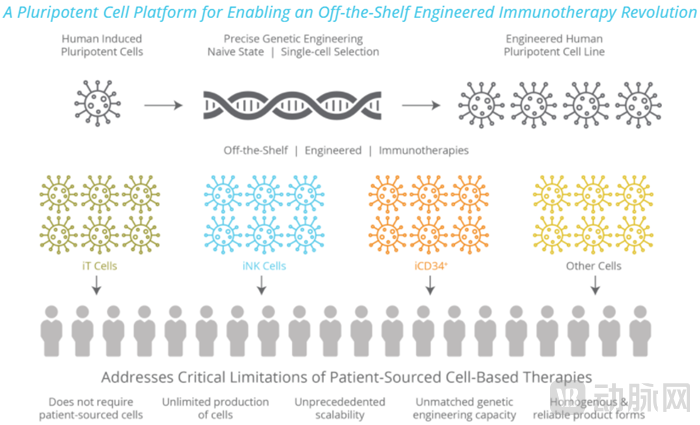
iPSC platform, image source: Fate Therapeutics official website
Fate’s iPSC platform enables genetic engineering, single-cell isolation, and selection of iPSCs for clonal expansion within the scope of patent protection. This platform is supported by an intellectual property portfolio comprising more than 300 issued patents and 150 pending patent applications.
The manufacturing of Fate’s iPSC-derived cell immunotherapy products consists of three stages. The first stage involves inducing pluripotency in qualified healthy human donor cells through processes such as genetic engineering, followed by cloning to establish a master iPSC bank. Cells from this bank are then induced to differentiate into specific cell types (e.g., CD34+ cells), which are subsequently expanded and further differentiated through cell culture to generate specific cell product pools. Finally, the cell product pools undergo qualified processing steps and are cryopreserved as finished cell products.
To support GMP manufacturing, processing, scale-up development, and technology transfer activities for its iPSC platform, as well as to expand the manufacturing scale of subsequent iPSC-derived cell immunotherapy products and conduct clinical research and IND-enabling activities for its product pipeline, Fate established a cGMP-compliant manufacturing facility in September 2019 for the production of iPSC-derived cell therapy candidates for clinical use. In January 2020, Fate entered into a lease agreement for a 200,000-square-foot space to develop cGMP-related facilities, including a 40,000-square-foot cGMP cell production facility. Located in San Diego, California, this cGMP facility is specifically designed to manufacture designated cell candidates using a master iPSC bank. The facility is now operational and has obtained licensure from the California Department of Public Health, Food and Drug Branch, for the production of cell therapy products.
Through the aforementioned platforms and manufacturing processes, Fate Therapeutics’ current pipeline comprises 13 candidate product lines and one allogeneic, non-gene-edited pipeline, ProTmun (in Phase II clinical trials). The indications for these candidate products include solid tumors, hematologic malignancies, lymphoma, and multiple myeloma. Among them, FT500 and FT516 are advancing rapidly, while FT819 has recently reported new progress.
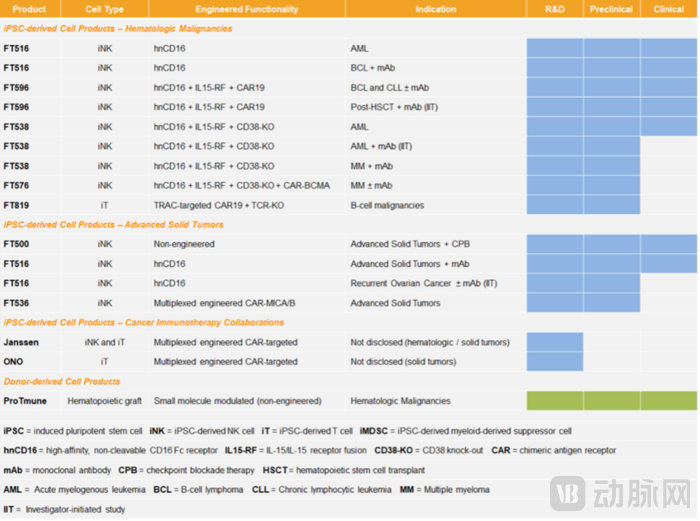
Product Line, Image Source: Fate Official Website
1. FT500, the first iPSC-derived cell therapy approved for clinical research in the United States
FT500 is an iPSC-derived NK cell immunotherapy and the first iPSC-derived cell therapy approved for clinical research in the United States for the treatment of advanced solid tumors; it is currently in Phase I clinical trials.
In November 2020, at the annual meeting of the Society for Immunotherapy of Cancer (SITC), Fate Therapeutics reported clinical data from the dose-escalation phase of its Phase I clinical trial, with data cutoff as of October 13, 2020. Fifteen heavily pretreated patients, including 10 who were refractory to prior therapies, received up to six doses of FT500. The report indicated that FT500 did not exhibit any dose-limiting toxicities (DLTs). No patients reported FT500-related serious adverse events (SAEs) or Grade ≥3 adverse events (AEs). Furthermore, there were no reports of cytokine release syndrome (CRS), immune effector cell-associated neurotoxicity syndrome (ICANS), or graft-versus-host disease (GvHD) events of any grade.
2. FT516, the world’s first iPSC-derived cell therapy for patients
FT516 is an iPSC-derived, off-the-shelf NK cell immunotherapy designed to express a novel CD16 Fc receptor, marking the first time globally that an iPSC-derived cell therapy has been made available to patients.This CD16 Fc receptor integrates two unique functions: enhancing the anti-tumor activity of FT516 by promoting high binding avidity and high affinity.
FT516 is currently undergoing Phase I clinical trials. The trials include two treatment regimens: FT516 as a monotherapy for patients with relapsed/refractory acute myeloid leukemia (AML); and FT516 in combination with a CD20-targeted monoclonal antibody for patients with advanced B-cell lymphoma (BCL). As of May 18, 2020, Phase I clinical data for AML showed no dose-limiting toxicities (DLTs), no FT516-related serious adverse events (SAEs), and no reported cases of cytokine release syndrome (CRS), immune effector cell-associated neurotoxicity syndrome (ICANS), or graft-versus-host disease (GvHD) of any grade. As of November 16, 2020, Phase I clinical data for BCL showed no DLTs identified by investigators, no FT516-related SAEs, and no reported cases of CRS, ICANS, or GvHD of any grade.
3. FT819: First Patient Treated in the First iPSC-Derived CAR-T Cell Therapy Trial
Recently, Fate Therapeutics announced that the first patient has begun treatment in the landmark Phase I clinical trial of FT819, its first iPSC-derived CAR-T cell therapy.FT819 is a CAR-T cell therapy targeting CD19+ malignancies and represents the first CAR-T cell therapy derived from a clonal master iPSC cell line. In vitro, FT819 demonstrates antigen-specific cytolytic activity against CD19-expressing leukemia and lymphoma cell lines that is comparable to that of primary CAR-T cells. FT819 is being evaluated in Phase I clinical trials for the treatment of relapsed/refractory B-cell malignancies, including B-cell lymphoma, chronic lymphocytic leukemia, and acute lymphoblastic leukemia.
4. ProTmune: FDA and EU Grant Orphan Drug Designation to This Allogeneic Cell Immunotherapy
The candidate product ProTmune, as an experimental programmed cellular immunotherapy, is used to prevent complications of cell therapy, including graft-versus-host disease (GvHD).GvHD is a leading cause of morbidity and mortality in patients undergoing allogeneic hematopoietic stem cell transplantation (allo-HSCT), and currently, there are no FDA-approved therapies for the prevention of GvHD. In June 2016, the U.S. Food and Drug Administration (FDA) granted Fast Track designation to ProTmune for reducing the incidence and severity of acute GvHD in patients receiving allo-HSCT. In September 2016, both the FDA and the European Commission awarded Orphan Drug Designation to ProTmune, thereby accelerating its development and commercialization.
Including the aforementioned products, Fate currently has seven products in Phase I clinical trials. In addition, Fate is actively collaborating with other companies to accelerate the research and development of its product pipeline.
On one hand, Fate Therapeutics is accelerating development and rapidly advancing its iPSC-derived cell therapy candidates into first-in-human clinical trials by establishing collaborations with relevant researchers and top-tier medical centers.Among them, Fate Therapeutics’ FT500 and FT516 programs are being conducted in collaboration with the team of Dr. Jeffrey Miller, an NK cell biologist and clinical researcher at the University of Minnesota. FT500 is the first iPSC-derived cell therapy ever administered to patients in the United States, while FT516 is the world’s first iPSC-derived cell therapy provided to patients.
Fate has also established a collaboration with Memorial Sloan Kettering Cancer Center, led by renowned T-cell biologist and CAR-T therapy pioneer Dr. Michel Sadelain, to support the development of iPSC-derived CAR-T cell therapeutic candidates, including FT819. Additionally, Fate has partnered with Oslo University Hospital under the leadership of Dr. Karl-Johan Malmberg, a leading expert in NK cell biology and killer-cell immunoglobulin-like receptors (KIRs). This collaboration aims to advance NK cell modifications that enhance persistence and anti-tumor efficacy, as well as to develop new iPSC-derived NK cell product candidates.
On the other hand, Fate selectively shares its proprietary iPSC product platform with industry-leading strategic partners to develop iPSC-derived cell therapies.In September 2018, Fate Therapeutics entered into a collaboration and option agreement with Ono Pharmaceutical Co., Ltd. (Ono) to jointly develop and commercialize two off-the-shelf iPSC-derived CAR-T cell therapy candidates. The first candidate is an iPSC-derived CAR-T cell therapy targeting certain lymphocytic leukemias, and the second is an iPSC-derived CAR-T cell therapy for treating certain solid tumors.
Pursuant to the terms of the agreement, Ono paid Fate a $10 million upfront fee upon execution of the agreement. In December 2020, Fate and Ono entered into a letter agreement under which Ono nominated and delivered to Fate proprietary antigen-binding domains targeting antigens expressed on certain solid tumors for the development of a second collaborative candidate product. Additionally, Fate will be eligible to receive milestone payments of up to $885 million.
In April 2020, Fate Therapeutics entered into a collaboration and option agreement with Janssen Biotech, Inc., a subsidiary of Johnson & Johnson, to develop and commercialize iPSC-derived CAR-NK and CAR-T cell therapy candidates for the treatment of certain hematologic malignancies and solid tumors. Under the terms of the agreement, Fate Therapeutics received $100 million upon closing, comprising a $50 million upfront, non-refundable, and non-creditable cash payment and a $50 million equity investment from JJDC, Inc., the venture capital arm of Johnson & Johnson Innovation. Additionally, Fate Therapeutics is eligible to receive up to $3 billion in potential milestone payments, as well as tiered royalties on future net sales of products developed under this collaboration.
Furthermore, Fate has applied to regulatory authorities for the efficient development and commercialization of cell immunotherapies through a fast-track approval pathway.For example, the FDA has granted Fast Track designation to ProTmune, a candidate product under development by Fate Therapeutics, and both the FDA and the European Commission have granted ProTmune Orphan Drug designation.
It is evident that, with no iPSC-derived cell therapies yet approved globally, Fate Therapeutics’ robust pipeline of candidates in clinical stages underscores its significant potential influence in the iPSC cell therapy landscape.
Currently, there are over 3,000 clinical trials or cases of stem cell therapy worldwide. According to a report released by the global market research firm Transparency Market Research, the global stem cell market is projected to reach $270.5 billion by the end of 2025, with a compound annual growth rate (CAGR) of 13.8% expected over the past eight years. With a significant increase in the number of clinical applications of stem cells and the emergence of new therapies for chronic diseases, the global stem cell market is poised for strong growth in the coming years. Facing this substantial market share, how significant a position will Fate Therapeutics be able to secure?
However, the path of iPSC-derived cell therapy is not entirely smooth or free of challenges; there remain several unresolved issues.Due to their capacity for unlimited proliferation, iPSCs may lead to tumor formation if the cells continue to proliferate after transplantation. Additionally, iPSC-derived cell immunotherapy faces the challenge of immune rejection, a severe adverse reaction that many patients receiving allogeneic cell transplants may encounter, potentially even life-threatening.
Furthermore, iPSCs are subject to heterogeneity issues. Each iPSC cell line differs from others during differentiation and proliferation. Subtle variations among different cell lines in morphology, growth curves, gene expression, and differentiation propensity contribute to varying degrees of heterogeneity, which may ultimately compromise the uniformity of iPSC-based products.
Although iPSCs still face many unresolved challenges, their immense potential—spanning markets in solid tumors, neurodegenerative diseases, diabetes and metabolic disorders, and heart failure—outweighs these drawbacks and represents the future worth envisioning.
Reference: Shinya Yamanaka. (2020) Pluripotent Stem Cell-Based Cell Therapy—Promise and Challenges. Cell Stem Cell 27(4), 523-531.