

Why Internet Giants Are Rushing Into the Medical Science Communication Sector
Any minor development at major tech companies draws heightened attention, and now they have all turned their focus to the field of medical science popularization.
June 2021,BaiduLead Investor in an Internet-Based Health Science Popularization PlatformYoulai DoctorSeries B financing, with a fundraising scale of nearly RMB 200 million, marking the largest investment to date in the healthcare content sector; in July 2021, according to reports from multiple media outlets,Tencent SogouInitial integration is nearing completion, with the core Sogou team merging into Tencent to support its internet-based medical science popularization platformPenguin Medical DictionaryProvides substantial support across multiple dimensions.
August 2020,ByteDanceCompleted the acquisition for a consideration of RMB 500 millionEncyclopedia of Famous DoctorsThe full acquisition will inject richer and higher-quality medical popular science content into platforms such as Toutiao, Douyin, and Xigua Video; during the 2020 epidemic,KuaishouIntroduced official and personal authoritative accounts of doctors from nearly 100 Grade A tertiary hospitals, covering 24 provinces and municipalities including Beijing, Shanghai, and Jiangsu. It has released over 1,000 short videos on epidemic information and public health education, achieving a total viewership of 2.29 billion.
The successive entry of major internet companies has undoubtedly made the field of medical science popularization more vibrant than ever before. However, this buzz is only temporary. What underlying forces are driving its rapid development, and has the future market direction already shifted? From a corporate perspective, why have major internet players chosen to collectively increase their investments in the medical science popularization sector at this particular time, and what are their respective strengths and advantages? To answer these questions, VCBeat has conducted a comprehensive review and analysis.
Internet Giants Converging into the Same River
As a vital component of the healthcare sector, medical science popularization is a key means to enhance the scientific literacy of the public and promote disease prevention. High-quality science communication can help shift the current medical paradigm from “treating existing diseases” to “preventing diseases before they occur,” which is of great significance for improving the health status of Chinese residents and serves as a concentrated reflection of the Outline of the “Healthy China 2030” Plan.
With the continuous advancement of internet technology, medical science popularization is no longer confined to traditional channels such as newspapers, television, and offline lectures. Instead, it is gradually shifting online, leveraging the opportunities of the “Internet Plus” era. Diverse formats—including short videos, online Q&A sessions, live streaming, and illustrated articles—are emerging in rapid succession, redefining medical science popularization in this new age.
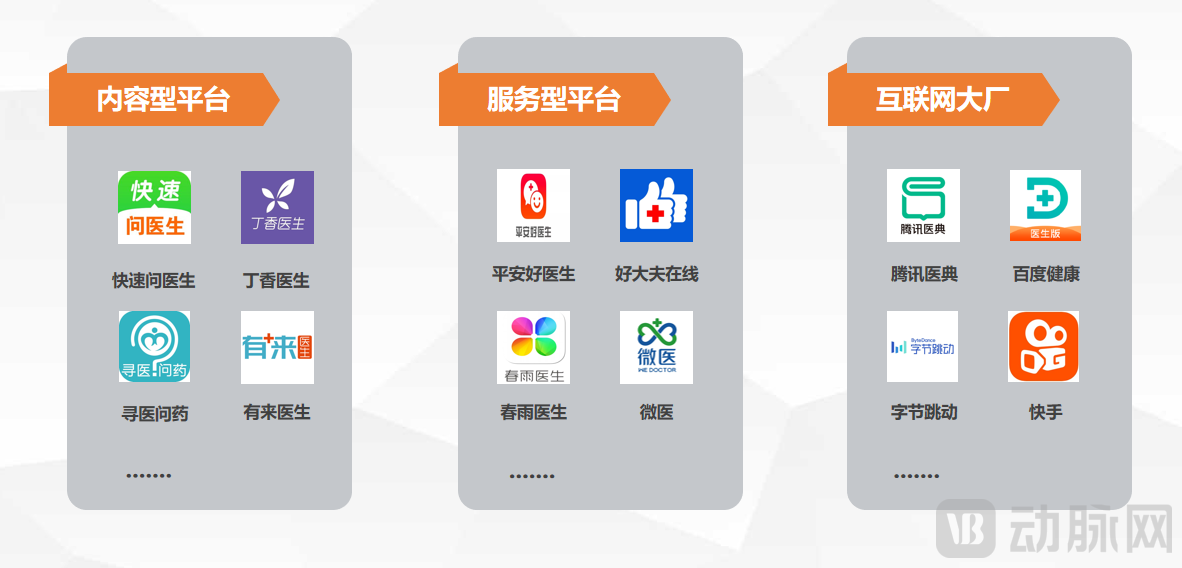
New developments always spark curiosity, and the medical science communication sector, with its renewed competitive intensity, is becoming more crowded than ever before. On one hand, content-based platforms continue to increase their investments,Dingxiang Doctor, Youlai Doctor, Quick Ask a Doctor, Xunyi Wenyaoplatforms are exerting comprehensive efforts to continuously enhance their functionalities through various means and expand their business coverage; on the other hand, service-oriented platforms are undergoing rapid transformation,Ping An Good Doctor, Haodf, WeDoctorInternet healthcare companies are increasingly adding science popularization sections to provide users with health information through various channels.
Major internet companies have also shown great interest in medical science popularization,Baidu, Tencent, ByteDance, Kuaishouhave flocked to the medical science popularization sector, leveraging their respective strengths to launch diverse types of medical science communication products.
First is Baidu.In March 2020, Baidu officially launched its health brand, Baidu Health. Within nearly a year, leveraging its strong resource advantages and broad user base, Baidu Health achieved a “leapfrog” advancement in the field of health science popularization. The daily volume of health-related content searches on Baidu reached 200 million, with Baidu Health serving over 100 million users per day. Baidu Health has established a comprehensive service chain spanning from science popularization to medical consultation and chronic disease management. To date, Baidu Health has indexed 500 million pieces of authoritative science popularization content, attracted more than 300,000 professional physicians to join its platform, and handles over 2 million online medical consultations daily.
Next is Tencent.Since the launch of Tencent Medical Dictionary in 2017, Tencent has been continuously refining the platform, pursuing ongoing exploration and innovation in content curation, presentation formats, and dissemination channels. As of September 2020, Tencent Medical Dictionary had collaborated with 5,000 physicians and academician experts across China to develop professional medical science popularization content covering the entire diagnosis and treatment process for more than 10,000 diseases. This comprehensive resource addresses not only common conditions but also severe and chronic diseases, including cancer.
Next is ByteDance.As a company rooted in content, ByteDance places significant emphasis on building its content ecosystem and has frequently made moves in the booming healthcare content sector in recent years. In August 2020, ByteDance completed the full acquisition of Baike Mingyi for RMB 500 million, aiming to inject richer and higher-quality medical popular science content into its products such as Toutiao, Douyin, and Xigua Video. As its primary platform for medical science communication, Douyin has attracted a number of “influencer” doctors, including Zhang Wenhong, Sun Qiuning, and Ji Yurong, each boasting over one million followers.
Lastly, Kuaishou.Compared with the first three major platforms, Kuaishou entered the medical science popularization sector relatively late, but it has made a strong and aggressive entry. According to data released by Kuaishou in September 2020, more than 400 local health commissions, public hospitals, and industry associations, along with over 2,000 practicing physicians from public hospitals, have joined the platform. Together, they have published more than 70,000 short videos on health education, accumulating over 15 billion views, and have conducted more than 3,000 live-streamed sessions on health science popularization, attracting over 600 million cumulative viewers.
A highly imaginative sector never lacks followers. In recent years, medical science popularization has continuously attracted various enterprises to enter the field, owing to its unique appeal and undeniable importance. Among these entrants are traditional healthcare companies that have long been deeply rooted in the medical sector, established robust operational systems, and built their own “moats” within the industry.
And, of course, there are the major internet tech giants. Leveraging their own platforms, they have launched a diverse array of medical science popularization products and fully capitalized on their substantial advantages in user traffic and distribution channels. This has enabled them to integrate into the medical science communication ecosystem at unprecedented speed, securing a highly advantageous position within the industry.
How Do Major Internet Companies Master Medical Science Popularization?
Medicine, being integral to human life and health, inherently demands a high degree of seriousness and academic rigor. This often creates a sense of distance for the general public; yet, it is precisely this dynamic that lends medical science communication its unique appeal—being closely related to daily life while maintaining a certain boundary. It is this “boundary” that makes medical science communication a highly specialized endeavor, not accessible to everyone. Only those who have established significant, barrier-like advantages in specific fields can secure the coveted “entry ticket” in this fiercely competitive industry.
The first step is to establish a continuous source of content.Medical science popularization is destined to be a protracted battle of continuous content creation. Much like a car, it requires constant input and refueling to keep moving forward. Furthermore, medicine is not static; as technology evolves, medical knowledge is continuously updated and iterated. Therefore, participants in this field must update their educational content in real time, ensuring it remains at the forefront of current knowledge.
From this perspective, enterprises have established diverse sourcing pathways, primarily includingIn-house physician-generated content, contributions from contracted industry experts, and integration with other medical science popularization platformsThree Modes.
For major internet companies, content is primarily sourced from contracted industry experts.According to the latest statistics, Baidu Health has onboarded over 300,000 professional physicians, including more than 1,500 top-tier authoritative medical experts. Tencent Medical Dictionary has partnered with over 5,000 physicians and academician experts across China. Kuaishou has attracted more than 400 local health commissions, public hospitals, and industry associations, along with over 2,000 practicing physicians from public hospitals.
Having content is only part of the task; it is also essential to ensure the authenticity and authority of the content.Medical science popularization must never be “adulterated”; every statement must be evidence-based. Therefore, for those entering this field, ensuring the authenticity and authority of content is a critical issue that must be addressed.
However, at present, no special policies have been issued at the national level to regulate medical science popularization, so companies must currently conduct their own reviews. Taking ByteDance as an example, in order to encourage scientific, rigorous, and high-quality science popularization content, Douyin released the "Douyin Community Medical Convention" in April this year, clearly proposing to build "three lines of defense" and sending a "zero tolerance" signal against pseudo-medical science popularization. The first line of defense involves strict verification of the qualifications of doctors and medical institutions; the second line of defense ensures the scientific accuracy and safety of the published content; and the third line of defense introduces a health rumor model, whereby any content that triggers the model’s alarm will be immediately removed.
Data shows that from January to March 2021, Douyin banned 1,278 accounts for violations such as illegally directing traffic off-platform to provide medical services and falsifying credentials. Meanwhile, the platform removed 612,000 non-compliant medical science popularization videos and 73,000 videos spreading health rumors.
But this is not the end point. Since it is science popularization, how to reach users becomes crucial.First, the dissemination channelsIn the internet era, communication has become more versatile, and knowledge acquisition is no longer confined to a single dimension; multiple channels have emerged from both PC and mobile app platforms. ByteDance primarily leverages its flagship products—Toutiao, Douyin (TikTok), and Xigua Video—as key entry points. Tencent maintains broad coverage across various touchpoints, including apps, WeChat Official Accounts, and Mini Programs. Meanwhile, Baidu capitalizes on its strengths in search engines, focusing its efforts on the mobile market.
Next is traffic.Traffic has always been a key metric in the internet sector, and this holds especially true for medical science popularization. Those who can secure a stable traffic base gain a first-mover advantage in the industry. Internet giants, already positioned at the forefront of traffic trends, naturally enjoy inherent advantages in user acquisition, which is precisely what enables them to rapidly dominate the medical science communication landscape.
Finally, precision.Determining the value of information lies not in the information itself, but in whether it precisely meets the user’s immediate needs. This is what constitutes information precision, a key focus that the entire internet healthcare sector has been exploring—and medical science popularization is no exception.
Taking Baidu Health Medical Encyclopedia as an example. The content provided by Baidu Health Medical Encyclopedia is guided by hundreds of millions of user search queries; that is, the creation of each health entry is driven by high-priority questions raised by users on Baidu. This enables the encyclopedia’s content to better align with user needs and comprehensively address their concerns.
Although medical science popularization is important within the entire internet healthcare industry, it is not fundamentally very different in essence; all requireAccess to physician resources, user traffic, distribution channels, and quality oversightand so on. However, these are precisely the areas where major internet companies excel. Leveraging their advantages in traffic and resources, they are creating greater possibilities in the field of medical science popularization.
Why Are Major Tech Companies So Keen on Medical Science Popularization?
The importance of medical science popularization is self-evident. For individuals, it can effectively promote physical health by shifting the current medical paradigm from “treating existing diseases” to “preventing diseases before they occur.” For physicians, it can enhance their professional value, help build their personal brand, and thereby generate additional income.
From the perspective of enterprises, however, a different landscape comes into view.Although major internet companies claim that their medical science popularization efforts are for public welfare, in reality, these tech giants have already calculated their strategic advantages before entering the field, because behind the medical science content lies a huge gold mine waiting to be exploited.
First, it opened a channel for user growth.According to a set of data released internally by Tencent, from the end of 2020 to the first quarter of 2021, the number of users who have watched medical science popularization short videos and live broadcasts has reached 873 million and 617 million, respectively. This means that 92% of internet users have experience watching short videos and live broadcasts related to healthcare. Therefore, this represents an enormous user traffic pool that will provide sustained revenue-generating capabilities for internet healthcare companies.
In short, as the core segment of the healthcare sector that most closely engages users, medical science popularization essentially builds an invisible traffic bridge for enterprises, enabling them to achieve the highest traffic returns at the lowest cost. This is undoubtedly a highly cost-effective endeavor.
Second, consolidate physician resources to synergize the development of content and online medical services.Medical science popularization must be carried out by physicians; therefore, doctors remain the core competitive advantage in the development of medical science popularization platforms. Major internet companies have long recognized this and have accumulated a substantial pool of physician resources through various means. In the case of Baidu Health, its Baidu Health Medical Encyclopedia has already partnered with more than 1,500 top-tier authoritative medical experts, including Li Lanjuan, Dong Jiahong, Ge Junbo, Wang Jun, and Fan Jia.
As a symbol of authority for internet healthcare platforms, physician resources serve as both content creators and primary providers of online medical services. A sufficient pool of physicians lays a solid foundation for internet healthcare companies to deliver online medical services. Specifically, by leveraging medical science popularization to aggregate a more robust physician workforce, the capacity of online medical services can be continuously expanded.
Third, promote the extension of business operations to the backend.Medical science popularization has long ceased to be limited to the dissemination of disease-related knowledge. Positioned at a new market inflection point, it now encompasses personalized services such as recommending healthcare institutions and facilitating online medication purchases. Consequently, enterprises engaged in medical science popularization inevitably gain access to extensive resources from healthcare providers and pharmacies. This access creates greater opportunities within the vast internet healthcare market, driving business expansion into areas such as online diagnosis and treatment and pharmaceutical e-commerce.
Major internet companies never engage in meaningless activities; every move represents new possibilities for their business, and their deep dive into the field of medical science popularization is no exception. On one hand, this opens up broader channels for traffic acquisition, giving them a critical advantage in industry competition. On the other hand, through medical science popularization, these tech giants can substantially supplement their access to key resources such as physicians, medical institutions, and pharmaceutical companies, providing significant support for the development of their online medical services.
Is the Future of Medical Science Popularization Destined to Be a Battlefield?
Medical science popularization has never been as vibrant as it is today. This surge is driven partly by direct policy guidance and strong market demand, but more importantly, by the proactive entry of major internet companies. Leveraging their inherent advantages, these tech giants have continuously innovated in both the content and format of medical science communication, propelling the field into a new stage of development.
The New Market Landscape Is Set to Spark a New Round of Competition. Although no substantial friction has occurred in the field of medical science popularization to date, the intensifying competition within the industry is inevitable as standards for content quality rise and more leading enterprises make significant entries into the market.
The focus of competition is primarily centered on the core segments of medical science popularization, including physician resources, user traffic, and dissemination channels. Among these, physician resources are the “primary target,” given their extreme scarcity—a reality that has persisted since the inception of internet healthcare.It is understood that many medical science popularization platforms have invested significant effort in expanding their physician resources, with some even signing exclusive cooperation agreements with doctors, aiming to cut off competitors’ access to collaborating with these physicians.
However, the “battle for doctors” is merely the first round. To truly secure a dominant position in medical science popularization, having access to physician resources alone is insufficient; it is also necessary to build on this foundation to explore new possibilities.
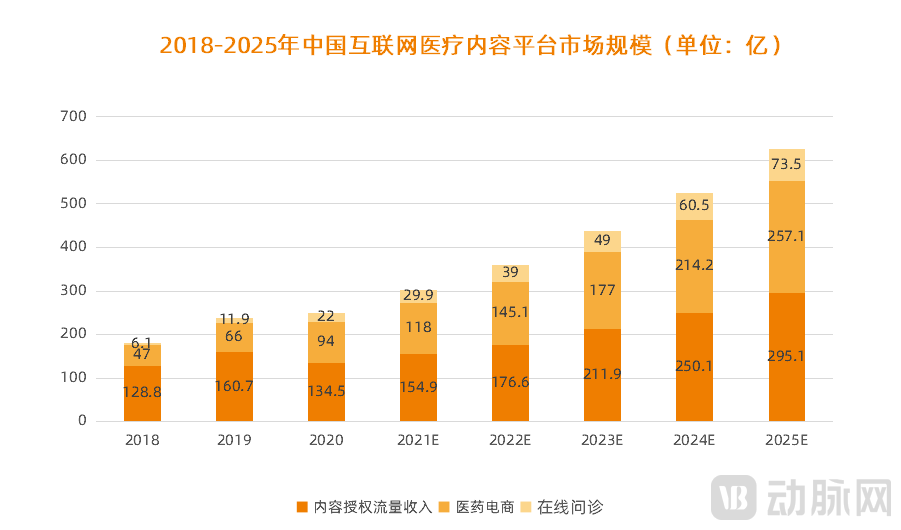
Data source: Iyiou Intelligence; Chart by VCBeat
First, strengthen its online diagnosis and treatment capabilities.According to the "2021 Research Report on China's Internet Medical Content Industry," the market size of China's internet medical content industry is projected to reach RMB 30.28 billion in 2021 and expand to RMB 65.27 billion by 2025, making medical science popularization an emerging market hotspot.
However, this is not the true objective behind the entry of many industry giants into the medical science popularization sector. As a vital component of the healthcare field, medical science popularization primarily serves to link core business operations. It comprehensively covers key stakeholders—including patients, physicians, healthcare institutions, and pharmacies—and efficiently integrates them. This approach generates substantial user traffic for enterprises and accumulates significant medical-related resources, thereby providing considerable support for the development of online healthcare services.
Following this path, medical science popularization is poised to become the foremost link in the closed-loop online healthcare service ecosystem, serving as a “stepping stone.” Therefore, those who can excel in medical science popularization while continuously strengthening capabilities in online consultation and pharmaceutical e-commerce—thereby bringing greater convenience to patients during their medical visits—will be the first to secure a competitive advantage.
Second, it has become a new breakthrough in chronic disease management.According to the "Report on the Nutrition and Chronic Disease Status of Chinese Residents (2020)," China currently has over 300 million patients with chronic diseases. In 2019, deaths attributable to chronic diseases accounted for 88.5% of all deaths in China, representing an increase of nearly 15 percentage points from 73.8% in 1991. It is projected that by 2050, as population aging accelerates further, this figure will exceed a staggering 90%. Effectively preventing and controlling chronic diseases and properly guiding patients to improve their personal health outcomes have become significant challenges facing China’s healthcare sector.
From this perspective, medical science popularization has greater room for innovation, primarily driven by a fundamental transformation in its formats. Interactive approaches that strongly connect doctors with patients, such as live streaming and Q&A sessions, will be fully leveraged. Yang Minglu, General Manager of Baidu Health, stated that Baidu Health is committed to leveraging its strengths to achieve precise patient matching and enhance the efficiency of connecting high-quality medical resources with patients in need.
Third is reverse input, transitioning from "people seeking content" to "content seeking people."At the Tencent ME Conference held last November, Huang Lei, Vice President of Tencent Medical, traced the origins of online medical science popularization and divided its development into three stages: the “1.0 Era,” characterized by uneven content quality and numerous industry pain points; and the “2.0 Era,” which emerged after clearing up chaotic practices and is marked by specialization, structuring, and ecosystem integration.
With the diversification of participants, the multimodal evolution of content, and the opening-up of coverage scenarios, the “3.0” era of medical science popularization is ushering in profound changes. Communication methods are undergoing a disruptive transformation, shifting from the traditional “people seeking content” model to “content seeking people.” While receiving scientific information, the public also contributes back to medical science popularization, facilitating the widespread dissemination of medical knowledge through social and scenario-based interactions.
Undeniably, with the successive entry of major internet companies, competition in the medical science popularization sector has become inevitable. However, in this battle that has yet to fully unfold, “poaching doctors” is merely the first round. More critical is the extended “long-board thinking,” namely the exploration of online diagnosis and treatment capabilities and chronic disease management services. Those who ultimately prevail may not be those focusing solely on medical science popularization itself, but rather the “pioneers” who explore innovative service models better aligned with patient needs, built upon the foundation of medical science popularization.