

Lancet Robotics Secures Tens of Millions in Pre-A Funding to Advance Clinical Trials for Joint Replacement Surgical Robots

Lancet Robotics
Developer of Robotic Systems for Orthopedic Joint Replacement Surgery
Shenzhen Lancet Robot Co., Ltd. (hereinafter referred to as “Lancet Robot”) recently announced the completion of its Pre-A financing round, raising tens of millions of yuan, with Haibang Fenghua as the investor.
It is reported that this round of financing will be primarily used to advance the clinical studies of the company’s hip and knee arthroplasty surgical robots, as well as to promote the market adoption of its digital orthopedic intelligent software, which is poised to receive regulatory approval. Currently, the company’s independently developed hip arthroplasty surgical robot has completed multiple clinical cases, demonstrating favorable clinical outcomes, while its knee arthroplasty surgical robot has obtained type testing reports and is on the verge of entering the clinical study phase.

Previously, the company completed a tens-of-millions-of-yuan angel financing round from Yuansheng Venture Capital and Shenzhen Qianhai Fund of Funds in October 2020.
Since its establishment in July 2018, Lancet Robot has remained focused on innovating intelligent orthopedic surgical solutions, committed to advancing orthopedic procedures toward greater intelligence, minimally invasiveness, and precision. The company’s core founding team members hail from prestigious universities such as Tsinghua University, Harbin Institute of Technology, Shanghai Jiao Tong University, and National Taiwan University, bringing extensive experience in the research and development of surgical robots. Within three years of its founding, Lancet Robot has secured dozens of intellectual property rights, gained recognition from numerous renowned orthopedic experts in China, and established long-term collaborative partnerships with multiple leading orthopedic manufacturers.
Population Aging and Precision Medicine Drive the Development of Orthopedic Surgical Robots
According to the latest census data, China's population aged 60 and above has reached 264.02 million, accounting for 18.70% of the total population. The deepening aging trend has led to a year-on-year increase in the incidence of joint and sports medicine injury-related diseases. Data shows that in 2020, the total number of joint replacement surgeries in China exceeded 900,000, including 580,000 hip replacements and 330,000 knee replacements. Despite maintaining rapid growth for consecutive years, there remains significant untapped potential in China's market compared to the volume of joint replacement surgeries in developed markets in Europe and the United States.
Furthermore, in recent years, the clinical demand for precision medicine has continued to grow. Traditional orthopedic surgeries largely depend on the surgeon’s experience and clear visualization of the lesion site; however, large incisions and high radiation exposure may increase surgical risks. In contrast, robot-assisted orthopedic surgery offers advantages such as precise targeting of the lesion, minimally invasive incisions, high stability, and favorable postoperative outcomes. Consequently, surgical robots are gradually gaining clinical acceptance.
At present, orthopedic surgical robots in China are still in the early stages of development. No domestically produced orthopedic joint replacement surgical robots have yet received regulatory approval for market entry in China. Meanwhile, joint replacement surgical robots from foreign brands currently available on the market meet only a small fraction of demand due to their high purchase prices and operational costs. High-performance domestic brands are poised to achieve leapfrog development and catch up with or surpass international competitors.
Intelligent and Precise: Addressing the Pain Points of Traditional Surgery
To address the pain points of traditional orthopedic surgery, such as high operational demands and large incisions, Lancet Robot integrates multiple independent innovative technologies and functions. By merging digital and intelligent tools with surgical robotics, it has developed a joint replacement surgical robot capable of preoperative planning, intraoperative real-time positioning and navigation, and postoperative simulation and evaluation. This system provides physicians with a minimally invasive surgical solution characterized by high precision, low radiation exposure, and enhanced safety, while also alleviating patient pain, shortening recovery time, and improving quality of life.
Currently, the company’s flagship product, a robotic system for hip replacement surgery, has been successfully used to perform robot-assisted hip arthroplasty at several renowned Grade A tertiary hospitals, including the Drum Tower Hospital Affiliated to Nanjing University Medical School. With the assistance of this surgical robot, postoperative abduction and anteversion angles matched preoperative planning expectations, while leg length and offset achieved ideal surgical outcomes.
In addition, the company has several other products, including a knee joint replacement surgical robot, currently undergoing preclinical animal and cadaveric studies, with clinical trials scheduled to commence soon.
Against the backdrop of a large population base and accelerating population aging, China has become the second-largest joint replacement surgery market in the world, trailing only the United States. It is believed that in the near future, the adoption of Lancet’s joint replacement surgical robot will break the monopoly held by imported products, meet broader clinical needs, and support the development of high-end medical devices manufactured in China.
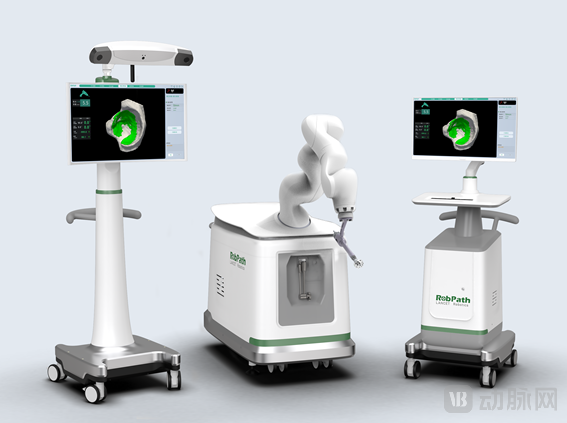
Lancet Hip Replacement Surgical Robot
As an investor in this financing round, Li Yang, Investment Director at Haibang Fenghua, stated, “The application of joint replacement surgical robots aligns with the broader trend toward digitalization and intelligence in orthopedics. The team at Lancet Robot boasts a strong engineering culture, effectively balancing product maturity, completeness, and R&D velocity. With robust execution capabilities, it is well-positioned to catch up and surpass competitors in this intensely competitive landscape. Leveraging its superior products and extensive clinical resources, Lancet Robot is poised to become a leading digital platform enterprise in the core orthopedic markets—spanning diagnostics, AI-based surgical planning, surgical robots, and consumables—by capitalizing on its technological prowess and differentiated market strategy. Haibang Venture Capital remains bullish on the company’s expansion capabilities in digital orthopedics and looks forward to new achievements as it further refines its product portfolio and advances its internationalization efforts.”
As the clinical trial sponsor, Professor Jiang Qing, Chief Physician at Nanjing Drum Tower Hospital, the Affiliated Hospital of Nanjing University Medical School, stated: “Surgical robots are a new type of medical device that integrates multiple disciplines, including clinical medicine, biomechanics, mechanics, computer science, and optics. By leveraging precise preoperative planning and flexible robotic arms, surgical robots assist physicians in performing complex and precise procedures through minimally invasive techniques. The annual number of total hip arthroplasty (THA) procedures in China is less than one-third of that in the United States, failing to meet the urgent demand of a large patient population, particularly elderly patients, for a high quality of life. Hip arthroplasty surgical robots help physicians develop personalized surgical plans, enable visualization of the surgical procedure, and ensure accurate prosthetic implantation, thereby allowing more physicians to benefit a broader patient population. Previously, this field was monopolized by foreign hip surgical robot manufacturers, resulting in high market prices. Developing surgical robots with independent Chinese intellectual property rights that are safe, reliable, and affordable holds significant practical importance for breaking foreign monopolies, serving the vast patient population, and promoting the development of China’s advanced medical equipment industry.”
About Haibang Fenghua
Haibang Fenghua was initiated and established by Zhejiang Haibang Investment, a well-known equity investment institution in Zhejiang Province, together with its entire investment management team. The company primarily focuses on early- to mid-stage equity investments in fields such as life health, the digital economy, and new materials. We adhere to the investment philosophy of “Technology + Talent,” firmly believing that technology changes the world, and are committed to supporting entrepreneurs with great ideals and an entrepreneurial spirit.