

ADC in the Spotlight: Who Will Be the Next RemeGen?
Editor’s Note: This article is republished from Archimedes Biotech, with authorization granted to VCBeat.
ADCs, known as "biological missiles," can precisely target cancer cells.
Seagen is a pioneer in ADCs, launching the world’s second ADC product, brentuximab vedotin, a decade ago; it has since been marketed in 76 countries worldwide.
Now, RemeGen’s sale of partial regional rights to its first domestically developed ADC, disitamab vedotin, to this pioneer is highly significant.
Total potential revenue reaches up to $2.6 billion, setting a new record for the highest value of an overseas licensing deal for a single product by a Chinese pharmaceutical company.
Amid the intense competition in the innovative drug sector, pipeline differentiation and in-house R&D capabilities are particularly critical.
Without Strong In-House R&D, How Can You Go Global and Earn US Dollars?
RemeGen’s disitamab vedotin is a novel ADC product that selectively delivers the anticancer agent monomethyl auristatin E (MMAE) to HER2-expressing tumor cells. This successful international expansion signifies renewed recognition of the vc-MMAE platform.
ADCs Are Stepping into the Spotlight; The Harvest Season Is Not Far Off.
Multiple Billion-Dollar Blockbuster ADCs Are Expected to Emerge in China.
According to statistics from Essence Securities, 32 domestic pharmaceutical companies have entered the field of ADC (Antibody-Drug Conjugate) R&D, targeting 23 different targets, with a total of 67 products in development. Who will be the next RemeGen?
01 Boundless Horizons
ADCs Have Become a Highly Contested Frontier.
According to Nature’s projections, the combined sales of ten ADC products launched before 2020 will exceed $16.4 billion by 2026. China’s ADC market only began to take off in 2020 and is expected to reach RMB 7.4 billion in 2024 and RMB 29.2 billion in 2030, representing a compound annual growth rate (CAGR) of 25.8% from 2024 to 2030.
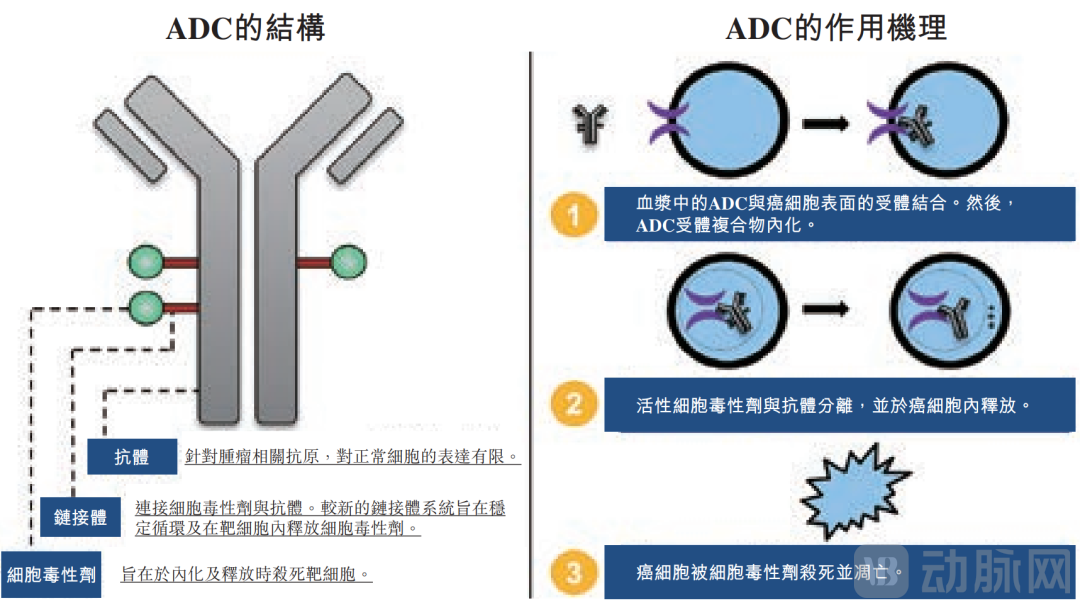
ADC (Antibody-Drug Conjugate) is a new generation of therapeutic agents composed of an antibody, a small-molecule toxin, and a linker, characterized by high target specificity and low toxicity.
Antibodies act as guidance systems, precisely directing toxins to their targets.
The linker connects the antibody to the toxin, facilitating intracellular release of the toxin.
Toxins are equivalent to warheads, serving as effective molecules for killing tumor cells.
There are two main types of toxins: microtubule inhibitors, including MMAE, MMAF, DM1, and DM4; and DNA-damaging agents, whose mechanisms of action include DNA double-strand breaks, DNA alkylation, DNA intercalation, and DNA cross-linking.
Domestic pharmaceutical companies that have selected MMAE include RemeGen, Lepu Biopharma, Keymed Biosciences, Genor Biopharma, and Eddia Biotech. MMAE can block tubulin polymerization and exhibits higher membrane permeability than DM1, thereby exerting a more potent bystander killing effect through the bystander effect.
A Quick Sketch of the Domestic ADC Landscape:
RemeGen is a domestic pioneer in ADCs; Lepu Biopharma has the largest number of ADC candidates in clinical stages; and traditional pharmaceutical companies such as Hengrui Medicine, Kelun Pharmaceutical, and Qilu Pharmaceutical have made strategic investments in this area.
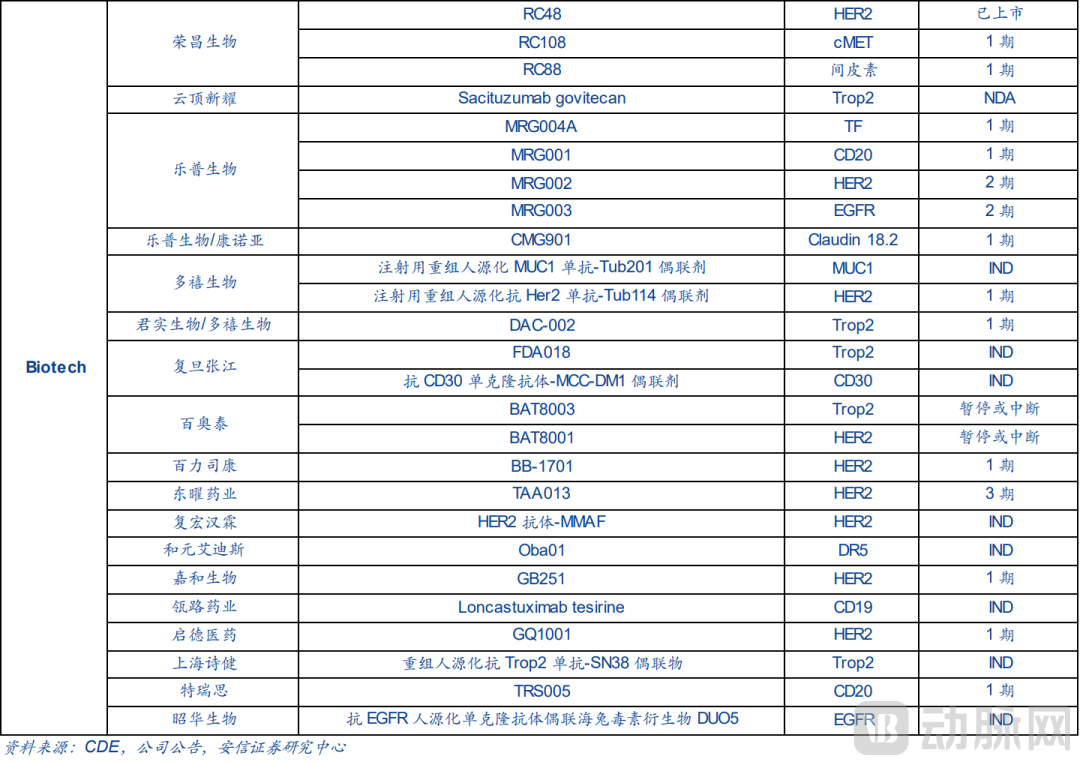
ADC Pipeline Layout of Domestic Biotech Companies
02 Mainstream Targets
HER2:Genetic drivers underlying the high incidence of various cancer types have made them the most sought-after targets for antibody-drug conjugates (ADCs), with 18 pharmaceutical companies in China currently pursuing this space. Rongchang Biotechnology’s disitamab vedotin was launched in June this year, TAA013 from Allist Pharmaceuticals has entered Phase III clinical trials, and five other candidates are in Phase II. Disitamab vedotin has demonstrated significant efficacy and survival benefits in patients with urothelial carcinoma who have received two or more prior lines of systemic chemotherapy, achieving an objective response rate (ORR) of 50% and a disease control rate (DCR) of 76.6% based on independent radiological assessment. Lepu Biopharma’s MRG002 shows distinct competitive advantages; preliminary clinical data indicate that no patients reported severe adverse events such as interstitial lung disease or ocular toxicities, which are commonly associated with other marketed or investigational ADCs targeting the same antigen. In the dose-escalation phase of its Phase Ia trial in China, MRG002 achieved an ORR of 50.0% and a DCR of 81.3% among evaluable breast cancer patients. Among heavily pretreated, evaluable patients with HER2-positive breast cancer, salivary gland carcinoma, colorectal cancer, and gastric cancer, the ORR was 42.9% and the DCR was 81.0%.
Trop2:Highly expressed in various solid tumors, it is the second most popular target, with 11 pharmaceutical companies in China having established pipelines. EverMed (Immunomedics), Junshi Biosciences (Duoxi Biotech), and Kelun Pharmaceutical constitute the first tier. Traditional pharmaceutical giants CSPC Pharmaceutical Group, Fosun Pharma, and Hansoh Pharma follow closely behind.
Claudin 18.2:Highly selective marker genes and emerging targets for advanced gastric and pancreatic malignancies; five domestic pharmaceutical companies have established pipelines in this area. CMG901, a CLDN18.2-targeted antibody-drug conjugate (ADC) co-developed by Lepu Biopharma and Keymed Biosciences, is the first of its kind globally to receive Investigational New Drug (IND) approval. It demonstrates robust capability for rapid internalization into tumor cells and potent cytotoxic activity against them.
TF:Emerging Target: A Transmembrane Glycoprotein Essential for Hemostasis, Aberrantly Expressed by Tumor Cells and Involved in Multiple Pathological Processes. Lepu Biopharma’s MRG004A is currently the first and only tissue factor (TF)-targeted antibody-drug conjugate (ADC) in China. It received Investigational New Drug (IND) approval from the U.S. Food and Drug Administration (FDA) in February this year and obtained implicit approval for its clinical trial application from the National Medical Products Administration (NMPA) on August 5. Preclinical studies of MRG004A have demonstrated superior circulation stability and enhanced efficacy in animal models of pancreatic cancer, ovarian cancer, and triple-negative breast cancer (TNBC).
EGFR:Super Target, Highly Expressed in Various Solid Tumors Such as Head and Neck Cancer, Nasopharyngeal Carcinoma, and Non-Small Cell Lung Cancer; ADC Drugs Have Huge Market Potential. Lepu Biopharma’s MRG003 is currently the first-in-class and only EGFR-targeting ADC product in China at the clinical research stage, covering multiple major indications. Phase II clinical trials are underway for recurrent or metastatic advanced HNSCC, advanced NSCLC, BTC, and NPC, with plans to initiate clinical studies for recurrent or metastatic advanced HNSCC in the United States.
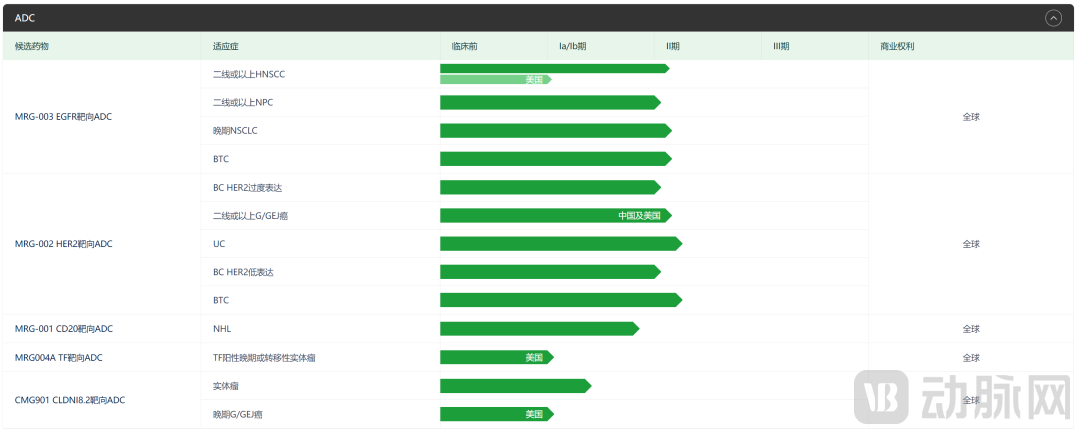
Lepu Biopharma ADC Pipeline
03 Leading Enterprises
RemeGen:RemeGen began strategizing its ADC product pipeline ten years ago. On July 14 this year, the National Medical Products Administration (NMPA) accepted RemeGen’s new indication application for disitamab vedotin (RC48), which is expected to be indicated for the treatment of HER2-overexpressing locally advanced or metastatic urothelial carcinoma. The cMET-targeted ADC RC108 and the mesothelin-targeted ADC RC88 have both been approved to enter Phase I clinical trials. Preclinical studies are underway for the CLDN18.2-targeted ADC RC118.
Lepu Biopharma:Possessing a fully integrated, proprietary ADC technology platform that encompasses the entire process of research, development, and manufacturing. Five ADC products have entered clinical stages, primarily featuring differentiated targets; among these, four are independently developed, four are filed for clinical trials in both China and the US, and three are currently the only ones of their kind in China. MRG001 is a CD20-targeting ADC product with a leading clinical progress status and first-in-class potential. A Phase I dose-escalation clinical study in patients with relapsed or refractory non-Hodgkin lymphoma is ongoing, positioning it as a potential key product in the hematologic oncology markets of China and the United States. MRG003 holds substantial commercial value; there are currently no marketed ADC products targeting EGFR, with only Rakuten, Lepu Biopharma, and Sutro/Merck having candidates in development. Notably, osimertinib, a small-molecule drug targeting EGFR in lung cancer, achieved global sales of $4.33 billion in 2020. As there are no marketed TF-targeting ADC products globally, MRG004A has promising commercial prospects. CMG901 is currently advancing patient enrollment for its Phase I clinical trial in China for advanced solid tumors (including gastric and pancreatic cancers), while simultaneously conducting a multicenter, open-label Phase I clinical trial in the United States for patients with advanced unresectable or metastatic gastric/gastroesophageal junction (G/GEJ) cancer. The marketing application for the melanoma indication of the PD-1 product HX008 was officially accepted by the National Medical Products Administration (NMPA) on July 5. The marketing application for the MSI-H/dMMR solid tumor indication will also be submitted within this year. Furthermore, the company is exploring novel combinations of PD-1 inhibitors with ADCs, having observed significant synergistic effects in inhibiting tumor growth, and plans to submit an Investigational New Drug (IND) application for the combination therapy in advanced head and neck squamous cell carcinoma (HNSCC) within this year.
Hengrui Medicine:Four ADC products have entered clinical development, and two ADC products have submitted Investigational New Drug (IND) applications; five of these are independently developed. SHR-A1403 is a cMET-targeting ADC and the first of its kind to enter clinical trials in China. SHR-A1904 is an independently developed ADC targeting tumor-specific antigens, with no similar drugs approved for marketing globally. Multiple ADC patents have been filed, covering ADC technology and various targets including HER2, EGFR, cMET, B7-H3, and HER3.
Kelun Pharmaceutical:Two ADC products have entered clinical trials, with dual filings in both China and the United States; eleven preclinical ADC candidates are in the pipeline. The Claudin18.2-ADC is expected to enter clinical stages this year. A166 (HER2-ADC) is conducting a pivotal Phase II clinical trial for the treatment of HER2-positive breast cancer, demonstrating a differentiated advantage with very low incidences of hematologic toxicity and interstitial pneumonitis. SKB264 (TROP2-ADC) has obtained Phase I clinical data and shows me-better potential, striving to become the first domestically produced TROP2 ADC to be marketed in China.
This presents an opportunity to leapfrog competitors, as none of the four ADC targets in Lepu Biopharma’s pipeline have yet seen approval for similar drugs globally.
Following PD-1 inhibitors and CAR-T therapies, Chinese innovative pharmaceutical companies have once again converged on the forefront of the industry, this time with antibody-drug conjugate (ADC) products. This has fostered a diversified and healthy competitive landscape, without widespread clustering around common targets.
As artificially engineered conjugate drugs, antibody-drug conjugates (ADCs) offer diverse combination possibilities. Coupled with continuous technological iterations, they are poised to avoid market saturation and carve out a path for differentiated innovation.