

Eli Lilly Bets $2.75B on Insilico Medicine's Once-Weekly Oral GLP-1 for Weight Loss
Innovent
High-end Biologics Developer

Frontier Biotechnologies
Innovative Biopharmaceutical Developer, Manufacturer, and Distributor

GSK
Pharmaceutical R&D Manufacturer
Text|Hu Xiangyun
Editor|Hai Ruo Jing
AI Drug Development Field Sees Another RMB 20 Billion-Level Deal.
On the evening of March 29, Insilico Medicine (HK:03696) announced its collaboration with Eli Lilly: an upfront payment of $115 million, a total deal worth up to $2.75 billion, plus potential sales royalties post-product launch. The core of the deal is a preclinical oral GLP-1 drug; additionally, based on Insilico’s Pharma AI technology platform, the two parties will also engage in multiple research collaborations "around targets selected by Lilly" in the future.
On the same day, Insilico Medicine's annual report showed that the total revenue for 2025 was $56.2 million, and the total value of BD licensing contracts as of the reporting date was $2.174 billion. In other words, the upfront payment from this single transaction was twice the company’s annual revenue, and the total value also directly exceeded the sum of all previous BD amounts.
On March 30, Insilico Medicine's stock price surged by up to 15% during the trading session and closed 2% higher. Overseas, this deal triggered an antitrust review by U.S. regulators due to its "large cash scale," which temporarily sparked rumors that "Insilico Medicine was acquired by Eli Lilly."
On March 30, Insilico Medicine held a media exchange meeting. Founder and CEO Alex Zhavoronkov stated, "We will adhere to independent development. Moreover, if a single BD deal can reach the current valuation, the acquisition valuation should logically be higher. Regarding this collaboration, the endorsement effect of Eli Lilly, as the 'NVIDIA of the pharmaceutical world,' is very strong. In the past two days, we have already received more communication and consultation invitations from large overseas pharmaceutical companies."
This transaction format is similar to the recent BD collaboration structures between Innovent Bio and Eli Lilly (USD 8.85 billion), as well as Frontier Biotechnologies and GSK (USD 1.003 billion). The licensed products are all in the early stages of development. Structurally, it is no longer a straightforward buyout; instead, the licensor leads the early clinical validation before handing it over to multinational pharmaceutical companies.
"At present, Insilico Medicine’s clinical team has only more than 20 people and does not have a commercialization team. Even if there are commercially launched products, with only 1-2 of them, sales revenue would hardly cover the sales costs. Therefore, in the short term (2-5 years), BD will remain the company's main source of income. However, in the long run, once BD can continuously generate stable cash flow, we will have the ability to build a global clinical team and a commercialization team, and even support us in independently conducting large-scale global Phase 3 clinical trials," said Dr. Ren Feng, Co-CEO and Chief Scientific Officer of Insilico Medicine.
Since last year, AI-native biotech companies have gradually become a rising force in China's innovative drug BD wave. Previously, companies such as XtalPi, HuaShen ZhiYao, and YuanSi ShengPeptide secured substantial upfront payments with total orders reaching billions of dollars. This time, the collaboration between Insilico Medicine and Eli Lilly serves as a strong testament to the current realization of value in AI-driven drug discovery.
"At least a 60% chance of achieving the milestone revenue"
Insilico Medicine did not disclose specific information about the collaboration pipeline in its announcement. However, by comparing the discrepancies between the information on Insilico Medicine's website and financial reports, it can be inferred that the subject of the deal is an oral GLP-1 inhibitor.
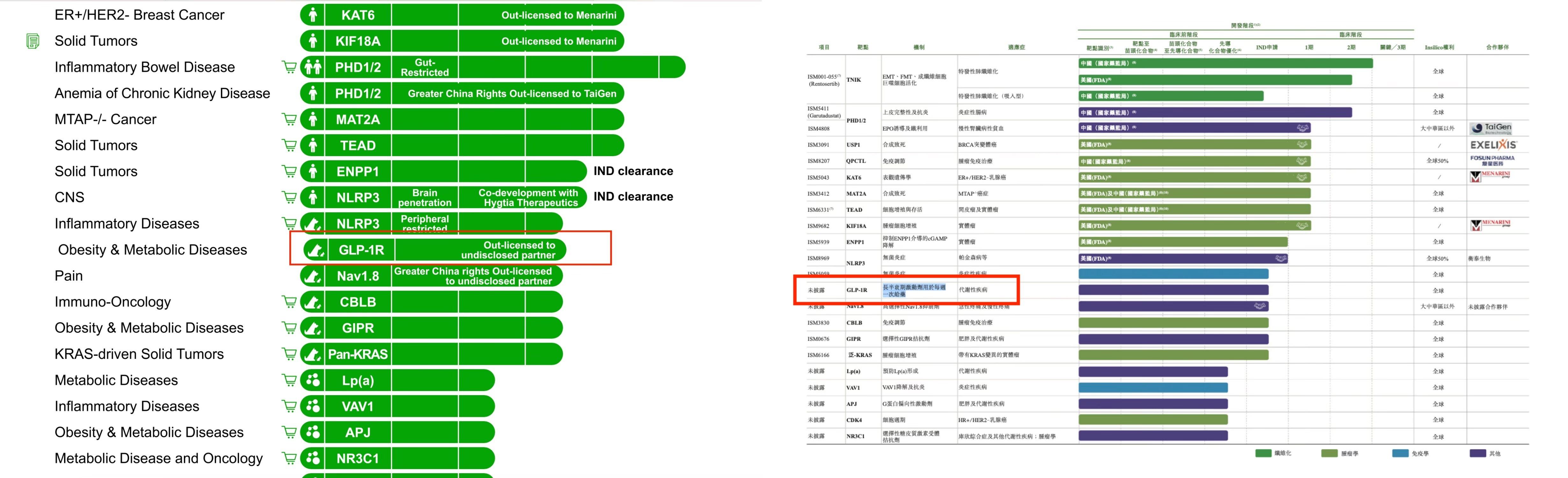
The figure on the left shows the pipeline diagram from Insilico Medicine's official website (screenshot date: March 30, 2026); the figure on the right is from Insilico Medicine's 2025 annual report.
Driven by the weight-loss indications, oral GLP-1 has become a key competitive point in the global pharmaceutical market, with most late-stage clinical products currently being "daily formulations." Among the frontrunners, Novo Nordisk's oral semaglutide weight-loss drug has been approved in the U.S., and Eli Lilly's Orforglipron has submitted marketing applications in both China and the U.S. Industry expectations for its annual sales peak reach $40 billion, approaching the level of tirzepatide.
In China, products from Hengrui Medicine and Chengyi Bio/AstraZeneca have also entered the late-stage clinical phase.
At this point in time, Lilly's acquisition of a preclinical oral GLP-1 weekly formulation demonstrates its recognition of the pipeline and the AI-accelerated capabilities behind it.
This preclinical oral GLP-1 candidate is part of the Pharma AI platform's portfolio of eight cardiovascular and metabolic products. Pharma AI, the crown jewel of Insilico Medicine, has been instrumental in developing over 20 clinical/IND-stage assets, seven of which have already generated $130 million in upfront payments through BD licensing deals, with a total deal value reaching $2.174 billion.
The innovation of this authorized product lies in its potential to achieve once-weekly dosing, which significantly surpasses the compliance of existing daily formulations. At the BioEurope conference late last year, Insilico Medicine also stated that the drug's "weight loss effect is comparable to or better than existing oral GLP-1R agonists."
From the buyer's perspective, Eli Lilly has been quite aggressive in its AI technology layout over the past two years.
Since hiring its first Chief AI Officer, Thomas Fuchs, in late 2024 and fully launching its AI strategy, Eli Lilly has begun to focus heavily on "infrastructure" development, whether it is the underlying computing power or midstream data validation. For instance, at the end of last year, Eli Lilly announced a collaboration with Nvidia to build an "AI factory" powered by over 1,000 B300 GPUs. According to industry practitioners in AI drug development, this level of infrastructure investment ranks among the top within pharmaceutical companies and is sufficient for conducting drug screening and design at the tens of millions scale.
In early 2026, Eli Lilly announced that it would invest $1 billion together with NVIDIA over the next five years to build an AI Joint Innovation Lab, creating a "dry and wet lab closed-loop" system to fully integrate AI into the entire process from molecule discovery, clinical trials, to manufacturing.
Externally, Eli Lilly continues to cast a wide net for BD collaborations and secure innovative pipelines. The interaction between Insilico Medicine and Eli Lilly has also deepened during this process.
In 2023, Eli Lilly actually started using Insilico's Pharma AI platform, albeit in the form of software services. By 2025, the collaboration had deepened. In November, the two parties signed a $100 million small-scale order based on Pharma AI to explore collaborative research and development; at the end of December, Eli Lilly's headquarters appeared on the cornerstone investment list of Insilico’s Hong Kong stock, with a subscription amount of $5 million, which objectively speaking, is not very high.
But at the time, industry investment professionals analyzed to 36Kr that multinational pharmaceutical companies generally do not position themselves for pure financial investments, and Eli Lilly's move was "most likely to secure a position for subsequent product cooperation."
Today, this $2.75 billion collaboration in research and development is also a chapter in the story of cooperation.
Regarding the future R&D plans and milestone revenue expectations for the pipeline, Ren Feng stated that the BD project planning will fully consider feasibility. "In terms of product quality and R&D progress, we have at least a 60%-70% chance of achieving the milestones. This is not a big issue."
When "Co-development" BD Becomes the Norm
In this transaction, apart from a confirmed GLP-1 oral weekly formulation, in the future, Insilico Medicine and Eli Lilly will also "carry out multiple R&D collaborations around Lilly-selected targets" based on the Pharma AI technology platform.
This form of transaction is similar to recent collaborations such as Innovent Bio/Lilly (USD 8.85 billion) and Frontier Biotech/GSK (USD 1.003 billion).
They are often based on collaborations involving multiple products, with the licensed products still in the early stages of development; Innovent Bio even completed the deal without any pipeline products. Structurally, it’s no longer a straightforward buyout—instead, after the licensor takes the lead in advancing early clinical validation, the project is handed over to multinational pharmaceutical companies.
Many practitioners in the innovative drug field unanimously believe that the interesting aspect of this model is that multinational pharmaceutical companies are essentially "treating Chinese innovative drug companies as their own 'outsourced' R&D centers."
But it is not entirely the same as the traditional CXO model. The authorizing party has "independent decision-making rights" in the research and development process and enjoys substantial rights to subsequent product development and commercialization, whereas traditional CXOs generally follow detailed work plans and "do not fund R&D themselves."
A person from an innovative pharmaceutical company mentioned that recently, they have also encountered such demands when negotiating with multinational pharmaceutical companies. "On the one hand, the transaction price will be much lower than purchasing a mature project, but the possibility of obtaining double returns is greater; at the same time, it can effectively supplement the R&D system of multinational pharmaceutical companies themselves, because the efficiency of the same amount of funds placed in European and American R&D centers will not be as high."
In the process, multinational pharmaceutical companies often "not completely let go." For Chinese innovative drug companies, this becomes a good opportunity to transform cooperation experience into their own capabilities and learn about the operation methods of overseas markets, while also obtaining some financial support to avoid dragging down the financial statements of listed companies. For instance, Innovent Bio previously mentioned that the upfront payment was "sufficient to cover the company's clinical costs."
This is also a point of great concern for many innovative pharmaceutical companies. Over the past two years, outbound BD deals in the innovative drug sector have been booming, providing many companies with "their first opportunity to collaborate with leading global pharmaceutical companies according to international standards." However, in this process, have Chinese companies moved beyond merely aiming to secure BD deals and achieve large milestone payments, striving instead for further collaboration in joint development and building certain global operational capabilities?
Recently, the BD head of a multinational pharmaceutical company's China branch mentioned to 36Kr that, from the perspective of bringing innovative products to market more quickly, "we also hope to help one or more Chinese innovative pharmaceutical companies achieve this goal through collaborative development."
However, stepping over this threshold is not easy—research and development capabilities, global thinking, and even the accumulation of trust with multinational pharmaceutical companies are all indispensable. Taking Eli Lilly as an example, its frequent collaborators, Innovent Bio and Insilico Medicine, essentially possess these qualities.
Insilico and Eli Lilly have a long-standing relationship. At this stage, business development (BD) is an important channel for Insilico to realize its commercial value. Therefore, instead of seeking intermediaries, the company has chosen to be directly led by Alex Zhavoronkov. Moreover, he has "known for many years" Jiye Shi, head of Eli Lilly's Computational Design and Automation Platform, as well as Andrew Adams, Vice President of Molecular Discovery at Eli Lilly. This might be an important opportunity for maintaining communication and cooperation between Insilico and Eli Lilly.
This time, Ren Feng also mentioned that platform-based AI pharmaceutical companies and established pharmaceutical enterprises can each play to their different strengths in the early research or clinical and commercial validation stages, enabling "the overall R&D efficiency of the industry to become higher and higher."