

Infervision Secures Second FDA Clearance for Its AI-Powered Stroke Detection Solution InferRead CT Stroke.AI

Infervision
Artificial Intelligence Product Developer
Recently, Infervision’s stroke AI product, “InferRead CT Stroke. AI” (hereinafter referred to as the Product), received clearance from the U.S. Food and Drug Administration (FDA), officially granting it market access in the United States.
Notably, in July 2020, Infervision’s AI-assisted lung detection software became the first application leveraging deep learning algorithms to receive FDA approval in the United States. With its stroke care product line now also securing FDA clearance, Infervision has become the first Chinese AI healthcare company to hold two FDA certifications simultaneously.
To date, Infervision has established a significant lead in market access for pulmonary disease solutions, holding regulatory approvals from the four major global markets: the U.S. FDA, the EU CE, Japan’s PMDA, and China’s NMPA. The recent FDA clearance for its stroke-related products not only marks new progress in Infervision’s pipeline for other major diseases and significantly strengthens its “horizontal and vertical” as well as “internationalization” product strategies, but also represents a robust endeavor by Chinese innovation to gain market access and recognition on the international stage.
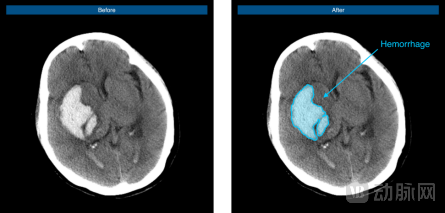
Schematic Diagram of AI Processing for Intracerebral Hemorrhage Cases by Infervision
According to data from the World Health Organization, stroke was the second leading cause of death globally in 2019. Publicly available information indicates that the number of stroke cases in China increased from approximately 4.3 million in 2016 to about 5 million in 2020. The 30-day mortality rate for intracerebral hemorrhage ranges from 35% to 42%, with half of these deaths occurring within the first 24 hours after onset.
However, taking hemorrhagic stroke as an example, cranial CT scanning is the “gold standard” for diagnosing early cerebral hemorrhage. Patients with suspected stroke should undergo CT examination as soon as possible to confirm the diagnosis. Nevertheless, numerous challenges persist in clinical practice: a severe shortage of medical personnel, variable interpretation skills among primary care providers, and significant disparities in healthcare capabilities across different regions. How to ensure rapid and accurate CT imaging for patients with suspected stroke upon hospital admission remains an urgent problem that the entire healthcare system needs to address.
In recent years, the application of new technologies such as deep learning-based artificial intelligence has significantly improved the efficiency of image processing in stroke diagnosis, making early diagnosis and treatment possible. This is particularly beneficial in remote, grassroots areas with underdeveloped medical conditions and scarce healthcare resources. By leveraging widely available CT scanners combined with AI-assisted triage software for cerebral hemorrhage CT imaging, suspected cases can be identified earlier through head imaging diagnostics. This approach provides substantial support to healthcare institutions in China and effectively alleviates the financial burden on patients’ families and the social healthcare system.
To address the aforementioned pain points, Infervision strategically positioned itself in the field of cerebrovascular diseases, including stroke, during its early development stages. At recent annual meetings of the Radiological Society of North America (RSNA), the company showcased its first AI-based investigational product for stroke. Through continuous R&D and rapid iterative “evolution,” this product can now rapidly determine the presence of hemorrhage, efficiently annotate hemorrhagic lesions, accurately locate and delineate hemorrhagic regions, and automatically calculate hemorrhage volume. These capabilities enhance physicians’ diagnostic speed, optimize intelligent triage and workflow management in hospital emergency settings, and thereby secure the critical “golden window” for treatment in stroke patients.
The product’s recent FDA clearance hinged on a multicenter scientific study. This validation study demonstrated that, using senior neuroradiologists as the reference standard, the product met its predefined trial endpoints, with sensitivity and specificity both at 92%, underscoring its excellent diagnostic performance. Furthermore, in terms of time efficiency, the product enables rapid triage and notification, substantially reducing diagnostic turnaround time for patients with hemorrhagic stroke and significantly improving the efficiency of emergency stroke care.
Clinical research supports the translation of scientific findings, while the latest applied outcomes of such research are translated into new clinical diagnostic and therapeutic solutions. Adhering to the philosophy of “from the clinic, back to the clinic,” Infervision has collaborated with more than 400 medical institutions worldwide. These collaborations encompass a range of scientific studies, including those on stroke diagnosis. Multiple research outputs have been published in core journals and presented at top-tier conferences, laying a solid foundation for the FDA clearance of Infervision’s AI-based stroke product.
In the study titled “Deep network for the automatic segmentation and quantification of intracranial hemorrhage on CT,” Infervision collaborated with a Grade A tertiary hospital in Beijing to explore the application of an AI-based stroke system in segmenting hemorrhagic lesions on brain imaging. The research conducted a comprehensive and in-depth quantitative analysis of the accuracy and consistency of deep learning–based automated calculation of hemorrhage volume, comparing it with the conventional ABC/2 method. The related scientific findings were published in the journal Frontiers in Neuroscience.
Furthermore, in the study titled “Deep Learning System for the Prediction of the Alberta Stroke Program Early CT Score From Non-Contrast Enhanced CT: Clinical Application and Performance Evaluation,” Infervision collaborated with a tertiary hospital in Sichuan Province to conduct an in-depth investigation into the accuracy of an AI system for stroke in automatically assessing the Alberta Stroke Program Early CT Score (ASPECTS) in patients with acute ischemic stroke. The study explored the feasibility of establishing a rapid quantitative assessment model for stroke patients based on non-contrast computed tomography (NCCT). The relevant findings were presented at the 2020 Radiological Society of North America (RSNA) Annual Meeting.
Translating scientific research into clinical applications is the lifeline for the survival of medical AI companies, determining the scale of market share they can capture in the future. With numerous research achievements already in hand, if Infervision can successfully translate them into clinical practice one by one in the coming period, its value is expected to rise further.
As one of the first life sciences companies to enter the medical AI market, Infervision has not only weathered successive waves of disruption but also maintained its position as a leading enterprise in AI-driven healthcare over the long term. Ultimately, these achievements stem from the dynamic strengths of Infervision’s R&D capabilities, strategic vision, and commercial execution.
With its latest FDA clearance, Infervision’s addressable market size is set to surge significantly. In the commercialization phase of medical AI, securing early regulatory approval will enable Infervision to deepen its relationships with healthcare institutions and further accelerate the implementation of its commercial solutions.
However, commercialization is not the end goal for AI companies. Chen Kuan, Founder and Chairman of Infervision, stated, “We are delighted that Infervision’s AI product for stroke has received clearance from the U.S. FDA. This not only serves as a positive affirmation of the product’s clinical performance but also brings substantial value to patients with hemorrhagic stroke.”
"As an international AI healthcare innovation enterprise, we have always been committed to building a shared future for human health. From longitudinal full-process management spanning single-disease imaging to clinical care, to the continuous exploration of cutting-edge AI technologies across multiple major disease areas, Infervision keeps moving forward and has earned numerous 'firsts' globally and in China. We aim to help physicians better address urgent medical needs and ultimately benefit more patients worldwide."
It appears that consistently proposing effective AI solutions tailored to genuine medical needs, and tangibly resolving the diagnostic and treatment challenges faced by physicians and patients, are the steadfast beliefs that drive Infervision forward.
About Infervision
Infervision Medical Technology Co., Ltd., founded in 2016, specializes in the field of AI healthcare. With the vision of “AI for Better Health,” the company is committed to becoming a leading international brand in hospital-wide AI solutions. By adopting a strategic layout characterized by “horizontal and vertical integration” and “globalization,” Infervision has built a multi-dimensional product portfolio that comprehensively covers major diseases and infectious diseases. Leveraging artificial intelligence and deep learning technologies, the company has developed multiple platforms to provide customers with intelligent solutions spanning the entire medical process: screening, diagnosis, treatment, management, and research. As one of the few AI healthcare technology companies worldwide to have obtained market access approvals from the U.S. FDA, the EU CE, Japan’s PMDA, and China’s NMPA, Infervision has served more than 400 medical institutions across nearly 20 countries. It provides advanced, integrated smart healthcare services to governments, medical institutions, physicians, and patients.