

SensView Secures Tens of Millions in Pre-A Funding to Advance Domestic Substitution of Core Imaging Components and Chips
VCBeat has learned that Chengdu Sensview Technology Co., Ltd. (“Sensview”) has completed a Pre-A financing round worth tens of millions of yuan, led by Danlu Capital and followed by Konggang Venture Capital.According to Luo Jie, founder of Sensview, the funds from this round of financing will be primarily used for new product research and development, market expansion, and production line construction.
Under the promotion of tiered diagnosis and treatment, the demand for CT scanners has surged significantly. Core components and chips, as critical elements, have become key to the future optimization and upgrading of CT systems.
According to the 2020 Research Report on China's Medical Imaging Industry,The global market for medical sensors is currently expanding, with the total market value for medical imaging sensors across various technologies projected to reach $54.5 billion by 2022. Overall, the importance and application of CT scanners and their core components are continuously increasing.
Opportunities and Challenges Coexist. On the other hand, since Huawei faced chip supply cuts, "domestic substitution" of core components has become an unavoidable topic. This is especially true in the field of medical imaging equipment. According to relevant statistics, 80% of the domestic CT market, 90% of the ultrasound equipment market, and 90% of the MRI equipment market are currently dominated by foreign brands. Although imaging equipment, as the main body of the industrial chain, has made technological breakthroughs and gradually achieved domestic substitution, most core components of China's medical imaging equipment still rely on overseas suppliers.
The absence of domestically produced core chips and components may lead to four types of problems:
First, the low localization rate of core chips and components means that the prices of complete machines are constrained by upstream imported core components, resulting in narrow profit margins;
Second, a complete and mature industrial chain has not yet been established in China, so new product development can only rely on imported components that have already been validated.
Third, due to certain technological blockades abroad, domestic original equipment manufacturers (OEMs) find it difficult to access the most advanced chips and components at the earliest opportunity.
Fourth, core chips and components entail high technical barriers, substantial investment, long development cycles, and elevated risks.
Furthermore, this issue will lead to challenges such as the pricing of complete medical imaging devices being constrained by upstream imported core components, low market share and recognition for domestically produced systems, severe homogenization, gross profit margins significantly lower than those of imported products, and a monopoly on the high-end market by foreign brands.
Amid these contradictions, overcoming bottlenecks in the R&D of core components is likely to become the central theme of the medical device industry’s development over the next decade, thereby sustaining continued attention.
Founded in 2019, Sensview was selected as a seed enterprise in Chengdu’s New Economy Gradient Cultivation Program within just one year of its establishment and has attracted interest from multiple investors.Why Has This High-Tech Company, Dedicated to the R&D, Manufacturing, and Sales of Solid-State Imaging Chips and Detector Modules, Garnered Favor from Prominent Investors?
In fact,SensView, formerly the Detector Division of Beijing NanoVision Technology Co., Ltd. (hereinafter referred to as “NanoVision”), has leveraged this background to equip its core team with robust R&D capabilities. This foundation enabled the rapid accumulation of early-stage chip and detector technologies and facilitated continuous breakthroughs in core technologies.
On the other hand, founder Roger holds a Ph.D. from Tsinghua University,With years of experience in the fields of semiconductors, radiation detection, and medical imaging, he is the founder of Sensview and one of the early co-founders of Nanovision. His interdisciplinary background has played a leading role in R&D, spearheading the research, design, and development of globally leading static CT detectors and chips.
Sensview’s core team itself boasts extensive experience in the research and development of chip and detector products., the team independently tackled key technological challenges and successfully developed the first domestically produced CMOS flat-panel detector in less than two years, accumulating extensive product R&D experience in single-crystal silicon X-ray detectors. Currently, nearly 50% of Sensview’s staff are R&D personnel, including two PhDs from Tsinghua University and multiple master’s degree holders from prestigious Project 985 universities, demonstrating robust R&D capabilities.
Amid the trend of “domestic substitution” for core components, Sensview has its own unique advantages.As Roger, founder of Sensview, stated, “Sensview will always position itself at the forefront of this emerging trend, determined to tackle this challenging endeavor.” The company’s ability to attract investment from multiple prominent capital firms may well stem from its focused commitment to and deep understanding of this sector, as well as the technological barriers it has built through its robust R&D capabilities.
As a company focused on the research and development of solid-state imaging chips, detector modules, and related products, Sensview has successfully developed China's first CMOS flat-panel detector and achieved mass production.. In terms of products and certifications, the Company has obtained ISO 9001 and ISO 13485 quality management system certifications. The Merak series of CMOS flat-panel detectors and linear array detectors, specifically developed for dental CBCT applications, have passed trial evaluations and registration certifications with major domestic manufacturers and international brand customers.
Specifically,Its high-performance CMOS flat-panel detector not only enables high-speed dynamic real-time imaging but also achieves high spatial resolution with low noise and low radiation dose, delivering the clearest images and yielding more valuable diagnostic information. It meets the demands of core medical imaging components in terms of image quality, speed, and power consumption.
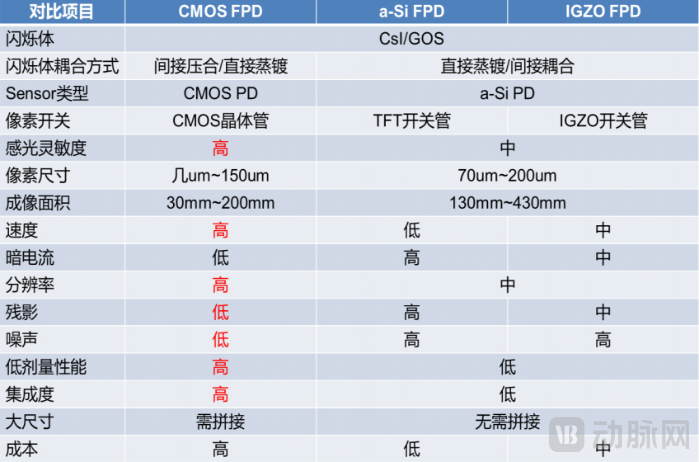
Its CT detector products target the medical CT and security inspection CT sectors, with a primary focus on custom ASIC chips and custom detector modules.
Moreover, in the research and development of photon-counting detectors, Sensview has already accumulated certain chip and detector technologies. It plans to launch photon-counting detector products within the next two to three years, featuring high detection efficiency, low radiation dose, zero electronic noise, high spatial resolution, and multi-energy spectral imaging capabilities.
Furthermore, targeting the industrial non-destructive testing (NDT) market in sectors such as the electronics industry and the new energy lithium-ion battery industry during the era of intelligent manufacturing, Sensview has successfully developed multiple flat-panel detector products, including the Pheda1313, Pheda1512, and Pheda0712. Meanwhile, the company will launch two new high-resolution products with a pixel size of 50 μm, the Pheda0606A and Pheda1313A, in the second half of the year.
When discussing Sensview’s product and strategic layout, Roger said:“Sensview will leverage chip technology as its foundation, spanning sectors such as healthcare, semiconductors, and new energy, with strategic layouts focused on applications in X-ray imaging, optoelectronic imaging, and ultrasound imaging. Meanwhile, prioritizing medical semiconductors, it aims to achieve a breakthrough in CMOS flat-panel detector technology in the first phase; establish a foothold with CMOS detector products and expand into CT detectors and photon-counting detectors in the second phase; and comprehensively extend into broader applications within the field of solid-state imaging in the third phase.”
In the future, Sensview will continue to build on its existing products, such as dental CBCT systems and small-format CMOS flat-panel detectors for industrial NDT applications, to achieve market breakthroughs, while also strategically positioning itself in two high-potential areas: low-dose flat-panel detectors for C-arm systems and high-resolution flat-panel detectors for mammography.
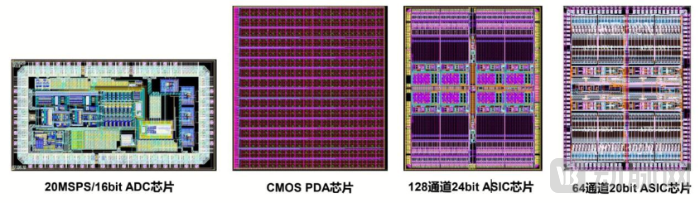
On the other hand, in addition to core components, Sensview is also engaged in the research and development of ASIC chips, CMOS chips, and PD chips. Its core chip technologies have now achieved independent controllability.In addition to wafer-level CMOS image sensor chips for CMOS flat-panel detectors, the company has also made technical reserves and product layouts in other chips. This includes six different architectures of ADC chips with varying precision, covering 14-bit to 24-bit accuracy, as well as PDA array chips based on CMOS technology, and signal processing ASIC chips that integrate multi-channel integrators and high-precision ADCs.
In summary,As a supplier of core chips, core components, and solutions in the medical imaging field and its extended domains, Sensview’s advantage lies in its ability to offer more diversified products and services, including chips, components, and customized solutions. The company continues to achieve technological breakthroughs, leveraging platform-based technologies and modular products to overcome challenges such as the long R&D cycles associated with core chips and components, thereby delivering customized offerings. Furthermore, building on its prior experience at NanoVision Imaging, Sensview possesses greater expertise in understanding end-user needs and addressing the “last mile” challenges faced by complete system manufacturers.
Following this successful fundraising, Lu Qinchao, Founder and Managing Partner of Danlu Capital, stated“In recent years, Chinese enterprises have demonstrated strong R&D capabilities. Sensview not only possesses foundational technologies in imaging chip design, but its planned core business also includes photon-counting detectors, fluorescence imaging and detection products, as well as custom chip solutions for specialized fields, with continuous highlights in its traditional business segments. By entering the dental CBCT market with CMOS small-area flat-panel detectors, Sensview has achieved product performance comparable to that of international giants, and its differentiated product portfolio has established the company’s core competitiveness. Danlu Capital is confident in the company’s market prospects and expects Sensview to lead innovative development in the industry in the future.”
Zhou Quan, Managing Director at Legend Capital, stated“Sensview is the first company in China to master wafer-level CMOS chip design capabilities and achieve localization of CMOS flat-panel detectors, accumulating extensive know-how in design and mass production. Amidst the global restructuring of supply chains and the broader trend of domestic substitution for upstream components, we expect the company to leverage its cost-effective solutions and scarce original R&D capabilities in China to empower downstream customers, expand into overseas markets, and grow into a leading upstream component provider offering detector solutions across multiple product categories.”
Cai Daqing, Founding Partner of Sherpa Capital, stated“China’s medical imaging equipment industry has made significant strides in import substitution, yet the localization rate for core components such as CT X-ray tubes and detectors remains low, indicating substantial market potential. To further increase the localization rate of downstream equipment, domestic production of core components is an inevitable trend. The Sensview team possesses extensive R&D and product experience in X-ray detectors. Its independently developed CMOS flat-panel detectors have gained recognition from mainstream dental CBCT customers, breaking through the technological barriers and market monopolies held by foreign giants, thereby demonstrating strong product competitiveness. Furthermore, Sensview has mastered the core technologies underlying detector imaging chips. Leveraging its accumulated expertise in chip technology, the company plans to expand into fluorescent detection photodetectors for the medical IVD sector, which holds significant market potential. We believe that Sensview will successfully expand beyond China, gaining international recognition through its superior product performance and competitiveness, and emerge as a dark horse in this field. As an early institutional investor in Sensview, Sherpa Capital will continue to support the Sensview team in scaling up the company and strengthening its market position.”
About Danlu Capital
Danlu Capital is an investment firm focused on early-stage equity investments in innovative medical technologies. It was co-founded in early 2018 by Lu Qinchao, former Partner at Sequoia Capital China, and Su Zhenbo, former Managing Partner at Fenxiang Investment Management. Its core team members all come from renowned venture capital firms and possess extensive healthcare industry resources in both China and the United States. Danlu Capital continues to deepen its presence in the early-stage healthcare sector, systematically investing across multiple areas including innovative medical technologies such as high-value consumables, in vitro diagnostic reagents, consumer healthcare, and digital health, as well as innovative drugs and novel healthcare services.
About Legend Capital
Legend Capital is an independent professional venture capital firm under Legend Holdings, established in April 2001. Its core business focuses on early-stage venture capital and growth-stage expansion investment, with a strategic emphasis on TMT and innovative consumption, professional services and intelligent manufacturing, healthcare, and culture and sports sectors. As of 2021, Legend Capital had invested in more than 500 companies, among which over 80 have successfully listed or been quoted on domestic or overseas stock exchanges, and more than 60 have achieved exits through mergers and acquisitions. Representative portfolio companies in the healthcare sector include WuXi AppTec, KingMed Diagnostics, Pharmaron, Innovent Biologics, and Mingde Biology.
About Sherpa Investment
Sherpa Capital, founded in 2018, has become an influential venture capital firm in China’s healthcare and medical sector. It has invested in multiple industry-leading companies across key sectors such as life sciences, pharmaceuticals, medical devices and diagnostics, and healthcare services. From 2011 to 2021, the firm went through four fund vintages and honed its expertise by investing in more than 120 healthcare projects.
About Airport Venture Capital
Chengdu Airport Innovation and Entrepreneurship Investment Co., Ltd. was established in October 2009 with a registered capital of RMB 761 million. It is a state-owned venture capital firm in Shuangliu District, Chengdu. The company is primarily engaged in equity investment and fund management, and currently serves as a council member of both the Chengdu Venture Capital and Private Equity Association and the Chengdu Angel Investment Association. The company focuses on investment opportunities in national strategic emerging industries—such as electronic information, next-generation information technology, new materials, and healthcare—as well as key development sectors prioritized by Chengdu Municipality.