

Eighteen Years of Regional Healthcare Informatization: Evolution from Concept to Healthcare Informatization 4.0
In July 2021, the National Health Commission successively released the latest results of the Electronic Medical Record (EMR) System Functional Application Level Evaluation and the Interconnectivity Standardization Maturity Measurement. As of July 2021, a total of 118 hospitals across China had passed the EMR evaluation at Level 5 or above; additionally, 153 regional health authorities and 503 secondary-level or higher hospitals had passed the Interconnectivity Standardization Maturity Measurement.
These two evaluation criteria are mandatory indicators for assessing hospital information systems, introduced by the National Health Commission this year. They have promoted the development and application of hospital informatization in China, and laid the data foundation for entering the Healthcare Informatics 4.0 stage, characterized by regional interconnectivity and big data analytics.
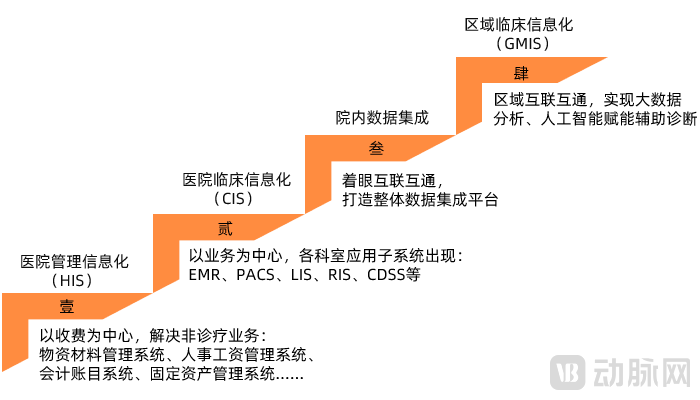
What Has Happened in the Over Ten-Year Growth of Regional Healthcare Informatics Since 2003? What Development Paths Have Been Explored? What Pressing Challenges Remain at the Current Stage? In Response to These Questions, VCBeat Has Compiled This Article.
Regional healthcare informatization is built on the framework of tiered diagnosis and treatment, with residents’ electronic health records as the core data. By leveraging tiered diagnosis and treatment and data sharing, it aims to address the difficulty residents face in accessing medical care. Through mechanisms such as two-way referrals, it seeks to rationalize patient expenditures, improve the quality and efficiency of hospital care, and alleviate the burden of high medical costs.
“Regional healthcare informatization refers to a business and technical platform that, within a defined geographic area and based on standardized construction outcomes and interoperable data sharing, provides healthcare providers, health administrative agencies, patients, payers, and pharmaceutical product suppliers with the capability to store and transmit health industry data in digital format, thereby supporting the workflows of medical services, public health, and health administration.”
Impacted by the SARS outbreak, China established a nationwide web-based direct reporting system spanning five administrative levels—central, provincial, municipal, county, and township—and strengthened the construction of emergency command and decision-making systems for public health emergencies at both the central and provincial levels. The system comprises 22 monitoring subsystems covering infectious diseases, public health emergencies, birth and death registration, and health risk factors, among others. This also marked one of the early applications of regional healthcare informatization in China.
Recognizing the immense potential of regional healthcare informatization, the state began planning to incorporate it into the objectives for the next phase of healthcare informatization development. In 2003, the former Ministry of Health formulated the Outline of the National Health Informatization Development Plan (2003–2010), which provided a clear definition of regional healthcare informatization systems: Regional health information systems encompass e-government, interoperability of medical insurance, community services, two-way referrals, personal health records, telemedicine, and online health education and consultation, constituting an integrated informatization application system that combines preventive care, medical services, and health management.
After 2004, pilot programs for the construction of regional health information platforms based on resident health records were successively launched in Minhang District, Zhabei District, and Changning District of Shanghai; Xiamen City, Fujian Province; Jiangmen City and Foshan City, Guangdong Province; and Zhejiang Province, among other regions. These platforms were gradually completed before 2010.
Shanghai is a typical representative of regional healthcare informatization construction, and its Shenkang Medical Consortium Project has also had a wide impact. In September 2005, the Shanghai Shenkang Center was established and began planning the implementation of the Medical Consortium Project to achieve clinical information sharing among affiliated medical institutions and integrate limited medical resources. In 2006, the Shenkang Center took the lead in launching the construction of the Shanghai Medical Consortium System, collaborating with Wonders Information Co., Ltd. and the Chinese Academy of Sciences to enable horizontal sharing of medical information among 23 tertiary hospitals across the city, breaking down hospital walls and information silos. After 15 years of exploration, the Shenkang Medical Consortium Project has expanded to cover 20 tertiary general hospitals and 16 tertiary specialized hospitals throughout the city. The regional healthcare informatization model pioneered by the Shanghai Shenkang Center has also been promoted to Guangzhou, Wuhan, Chengdu, and other cities.
Following the establishment of a top-level design for the national master plan on regional healthcare informatization, China has successively promulgated relevant laws and regulations to facilitate its development and promotion.
In 2009, the former Ministry of Health issued the Guidelines for the Construction of Regional Health Information Platforms Based on Health Records and the Technical Specifications for Regional Health Information Platforms Based on Resident Health Records, providing further technical guidance for the development of regional health informatization across China. Building on this foundation, regions throughout the country began to actively establish regional health information platforms centered on the sharing of clinical diagnosis and treatment data and health records.
In 2010, the former Ministry of Health organized the formulation of the “12th Five-Year Plan” for Health Informatization Development, proposing the overall design scheme of the “3521 Project,” which was subsequently updated and evolved into the “35212 Project.” By exerting efforts across multiple dimensions—including information platforms, business applications, and databases—the focus of hospital informatization construction in China gradually shifted from institutional-level hospital informatization to regional medical informatization.
During the 12th Five-Year Plan period, regional medical information platforms in China developed rapidly with the support of national policies. In August 2015, the former National Health and Family Planning Commission conducted a nationwide questionnaire survey on the construction status of interoperability for regional population health information. The results showed that 22 provinces, including Tianjin, Shanghai, Jiangsu, and Chongqing, had established provincial-level population health information platforms, enabling real-time collection, sharing, and exchange of certain population health data, supporting cross-regional business collaboration, and facilitating comprehensive management and scientific decision-making. A total of 152 prefecture-level cities (accounting for one-half of the total surveyed) had established municipal-level population health information platforms, and 644 districts and counties (accounting for one-third of the total surveyed) had established county-level population health information platforms, thereby achieving within-region queries of residents’ health records, coordination of certain medical and health services, and comprehensive health management.
Meanwhile, numerous challenges have emerged during this development process. The most pressing issue is the uneven development of regional platforms across different prefectures. Platform coverage in the eastern and central regions is significantly higher than in the western region, while the construction progress at the county level lags considerably behind that at the provincial and municipal levels. Cities such as Shanghai, Guangzhou, and Xiamen have implemented regional health informatization initiatives based on electronic health records (EHRs). In some areas, this has enabled the sharing of residents’ EHRs between hospitals and community health centers, as well as the provision of “electronic two-way referral services” grounded in these records. To address the relative imbalance in medical resources across regions, the national government has launched telemedicine pilot programs in provinces and autonomous regions including Guizhou, Ningxia, Tibet, Yunnan, and Inner Mongolia, aiming to gradually resolve the unequal distribution of medical resources and the relatively low efficiency of healthcare services. Nevertheless, how to explore effective construction and operational models for regional medical information platforms, and how to better leverage the role of these platforms in future healthcare industry reforms, remain topics requiring in-depth exploration by the industry.
Migrating Regional Healthcare Informatics to the Cloud
Since 2015, with the tiered diagnosis and treatment system being advanced as a key task of healthcare reform, the existing regional health information systems have struggled to fully meet the demands of tiered diagnosis and treatment, telemedicine, and medical consortium operations. Furthermore, due to their reliance on traditional data integration technologies, these legacy systems are difficult to upgrade or retrofit to support the business requirements of new policies. Consequently, new-generation regional health information systems developed on cloud computing architectures have emerged as the new direction for regional health informatization construction.
Taking the Suzhou Medical Imaging Cloud Platform, released this year, as an example. The Suzhou Medical Imaging Cloud Platform is a city-level regional medical imaging platform based on imaging data from public healthcare institutions at all levels in Suzhou. The platform provides image data sharing and access, as well as data disaster recovery services, to large and medium-sized medical institutions in Suzhou; it supports imaging consultations for primary care institutions, helping physicians at grassroots hospitals improve their clinical skills; it offers residents online access to their imaging data via the internet; and it provides health regulatory authorities with services such as data supervision and quality control. As of January 2021, the Suzhou Medical Imaging Cloud Platform had integrated imaging examination data from more than 140 public medical institutions.
Data is the Core of Regional Healthcare Informatization
In the process of building regional healthcare informatization, relevant authorities have also come to deeply recognize the critical role of Electronic Medical Records (EMR). To promote the greater efficacy of informatization systems in hospitals across China, the National Health Commission has implemented mandatory evaluation standards for hospital informatization systems in recent years. Key assessment indicators include the EMR Functional Application Level Evaluation and the Interconnectivity Standardization Maturity Assessment. As of July 2021, a total of 118 hospitals nationwide had passed the EMR evaluation at Level 5 or above; additionally, 153 regional administrative bodies and 503 secondary-level-and-above hospitals had passed the interconnectivity level assessment. The continuous improvement of in-hospital EMR application levels has laid a solid foundation for the standardized databases underpinning regional healthcare informatization.
Big data centered on residents’ electronic health records (EHRs) has provided multiple possible models for the development of regional healthcare informatization. Therefore, the establishment and improvement of residents’ EHRs are particularly important on regional healthcare informatization platforms. In 2016, the “Guiding Opinions on Promoting and Standardizing the Application and Development of Health and Medical Big Data” were released, proposing to build a national hierarchical open-application platform for healthcare information by 2020, with the goal of achieving cross-departmental and cross-regional sharing of basic data resources. Subsequently, public health big data platforms began to be established in various regions.
In terms of implementation, the Northern Center is the first national-level health and medical big data center in China to pass the pilot assessment conducted by the National Health Commission (NHC) and receive official authorization. The Northern Center was jointly established through a tripartite agreement signed by the NHC, the People’s Government of Shandong Province, and the People’s Government of Jinan City, with Lianren Health Medical Big Data Technology Co., Ltd. (Lianren Health) authorized to operate health and medical data services.
In the field of regional healthcare informatization, Lianren Health builds upon the interconnectivity of regional data, driving the development of regional healthcare information systems through data aggregation, data application, and data operations. This approach effectively addresses critical issues within the healthcare system, such as information gaps between upstream and downstream entities, difficulties in implementing two-way patient referrals, and insufficient service capacity at the primary care level. Successful implementations have already been achieved in regional medical consortium projects in Shandong, Sichuan, and other areas.Lianren Health has facilitated the iterative advancement of primary care informatization through its Telemedicine Collaborative SaaS Cloud Platform. By enabling data synchronization and integrating business interfaces, the platform breaks down barriers between regional healthcare institutions and across different hierarchical levels. It supports real-time video consultations and prescription circulation, thereby promoting the coordination of regional medical resources and the implementation of tiered diagnosis and treatment policies. This not only helps enhance the diagnostic and treatment capabilities of primary hospitals but also achieves the connectivity and aggregation of regional data.While supporting regional healthcare informatization, the regionally based data center enables multi-topic data applications to meet business needs such as clinical quality control, clinical research, and regional public health. Looking ahead, Lianren Health aims to establish a manageable, controllable, and traceable open operational system for healthcare big data through massive data collection, while exploring the creation of new business models in healthcare services.
Regional Health Big Data Platform enables unified management of health data, allowing information management departments to monitor changes within complex data integration environments while delivering trustworthy and secure data. Regionalization represents an advanced stage of healthcare informatization and has emerged as a major focus following the implementation of hospital management and clinical informatization systems.
Regional healthcare, as a key informational tool for government-led healthcare reform, requires coordination among medical institutions within a specific area and is therefore typically spearheaded by health authorities capable of exercising overall planning. However, this model faces numerous challenges: for the leading entities, there is significant pressure on investment amid limited funding; for health IT companies, the prolonged implementation cycle results in low project returns, making short-term profitability difficult to achieve; and for hospitals, major institutions are often reluctant to share data due to concerns such as data security. In light of these factors, the Public-Private Partnership (PPP) platform operation model has emerged, alleviating fiscal expenditure pressures on local governments to some extent.
![H$S]KPIL`A_]62EI25K3ET4.png](http://cdn.vcbeat.top/upload/image/06/08/19/42/1629355373223332.png/dmw)
The Public-Private Partnership (PPP) model, referring to government-social capital cooperation, is a project financing mechanism implemented in the field of public infrastructure, wherein medical IT enterprises provide capital for construction and subsequently participate in platform operations. The "Outline of the 13th Five-Year Plan," released in March 2016, explicitly encourages the diversification of supply methods and broadly attracts social capital participation in areas where services can be provided through government-social capital cooperation. In the healthcare sector, the PPP model not only increases the quantity and quality of healthcare services and products but also effectively addresses the mismatch between healthcare demand and the quantity and quality of supply.
Health Sector-Led Model:
Winning Health - Zhangjiagang City Medical Convenience "One-Card" Project
Since launching its health informatization initiative in 2010, Zhangjiagang has leveraged information technology to build a smart service system featuring “one platform and four clouds,” significantly enhancing the overall level of health informatization across the city. It became the first regional health entity in China to pass the Level 5 Grade B evaluation for interoperability. Relying on the Citizen Card, the project integrates medical care, health insurance, municipal services, and financial services by establishing four cloud platforms: Medical Service Cloud, Public Health Service Cloud, Regulatory Service Cloud, and Convenience Service Cloud. This enables residents to access flexible, card-based healthcare services at both public and private hospitals throughout the city.
Winning Health—Regional Healthcare Informatization Construction in Jintan District, Changzhou City
Jintan District of Changzhou City was among the first batch of pilot districts and counties for regional health informatization in Jiangsu Province. Construction of population-wide health informatization commenced in 2009. The project was jointly developed by the Jintan District Health Commission, China Telecom Jintan Branch, and Winning Health Technology Group. A provincial on-site conference on regional health informatization was held in Jintan District to comprehensively advance the construction of regional health informatization. After more than a decade of development, the population-wide health information platform has been leveraged to comprehensively enhance the service quality of family doctor contracting, promote coordination of medical services, and facilitate convenient and beneficial public services, thereby ensuring the sustained and healthy development of healthcare undertakings in Jintan District.
PPP Model: B-Soft — “Healthy Zhongshan” Project
In 2015, B-Soft was commissioned by the Zhongshan Municipal Health Commission to undertake the “Zhongshan Regional Health Information Platform Construction and Operation Project.” The project was implemented in two phases: the construction of the Zhongshan Regional Health Information Platform and the operation of the “Healthy Zhongshan” service platform. By 2018, Phase I had been completed, with the resident electronic health card platform, regional data center, data quality monitoring platform, medical health cloud platform, and family doctor contract service platform, among other components, successfully operational.
Leveraging the regional health information platform, B-Soft has integrated the citywide health service industry chain and consolidated medical and healthcare resources across the city, achieving integrated management of “medical care, elderly care, prevention, and rehabilitation.” As a key component of the Zhongshan regional medical ecosystem, it has helped build a smart health industry ecosystem within the Guangdong-Hong Kong-Macao Greater Bay Area. Meanwhile, B-Soft established a city-level internet hospital in Zhongshan and launched the “on-demand nurse” service in June 2019. In the National Health Informatics Development Index Report (2021), released in July 2021, Zhongshan City, Guangdong Province, ranked first among prefecture-level cities in the comprehensive evaluation of the overall health informatics development index.
According to the classification in “Research on the Technical Architecture of Regional Medical and Health Information Platforms under Digital Transformation,” the construction models of regional medical information platforms are further divided into horizontal and vertical models.
Horizontal Integration and Sharing Model:Led by local health administrative departments, a three-tier regional health information platform and regional data center—spanning provincial, prefectural, and district/county levels—are established in a unified manner to horizontally integrate public health, medical services, and health insurance. Information systems of various types and levels of healthcare institutions within the region are interconnected through the regional healthcare platform, while cross-regional information exchange is facilitated through higher-level regional health information platforms.
Vertical integration and sharing models can also be subdivided into two categories:First, hospitals of different types engage in in-depth collaboration by leveraging their complementary strengths. For instance, general hospitals collaborate with specialized hospitals, and large tertiary hospitals partner with multiple surrounding primary community health service institutions to establish medical service platforms that enable functions such as two-way patient referrals, access to medical records, and chronic disease management. Second, led by local health administrative departments and driven by the needs of disease control and health supervision management, platforms covering specific operational domains are established to promote information sharing within vertical business lines. An example is the infectious disease reporting system, where data are reported by relevant departments through vertically deployed application systems.
Meanwhile, the unbalanced and inadequate development of regional healthcare informationization in China is also quite evident.
Based on the evaluation results of regional interconnectivity standardization maturity, the health information authorities in Zhejiang and Jiangsu provinces have both achieved a rating of Level 4 Grade B or higher in the standardization maturity assessment for medical and health information interconnectivity. These two provinces account for 41.2% of all regions nationwide rated at Level 3 or above. The average level of medical and health information interconnectivity in this area is significantly higher than that of other regions. Among the 32 hospitals rated at Level 5 Grade B, Shanghai has eight, representing 25% of the total number of hospitals with this rating. The Yangtze River Delta region, primarily comprising Zhejiang, Jiangsu, and Shanghai, represents the highest level of regional medical and health information interconnectivity in China. However, due to constraints in economic and geographical conditions, some areas have not yet achieved full coverage of resident health information platforms. As mentioned in the previous article “Over Eight Years, 153 Regions and 503 Hospitals Participated: Three Major Trends Emerge in the Medical Interconnectivity Assessment》Provides a detailed analysis of the characteristics of China's interoperability assessment.
![82N]B9{X`3(MH8%`KLRH6@1.png](http://cdn.vcbeat.top/upload/image/01/08/19/59/1629338354531025.png/dmw)
Based on regional healthcare informatization bidding and tendering data from 2019 to July 2021, Gansu and Guangdong ranked among the leaders. This is because 2019 was a critical period for regional informatization development in both provinces.
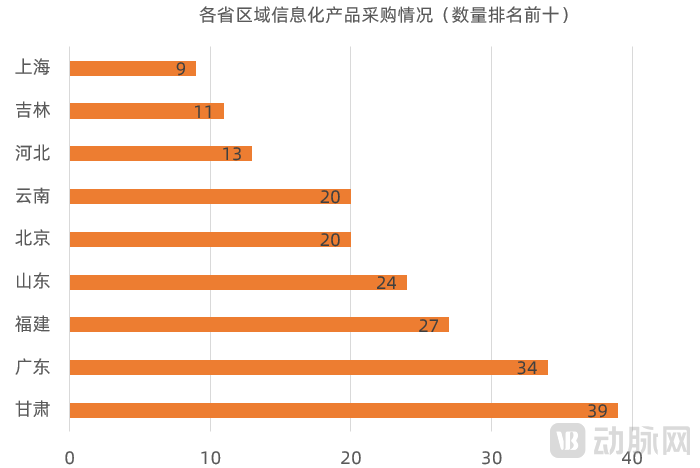
Gansu Province stretches over 1,600 kilometers from east to west, covering an area of 425,800 square kilometers. Its elongated terrain and low population density are among the key reasons why the region has prioritized the development of regional healthcare informatization. In 2018, the Gansu Provincial Health Commission submitted documents to the General Office of the Provincial People’s Government for formulation, including the Administrative Measures for the Construction of National Health Informatization in Gansu Province (Trial) and the Administrative Measures for National Health Information in Gansu Province. These initiatives established a top-level design and working mechanism to coordinate and advance healthcare informatization. Since 2019, Gansu has entered a critical phase of regional informatization development, having now built a comprehensive healthcare network system and a provincial-level national health information platform.
In 2019, the General Office of the People’s Government of Guangdong Province issued the Implementation Plan for Strengthening the Construction of Close-knit County-level Medical Communities in Guangdong Province (hereinafter referred to as the “Plan”), which proposed that by 2020, Guangdong would achieve full coverage of county-level medical communities across all counties (cities and districts) in the province, with an inpatient utilization rate within these counties reaching approximately 85%. Guangdong entered the final sprint phase of regional healthcare informatization construction, with the second half of 2019 and the year 2020 marking the peak period of development, thereby driving an increase in procurement volumes.
Shanghai’s relatively low volume of regional healthcare IT projects should not be interpreted as a lack of emphasis on this sector. In fact, Shanghai is undoubtedly among the country’s top tier in terms of healthcare informatization and was one of the earliest regions to launch regional informatization initiatives. We believe that its lower procurement levels are partly attributable to the fact that it has already passed through the period of high-intensity investment.
Overall, with the implementation of policies and regulations such as the "Healthy China 2030" Planning Outline, and the deep integration of new-generation information technologies like big data and artificial intelligence into the healthcare sector, the standardization of regional health information infrastructure during the 14th Five-Year Plan period faces a landscape where opportunities and challenges coexist. Issues such as insufficient funding, inconsistent quality and low utilization of medical data, and significant difficulties in achieving cross-institutional and cross-sectoral data interoperability and sharing remain prevalent. In summary, after 18 years of development, the informatization of regional healthcare is still immature and confronts numerous challenges. Addressing these issues requires concerted efforts from multiple stakeholders, including government agencies and enterprises. After all, even the Long March of 25,000 li was accomplished one step at a time.
Acknowledgments to the following guests for providing relevant information (listed in no particular order):
Wu Kun, Software Engineer in the Information Department of Tongji Hospital Affiliated to Tongji Medical College of Huazhong University of Science and Technology; friends from Winning Health, B-Soft, and Lianren Health
Reference Article:
In-Depth Analysis of 11 Domestic and International Models for Regional Health Informatics Development
Exclusive Interview with Rao Keqin, Director of the Statistical Information Center of the Ministry of Health: “Tearing Open” a Breach for Breakthrough in Health Informatization
Information and Computerization: An Overview of the Construction of Provincial Regional Population Health Information Platforms
CICC Securities: Special Series on Healthcare Informatics III: Regional Healthcare Informatics Urgently Requires the Advancement of Tiered Diagnosis and Treatment
Exploration of the “Three Centers” Construction Model in Jintan District
China Baoxin: Research Report on the Development of Regional Health Information Platforms in China
China Digital Medicine: Research on the Technical Architecture of Regional Medical and Health Information Platforms Under Digital Transformation