

Ganluhai Advances Modernization of Tibetan Medicine with 'Three-Cause Therapy', 'Seven Business Segments' and '3-Alls & 3-Directs' Operational Model; Files IPO Prospectus
While Tibetan medicine may be unfamiliar to many, people are generally more acquainted with Tibetan herbal remedies such as Rhodiola rosea and Ophiocordyceps sinensis (Cordyceps).
In fact, Tibetan medicine, together with Indian Ayurveda, Western traditional medicine, and Traditional Chinese Medicine (TCM), is recognized as one of the “Four Great Traditional Medical Systems” of the world. Within the pharmaceutical heritage of the Chinese nation, it holds a significant position alongside Mongolian medicine, Uyghur medicine, and other ethnic medical traditions. With a history spanning more than 3,000 years, Tibetan medicine is a medical system characterized by a comprehensive theoretical framework, unique therapeutic methods, and distinct ethnic features, developed and refined by the Tibetan people through long-term practice and continuous accumulation.
In May 2006, with the approval of the State Council, the Southern School of Tibetan Medicine in Garzê Prefecture was included in the first batch of China’s National List of Intangible Cultural Heritage. In 2018, “Lum Medicinal Bathing of Sowa Rigpa – Knowledge and practices concerning life, health and illness prevention and treatment among the Tibetan people in China” was officially inscribed on UNESCO’s Representative List of the Intangible Cultural Heritage of Humanity, becoming the 40th element from China to be included in the list under the Convention for the Safeguarding of the Intangible Cultural Heritage. Tibetan medicine has thus received official and authoritative recognition.
However, there are still many misconceptions among the public regarding Tibetan medicine, such as concerns about excessive heavy metal content in Tibetan herbal medicines. The Ganluhai team believes that the root cause lies in the lack of comprehensive and scientific understanding of Tibetan medicine. Their goal is to introduce Tibetan medicine to a broader market and help the public develop a correct understanding of it. It is their mission to be “practitioners of the modernization of Tibetan medicine and pioneers in its universal adoption.”
Xiong Shan, Brand Director of Ganluhai, stated that the team has received extensive positive feedback during project operations. Feedback from scientists, clinicians, and patients alike has greatly bolstered the Ganluhai team’s confidence in advancing Tibetan medicine. This confidence stems not only from the inherent value and advantages of Tibetan medicine but also from the currently underdeveloped market landscape for this discipline.
In 2017, driven by great enthusiasm and high expectations for promoting Tibetan medicine, and with a profound understanding of its charm and value, Cong Yu (Chairman of Ganluhai) actively engaged in the modernization and R&D of Tibetan medicinal products. Previously, Mr. Cong served as Business Manager at Guangdong Medicinal Materials & Pharmaceutical Co., Ltd. and General Manager of Guangzhou Kangben Pharmaceutical Co., Ltd., accumulating decades of extensive experience in the pharmaceutical and investment industries.After three years of development, the project’s post-money valuation in its latest funding round in 2019 reached RMB 220 million.
In recent years, the Ganluhai team has gradually established a modern, comprehensive health platform with a complete value chain for the promotion of Tibetan medicine. This integrated platform encompasses a Tibetan hospital, an internet hospital, medicinal herb planting bases on the Qinghai-Tibet Plateau, a GMP-certified Tibetan herbal decoction pieces factory, a GMP-certified pharmaceutical preparation center, a Tibetan Medicine Research Institute, international chain cooperation partners, a big data health management center, a Tibetan cultural media center, and a major disease research center led by top experts from the Northern and Southern schools of Tibetan medicine and Changjiang Scholars.Established a business layout comprising one physical hospital, one internet hospital, two major R&D and production centers, and three major innovation platforms, achieving seven industry-first milestones.
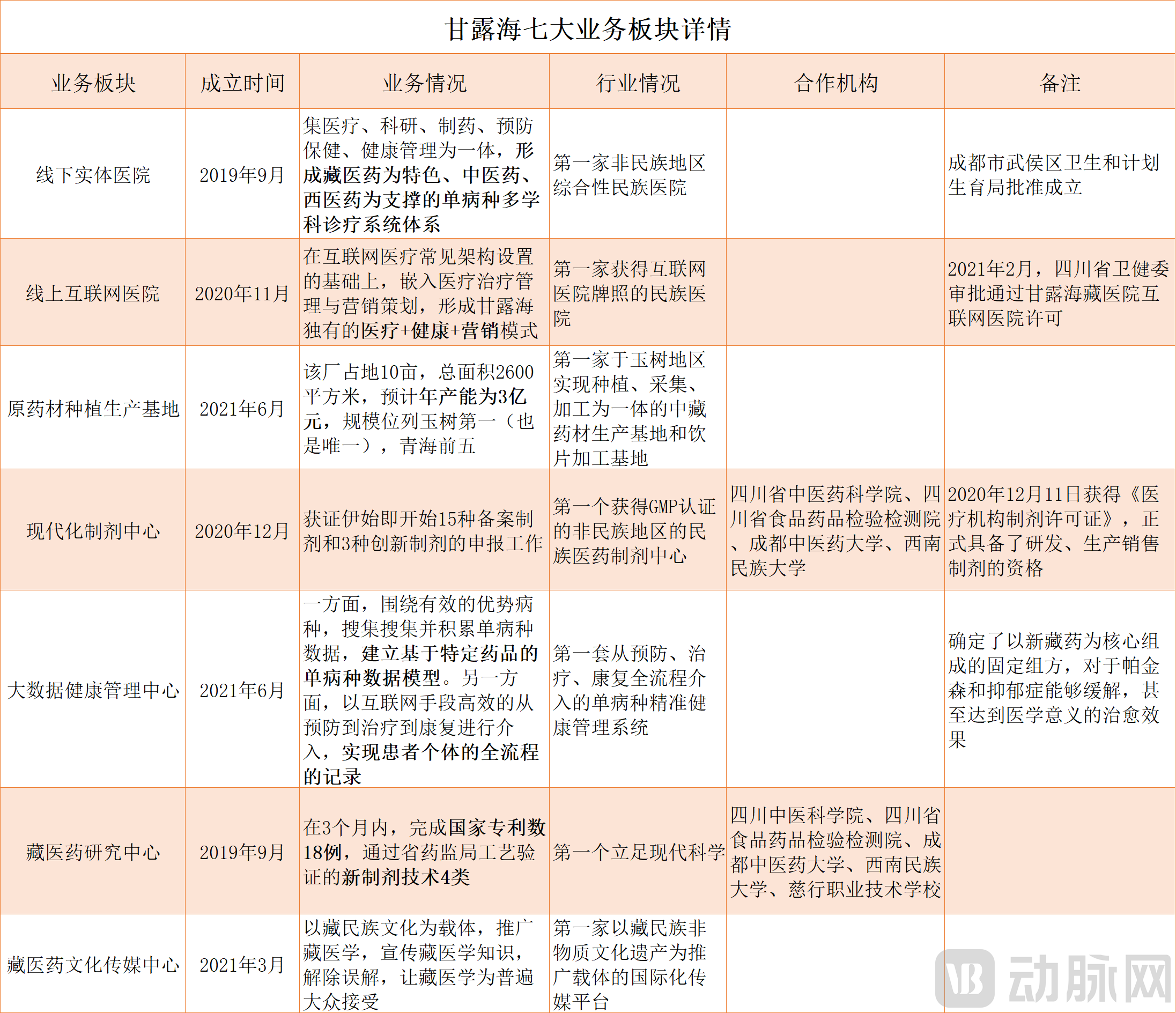
(Compiled by VCBeat based on information provided by the enterprise)
The issue of patient trust in private hospitals has long been a major challenge that the private healthcare sector has struggled to overcome. Public negative bias toward Tibetan medicine has also persisted. For Ganluhai, operating a private Tibetan hospital presents formidable challenges.
In response to these two major issues,Ganlu Hai has innovatively developed the “Three-Comprehensive, Three-Direct” operational model, breaking down public negative biases against Tibetan medicine, enhancing patient trust in private hospitals, and refreshing users’ treatment experience by focusing on “full-chain, full-scenario, and full-health-cycle” coverage as well as “direct supply, direct service, and direct efficacy.”
Xiong Shan stated, “In the early stages of the project, we conducted detailed internal analysis and research on how to address these two issues, specifically targeting the pain points experienced by patients, physicians, and our own organization. Ultimately, we developed the ‘Three-Comprehensive, Three-Direct’ operational model.”
Xiong Shan explained, “Full-chain management means that we are not just operating a single hospital; in reality, we manage the entire chain from herbal medicine cultivation bases to preparation centers, and from offline hospitals to online platforms. In terms of full-scenario coverage, in addition to establishing physical offline hospitals, we have also launched an online internet diagnosis and treatment platform, enabling Ganluhai to achieve comprehensive coverage across both online and offline scenarios. As for full health cycle management, a significant advantage of both Traditional Chinese Medicine (TCM) and Tibetan Medicine is their ability to provide holistic management spanning prevention, therapeutic efficacy monitoring, and wellness care. This is precisely the full health cycle management that Ganluhai delivers.”
Regarding the “Three Directs,” Xiong Shan explained, “Our products go directly from herbal medicine bases to our formulation centers and are then supplied directly to our Ganluhai Tibetan Hospital, with no intermediaries involved. This ensures that the quality of our medicines and herbal materials is fully traceable throughout the entire process. Moreover, by eliminating intermediaries, we reduce medication costs for patients—this is ‘Direct Supply.’ ‘Direct Service’ refers to Ganluhai’s establishment of its own medical team, which allows us to receive patient feedback directly and ensure the quality of our services. ‘Direct Efficacy’ pertains to Ganluhai’s proprietary big data platform. Based on this platform, we can provide patients with intuitive and dynamic insights into treatment outcomes, whether for efficacy management or for treating conditions where we have particular therapeutic strengths.”
Xiong Shan stated that, based on the aforementioned operational model, Ganluhai is gradually establishing and strengthening its brand credibility, thereby building its core competitive advantage.
Tibetan medicine is characterized not only by its extensive literature, rich clinical practice, and proven therapeutic efficacy but also by its systematic and comprehensive theoretical framework. According to the Tibetan medical theory of the Three Humors, “Lung,” “Tripa,” and “Beken” are the fundamental substances and energies that constitute the human body and sustain vital activities; they are also the three primary factors responsible for disease onset. These three humors maintain a dynamic equilibrium in the human body through mutual dependence, interaction, and constraint, thereby jointly preserving normal physiological functions.
If the human body is disturbed by internal and external factors such as diet and lifestyle, the Three Humors may become excessive or deficient, conflict with one another, and lose their balance and harmony. This leads to pathological changes and triggers various diseases, becoming the root cause of illness. Therefore, Tibetan medicine emphasizes the body’s inherent resistance to disease, focuses on regulating physiological functions, and strives to maintain the balance of the Three Humors.
To leverage the unique advantages and holistic medical perspective of Tibetan medicine, enabling it to serve modern health needs in a more scientific manner, Ganluhai has integrated the holistic philosophy of traditional Tibetan medicine with modern analytical methods to develop its distinctive “Ganluhai Three-Humor Therapy.”An innovative therapy that integrates dietary and lifestyle adjustments, pharmacological interventions, and psychological therapies to regulate the balance of the three humors (Lung, Tripa, and Beken), thereby restoring patients’ physical and mental health.
Ganluhai’s Three-Humors Therapy does not merely combat disease in a simplistic manner; rather, it is grounded in holistic regulation. Starting from the patient’s constitution and disease presentation, it targets the balance of the three humors, employing proprietary formulations to address pathological changes through pharmacological actions, thereby rapidly restoring the three humors to a state of dynamic equilibrium and achieving cure. Therefore,It has demonstrated significant efficacy in the treatment of refractory conditions, including depression, cardiovascular and cerebrovascular diseases, gastrointestinal and hepatobiliary disorders, diabetes, and rheumatism.
Looking to the future, Xiong Shan, Brand Director of Ganluhai, stated that Ganluhai will center on its brand philosophy of “Treating Disease and Nurturing the Mind, Enjoying Health,” focus on the “Ganluhai Three-Humors Therapy” to serve more patients, while building a comprehensive health ecosystem, delivering multi-touchpoint services to the public, developing consumer-grade products, and establishing an intelligent peripheral ecosystem.