

MegaRobo Launches China's First General-Purpose Intelligent Automated Biological Lab – Kunpeng Lab – Integrating AI, Automation, and Life Sciences

MegaRobo
Robot Developer
Life sciences is a field with high professional barriers and one that has been developing rapidly in the 21st century. However, many highly educated life scientists in laboratories spend a significant portion of their time on highly repetitive manual tasks, such as solution preparation and reagent setup. The contradiction between the industry’s outdated laboratory productivity and the ever-increasing production demands of scientists is at odds with the current race-against-time environment of new drug development.The integration of intelligent automation and life sciences can effectively resolve most fundamental production contradictions.
Abundant data is another urgent need for life scientists.The integration of AI can identify target compounds from libraries containing hundreds of millions of molecules within just a few days, while aggregating and learning from vast amounts of medical big data. This significantly reduces both the timeline and the scope of trial-and-error in innovative drug development.Moreover, AI enables more accurate and rapid completion of tasks in medical assisted diagnosis, health management, new drug development, and rehabilitation therapy.
The rapid advancement of technology and the times has led to increasingly stringent requirements for experiments in both scientific research and production. Demands for throughput, operational precision, reproducibility, safety for experimental subjects and personnel, and compliance with laws and regulations have surpassed the capabilities of manual labor. Integrating automation with AI to create intelligent automated life science services aligns with current disciplinary advancements and industry needs.
In response to these needs and pain points, MEGA Robo (hereinafter referred to as “MEGA”) has developed a comprehensive solution that breaks down disciplinary barriers among automation, AI, and life sciences, independently creating China’s first general-purpose intelligent automated biological laboratory—the Kunpeng Laboratory.Kunpeng Laboratory focuses on research in fields such as cell and gene editing, high-throughput drug screening, and synthetic biology. By providing life science infrastructure, it can significantly enhance the efficiency of life science R&D and production.
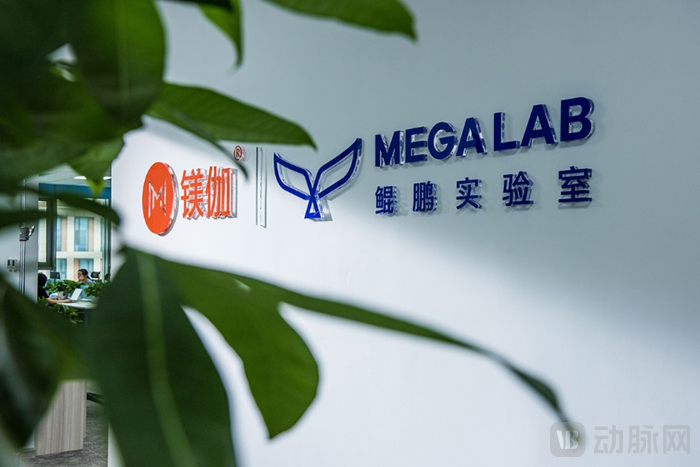
Mega Kunpeng Laboratory
Megarobo, founded in 2016, specializes in integrating advanced robotics and artificial intelligence technologies into industry applications. It provides end-to-end products and services—from edge devices to the cloud—empowering intelligent transformation in fields such as life sciences and advanced manufacturing, while simultaneously exploring innovative applications in scenarios like smart retail. At its inception, Megarobo was merely a small team of three. The three founders—Huang Yuqing, Qiao Zhixin, and Zhang Yan—had known each other for many years; all were robotics enthusiasts with extensive experience in R&D, mass production, and project management of precision instruments.
Dr. Zhang Yan, currently responsible for Megarobo’s life sciences sector, previously served as the project leader for the “National Major Scientific Instrument Special Project” under the Ministry of Science and Technology. In this role, he led nearly 100 project members across ten partner organizations to complete the research and development, certification, and industrialization of China’s first ultra-high-performance liquid chromatography (UHPLC) system. Dr. Zhang holds dozens of invention patents in analytical instrument design and automation technology, and has extensive practical experience in the R&D, manufacturing, and after-sales support of high-end analytical instruments and laboratory automation products.
The three founders hit it off immediately and jointly established Megarobo in 2016, bringing their respective expertise and passion for the industry.To date, Megarobo has been in existence for only five years, growing from an initial team of three to a current workforce of nearly 500 high-caliber, cross-disciplinary professionals, with R&D personnel accounting for 60% of the total.Throughout its growth, Megarobo has continued to attract scientists from diverse disciplines to join the team.
Take Dr. Wang Chengzhi, Chief Scientist in the Life Sciences Division at Megarobo, as an example. He majored in clinical medicine during his undergraduate studies and worked as a physician after graduation before transitioning to biological research. Prior to joining Megarobo, Dr. Wang had over 20 years of scientific research experience at internationally leading institutions in tumor-targeted therapy, genomics, molecular biology, and epigenetics, and he engaged in clinical research on innovative drugs at CROs and well-known pharmaceutical companies. When asked why he made the leap from medicine to automation, Dr. Wang stated, “I also found it strange at first—why would a robotics company hire a Chief Scientist for life sciences? But after speaking with Zhang Yan, I realized that applying AI and automation to the life sciences field to drive industry development is a highly worthwhile endeavor.”
Currently, Dr. Wang is primarily responsible for the planning and design of Megarobo’s biological application scenarios, as well as the establishment and scientific research of Kunpeng Laboratory, an automated biological laboratory independently developed by Megarobo.
Under the leadership of an interdisciplinary team, Megarobo continues to be driven by innovations in independently developed technologies,The company has a presence in Beijing, Detroit (USA), Suzhou, Shanghai, Shenzhen, and Munich (Germany). It has filed more than 260 invention patents, served over 110 clients, and completed seven rounds of financing within five years, raising a total of more than RMB 1 billion. Investors include well-known institutions such as WuXi AppTec, Bosch (Germany), Sinovation Ventures, Joy Capital, and Matrix Partners China.
China's First General-Purpose Intelligent Automated Biological Laboratory,
“Automation + Artificial Intelligence + Biology” Capability Closed Loop
Since its inception, MEGAROBOT has been strategically positioning itself in the life sciences sector. Leveraging the efforts of its team and the support of investors, the company started with automated robotics and has progressively integrated intelligent automation with life sciences.Recently, Megarobo’s independently developed Kunpeng Laboratory Phase I, the first general-purpose intelligent automated biology laboratory in China, was officially completed at the Life Science Park in Changping District, Beijing. Meanwhile, Megarobo has also begun deploying automated biology laboratories with diverse functionalities in Shanghai and Suzhou, which are expected to become operational in early 2022.
As MegaRobo’s integrated innovation platform for engineering technology and life sciences, the Kunpeng Laboratory represents a strategic deployment and practical application of MegaRobo’s in-house R&D capabilities, serving as the core instrument for its continuous exploration of frontiers in the life sciences sector.Kunpeng Laboratory integrates biological capabilities with automation and artificial intelligence to establish a closed-loop system of “automation + AI + biology,” aiming to address bottlenecks in biopharmaceutical R&D, such as labor intensity, experimental stability, and reproducibility.
In terms of automation, the intelligent automated biology platform applied by Kunpeng Laboratory is entirely based on MegaFluent technology.MegaFluent, a fully automated robotic laboratory platform system independently developed by Megarobo, features high levels of customization and integration capabilities. It can flexibly adapt to diverse requirements to deliver personalized solutions. Leveraging robots as the medium and an intelligent scheduling engine, the system integrates various automation devices required for experimental workflows through a graphical user interface software that abstracts away differences among heterogeneous equipment.
Building on automation, Kunpeng Laboratory will continue to explore how artificial intelligence technologies can enhance R&D capabilities in the frontier fields of life sciences.Kunpeng Laboratory treats data as a core asset, designs relevant experiments for algorithmic data collection, and generates data using a large-scale automated experimental platform. For instance, Kunpeng Laboratory is employing technologies such as genome-wide screening and small-molecule compound library screening to build a gene-pathway association database, as well as a phenotypic database of extensive drug libraries across various disease cell models, including organoid systems. Compared with traditional laboratories, biological data generated by automated systems adhere to unified standards, exhibit better uniformity than manual operations, and are well-suited for machine learning.
By deeply integrating robotics, automation, artificial intelligence, and biological capabilities, Kunpeng Laboratory continuously explores the potential applications of intelligent automation across various biotechnology verticals, including new drug development, genetic engineering, clinical diagnostics, synthetic biology, regenerative medicine, and immunology.In addition to addressing a range of industry bottlenecks, Kunpeng Laboratory can flexibly configure automated facilities according to diverse needs to create personalized solutions, thereby revolutionizing the process of life science research. Meanwhile, through large-scale automated data accumulation, it continuously optimizes artificial intelligence prediction models, leading to sustained improvements in experimental efficiency.
Currently, Kunpeng Laboratory has established multiple automated platforms for diverse biological scenarios, including the MegaCell fully automated cell experimentation platform, the MegaMolecule fully automated molecular experimentation platform, the MegaMicro ultra-high-throughput fully automated viral nucleic acid detection system, and the MegaOmics intelligent automated platform for omics sample preparation. Megarobo is committed to developing these platforms into the next-generation “operating system” for life sciences and applying them across various biological fields, such as building new immune target screening systems, PROTAC linker compound libraries, and tumor organoid libraries.
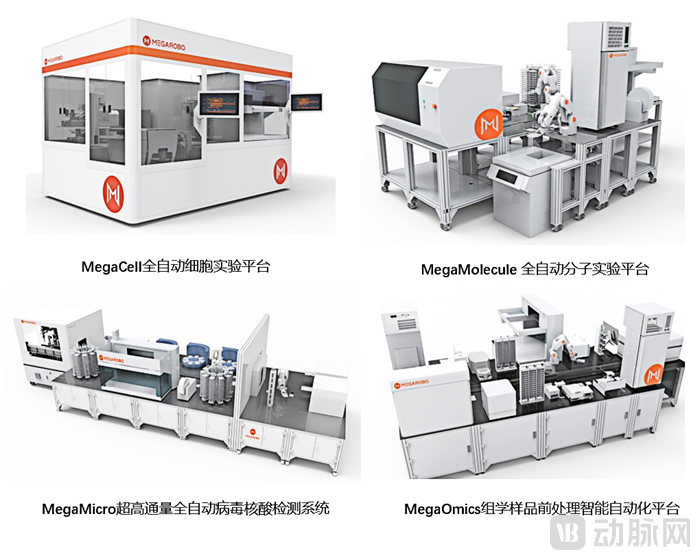
Four Automated Platforms
1. MegaCell: Fully Automating Common Cell Operations
MegaCell is a cell biology-centric platform that fully automates routine cell manipulation procedures, such as passaging, media exchange, and culture. It also enables automated phenotypic image acquisition and AI-powered intelligent analysis of cells. The platform is widely applicable to research areas where cell-based techniques are central, including high-throughput drug screening, stem cell and organoid research, and immunology.
2. MegaMolecule: An Intelligent Automation Platform Centered on Molecular Biology
The platform fully automates molecular cloning, intermolecular interaction analysis, and other processes. It is widely applicable to research fields that rely primarily on molecular biology techniques, such as phage display, antibody screening, and synthetic biology.
3. MegaMicro: High-Throughput Pathogen Detection System
During the pandemic, Megarobo provided a high-throughput pathogen detection pre-processing workstation to meet the demands of nucleic acid testing for COVID-19. This system operated without any manual intervention, achieving an efficiency more than 20 times higher than that of manual processes. Building on this foundation, the Kunpeng Laboratory developed MegaMicro, an ultra-high-throughput fully automated viral nucleic acid detection system. MegaMicro enables end-to-end automation from sample to result and is widely applicable for large-scale screening of infectious diseases in human populations or animals. It offers efficient and reliable pathogen detection solutions for in vitro diagnostics (IVD) companies, as well as enterprises in the livestock and aquaculture industries.
4. MegaOmics: An Automated Platform Centered on Multi-Omics Research
This platform is broadly applicable to the pre-processing of samples for genomics, transcriptomics, proteomics, metabolomics, and other omics fields, providing scientists with stable and reliable experimental results.
Through the continuous expansion and maturation of its team, Megarobo will gradually transform from an automation company with expertise in biology into a biotechnology company with expertise in automation. Leveraging intelligent automation products such as the Kunpeng Laboratory, Megarobo can provide verticalized solutions for the industry.
In the future, Megarobo will strive to become a catalyst for advancing intelligence, automation, and informatization in the life sciences industry through continuous accumulation.