

Insight Lifetech Files for Hong Kong IPO: Breaking FFR Bottlenecks with Domestic Innovation and Backed by Sequoia’s Four Rounds of Investment

sherpa
Venture Capital Institution

Springhill
Healthcare-Listed Stock Investment Institutions

Octagon Investments Master Fund
Late-Stage Venture Capital Firms

LOTUS LAKE CAPITAL
Investment Institutions in the Field of Technological Innovation

HongShan
Business Consulting, Enterprise Management Consulting Investment Institutions

Green Pine Capital
Venture Capital Management Institution

Efung Capital
Biomedical Professional Investment Institutions

InSight Lifetech
Cardiovascular Interventional and Implantable Device Manufacturer
Recently, Shenzhen Insight Lifetech Co., Ltd. (hereinafter referred to as “Insight Lifetech”), a leading player in the cardiovascular interventional device market, filed its draft prospectus with the Hong Kong Stock Exchange. According to the prospectus, it is currently the only domestic medical device company in China that possesses a combined portfolio of precise intravascular physiology and imaging products. VCBeat (WeChat ID: Vcbeat) has provided an analysis of Insight Lifetech’s draft prospectus.
Driven by factors such as population aging, obesity, chronic diseases, and sedentary lifestyles, the prevalence of cardiovascular diseases—primarily coronary artery disease (CAD), peripheral artery disease (PAD), and arrhythmias such as atrial fibrillation (AF)—is rising rapidly in China and worldwide.
Coronary heart disease (CHD), also known as ischemic heart disease, is a form of cardiac pathology characterized by myocardial ischemia resulting from coronary artery stenosis or occlusion due to atherosclerosis, which manifests as angina pectoris or myocardial infarction. This condition is frequently associated with complex lesions—including calcified lesions, bifurcation lesions, chronic total occlusions, unprotected left main coronary artery lesions, and diffuse lesions—contributing to persistently high morbidity and mortality rates.
Currently, coronary heart disease (CHD) has become the leading cause of death among most patients with heart disease—accounting for the highest number of fatalities among all cardiovascular diseases. According to Frost & Sullivan, 1.8 million people in China died from CHD in 2019.
Most vascular diseases are age-related and closely associated with aging. Given the rapid growth of China’s aging population, the prevalence of cardiovascular diseases is expected to continue rising in the future. According to Frost & Sullivan data, the number of patients with coronary heart disease (CHD) in China increased from 22.7 million in 2016 to 25.3 million in 2020, representing a compound annual growth rate (CAGR) of 2.7% during this period. The number of CHD patients in China is projected to reach 28.6 million by 2025 and surpass the 30-million mark by 2030, reaching 31.8 million.
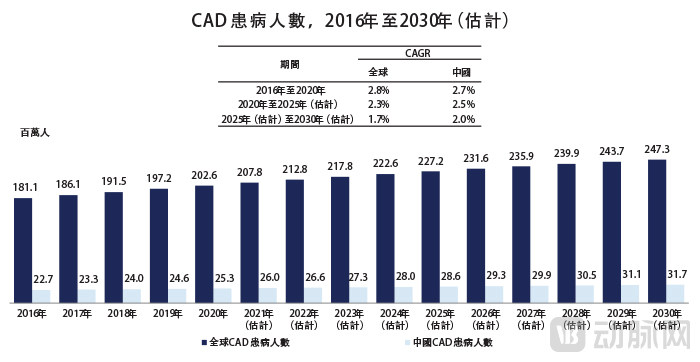
Image from InSight Lifetech's prospectus
Currently, the primary treatment modalities for coronary heart disease include pharmacotherapy, percutaneous coronary intervention (PCI), and coronary artery bypass grafting (CABG). Relatively speaking, PCI offers advantages such as minimal invasiveness, shorter hospital stays, faster postoperative recovery, and relatively lower medical costs, making it the mainstream treatment approach for patients with ischemic coronary artery disease (CAD).
As a non-surgical therapeutic approach, percutaneous coronary intervention (PCI) is typically performed under the guidance of various techniques to assess the hemodynamic significance of coronary artery stenosis. It has become an industry trend in PCI practice to utilize guidance modalities such as fractional flow reserve (FFR) and intravascular ultrasound (IVUS) to achieve precise diagnosis and treatment during coronary interventions.
Through FFR measurement, physicians can functionally assess stenotic lesions and accurately identify those that are hemodynamically significant and cause myocardial ischemia, thereby providing critical information for selecting the optimal treatment strategy for patients.
FFR measurement has received the highest Class IA recommendation in both the 2014 ESC/EACTS Guidelines on Myocardial Revascularization and the Chinese Guidelines for Percutaneous Coronary Intervention (2016). The guidelines recommend using FFR to guide coronary intervention in multiple clinical scenarios, including stable coronary artery disease and multivessel disease.
Although FFR-CT, which calculates functional indices based on medical image modeling, holds considerable potential clinical value, current guidelines explicitly recommend only wire- and microcatheter-based direct FFR measurement techniques that are supported by robust clinical evidence.
Direct-measurement FFR technology is classified as a Class III active interventional medical device, characterized by a complex technological chain and extremely high requirements for precision manufacturing and quality control. Consequently, the FFR market was historically monopolized by imported manufacturers such as Abbott, Philips, and Boston Scientific. The high cost of guidewires has resulted in suboptimal penetration of FFR in China.
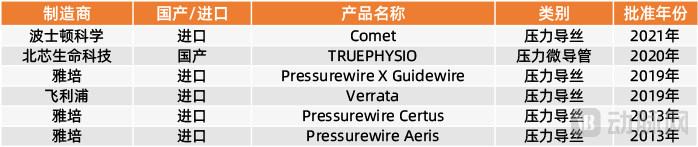
Major FFR Guidewire/Microcatheter Products in China (Data sourced from InSight Lifetech’s prospectus; graphic by VCBeat)
InSight Lifetech’s FFR measurement system comprises two components: a pressure microcatheter and the FFR measurement system itself. This innovation not only breaks the long-standing absence of domestic Chinese products in this field but also achieves multiple technological innovations with independent intellectual property rights, holding significant importance for addressing China’s “chokehold” challenges in this sector. As FFR prices decrease, it is expected to promote broader clinical adoption and popularization of FFR within China.
According to Frost & Sullivan data, the market size of FFR in China has grown at a CAGR of 31.4% since 2016, reaching RMB 92.2 million in 2020. Driven by robust clinical evidence, strong recommendations from medical guidelines and expert consensus, technological advancements, and increased patient awareness, the market size of FFR in China is projected to further reach RMB 2.168 billion in 2025 and RMB 5.391 billion in 2030, representing a more than 50-fold growth over ten years.
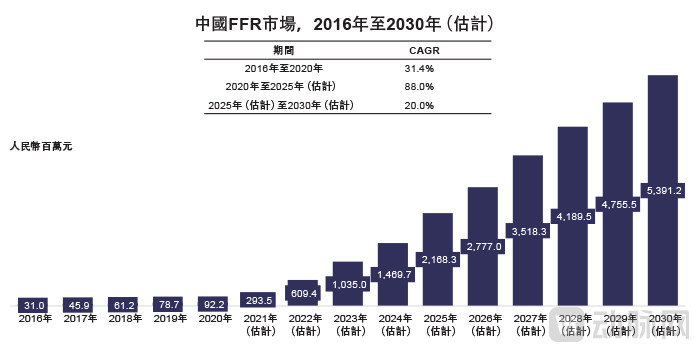
Image from InSight Lifetech's prospectus
Meanwhile, InSight Lifetech’s pressure microcatheters have reached an internationally advanced level, even on a global scale.
Prior to the launch of InSight Lifetech’s pressure microcatheter, FFR products were all based on pressure wires, suffering from limitations such as poor pushability and maneuverability, a high likelihood of signal drift, operational complexity due to repeated disconnection and reconnection at the proximal end, and risks associated with traversing complex lesions.
InSight Lifetech’s pressure microcatheter is the world’s first rapid-exchange FFR pressure microcatheter based on MEMS sensors, featuring internationally leading performance characteristics and advantages such as stable and accurate readings, an ultra-slim catheter body, significantly low drift rate, and a rapid-exchange design.
Moreover, it is currently the smallest pressure microcatheter in the world. This is primarily attributable to InSight Lifetech’s breakthrough proprietary packaging technology that enables the integration of MEMS sensors onto ultra-fine microcatheters.
Designed with a focus on the needs of physicians and patients, it enhances product usability and is compatible with standard guidewires used by physicians, enabling rapid access to the distal end of the lesion. It broadens the application scenarios for FFR measurement, allowing for repeated pullback assessments and measurements in various complex lesions. It ensures accurate and stable measurements with a significantly low drift rate, thereby reducing procedure time and improving physicians' surgical efficiency.
As a result, InSight Lifetech’s pressure microcatheter and FFR measurement system were approved in 2019 to enter the National Medical Products Administration (NMPA) Innovative Medical Device Approval Channel, and officially received Class III medical device certification in September 2020.
The announcement on the NMPA website regarding the product’s approval states: “This product is internationally leading, the first of its kind in China, and fills a domestic gap. It addresses the absence of gold-standard fractional flow reserve (FFR) measurement technology in China. Furthermore, through the innovative design and implementation of a pressure microcatheter, it overcomes many of the issues and limitations associated with traditional pressure guidewires, simplifies the clinical workflow for FFR measurement, and enhances the usability and accessibility of interventional FFR measurement technology.”
In addition to direct FFR measurement systems, intravascular ultrasound (IVUS) imaging systems represent another core technology of InSight Lifetech. Similar to the situation prior to the advent of domestic direct FFR measurement products, the current IVUS market in China is dominated by two international brands, Boston Scientific and Philips, resulting in a severe "chokehold" dependency.
IVUS is an imaging medical device that utilizes ultrasound transducers to generate images of the interior of entire arteries. By providing visual images of the arterial interior (vessel wall and lumen) as well as atherosclerotic plaques hidden within the arterial wall, IVUS reveals the extent of arterial narrowing or thickening (stenosis), thereby assisting physicians in accurately selecting stent sizes, identifying optimal stent placement locations, and assessing stent apposition to the arterial wall.
Authoritative academic journals, including *Circulation* and the *American Heart Journal*, have published a substantial body of research. These studies clearly demonstrate that intravascular ultrasound (IVUS) plays a crucial role in optimizing percutaneous coronary intervention (PCI) outcomes by reducing adverse events, particularly in patients with complex vascular lesions.
Currently, IVUS is recommended by major clinical guidelines, including the Chinese Guidelines for Percutaneous Coronary Intervention (2016), the US 2011 ACCF/AHA/SCAI Guideline for Percutaneous Coronary Intervention, and the European 2018 ESC/EACTS Guidelines on Myocardial Revascularization.
Meanwhile, IVUS is increasingly being used in combination with other tools such as FFR to maximize the overall benefit for patients throughout the PCI procedure.
The domestic market for intravascular ultrasound (IVUS) in coronary artery disease has experienced rapid growth in recent years. With the increasing demand for precise diagnosis and treatment of complex coronary lesions, along with the commercialization of domestically produced IVUS products, IVUS utilization is expected to increase substantially in the coming years. According to Frost & Sullivan data, the size of China’s IVUS market reached RMB 514 million in 2020. The overall domestic IVUS market size is projected to grow significantly to RMB 3.479 billion by 2025 and RMB 6.432 billion by 2030.
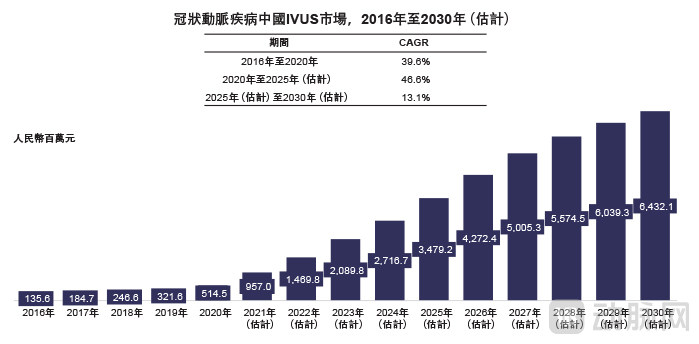
Image from the prospectus of InSight Lifetech
Currently, InSight Lifetech is making a push to break this monopoly—its first-generation IVUS is the first domestically produced IVUS system in China to enter clinical trials and complete patient enrollment. As planned, InSight Lifetech’s IVUS will submit registration applications to the NMPA and EU notified bodies in the third and fourth quarters of 2021, respectively.
According to the prospectus, as it offers both FFR and IVUS products, InSight Lifetech is also the only domestic medical device company with a portfolio of precise intravascular physiology and imaging products.
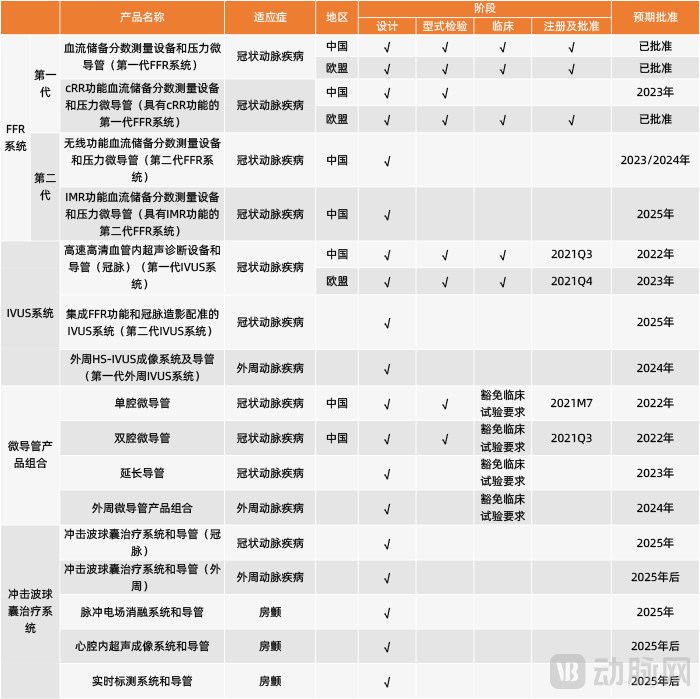
InSight Lifetech Product Pipeline (Data sourced from InSight Lifetech's prospectus; graphic by VCBeat)
In addition, InSight Lifetech’s product pipeline includes a portfolio of microcatheters, an Intravascular Lithotripsy (IVL) balloon therapy system, and Electrophysiology (EP) solutions. Together with FFR and IVUS, its pipeline comprises a total of 16 interventional cardiovascular products and investigational products with global patents, applicable to the diagnosis and treatment of coronary artery disease, peripheral artery disease, and atrial fibrillation. Currently, InSight Lifetech has initially established a comprehensive solution platform for the precision diagnosis and treatment of cardiovascular diseases.
InSight Lifetech’s significant breakthroughs are inextricably linked to the increased R&D investment in China in recent years. Encouraged by this policy, Song Liang, co-founder and chairman of InSight Lifetech, gave up the opportunity to continue his research in the United States and joined the Shenzhen Institutes of Advanced Technology, Chinese Academy of Sciences (hereinafter referred to as “Shenzhen Advanced Institute”) in February 2011.
In an interview with the media, Song Liang stated that one of the reasons for his return to China was SIAT’s ambition to build a world-class industrial research institute and its strong commitment to the commercialization of scientific and technological achievements. Another key factor was SIAT’s highly flexible talent attraction mechanism, which allows individuals to serve as independent Principal Investigators (PIs) and lead their own research teams even without prior postdoctoral experience.
During his tenure at the Shenzhen Institute of Advanced Technology, Song Liang demonstrated exceptional research performance. He served as the principal investigator for more than 20 scientific research projects, including the National Natural Science Foundation of China’s Major Program for the Development of National Research Instruments, the Ministry of Science and Technology’s International Cooperation Program, and the Ministry of Science and Technology’s Key Special Project on “Research and Development of Digital Diagnostic and Therapeutic Equipment.” He has published over 80 papers in international SCI-indexed journals.
During his collaboration with hospitals, Song Liang gradually realized that the translation of scientific research requires a more comprehensive and multidimensional approach to addressing pain points, such as understanding clinicians’ perspectives, identifying the most critical problems to be solved, and determining the means to achieve these goals. Ultimately, he focused on percutaneous coronary intervention (PCI) as a genuine clinical need.
In March 2016, Song Liang requested a leave of absence without pay from the Shenzhen Institute of Advanced Technology, marking the beginning of InSight Lifetech’s journey. Since then, InSight Lifetech has completed six rounds of external financing, with prominent investors such as HongShan, SDIC Chuanghe, and Qiming Venture Partners joining in succession. Notably, HongShan acquired a 10.41% equity stake through four capital injections, becoming the second-largest shareholder.
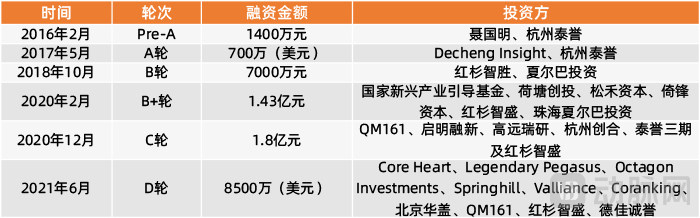
InSight Lifetech’s Historical External Financing Rounds (Data sourced from InSight Lifetech’s prospectus; chart by VCBeat)
Why Can InSight Lifetech Attract Top-Tier Investors? Three Key Reasons.
First, there is genuine demand for value behind the strategic direction of InSight Lifetech. Centering on pain points in clinical needs, InSight Lifetech has laid out four product directions, including FFR, intravascular ultrasound, and therapeutic products, all of which are innovative technologies filling domestic gaps and possessing real value.
Secondly, InSight Lifetech’s product portfolio features high technical barriers, presenting significant difficulty and challenges. Currently, InSight Lifetech holds 66 patents and has 62 patent applications pending in China and overseas.
Finally, InSight Lifetech boasts strong R&D capabilities, with R&D personnel accounting for nearly 50% of its workforce. Among them, over 30% hold master’s degrees or higher. The majority of the R&D team comes from leading industry enterprises and possesses extensive experience in product development, precision manufacturing, product registration, and clinical trials.
Despite achieving technological breakthroughs, InSight Lifetech still faces the challenges of commercialization. With its first-generation FFR measurement system obtaining both the Class III medical device registration certificate from China’s National Medical Products Administration (NMPA) and CE certification in the European Union, the company has embarked on its commercialization journey. InSight Lifetech has already generated actual sales revenue, recording RMB 1.588 million in just two months in 2020.
Currently, InSight Lifetech’s FFR measurement system has been adopted by over 500 hospitals in China and is also in use in seven major overseas countries, including Belgium, Germany, Italy, and Spain. In the first three months of 2021, InSight Lifetech’s sales revenue nearly tripled, reaching RMB 4.753 million. This further underscores the broad prospects of this market.
Nevertheless, in the face of competition from international giants, this industry still requires substantial capital investment. Taking manufacturing investment as an example, InSight Lifetech has established three GMP-compliant catheter production facilities in Shenzhen, China, for its portfolio of FFR measurement systems, IVUS imaging systems, and microcatheters. Additionally, the company has built a production base with a total area of approximately 5,000 square meters dedicated to the host units of its FFR measurement systems and IVUS imaging systems. Furthermore, the company is constructing a new production base in Shenzhen to prepare for the commercialization of other pipeline products upon regulatory approval.
Overall, InSight Lifetech is currently in its investment phase. Consequently, the company recorded net losses of RMB 39.644 million and RMB 57.115 million for the full years of 2019 and 2020, respectively. InSight Lifetech also disclosed in its prospectus that it expects to incur higher operating expenses in the near term as it further conducts preclinical research, continues clinical development of products under investigation and seeks regulatory approvals for such products, launches pipeline products, expands the commercialization of approved products in China and overseas, and increases production capacity for both approved products and product candidates.
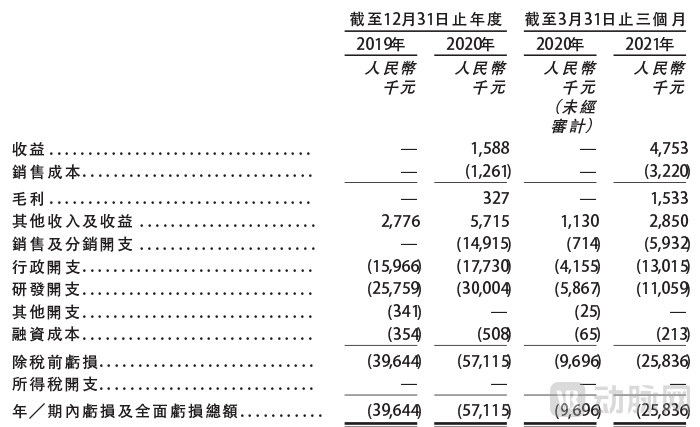
Image from InSight Lifetech's prospectus
However, InSight Lifetech currently maintains ample cash flow, holding RMB 240 million in cash as of the reporting period. Meanwhile, given the immense potential of the cardiovascular market and the significant strategic importance of breaking international monopolies through technologically advanced solutions that meet global standards, profitability for InSight Lifetech is merely a matter of time.
VCBeat will continue to closely monitor whether InSight Lifetech can successfully navigate the listing process and how it performs post-IPO.
References
HKEX: Prospectus Application by Insight Lifetech Co., Ltd.
Yan Dao Doctor Network: "OCC2020 - InSight Lifetech's First Domestically Developed and Manufactured Direct Measurement FFR Product Officially Debuts"
Zhitong Finance: [IPO News | InSight Lifetech Files for Main Board Listing on the HKEX, with Both Fractional Flow Reserve (FFR) Measurement Systems and Intravascular Ultrasound (IVUS) Imaging Products]
Shenzhen Institute of Advanced Technology, Chinese Academy of Sciences: “SIATER Talks | Song Liang: An Emerging ‘Star’ Entrepreneur from SIAT”