

Google Health on the Brink: Why Google Struggled in Healthcare

Internet-related services and product providers
On August 20 (U.S. local time), which corresponds to August 21 in Beijing time, multiple U.S. media outlets reported that tech giant Google will adjust its healthcare initiative, Google Health. The announcement sent shockwaves through the industry. Only a few years ago, Google made a significant push into the healthcare sector, recruiting a team of top-tier talent; the current situation is truly lamentable.
This is not the first time tech giants have stumbled on their healthcare journeys—in February 2021, IBM prepared to divest from Watson Health after a decade of losses. Meanwhile, progress by other tech behemoths such as Apple and Amazon on their healthcare initiatives has also fallen far short of their respective expectations.
So,Why is Google adjusting Google Health? What has this health business accomplished since its inception, in which areas has it established a presence and driven innovation, and what is the future direction of Google’s healthcare initiatives?VCBeat (WeChat ID: Vcbeat) has compiled the relevant information for industry reference.
According to U.S. media reports, the immediate trigger for Google’s restructuring of Google Health was likely tied to the departure of its department head—just one day before U.S. media outlets reported that Google was shutting down Google Health, Cerner, the U.S. giant in electronic health records (EHR), announced that David Feinberg, head of Google Health, would succeed current CEO Brent Shafer as the company’s CEO and President, effective October 1, 2021.
Cerner is one of the largest electronic health record (EHR) service providers in the United States, with a client base that includes numerous U.S. government agencies. For instance, in May 2018, the U.S. Department of Veterans Affairs (VA) signed a 10-year agreement worth $10 billion with Cerner. According to its financial report for fiscal year 2020, Cerner generated $5.5 billion in revenue. It is a typical healthcare informatics company, rather than a healthcare division under an IT corporation.
David Feinberg himself stated that he will leave Google Health on September 1.
According to U.S. media reports, on the day of Cerna’s official announcement, Jeff Dean, head of Google Research and Fei-Fei Li’s direct supervisor, stated in a memo to employees that while the Google Health brand would be retained, it would no longer operate as a unified organization. The memo further outlined adjustments to the organizational structure, with Google’s Chief Medical Officer temporarily overseeing the business operations of related projects.
In previous reports by some domestic media outlets, terms such as “shut down” and “disbanded” were used. VCBeat considers this characterization inaccurate—first, Google has not made any official announcement, with corresponding reports stemming solely from an internal memo leaked within Google; second, the Google Health brand and the majority of its team have been retained.
Under the new arrangement, the Google Health team will be dispersed across various departments within the company. For instance, the clinical team developing search tools to facilitate physicians’ access to patient health records will be integrated into Google Research, while the team focused on AI-powered medical imaging will be moved to Google’s Search and AI division.
This means that Google will integrate its existing healthcare initiatives into other divisions, rather than maintaining them as a standalone business line. At least in terms of business units, Google Health is effectively defunct.
Subsequently, in a statement issued to U.S. media, Google stated: “Google firmly believes in the power of technology to improve healthcare and has increased its company-wide investments in this sector. This includes development initiatives within Google Health, the launch and expansion of healthcare-related features across Search, Maps, and YouTube that reach billions of users, and leveraging the value brought by Fitbit.”
According to U.S. media reports, Google Health already had more than 500 employees as early as February 2020. At the time, David Feinberg also stated that he was not under pressure from superiors to meet revenue targets for the medical team.
In June 2021, alongside Google’s completion of its acquisition of Fitbit, the wearable health device giant, Google Health underwent an internal restructuring—more than 130 employees were transferred to Fitbit and the Search division. This reduced Google Health’s workforce from approximately 700 employees prior to the adjustment to 570.
Meanwhile, David Feinberg remarked at the time during a conference, “The real pressure is: ‘Will this truly help millions of people? Is it at Google scale?’ That is the pressure.” Furthermore, according to interviews with former Google employees by U.S. media, Google Health had established a central business development team to explore how Google Health could monetize its products.
In response, Google stated at the time that it would not lay off employees or cut projects due to the ongoing restructuring. However, anyone with even modest workplace experience could easily read between the lines. With the departure of its leader, it came as no surprise that Google took action against Google Health.
Synthesizing various pieces of information, it is evident that if the reports by U.S. media are accurate, pressure from commercial performance was a significant factor in the head of Google Health’s decision to resign and led to the division’s spin-off. Although Google is generally perceived as a company that prioritizes long-term value, it is not immune to the imperative of profitability.
Certainly, it is not only Google’s health division that faces commercialization pressures; healthcare initiatives by many other tech giants, including Apple, IBM, and Amazon, are also under significant pressure to monetize, often struggling to generate revenue and secure support from senior leadership. IBM, having already divested Watson Health, is a case in point; nearly on the same day as Google restructured Google Health, reports emerged that Apple was scaling back its team developing health-related applications.
In fact, this is not Google’s first failure in the healthcare sector. As early as 2008, Google launched an online storage service aimed at enabling consumers to transfer their health data to the cloud. Named Google Health, it was Google’s first serious foray into healthcare. Due to its failure to meet project expectations, Google announced the shutdown of the service in 2012.
In its statement at the time, Google said, “Google Health has not achieved the broad impact we had hoped for. Although certain user groups—such as tech-savvy patients and their caregivers, as well as recent fitness enthusiasts—began using the service, we have not yet found a way to scale this limited usage into the daily health routines of millions more people.”
Subsequently, Alphabet, Google’s parent company, also ventured into the healthcare sector by establishing Verily and Calico.
In 2013, Calico was established with the goal of understanding the biology of aging and developing therapies to extend human lifespan. In 2015, Verily was founded, focusing primarily on drug development and precision medicine.
As an aside, before the establishment of Google Health, Verily was the subsidiary that housed most of Google’s healthcare operations. This subsidiary focuses on improving healthcare through data-driven approaches, including analytical tools, interventions, and research. Verily has made significant investments in wearable devices; its ECG feature received FDA clearance in early 2019, and the company subsequently acquired two major wearable health device manufacturers, Fossil and Fitbit.
Had Verily not existed, these businesses might well have ultimately fallen under the purview of Google Health. With the advantage of wearable technology integration, the current trajectory of Google Health could have been markedly different. Yet history admits no “what ifs.”
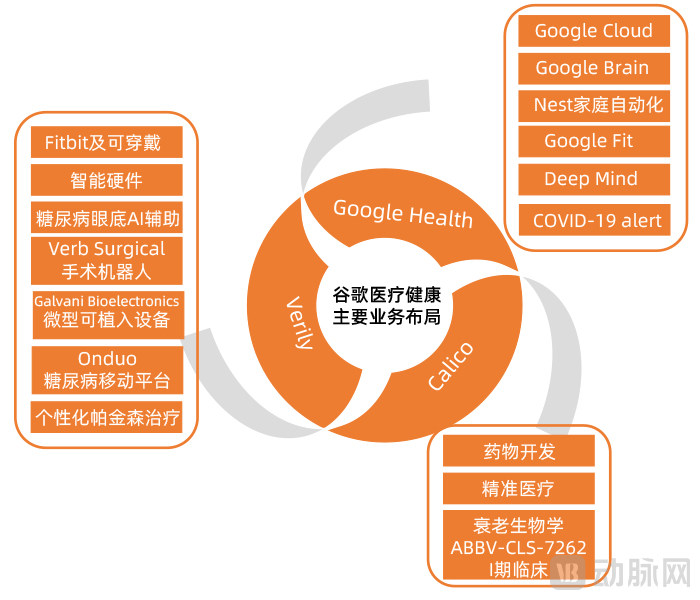
"Google-affiliated" Companies' Key Business Layout in the Healthcare Sector
Until 2018, with the rapid rise in popularity of the digital health concept, Google began to reposition itself in the healthcare sector. Throughout 2018, Google consistently strengthened its leadership in the healthcare industry by recruiting the former CEO of Cleveland Clinic and the former Chief Quality Officer of the University of Chicago into its cloud computing and artificial intelligence teams, respectively.
As the timing gradually matured, Google began to restart Google Health. Learning from previous lessons, Google recruited medical professionals to take charge, hoping to break new ground. In January 2019, Dr. David Feinberg, M.D., then CEO and President of Geisinger Health System in Danville, Pennsylvania, joined Google to lead Google Health.
David Feinberg holds not only an M.D. but also an MBA. Before joining Google, he served as CEO of the healthcare provider Geisinger and as Chief Executive Officer of UCLA Health, establishing himself as a highly respected leader in the healthcare industry.
As planned, Google Health, led by David Feinberg, will focus on consolidating Google’s various fragmented health initiatives, including projects such as Google Cloud, Google Brain, Nest home automation, and Google Fit wearable devices.
Shortly after David Feinberg joined Google, he stated that Google Health would be dedicated to organizing global health information and making it “widely accessible and useful.” When patients need information on medical conditions, directions to nearby hospitals, medication reminders, or assistance in tracking fitness progress, Google aims to provide the most accurate and helpful information through its services, including Google Search, Maps, Assistant, Fit, and Wear OS smartwatches.
In an interview, he stated that he hoped to treat Google Health users as he would his own patients. Google, for its part, sought to leverage David Feinberg’s industry prestige and professional network, as well as his experience in negotiating deals with large hospitals through health organizations serving millions of patients.
Overall, much of Google Health’s work has focused on leveraging machine learning and other intelligent technologies to assist in patient care. In September 2019, as part of an effort to consolidate the company’s healthcare strategy, Google Health began taking over marketing responsibilities for certain products from DeepMind, the artificial intelligence division of Google’s parent company, Alphabet.
Leveraging Cloud Platforms and AI to Collaborate with Hospitals and Institutions on EHR
As early as 2016, Google acquired Apigee, a company that provides data management interfaces for healthcare institutions, and began planning to build an electronic health record ecosystem. With the establishment of Google Health, it also seeks to help healthcare institutions understand the current state of their data and create pathways for cross-system standardization and integration.
Meanwhile, Google has been exploring ways to empower electronic health records (EHRs) through NLP-based artificial intelligence. With the widespread adoption of EHRs, there is a growing shortage of primary care physicians and an increasing rate of professional burnout. By optimizing the process of information extraction and analysis, Google’s automatic speech recognition (ASR) technology can improve voice transcription for EHRs, helping doctors alleviate the so-called administrative burden and deliver higher-quality, more focused medical care.
In a 2018 AI study, ASR analyzed 216,221 inpatient cases involving 114,003 patients and over 46 billion data points to create accurate and scalable predictions for various clinical scenarios. Building on this research, Google is also developing speech recognition systems for clinical documentation, aiming to improve the voice transcription process for electronic health records by constructing automatic speech recognition technology models.
In September 2019, Google announced a 10-year partnership with Mayo Clinic. Google Cloud will protect and store Mayo Clinic’s data while collaborating to apply artificial intelligence (AI) and other cloud computing technologies to address complex healthcare challenges. Building on Google’s expertise in AI-assisted diagnosis of diabetic retinopathy and breast cancer, the two parties plan to jointly research and develop AI-assisted cancer radiotherapy, aiming to shorten radiotherapy planning time and improve efficiency.
Inspired by this, in November 2019, Google Health announced the ambitious Project Nightingale and detailed its partnership with Ascension Health, a hospital chain operating 2,600 hospitals and clinics. Ascension Health will migrate its local data warehouses and analytics environments, including patients’ electronic health records, to Google Cloud, and internally transition to Google G Suite office applications for communication and collaboration.
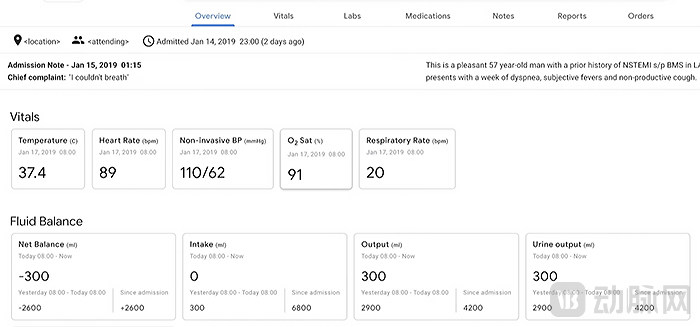
Google's Patient Search Tool Interface
Google analyzes and compiles these data to develop a patient search tool, enabling healthcare providers to conveniently access all patient data—including vital signs and laboratory results—on a single page. Meanwhile, Google Health will further leverage these data and plans to develop machine learning-based tools to recommend potential changes in patient treatment to physicians.
Although this initiative resembles an electronic health record (EHR) system, Google Health states that it does not intend to replace EHRs but rather to complement existing EHR systems by providing a unified interface for searching across various previously siloed data systems and streams.
However, despite both Google and Ascension Healthcare asserting that the initiative complied with HIPAA (the Health Insurance Portability and Accountability Act’s privacy rules), the agreement still faced scrutiny from the U.S. Congress and the public. Critics argued that the two companies failed to notify patients before collaborating, thereby violating relevant regulations. Meanwhile, media outlets contended that granting 150 Google employees access to tens of millions of patient records without their knowledge was clearly non-compliant.
Some health privacy experts argue that HIPAA contains loopholes that allow companies to share health data without notifying patients. Although such data-sharing practices are commonplace in the healthcare industry, Google has faced significantly greater scrutiny, partly due to a lack of public trust in the company.
To this day, this collaboration remains highly controversial and has significantly impacted the subsequent development of Google Health.
In December 2020, Google Health and Highmark Health established a six-year strategic partnership. The two parties plan to build a platform that makes it easier for patients to share health information and reduces the administrative burden on clinicians. Google will leverage its artificial intelligence and analytics capabilities to provide clinicians with timely information about each patient. For example, patients with hypertension can use wearable devices at home and transmit data to their physicians via cloud services.
Mobile Health Applications
In December 2020, to help combat the COVID-19 pandemic, Google Health partnered with the U.S. Department of Health and Human Services to launch a tool called “COVID-19 Alert,” which provides users with a list of resources ranging from the Centers for Disease Control and Prevention (CDC) to healthcare facilities. Users can complete or query common questions related to COVID-19 through this tool. Upon completion, the tool reminds patients to bring a list of their current medications, insurance cards, and other relevant documents.
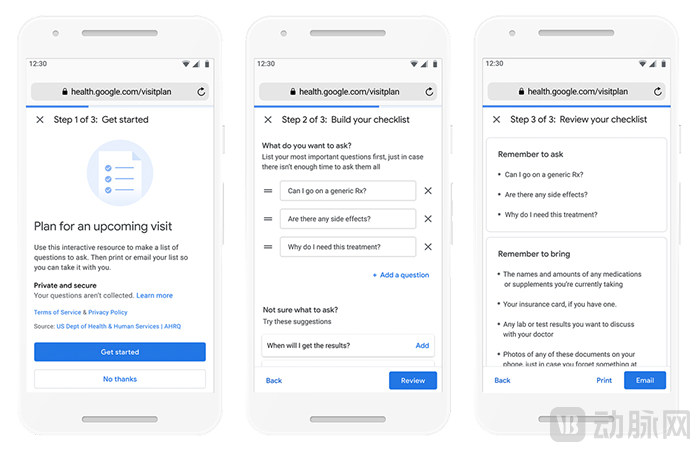
Google COVID-19 alert
Meanwhile, Google Health also launched the Google Health Studies app. Users can participate by answering questions to contribute relevant data to research. Users who choose to share their data can view their individual contributions within the entire enrollment cohort throughout the process.
Harvard Medical School and Boston Children’s Hospital have launched their first study to better understand respiratory diseases such as influenza and COVID-19. This respiratory health study will be open to adults in the United States and will focus on determining how these types of diseases develop within communities, as well as differences in risk factors such as age and activities like travel. Participants will be asked to provide regular self-reports on how they feel, potential symptoms experienced, preventive measures taken, and other relevant information.
In February 2021, Google Health launched Google Fit. This app can capture images of the user’s upper body using the front-facing camera of an Android phone and measure respiratory rate by detecting subtle chest movements. Additionally, the app can measure heart rate by having users place their fingers over the rear-facing camera to take a photo.
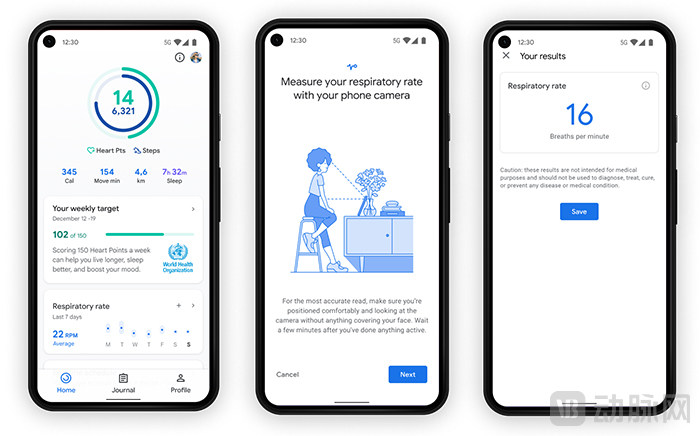
Google Fit
In April 2021, Google Health revived its failed 2012 attempt to allow users to sync their electronic health records (EHRs) with Google services. Patients can log in to their hospital records and synchronize them. Google displays the information in a more organized and thoughtfully designed manner.
Three hundred patients using the Epic electronic health record system in California, Atlanta, and Chicago tested this platform. However, participants found Google Health’s electronic health record initiative impressive, though not groundbreaking. Many other applications, including Apple’s iOS Health, offer similar functionalities.
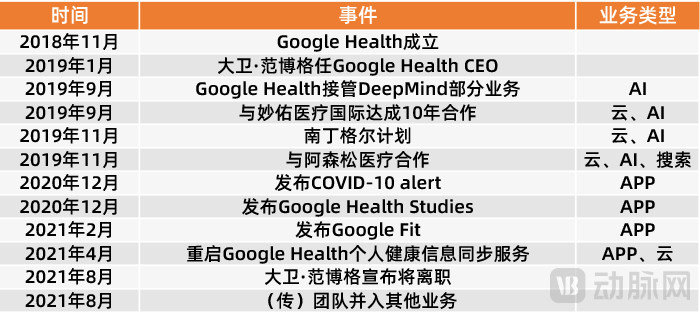
Google Health's Key Business Developments in Recent Years
It is evident that Google Health’s business model is closely tied to cloud computing and artificial intelligence. In particular, building healthcare services around electronic health records (EHRs) is a strategic masterstroke. This approach will help secure revenue for Google Health, as healthcare systems can access private health information comprehensively, conveniently, and cost-effectively, while also leveraging data more easily to support research and development.
Meanwhile, through collaborations with hospitals and electronic health record vendors, Google Health can migrate patient systems and data to the cloud, further advancing the integration of patient-generated data into Google’s software ecosystem, thereby firmly retaining users within its platform.
Regrettably, the unsuccessful partnership with Ascension Health has undoubtedly dealt a significant blow to Google Health. This has compelled Google Health to pivot toward a consumer-centric strategy, aiming to establish its consumer-facing applications as data entry points. Of course, compared to collaborating with hospitals and institutions, this path is far more protracted.
David Feinberg, head of Google Health, has chosen to join an electronic health record giant as his next career move, a decision that clearly signals his confidence in this model. Of course, anything is possible; his departure might even facilitate better collaboration between Google and the EHR giant.
The dissolution of Google Health may not be a positive development for Google, but its impact on the broader “Google ecosystem” is likely less significant than anticipated. For instance, Verily has already established its own position in the healthcare and medical sector. For Verily, the absence of Google Health may even prove beneficial.
In the field of wearable devices, Verily has become a leading industry player after years of accumulation, particularly through the acquisitions of Fossil and Fitbit. As a corresponding developer, Verily has made extensive efforts. To date, in addition to smartwatches, Verily has launched a series of intelligent hardware products, such as smart spoons that help Parkinson’s disease patients control tremors, wearable sensors for multiple sclerosis research, and painless blood sampling devices similar to watches.
Meanwhile, although Verily halted the development of its smart contact lens for non-invasive blood glucose monitoring via tears in 2018, this was primarily due to technological limitations at the time; specifically, the insufficient correlation between tear glucose levels measured by the sensor and actual blood glucose concentrations made it untenable to continue the research. With the gradual maturation of relevant technologies in recent years, this concept could be revived at any time.
Meanwhile, Verily is engaging in extensive industry collaborations, particularly in the field of chronic degenerative diseases. Leveraging its strengths in microelectronic devices, data analytics, and software development, Verily partners with enterprises possessing rich clinical medical knowledge and experience to continuously expand its healthcare footprint.
Furthermore, Verily has made extensive investments in the healthcare industry, primarily focusing on early-stage biotechnology companies in the fields of oncology, cancer, and Parkinson’s disease. Since its establishment in 2015, Verily has participated in financing rounds for nearly 10 healthcare companies, with cumulative investments reaching approximately $500 million over the past five years.
Of course, all of this is predicated on Verily operating as an independent entity capable of raising capital in the primary market. By late 2020 alone, Verily’s latest funding round had secured $700 million—by comparison, Google Health seemed quite modest.
In many business areas, Verily and Google Health are actually highly complementary. However, the fact that both have launched COVID-19 notification apps suggests that competition better reflects their stance—after all, within such tech giants, internal rivalry can be even more intense than external competition. Perhaps in the future, through some form of restructuring, Verily may well bring Google Health under its wing.
The failure of Google Health serves as a clear illustration of the complexities inherent in the healthcare industry. Even with its substantial financial resources and capabilities, Google has seen limited success after years of investment, a outcome that warrants deep reflection. VCBeat believes that there are generally three reasons why IT giants have underperformed in the healthcare sector.
First, given their inherent attributes, IT giants entering the healthcare sector typically choose to extend their existing technological strengths, approaching the market through technological innovation. Once successful, such innovation inevitably establishes a solid competitive advantage; however, the path of technological innovation is fraught with challenges and carries a very high failure rate. This is one of the reasons why IT giants have not achieved a high success rate in this field.
Second, unlike the original industry environment, patient privacy protection and data collection standards often become significant barriers in the heavily regulated healthcare sector. IT giants have found that their traditional data-driven approaches cannot resolve the most complex challenges in healthcare, making the path to intelligent diagnosis and treatment a long one.
Third, a primary reason why IT giants have struggled in the healthcare sector is their overconfidence that technology can solve all problems. For patients, the issue lies more with the overall experience than with the technology itself. Therefore, giants like Amazon and Walmart, which place immense emphasis on consumer experience, along with their partners, may truly disrupt the industry.
Fourth, IT giants often treat healthcare as merely one of many business lines, making it difficult to consolidate fragmented medical operations scattered across various departments into a cohesive force. Even when a few companies, such as Google, have established independent business units, they lack the psychological readiness to sustain long-term unprofitability. Under persistent pressure to deliver performance results, strategic directions for these business units frequently shift, undermining continuity. However, the healthcare industry precisely demands long-term, stable investment.
Going forward, VCBeat will continue to closely monitor developments involving IT giants in the healthcare sector, delivering reporting that is in-depth, timely, and distinctive. We also welcome industry professionals to contribute story tips and materials.
References:
appleinsider.com:Google shuts down unified health division as chief leaves company
businessinsider.com:LEAKED MEMO: Google is dismantling its embattled health division as the tech giant reconsiders its strategy for healthcare
9to5google.com:Google Health loses its first leader, projects set to continue
Cnbc.com:Google Health boss leaves to become CEO of health tech company Cerner
Cerna Corporation:Cerner Announces Appointment of David Feinberg, M.D. as President and Chief Executive Officer
searchengineland.com:Google Health To Be Shuttered On January 1, 2012
CNBC.com:Congressional Democrats demand details on Google’s use of patient data by Dec. 6
MedCity News:Highmark strikes six-year contract with Google Cloud
MedCity News:Google, Ascension expand pilot of health record search tool