

AccuMed Secures Dual NMPA Approvals for Core Navigation Products, Poised to Capture Surgical Navigation Market

AccuMed
Developer of Medical Devices for Precision Surgery
Recently, a surgical robot developerJingmai MedicalGood news has arrived.
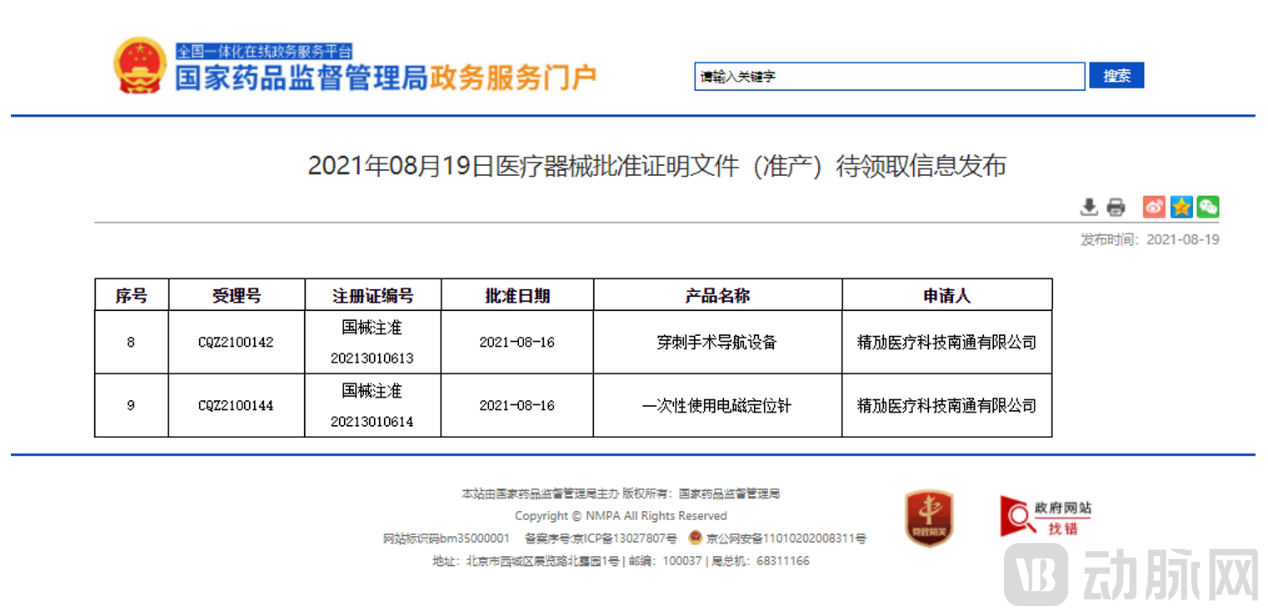
According to publicly available information, Jingmai Medical's independently developed“Single-Use Electromagnetic Localization Needle”and“Puncture Surgery Navigation System”Both have obtained Class III medical device registration certificates from the National Medical Products Administration (NMPA) and are now officially approved for market launch.
Jingmai Medical, established in 2016, is a high-tech medical company dedicated to the research, development, and production of navigation and robotic systems for precision surgery, with a focus on building an integrated treatment system for solid tumors in the thoracic and abdominal regions using surgical robots.
To date, Shanghai Jingmai Medical Technology Co., Ltd. has completed three rounds of financing. The most recent round, a Series A financing closed this March, saw Kaditai Medical, a subsidiary of Chia Tai Pharmaceutical Group, exclusively lead an investment amounting to hundreds of millions of RMB.
With two products approved for market launch and capital investment continuing to surge, what sets Jingmai Medical apart amidst the steady stream of good news?
“The Brain” and “The Eye” Work in Close Coordination to Significantly Enhance Surgical Precision and Safety
With the continuous evolution and maturation of internet technology, the concept of “precision medicine” has become increasingly deeply rooted in public consciousness, specifically manifested in the formulation of refined, personalized treatment plans for patients. Initially, “precision medicine” was widely applied only in the pre- and post-diagnosis stages, primarily covering core components such as consultations, examinations, and rehabilitation planning. However, this novel paradigm is now beginning to “advance” into the surgical domain.
This is an inevitable developmental direction. It is reported that traditional surgical procedures rely on preoperative imaging, such as magnetic resonance imaging (MRI) and computed tomography (CT), to identify lesion locations and formulate surgical plans. This approach undoubtedly has certain limitations, primarily because preoperative images cannot provide real-time reference or operational warnings during surgery, thereby increasing the difficulty and uncertainty of surgical procedures to some extent.
Surgical navigation technology has emerged as a breakthrough in addressing this issue.By leveraging innovative surgical navigation systems, physicians can detect minute tumor foci at an early stage, thereby improving intraoperative tumor detection rates and postoperative prognoses. Furthermore, these systems enable precise intraoperative localization of tumor margins, minimizing tissue trauma and reducing the risk of recurrence. Tailoring precision therapy to individual patients and specific disease profiles to maximize therapeutic efficacy while minimizing adverse reactions aligns with the fundamental objective of developing precision medicine as explicitly outlined in China’s 13th Five-Year Plan.
Following this path, Jingmai Medical, with over a decade of deep expertise in the field of precision surgical medical instruments, has developed innovative solutions.
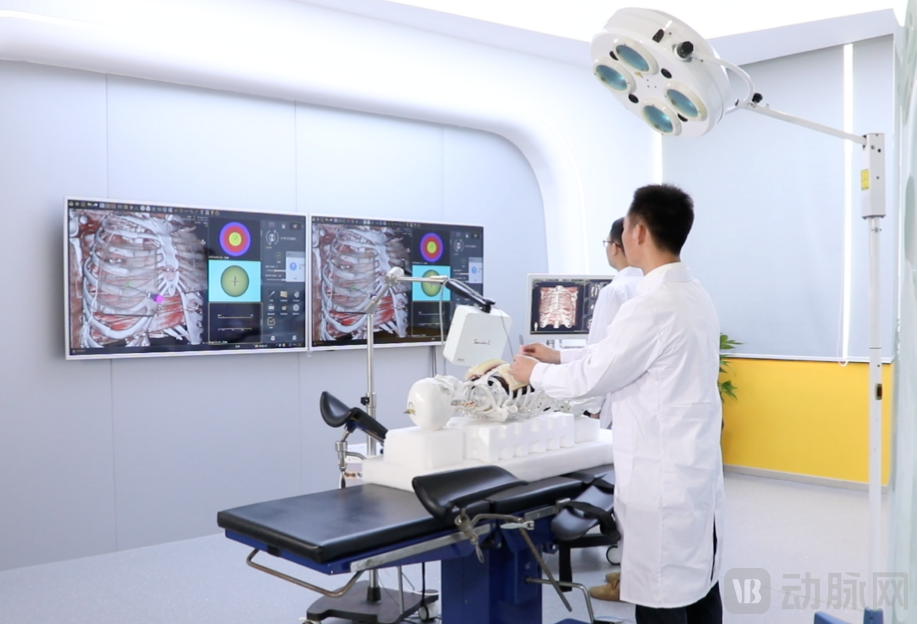
Core Products"Intelligent Puncture Surgical Navigation Device"By fully integrating C-arm/CT imaging data with virtual reality-based 3D immersive scenarios, the system provides physicians with a real-time, realistic intelligent guidance environment. Equipped with China’s first intelligent navigational biopsy needle, it acquires lesion location information in real time to assist physicians in precisely targeting lesions. The system offers functionalities including image display, tissue segmentation and modeling, preoperative planning, respiratory motion correction, intraoperative navigation, and postoperative reporting. It delivers a comprehensive solution for thoracoabdominal puncture localization and subsequent precision surgical treatment, accelerating China’s leap forward in the field of high-end equipment for intelligent precision surgery.
Intelligent puncture surgical navigation equipment creates a safe, precise, and agile minimally invasive percutaneous interventional treatment channel for thermal ablation (both cryo- and heat-based), placement of localization hooks, particle implantation, and intratumoral drug delivery. It breaks through the barriers of clinical experience, provides more comprehensive surgical diagnosis and treatment solutions, and is expected to help improve the five-year survival rate of cancer patients in China.
Among the more than 200 clinical cases completed to date, a clinical accuracy of within 3 mm has been achieved, better meeting the requirements for needle biopsy diagnosis of early-stage cancerous lesions (“≤8 mm”) as specified in the Chinese Guidelines for Lung Cancer Screening, Early Diagnosis, and Early Treatment (2021, Beijing).The device’s streamlined operational workflow, safety alerts for risk mitigation, drift correction for respiration, and precise surgical outcomes have not only facilitated its demonstration and application in Grade A tertiary hospitals but also provided support for the broader adoption of puncture and surgical treatments in primary healthcare institutions.
This is inseparable from the “efforts” made by two approved products. One of the marketed products"Puncture Surgery Navigation Device"Equivalent to the “brain,” it integrates deep learning and sensor network technologies to achieve highly efficient, fully automatic preoperative navigation registration, thereby addressing the intraoperative challenge of respiratory drift correction.
Another Listed Product“Single-Use Electromagnetic Positioning Needle”which is equivalent to the "eye," this isChina's First Intelligent Navigation Puncture Needle, enabling real-time acquisition of lesion location information to assist physicians in precisely targeting the area of interest.
The two core products work in synergy to significantly enhance the precision and safety of percutaneous puncture procedures, delivering clinical outcomes superior to conventional therapies and comparable products. They are not only suitable for localization biopsy of early-stage small lesions but also well-suited for more demanding novel precise physical therapy modalities. This provides physicians with convenient and efficient intraoperative operations while ensuring high-quality patient care.
Industry Pain Points Spawn a Blue Ocean Market: What Lies Ahead for Jingmai Medical?
Cancer, which has been battling humanity for a century, continues to pose a persistent threat to human life and health. According to data released by the International Agency for Research on Cancer (IARC) of the World Health Organization, there were 19.29 million new cancer cases and 9.96 million cancer-related deaths worldwide in 2020. It is projected that cancer will remain the leading global “killer” by the end of this century, becoming the biggest “obstacle” on the path to extending human life expectancy.
Among these, lung cancer is the most "prominent," currently ranking as the leading cancer in China, with both incidence and mortality rates topping the list. Early diagnosis and early treatment are key to improving lung cancer cure rates at this stage.
But this is not easy. On one hand, at the diagnostic end,Because early-stage lung cancer lesions are small and insidious, they are often difficult to detect, leading to missed opportunities for optimal early treatment.; on the other hand, in terms of treatment,Conventional CT- and C-arm-guided surgeries are technically challenging and time-consuming. Moreover, the inability to accurately localize lesions increases the likelihood of indiscriminate over-resection, causing unnecessary harm to patients to some extent.
As a pioneer in the field of thoracoabdominal surgical robotics, Jingmai Medical is dedicated to the independent research, development, and production of high-end intelligent medical devices, with its core products primarily applied to percutaneous procedures for thoracoabdominal tumors, such as lung cancer.
As a technology-driven enterprise, Jingmai Medical has assembled the nation’s top research teams and leading business executives in its field. The three founding initiators of Jingmai Medical are all seasoned serial entrepreneurs in the medical device industry. One of the founders, Mr. Gu Lixu, previously studied under internationally renowned experts and served as an Associate Researcher at the Medical Imaging Laboratory of the Robarts Research Institute in Canada, where he was responsible for translating surgical navigation research achievements into practical technologies. He also concurrently served as Technical Director at CEDARA Corporation. Furthermore, Mr. Gu has collaborated with Harvard Medical School to conduct international research on surgical navigation projects.
In addition, Shanghai Jingmai Medical Technology Co., Ltd. leverages the interdisciplinary research strengths in medicine and engineering at Shanghai Jiao Tong University to facilitate the clinical translation of high-tech achievements. With an internationally leading team spanning R&D, clinical practice, and industrialization, the company has established a stable and virtuous operational model encompassing both technology and management.
These core capabilities not only accelerate the development of Jingmai Medical but also equip the company with strong competitiveness for the future. As market demand continues to expand and technology matures, surgical navigation is poised to become a lucrative blue-ocean market. Amidst this landscape filled with challenges and boundless potential, Jingmai Medical, with its comprehensive strategic solutions for innovative, minimally invasive, and precise surgical treatments, is certainly a company to watch.