

Alibaba Health Partners with Xiaolu TCM to Forge Integrated Internet-Based Traditional Chinese and Western Medicine Platform
From its inception over a decade ago to the current era of robust expansion, internet healthcare has undergone multiple iterations.
For instance, early internet healthcare companies offered only basic services such as remote consultations and appointment registration. Today, their offerings have expanded to encompass a full spectrum of services covering online consultations, medical education, pharmaceutical e-commerce, and health insurance payment processes, thereby continuously broadening the scope of service coverage.
In particular,Driven by the pandemic last year, public awareness of internet healthcare has increased significantly.According to data from iiMedia Research, 74.4% of residents in China received services such as online consultations, pharmaceutical e-commerce, or online health counseling in 2020, indicating a rapid increase in patient acceptance of internet-based healthcare.
Against this backdrop, numerous internet healthcare companies have continuously expanded their business coverage, leading to increasing homogenization. As a result, an interesting phenomenon has emerged: after opening the apps of major internet healthcare providers, users find that the displayed page functions are remarkably similar, typically limited to services such as “Quick Consultation,” “Health Checkup Testing,” and “Rapid Medication Purchase.”
This has led to increasingly fierce competition in the internet healthcare industry, making it imperative for market participants to achieve new breakthroughs and innovations across all levels.Among these, the integration of traditional Chinese medicine (TCM) with the internet is highly anticipated by the industry. This expectation stems primarily from the Chinese government’s intensive policy support for the inheritance and innovation of TCM, as well as the fact that the vast market potential of internet-based TCM services remains largely untapped.
Just recently,Alibaba Health Announces Merger with Xiaolu TCM, Expanding Strategic Footprint into Internet-Based Traditional Chinese Medicine and Sparking Industry-Wide DebateOn one side stands a leading enterprise in internet healthcare; on the other, a top-tier domestic online platform for traditional Chinese medicine (TCM) diagnosis and treatment. What synergies will emerge from their combination? What implications does this hold for the internet healthcare industry? VCBeat will provide an exclusive analysis to address these questions.
In the competitive landscape of online traditional Chinese medicine (TCM), numerous enterprises have already entered the fray. These include internet-based TCM platforms established by traditional Chinese herbal medicine companies, as well as a cohort of native digital players that originated in the online TCM sector.
Why Did Alibaba Health Choose Xiaolu TCM? To answer this question, we must examine the fundamentals of both Xiaolu TCM and Alibaba Health.
First, let’s take a look at Xiaolu TCM.Since its establishment in November 2015, Xiaolu TCM has remained dedicated to the field of Traditional Chinese Medicine (TCM), leveraging internet technology to facilitate effective communication among hospitals, healthcare professionals, and patients. It has evolved into a comprehensive TCM diagnosis and treatment service platform that integrates physician-patient management, remote consultations, and home delivery of medications, establishing itself as a leading online specialized TCM healthcare platform in China. Furthermore, Xiaolu TCM holds licenses for two internet hospitals established in Qinghai and Hainan provinces, China.
For internet healthcare platforms, the ability to aggregate medical resources, operational capabilities in managing doctors and patients, and supply chain control are critical dimensions for evaluating platform performance.
An analysis of Xiaolu TCM’s data reveals that its services currently span over 40 TCM specialties, including gynecology, dermatology, gastroenterology, and respiratory medicine. The platform has onboarded more than 60,000 physicians and served over 7 million patient visits.
In terms of operations, the Xiaolu TCM APP features a rapid iteration cycle, with functional updates released almost monthly in response to the needs of physicians and patients. These updates primarily focus on enabling physicians to serve patients more efficiently and cultivate a loyal patient following, while also empowering patients with greater access to information, knowledge, and services related to their medical conditions. This strategy ultimately drives physician and patient engagement and retention.
In terms of controlling upstream enterprises, Xiaolu TCM has not only integrated pharmacy resources but also provided a doctor-patient communication platform, extending into value-added services such as information services and insurance services. This has significantly strengthened Xiaolu TCM's influence over both the upstream and downstream segments of the industry chain.
Thus, it is evident that Xiaolu TCM has already accumulated successful practical experience and extensive industry expertise in the field of online Traditional Chinese Medicine (TCM), which will help Alibaba Health better enhance its internet healthcare service platform.
Next, let's take a look at Alibaba Health.Backed by Alibaba, Alibaba Health, established in October 2014, is one of China’s earliest internet healthcare enterprises. For such companies, the key to achieving sustainable development lies in continuous iterative innovation.
Throughout the history of global business evolution, any enterprise that has maintained its vitality has done so by continuously adapting to deliver greater incremental value to the market. Adhering to this principle, Alibaba Health has been constantly updating and reinventing itself since its inception, enabling it to serve a broader user base more effectively and efficiently.
For instance, at the Future Healthcare Top 100 Conference held this year, Alibaba Health unveiled its new strategic vision. Zhu Shunyan, Chairman and CEO of Alibaba Health, stated that the future trend in the healthcare industry is shifting from treatment to “treatment + prevention + wellness,” and from in-hospital care to “in-hospital + out-of-hospital health services.” He believes thatInternet-based medical services are, in essence, inclusive services, with user value being the primary consideration for Alibaba Health.
Data supports this. Alibaba Health’s medical and healthcare service platform handles over 180,000 online consultations on average per day, with more than 520 million annual active users, as it strives to expand its user base and increase service penetration.
Leveraging the online-to-offline integrated healthcare service system built on the “Yilu App + Alipay Healthcare Channel,” Alibaba Health is actively exploring more innovative business models centered around user needs.
It is evident that, along the extensive value chain centered on users’ healthcare needs, Alibaba Health has established an integrated online-to-offline (O2O) one-stop healthcare service system, comprehensively embedding its services throughout every stage of the user’s healthcare journey.
More importantly, leveraging Alibaba Health’s integrated online-to-offline medical and healthcare service system, combined with Xiaolu TCM’s leading advantages in the internet-based traditional Chinese medicine (TCM) sector, Alibaba Health is well-positioned to pioneer integrated TCM-Western medicine digital healthcare services for users following the integration of Xiaolu TCM, and even develop additional innovative business models. This holds significant implications for users, healthcare providers, and the entire digital healthcare industry.
Partnering with Xiao Lu Zhongyi demonstrates Alibaba Health’s determination to leverage innovative internet technologies to advance the development of Traditional Chinese Medicine (TCM) and provide comprehensive solutions for healthcare services.Behind this lies the attempt by internet healthcare companies to identify new strategic growth avenues in today’s increasingly competitive landscape.
More importantly, Alibaba Health’s entry into the market will accelerate the penetration of new technologies and business models into the field of Traditional Chinese Medicine (TCM) across the entire industry, thereby promoting complementary and coordinated development between TCM and Western medicine, while also bringing immense opportunities to the TCM industry.This aligns with the broader industry trend.
Specifically,At the macro level, internet-based traditional Chinese medicine (TCM) is receiving strong support from the state.In May 2015, the Chinese government’s official website released the Development Plan for Traditional Chinese Medicine (TCM) Health Services (2015–2020). The document specifically highlighted the development of intelligent TCM health service products by leveraging information technologies such as cloud computing, mobile internet, and the Internet of Things (IoT). This plan served as the guiding framework for the development of China’s TCM health services industry over the subsequent five years and was the first national-level development plan in this field. According to incomplete statistics from VCBeat, more than 40 TCM-related policies were issued at the national level alone between 2015 and early 2021.
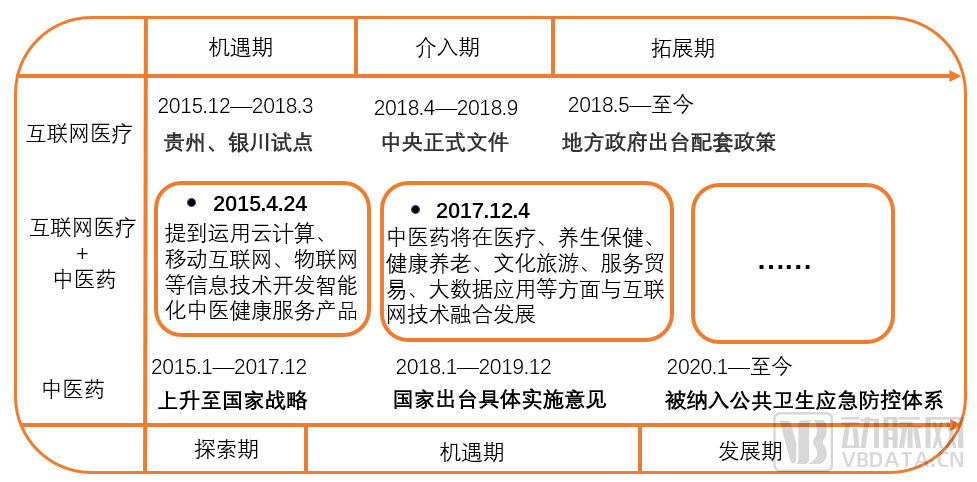 (Key Milestones in Policy-Driven Development of Internet-Based Traditional Chinese Medicine; Chart by VCBeat)
From a meso-level perspective, the development of the traditional Chinese medicine (TCM) industry currently faces numerous challenges.At the primary care level, grassroots physicians lack sufficient experience and methodological rigor, failing to establish systematic clinical logic. In clinical practice, there is a significant gap between academic textbooks and actual clinical needs, resulting in weak practical skills. Meanwhile, TCM practitioners are increasingly emphasizing scientific research. These issues have become critical pain points hindering the development and inheritance of Traditional Chinese Medicine (TCM). Therefore, the entire industry urgently requires external support and integration to facilitate transformation and upgrading.
In this process, the internet can undoubtedly bring more incremental value to the traditional Chinese medicine industry. However, it is important to note thatThe integration of Traditional Chinese Medicine (TCM) with the Internet is not limited to online TCM consultations; rather, it encompasses a series of deeply integrated initiatives, including digital tools for TCM treatment, scientific evaluation of TCM efficacy, the traditional Chinese medicine supply chain, and the standardization of TCM decoction pieces.
“The ‘Internet + Healthcare’ model, which connects pre-hospital, in-hospital, and post-hospital care, facilitates the systematic collection and storage of patient medical records, examination and test results, and follow-up data before and after receiving traditional Chinese medicine (TCM) treatment. As the case volume accumulates, scientific statistical analysis methods can be employed to systematically evaluate the efficacy of TCM. This will significantly help build patients’ confidence in the effectiveness of TCM and, more importantly, enhance public trust and acceptance of TCM,” stated Lu Qingjun, Director of the Office of the National Telemedicine and Internet Medical Center and Director of the Development Department at China-Japan Friendship Hospital, during this year’s Two Sessions.
That is to say,Leveraging the technological and data advantages of internet platforms will help transform traditional pathways in Traditional Chinese Medicine (TCM), thereby better harnessing its unique strengths to provide patients with more convenient and high-quality services.
Furthermore, internet-based Traditional Chinese Medicine (TCM) is particularly well-suited for health management. This is because health management requires a platform with strong user stickiness capable of providing continuous monitoring, which is difficult to achieve offline but easily accomplished online. More specifically, this involves leveraging online platforms to aggregate patients’ healthcare needs and building and providing supply chain solutions, thereby overcoming time and spatial constraints, expanding the service radius of TCM practitioners, and transforming low-frequency clinical consultations into high-frequency health demands such as health management.
From a micro-level corporate perspective, Alibaba Health, which has been publicly listed for many years and has established a presence across various sectors of internet healthcare, has accumulated substantial experience and strength. This positions the company with both sufficient advantages and a clear necessity to build an integrated traditional Chinese and Western medicine healthcare service platform. This initiative represents not only an extension of Alibaba Health’s core competencies and strategic roadmap but also a fulfillment of its mission to leverage internet technologies in driving the transformation and upgrading of the broader healthcare industry.
In 2013, American cardiologist Eric Topol, in his book The Patient Will See You Now: The Future of Medicine is in Your Hands, depicted the transformation that digital technology would bring to the healthcare industry and heralded the advent of a new era.
It is precisely under the inspiration of such a promising business landscape,Countless investors, enterprises, and entrepreneurs have flocked to this sector, striving to leverage the power of the internet to break down the barriers of public hospitals, enabling medical resources—such as physicians, treatment protocols, and pharmaceuticals—to transcend geographical constraints and reach patients across diverse locations.
Yet, amid repeated shifts in policy and market dynamics, the internet healthcare industry has experienced multiple cycles of boom and bust, with countless entrepreneurs and their ventures disappearing as the tide of internet entrepreneurship receded.
Consequently, many critics argue that the internet healthcare industry has delivered limited value, citing the overly simplistic nature of its business models as their primary evidence. An analysis of the revenue structures of leading companies reveals that pharmaceutical e-commerce currently serves as the main source of revenue and profitability for major internet healthcare firms. This has led numerous observers to characterize the industry with the adage: “Those with e-commerce operations rely on drug sales; those without depend on financing for survival.”
However, the issue lies in the fact that when examining an industry and its enterprises, one should not focus solely on performance metrics reflected in current financial data, capital market effects, or emerging buzzwords and concepts. Greater attention should be paid to the evolution of business logic underlying every action taken by the industry and companies, as well as their forecasts for the future and the resources and practical measures aligned with these projections.
From this perspective, although pharmaceutical e-commerce is currently a major revenue source for internet healthcare companies, it is important to note thatIndustry pioneers such as Alibaba Health are also deepening their engagement in service sectors like health management, aiming to become key participants and drivers in the broader health ecosystem.
Taking traditional Chinese medicine (TCM) as an example, the TCM industry, as a vital healthcare and cultural resource in China, carries the nation’s long history. How to innovate while preserving its heritage has consistently drawn widespread attention from both society and the industry. AndThe empowerment and integration of internet healthcare will provide a significant boost to the revitalization of the traditional Chinese medicine industry.
This is because the high degree of compatibility between the internet and Traditional Chinese Medicine (TCM) enables TCM to extend more flexibly into the entire big health industry. For instance, the TCM concepts of preventive care before diagnosis, treatment during diagnosis, and rehabilitation after diagnosis align closely with internet-based health management. Spanning from pre-illness to post-recovery, from offline to online, from within hospitals to outside hospitals, and from single visits to cyclical care, TCM’s big health ecosystem can cover all aspects of people’s daily lives, including clothing, food, housing, and transportation. The emerging internet-based TCM model is transforming the traditional healthcare landscape, which has historically been limited to providing patients with single, ad-hoc diagnostic and treatment services.
From the perspective of the overall layout of the broader health industry, internet-based Traditional Chinese Medicine (TCM) can also connect multiple stakeholders across the industrial chain, such as pharmaceutical retail, pharmaceutical and medical device companies, and commercial insurance providers. By integrating the entire healthcare value chain and pooling diverse medical resources, it delivers TCM products and services that span the full life cycle and cover all health scenarios for users.Overall, there remains significant room for development in the roadmap for online Traditional Chinese Medicine (TCM). Therefore, the strategic partnership between Ali Health and Xiaolu TCM will bring greater possibilities and opportunities to the online TCM sector.
From conceptualization to rapid expansion, internet healthcare has come a long way today, integrating with an increasing number of industries and delivering many surprises to the sector. However, as healthcare and wellness are ultimately tied to people’s safety, life, and health, it remains a “slow” industry. Therefore, as it delves deeper into service provision, many uncertainties and challenges still lie ahead.
Throughout this process, the direction of industry development may change, but our original aspiration to make healthcare services universally accessible and trustworthy will remain unwavering.