

Ping An Healthcare's Methodology Behind Sustained Growth in Medical Services Revenue
On August 24, Ping An Health released its 2021 interim results report. In the first half of 2021, Ping An Health’s total revenue reached RMB 3.818 billion, representing a year-on-year increase of 39.0%. As its core business, the medical services segment generated revenue of RMB 1.067 billion, up 50.6% year on year.
In mid-2020, Fang Weihao assumed the roles of Chairman and CEO of Ping An Health’s Board of Directors, while the company comprehensively launched a strategic upgrade focused on three key areas: channels, services, and capabilities. One year on, what results have been achieved from Ping An Health’s strategic upgrade? How does it support the sustained growth of its core business? VCBeat provides an analysis.
As its core business, Ping An Health’s medical services segment saw its revenue increase from RMB 708 million in the first half of 2020 to RMB 1.067 billion in the first half of 2021, with the proportion of medical services revenue in total revenue rising from 25.8% to 27.9%.
From a longer-term perspective, Ping An Good Doctor has maintained the growth momentum of its core business. In the first half of 2018 and the first half of 2019, the revenue from its core online healthcare segment amounted to RMB 186 million and RMB 336 million, respectively.
Ping An Health, emerging as an internet healthcare company, has strengthened its "medical" capabilities and further consolidated the core position of its "services."
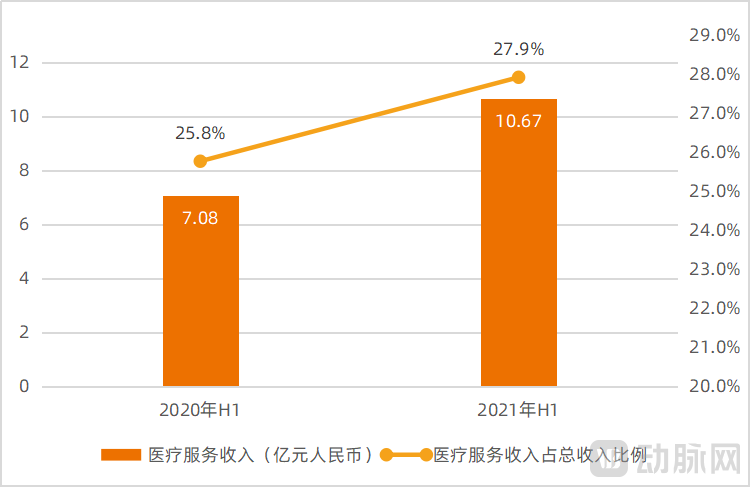 Growth of Ping An Healthcare’s Medical Services Segment, Data Source: 2021 Interim Results Report, Chart by VCBeat
(Note: In 2021, Ping An Health reclassified its core business from “Online Healthcare” to “Medical Services”; the data in the above chart are all adjusted figures.)
At the departmental level, corresponding operational metrics have shown an upward trend following the implementation of Ping An Health’s strategic upgrade measures. For instance, the number of physicians in the Traditional Chinese Medicine (TCM) Department increased by nearly 50%, with revenue continuing to grow steadily; the Dermatology Department saw a 12.9% rise in average daily consultations, and its average daily revenue increased by approximately 30% year-on-year; the Obstetrics and Gynecology Department experienced robust growth in consultation volume, driving increases in prescription and product revenue, with related prescription revenue rising by approximately 35%.
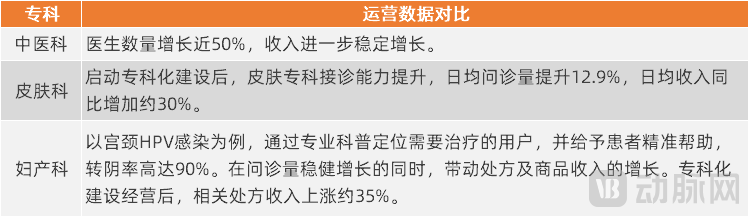 Growth in Operational Data of Ping An Health’s Key Specialties, Source: Public Information, Chart by VCBeat
During its strategic upgrade, Ping An Health has progressively refined its four-tier physician network system, delivering systematic, end-to-end medical and health services to users through AI physician assistants, its in-house medical team, external physicians, and renowned medical experts. It reaches individuals with medical and health service needs through four key scenarios: health management, sub-health management, disease management, and chronic disease management.
Currently, Ping An Health’s AI-assisted diagnosis and treatment system covers diagnostic models for over 3,000 diseases, helping physicians improve the efficiency and accuracy of daily consultations. Its in-house medical team comprises approximately 2,000 professionals who respond promptly to user needs. Additionally, it has contracted with 38,000 external physicians who provide real-time or asynchronous consultations, as well as offline second-opinion services.
In terms of pharmaceutical and medical device services, as of the end of June 2021, Ping An Health had partnered with 163,000 pharmacies, an increase of over 10,000 from the 151,000 at the end of 2020, covering 32 provincial-level administrative regions and 379 cities across China. Its express medication delivery service has already reached 56 major cities in 26 provincial-level administrative regions nationwide. The combination of these two networks enables more comprehensive and faster delivery for users.
While integrating resources from various parties, Ping An Health has established an “online tiered diagnosis and treatment” mechanism, defining its in-house medical teams from 20 specialties as “medically knowledgeable client managers.” These professionals arrange comprehensive online-to-offline healthcare services for users, create lifelong electronic health records, and strive to achieve the goal of providing each individual with a dedicated general practitioner under the “one person, one doctor” model.
Strategic Upgrade Yields Results, Highlighting the Value of Medical Services: What Is Ping An Health’s Methodology? In Summary, There Are Three Key Points.
From Point to Plane: Achieving Breakthroughs in Specialty Construction One by One
Specialized operations are a key pathway for Ping An Health to enhance its medical service capabilities. What is the significance of specialty development and disease-specific services?
First, for patients, it enables access to more continuous and comprehensive medical and health services.
For example, through Ping An Health’s services, a patient’s care journey unfolds as follows: Prior to consultation, patients receive pre-visit education on basic disease concepts, prevention strategies, and etiology. During the consultation, specialists provide diagnoses while communicating treatment principles and plans, medication regimens, and follow-up visit reminders. Post-consultation, an internal medical team and AI assistant deliver regular follow-up management services, subsequent recuperation plans, and, if necessary, guidance for further offline referrals.
Second, for platforms, user acquisition, data accumulation, and resource aggregation become more precise. By operating specialized departments focused on specific diseases, platforms can attract targeted users with particular conditions and gain stronger bargaining power when collaborating with pharmaceutical and medical device companies specializing in those conditions. Meanwhile, precisely clustered data further enhances platform operations, such as aiding the learning and training of AI-assisted tools tailored to specific specialties.
It is understood that since early 2021, Ping An Health has been systematically reviewing common and complex conditions across various medical specialties. By leveraging its internal physician clinics as an entry point, the company provides specialized care solutions, integrates internal and external services, and streamlines online-to-offline processes. These efforts aim to enhance user retention and long-term disease management, thereby driving higher conversion rates.
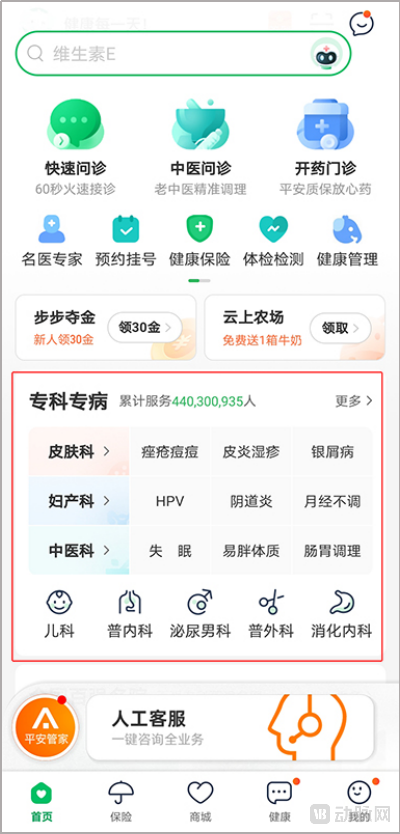
Specialty and Disease-Specific Sections Have Occupied a Prominent Position on the Homepage of the Ping An Health App
In fact, the development of specialized medical disciplines has become a common direction within the industry. The difference lies in Ping An Health’s approach: rather than pursuing large-scale coverage in the short term, it has chosen to focus on building up several key departments. The first three specialties launched—Traditional Chinese Medicine (TCM), Dermatology, and Obstetrics & Gynecology—have all established comprehensive, disease-specific care pathways covering pre-diagnosis, treatment, and post-treatment stages, with a team of more than 100 renowned specialists. Building on the initial success of these first three specialties, Ping An Health is simultaneously incubating multiple other specialties, including Ophthalmology, Pediatrics, Internal Medicine, Surgery, and Andrology.
Top-Down Approach: Leading Experts Mobilize More Physicians
Over the past year, Ping An Health has accelerated its collaboration with external physicians, particularly with renowned experts, including academicians, National Masters of Traditional Chinese Medicine, and leading specialists from key departments of Grade 3A hospitals. It has established “Renowned Expert Studios” centered around each of these top-tier physicians, providing specialized care for specific diseases and medical specialties.
Taking the three key specialty departments prioritized in the initial phase as examples: In Traditional Chinese Medicine (TCM), top-tier TCM dermatology expert Qin Wanzhang and National Medical Master Li Diangui have joined the Ping An Health APP. In Obstetrics and Gynecology, Director Huang Suying, Chief Physician of TCM Gynecology at the Shanghai Municipal Museum of Traditional Chinese Medicine Literature and the eighth-generation representative inheritor of the Cai School of Gynecology, as well as Director Qiu Lihua, Chief Physician of Gynecology and Doctoral Supervisor at Renji Hospital Affiliated to Shanghai Jiao Tong University School of Medicine, have joined the Ping An Health APP. In Dermatology, Academician Liao Wanqing from Changzheng Hospital serves as Ping An Health’s first “Chief Expert for Internet Dermatology Specialty,” while experts such as Director Zhang Jianglin, Chief Physician of Dermatology at Xiangya Hospital of Central South University, and Director Xi Liyan, Chief Physician of Dermatology at Sun Yat-sen Memorial Hospital of Sun Yat-sen University, have also joined the Ping An Health APP.
Currently, Ping An Health has established more than 450 renowned physician studios.
After renowned medical experts join the platform, their academic authority generates significant appeal and creates a demonstration effect, encouraging students, junior doctors, and even peers within the same specialty to “go online.” As of the end of June 2021, Ping An Health had contracted with 38,000 external physicians, 70% of whom were from tertiary hospitals. In contrast, during the same period in 2020, Ping An Health had only 5,978 external physicians, reflecting rapid growth in its physician network.
Internal and external physicians integrate work and learning through various formats.
First, in the context of academic exchange, external physicians affiliated with renowned expert studios conduct training for internal medical teams;
Second, during the user service process, the internal medical team conducts preliminary consultations for patients, then matches them with renowned specialists for consultation or diagnosis, followed by regular follow-ups from the internal medical team to monitor rehabilitation and health management;
Third, renowned external physicians have made their expertise and proprietary prescriptions accessible to the internal medical team. This enables the internal team to utilize specialized diagnostic protocols and prescriptions for specific diseases, thereby receiving indirect training while delivering patient care.
In June 2021, Ping An Health and Roche Pharmaceuticals jointly launched an integrated pan-cancer precision diagnosis and treatment platform. On this platform, the internal medical team provides patients with pre-diagnostic consultations, condition assessments, and post-diagnosis management, while oncology experts offer consultative services and even offline treatment plans. This represents a typical model of collaboration between Ping An Health’s internal and external medical teams.
Ping An Health has long been renowned in the industry for its large-scale, in-house medical team. The advantage of an in-house medical team lies in the ability to autonomously manage physician scheduling, allowing full-time doctors to devote their entire working hours to online consultations and ensuring rapid response to patient needs. However, patient demand for medical services is outcome-oriented; that is, regardless of whether care is accessed online or offline, and whether through medication or other treatments, patients’ ultimate goal is “to be cured.” To enhance service continuity and better address patient needs, offline service capabilities are also indispensable in the internet healthcare industry. Expanding the scale of external physicians not only strengthens overall medical service capabilities but also augments offline service capacity.
Simplifying Complexity: Technology-Driven Enhancement of Doctor-Patient Efficiency
After several years of development, internet-based healthcare has been increasingly accepted by physicians; however, a significant number of doctors remain conservative toward this new model. VCBeat has learned from numerous physician interviews that some doctors are reluctant to embrace internet-based healthcare or are inactive in providing online consultations. A key reason is their perception that the time required for online consultations far exceeds that of offline visits. These physicians note that the duration of care for a single patient on internet healthcare platforms can range from one to two hours to as long as 48 hours. If the platform does not limit the number of questions, patients may ask queries at any time during this period. To secure favorable ratings, doctors feel compelled to respond to every inquiry. In contrast, an offline consultation with a patient may take only a few minutes, whereas online interactions with a single patient can involve countless back-and-forth exchanges.
In fact, the tension between patients’ desire to ask more questions and gain deeper understanding, and doctors’ need to conduct consultations more efficiently, exists in both offline and online settings. Since its inception, Ping An Health has been leveraging AI technology to address this supply-demand imbalance between patients and physicians. In 2021, its AI-assisted products underwent continuous upgrades and iterations.
For example, as of the end of June 2021, Ping An Health’s AI-assisted diagnosis and treatment system achieved a triage accuracy rate of over 99% and an auxiliary diagnostic accuracy rate exceeding 95%. It provides physicians with end-to-end support throughout the consultation process, from information collection to delivering diagnostic results, thereby enhancing both the user consultation experience and physicians’ efficiency. As the underlying data foundation, Ping An Health has amassed tens of millions of entries in its disease database, drug and medical device database, prescription database, healthcare resource database, and personal health database, encompassing 300 million medical concepts and more than 140 million medical relationships. Together with the platform’s accumulated data from 1.18 billion online consultations, these resources are provided to the AI-assisted diagnosis and treatment system for learning and training, ensuring and improving the accuracy of AI operations.
To meet the needs of specialized operations, Ping An Health has also developed AI for key departments, such as AI Traditional Chinese Medicine, AI Dermatology, and AI Ophthalmology.
It is worth mentioning that Ping An Health has developed an intelligent online platform for TCM four-diagnosis pattern differentiation, where AI image recognition capabilities can accurately extract characteristic features from tongue and facial diagnosis. Currently, the platform defines over 80 patient profiles, integrates 50 features from the “inspection, listening/smelling, inquiry, and pulse-taking” diagnostic methods, and covers 266 common diseases. The average recognition accuracy for 13 tongue diagnosis features reaches 85%, while that for 7 facial diagnosis features exceeds 80%.
In addition, Ping An Health has launched AI-assisted diagnosis or intelligent screening systems in dermatology and ophthalmology to enhance physician efficiency.
Alongside the release of a series of impressive figures, VCBeat also noted that Ping An Health’s adjusted net loss for the first half of 2021 amounted to RMB 791 million, representing a substantial increase from RMB 208 million in the same period of 2020. Prior to this, Ping An Health had been demonstrating a year-on-year narrowing trend in its net losses. Why has the deficit widened once again?
At the earnings conference held on August 24, Ping An Health’s CFO, Ye Lan, stated that the company aims to achieve break-even between 2024 and 2025. The current widening of losses is aligned with the company’s overall development pace and is primarily driven by strategic upgrades. These include expanding service channels—such as corporate client channels and internet hospital platforms—upgrading technological and service capabilities, building an internal insurance business unit, and extending its external pharmacy network.
It is understood that Ping An Health is leveraging the HMO model to deliver high-value medical and health management services to users across various payer channels in the industry, including commercial insurers, public health insurance programs, enterprises, and individuals. The platform aggregates and retains these high-value users brought in by various stakeholders, enhancing their perceived value and stickiness through timely, high-quality, and efficient services, thereby strengthening the platform’s bargaining power.
In the HMO model, stakeholders such as individuals, healthcare providers, and payers share aligned objectives: to achieve disease treatment or health maintenance at the lowest possible cost. This represents the ideal state within a healthcare service system. In contrast, in fee-for-service medical care, the profit-seeking tendencies of any party can disrupt this balance of interests. For instance, healthcare providers may engage in overtreatment to maximize profits, thereby alleviating the patient’s condition while simultaneously increasing the financial burden on either the patient or the payer.
However, the HMO model requires the mobilization and coordination of resources on a massive scale. Leveraging Ping An Group’s healthcare ecosystem, Ping An Health holds significant advantages in terms of payers and user scale. Its current and near-term strategic focus is on strengthening supply-side medical capabilities and integrating channels among providers, users, and payers, thereby fostering a multi-stakeholder value network with interconnected participants.
For example, commercial insurance companies or large enterprises purchase medical and health services from Ping An Health, which leverages its rapidly expanding medical resources to serve commercial insurance clients or corporate employees. When these individual users receive effective treatment for their illnesses and maintain their health on an ongoing basis, not only do their personal healthcare expenditures decrease, but the claims payouts of commercial insurers and the employee benefit costs of enterprises are also correspondingly reduced. Meanwhile, commercial insurance companies and large enterprises bring in a substantial number of individual users. On one hand, as user retention improves and economies of scale take effect, Ping An Health strengthens its bargaining power and reduces costs when procuring pharmaceuticals, medical devices, or other resources. On the other hand, during the process of user growth, Ping An Health can uncover users’ latent demand for medical and health consumption, thereby driving paid conversions.
In the aforementioned value relationship, there are no isolated point-to-point transactions for products or services; instead, all parties participate and their needs are fully met. Therefore, logically speaking, the HMO model can serve as a sustainable driving force for Ping An Health. However, commercial health insurance currently accounts for a relatively small proportion of China’s medical payment system. For commercial insurers, enterprises, and insured individuals alike, it is still necessary to promote and popularize both the conceptual framework and specific products. This is not an overnight process and will inevitably entail substantial costs.
We also believe that in the near future, when looking back, the substantial current investments will prove worthwhile for both Ping An Good Doctor and the entire internet healthcare industry.