

GemCare Health: Jingli Tech's Leap into Proactive, Patient-Centered Digital Healthcare
In 2016, Jingli Technology was established to address the pain points of in-depth operations within enterprises’ private domain traffic. Over the past five years, Jingli Technology has delved deeply into various industries, focusing on optimizing digital supply on the service side, and has emerged as a solutions expert in the private domain sector. By delivering exceptional, perceptible, and personalized digital services, Jingli Technology has created benchmark private domain solutions across multiple industries, including maternal and child care, consumer retail, and healthcare.
Recently, Jingli Technology unveiled its new brand positioning, upgrading to become “the digital health service platform that best understands users.” VCBeat sought to gain insights into the current state of the outpatient patient services market and Jingli Technology’s strategic layout in the digital outpatient patient services sector through a conversation with Lai Gangbin, Founder and CEO of Jingli Technology.
In 2021, the State Council issued the "Opinions on Promoting the Normalization and Institutionalization of Centralized Volume-Based Procurement of Drugs," signaling that volume-based procurement has become a normalized and institutionalized practice, emerging as the mainstream approach to drug procurement. Under the pressure of centralized procurement, out-of-hospital patient management is becoming a critical channel and scenario for pharmaceutical companies to drive sales growth.
Furthermore, in 2020, the COVID-19 pandemic brought societal functions to a standstill and restricted access to off-site medical care. In this context, digital out-of-hospital patient management demonstrated distinct advantages, leading to increased recognition among patients, physicians, and pharmaceutical companies. Innovations in foundational technologies have also made it possible to enhance the efficiency, comprehensiveness, and effectiveness of out-of-hospital patient management.
Undoubtedly, influenced by factors such as the volume-based procurement policy, the COVID-19 pandemic, and technological innovation and upgrading, pharmaceutical companies will prioritize increasing investment in out-of-hospital patient management, providing more precise and convenient products and health services, and facilitating the outflow of prescriptions from hospitals.
Effective out-of-hospital patient management has ushered in a blue-ocean landscape. In this context,How to build a precise and efficient out-of-hospital patient management solution has become the focus of attention for all parties, and it is also a long-unmet pain point.
Jingli Technology enters the out-of-hospital patient services sector, leveraging its years of private-domain operational experience in maternal and infant care and consumer goods to provide an innovative and effective solution for out-of-hospital patient management.Achieved low-cost, high-efficiency, large-scale patient management.The addition of Jingli Technology, a new force in the industry, has injected fresh energy into the out-of-hospital patient management market.
China’s out-of-hospital patient management market has been developing for many years. Currently, both domestic and international pharmaceutical companies are positioning themselves in this market, with some focusing on traditional out-of-hospital follow-up and others emphasizing proactive patient management. Overall,Pharmaceutical companies are still in the introduction phase of the out-of-hospital patient management market, with further room for deepening technological innovation and strategic deployment.
From the perspective of management tools, traditional telephone calls and text messages have been the primary means of managing patients outside the hospital. Around 2015, driven by the boom in internet healthcare, mobile apps emerged as important platforms for out-of-hospital patient management. In the past two years, social tools represented by WeChat’s private-domain ecosystem have become a superior choice for out-of-hospital patient management, owing to their advantages in efficiency, accessibility, and low cost.
However, despite the long development history, strong willingness of pharmaceutical companies to expand their presence, and the continuous emergence of new technological approaches, the out-of-hospital patient management market still presents a highly contradictory phenomenon. On one hand, there are numerous enterprises in the market offering a dazzling array of solutions; on the other hand, the effectiveness of out-of-hospital patient management remains less than satisfactory.
Taking the management of patients with diabetes as an example, China has the largest number of diabetic patients worldwide, with 116 million cases reported in 2019. Out-of-hospital follow-up and management are key to ensuring the quality of life for patients with diabetes. It is reported that patients with type 2 diabetes require approximately 400 blood glucose monitoring tests per year; however, in reality, patients undergo fewer than 50 tests on average annually. In other words,Efficient and precise outpatient management solutions remain a scarce resource in the industry.
Lai Gangbin stated that many enterprises currently adopt relatively traditional out-of-hospital patient management approaches, such as regular follow-up reminders, which offer certain advantages in the accumulation of medical expertise.However, the lack of internet product capabilities and patient service capabilities makes it difficult to accurately identify and meet patients' real needs.
Low patient engagement, coupled with a lack of perceived value and sense of gain, is the crux of the poor effectiveness in out-of-hospital patient management, and also represents the breakthrough point for building an efficient and precise out-of-hospital patient management system.
Lai Gangbin emphasized,An efficient, precise, and accessible out-of-hospital patient management system is inevitably a combination of patient service capabilities, medical expertise, and intelligent product capabilities.
Among these, patient service capability is the core. Traditional patient management approaches emphasize compliance but often overlook the human attributes of patients. It is essential to recognize that patients are, first and foremost, individuals with corresponding psychological and social needs, and only secondarily patients. Therefore, patients should be served as “people” rather than simply managed as “cases.” By simultaneously addressing and fulfilling patients’ physiological and psychological needs, we can stimulate their proactive engagement in disease management, continuously help them establish better health habits and medication adherence, and ultimately improve their health outcomes.
Jingli Technology has deeply cultivated three key areas—patient service capabilities, medical expertise, and intelligent product solutions—successfully transitioning from maternal and infant care to comprehensive healthcare services, thereby creating an out-of-hospital digital health platform that better understands patients’ needs.
Leveraging its years of experience in WeChat private-domain solutions, Jingli Technology has launched GemCare, a patient-centric digital healthcare solution for the medical sector. The solution features an evidence-based digital proactive intervention service system and AI-powered health service tools, supported by a team of over 100 health management specialists and medical assistants.
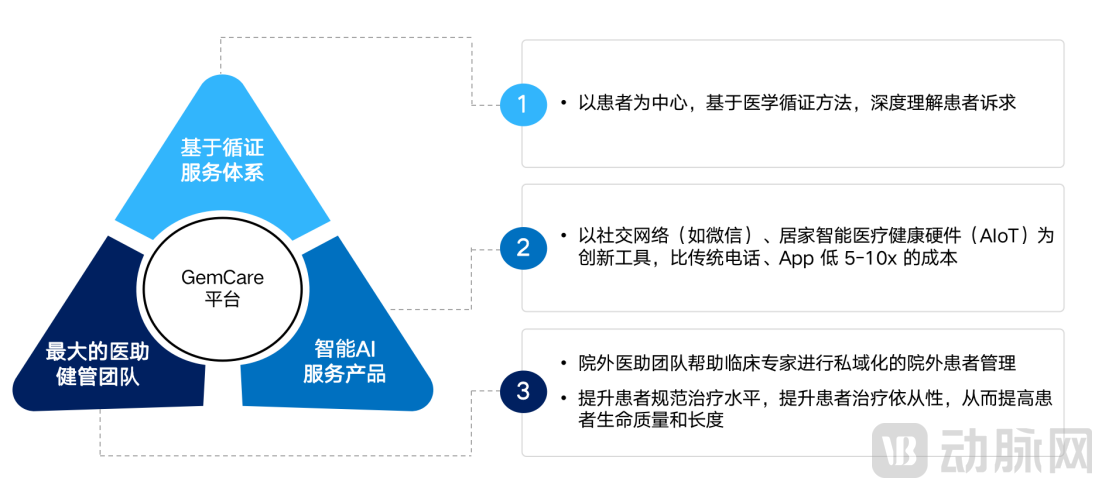
In terms of the patient management service system,Improving management adherence is fundamental, yet poor patient engagement and motivation remain persistent challenges in out-of-hospital patient management. Adhering to a patient-centric approach, Jingli Technology captures patients’ true needs by analyzing data on their diseases, health status, lifestyles, and behavioral habits, thereby establishing a framework grounded in both physiological and psychological needs.An Evidence-Based “Proactive” Health Service System.
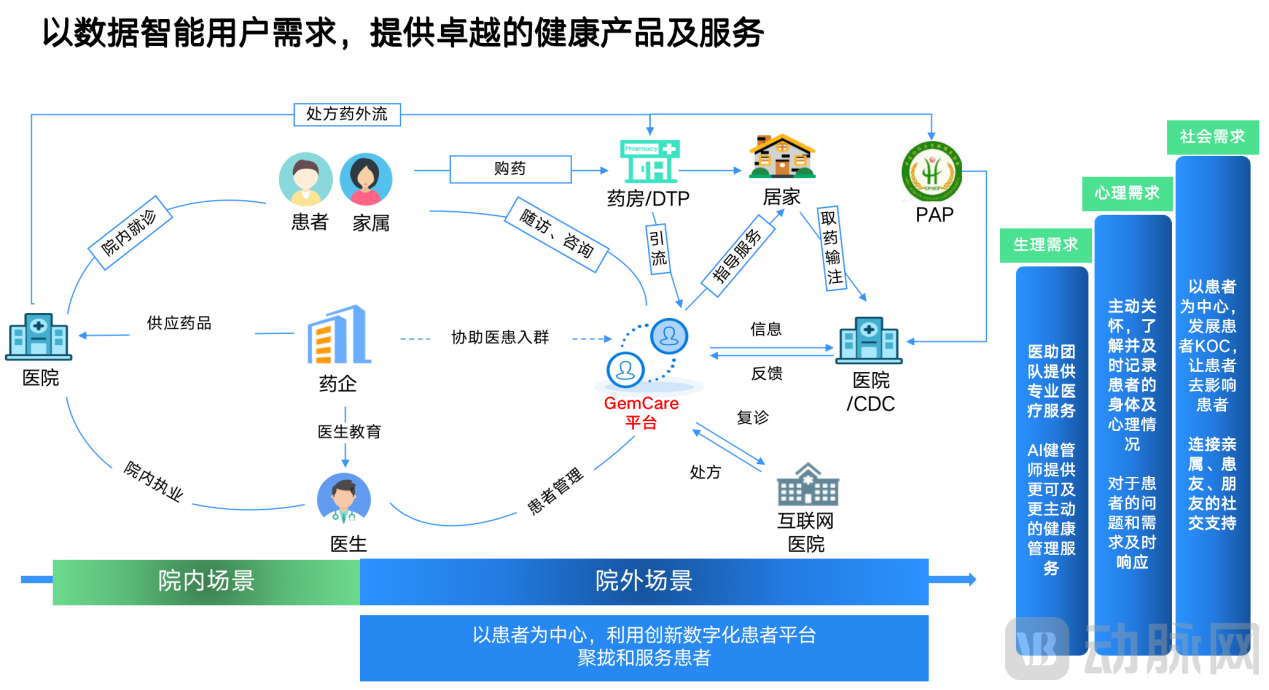
Intelligent Upgrades of Management Tools,Jingli Technology has developed the MagicFlow series of AI product tools, based on WeChat’s private-domain ecosystem, for applications such as community management and automated service engines.Lai Gangbin stated that WeChat boasts 1 billion daily active users and has a low barrier to entry. In particular, WeCom (Enterprise WeChat), which accelerated its development at the end of 2019, features robust underlying APIs and integrates effectively with tools such as Mini Programs, Official Accounts, and Channels. This enables health education, consultations, and medication purchases to be completed entirely within the WeChat platform, facilitating efficient and cost-effective out-of-hospital patient management. “According to statistics, the cost of managing patients via WeChat’s private-domain traffic is 5–10 times lower than that of traditional apps.”
In terms of medical capacity building,Jingli Technology has established a health management team of over 100 professionals by building an in-house medical team and fostering extensive collaborations with experts, associations, enterprises, and hospitals. This professional medical assistant team provides patients with timely and specialized medical services. Proactive engagement and a “respond-to-every-inquiry” approach within patient communities have significantly enhanced the patient service experience. This success is largely attributable to the service workflows and quality control systems accumulated over five years. Furthermore, to address the massive volume of patient inquiries, AI-powered solutions are employed to effectively identify and route questions. This ensures that physicians, medical assistants, and AI health managers receive and respond to relevant queries promptly, each fulfilling their specific roles, thereby greatly improving efficiency. By reviewing and refining insights from vast amounts of Q&A data, the company continuously strengthens its disease knowledge base, significantly enhancing the professionalism of its medical services.
Moreover, data security is the lifeline of out-of-hospital patient management. Jingli Technology places great emphasis on underlying data security and has obtainedCertificate of Filing for Level 3 Security Classification of Information Systems and CMMI Level 3 Certificate, effectively safeguarding patient privacy and data security.
Currently,Jingli Technology has deeply penetrated multiple disease areas, including diabetes, cardiovascular diseases, and oncology, partnering with leading pharmaceutical companies such as AstraZeneca, Roche, and China Resources.
For instance, to address the challenges of low patient adherence and infrequent blood glucose monitoring faced by a blood glucose meter manufacturer in managing out-of-hospital diabetic patients, Jingli Technology designed a comprehensive patient service system. Through targeted special initiatives such as the “28-Day Light Sugar Training Camp,” which incorporated patient incentive mechanisms, check-in systems, and patient story-sharing sections, the program effectively cultivated patients’ habits of regular blood glucose monitoring, increased test strip consumption, and enhanced brand loyalty. Data shows thatDuring the campaign, the brand’s test strip consumption increased by 2.2-fold, community engagement rose by 2-fold, and the check-in rate grew by 1.9-fold.
Lai Gangbin stated: “Out-of-hospital patient services constitute a rapidly growing market, projected to rival the in-hospital patient management market within three to five years.“Therefore, out-of-hospital patient services are a key strategic focus for Jingli Technology in the future.” Moving forward, Jingli Technology will continuously strengthen its patient service system, intelligent product capabilities, and medical expertise, consistently providing precise, accessible, and cost-effective digital solutions for out-of-hospital patient care. Meanwhile, it will deepen its engagement across various disease areas and expand its coverage of conditions, aiming to establish Jingli Technology as a leading digital health platform in China.