

2021 Survey on Physician Behavior Highlights Four Key Industry Impacts Amid Surge in Online Medical Engagement
On August 27, the 48th “Statistical Report on China’s Internet Development” released by the China Internet Network Information Center (CNNIC) showed that as of June 2021, the total number of internet users in China had reached 1.011 billion, forming the world’s largest and most vibrant digital society. Among them, the number of online medical service users reached 239 million, an increase of 24.53 million from December 2020, accounting for 23.7% of the total internet user base.
On the demand side of online healthcare, the user base continues to grow steadily, while on the supply side, online medical resources are rapidly expanding. As of June 2021, there were 1,600 internet hospitals across China, an increase of 500 from December 2020. As the key link between supply and demand and the most direct providers of online medical services, physicians are also accelerating their transition to digital platforms.
On August 26, DXY released the “2021 China Physician Insights Report: Analysis of Online Medical Behaviors” (hereinafter referred to as the 2021 Report). The report highlights that online consultations constitute only a small portion of physicians’ online medical activities, which also encompass acquiring fragmented information, using tools for search and retrieval, engaging in academic learning, producing academic content, and providing public health education.
In today’s vibrant digital society, the internet is creating ever-expanding value opportunities for physicians.
In the medical field, physicians are key decision-makers. Changes in their professional practice and learning pathways also drive transformations within the healthcare industry. Physicians’ decision-making role is primarily reflected in areas such as drug prescribing and the formulation of diagnostic and treatment plans, resulting in strong ties with pharmaceutical and medical device companies. Pharmaceutical companies need to convey information on disease symptoms, treatment options, and product specifications to physicians through marketing efforts, thereby enhancing physicians’ awareness and understanding of specific drugs and medical devices, and ultimately influencing their clinical decisions.
The digitization of physicians’ medical practices presents opportunities for digital marketing. A thorough understanding of the characteristics of online medical behaviors is a prerequisite for executing precise digital marketing strategies.
It is reported that DXY, leveraging its extensive base of physician users and supported by data from its official WeChat accounts and physician tool usage, has released the Report on Physicians’ Online Medical Behavior for two consecutive years. VCBeat synthesized the 2021 and 2020 editions of the Report and identified four major characteristics of physicians’ online medical behavior.
Online behaviors are diverse and continuous.
The 2021 edition of the Report points out that physicians’ online medical activities, categorized by level of engagement, mainly comprise three components: passive information acquisition, active learning, and active content output. These are further subdivided into acquiring fragmented information, studying academic knowledge through online conferences or courses, and disseminating academic content via teaching, question design, and other methods. Providing services to patients or the general public is also a form of knowledge output. Therefore, overall, physicians’ online medical activities are rich in content.
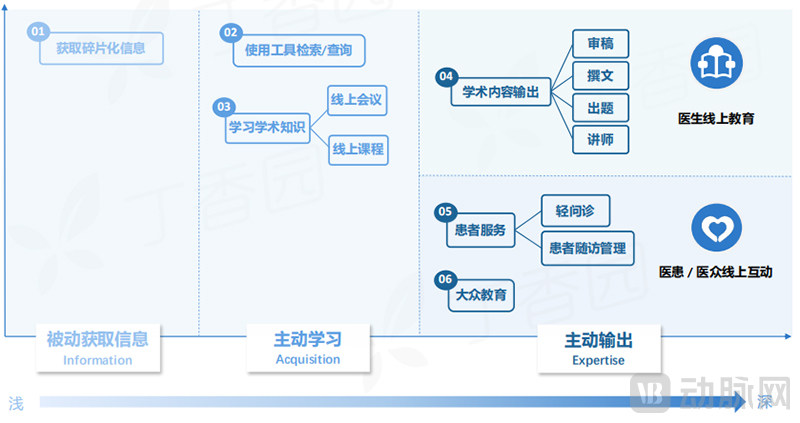
Content of Physicians’ Online Medical Practices, Source: DXY’s 2021 Edition “Report”
For any given medical specialty or disease area, physicians must thoroughly assimilate knowledge, integrating fragmented, systematic learning with clinical practice to enhance their academic proficiency and clinical diagnostic and therapeutic capabilities. This enables them to produce valuable academic content or provide higher-quality services to patients and the public. In terms of individual career trajectories, junior physicians primarily rely on passive information acquisition and active learning, with active output playing a secondary role. As they advance to senior positions and achieve a certain level of academic competence, active output constitutes a significantly larger proportion of their professional activities. Therefore, physicians’ online medical activities fully reflect the continuity of applying learned knowledge to practice and subsequently validating theoretical frameworks through practical application.
The 2021 edition of the Report also compiled statistics on the number of internet platforms used by physicians. Overall, physicians tend to access information through multiple apps, with an average of three medical apps frequently used and two occasionally used per physician. According to Qimai Data, utilization rates for comprehensive medical platforms are generally higher among physicians.
This indicates that, at present, no single internet platform can fully meet physicians’ needs for all online medical activities, and physicians will need to continue using multiple apps simultaneously for a considerable period in the future.
Senior Physicians Have a Strong Desire to Enhance Their Influence
In both editions of the Report, DXY categorized physicians into four groups—Pioneers, Digital Natives, Learners, and Traditionalists—based on the frequency of their online medical activities and the intensity of their need to enhance industry influence and public-facing impact.
The four categories of physicians exhibit distinct characteristics in terms of demand and online medical behaviors. For instance, pioneer physicians are predominantly from first- and second-tier cities and tertiary Grade A hospitals, with a high proportion holding associate senior or higher professional titles. They are keen on engaging in knowledge exchange with peers online and are willing to interact with patients, demonstrating a high frequency of online medical activities. Their primary objectives are to enhance their professional influence within the industry and their public visibility.
“Internet-addicted” physicians are primarily from tertiary hospitals and those at lower tiers, with a high proportion holding intermediate or junior professional titles. They frequently go online and exhibit a high frequency of digital medical activities, but have limited desire to enhance their personal influence.
Learning-oriented physicians and pioneer physicians share many commonalities; they are predominantly from first- and second-tier cities and Grade A tertiary hospitals, with a high proportion holding associate senior or higher professional titles, and they exhibit a strong desire to enhance their personal influence. The difference lies in that learning-oriented physicians are more likely to be surgeons, whose offline responsibilities such as surgeries consume substantial time, resulting in a lower frequency of online medical activities.
Traditional physicians are more likely to originate from second-tier cities and below, as well as from tertiary hospitals and lower-level institutions. A significant proportion hold intermediate or junior professional titles, and they exhibit lower frequencies of online medical practice and less demand for enhancing their professional influence.
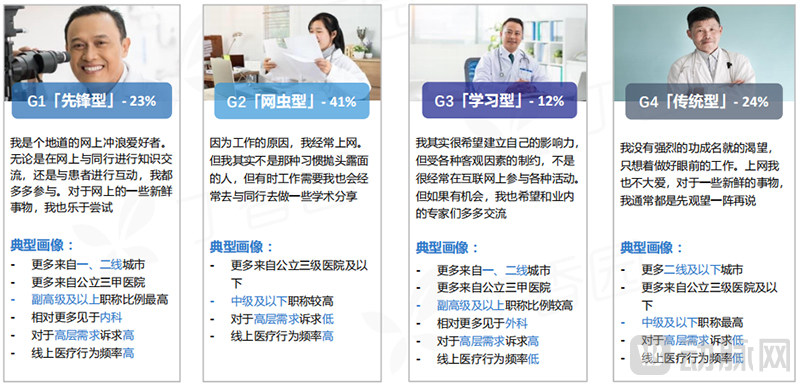
Segmentation of the Physician Population, Image Source: 2021 Edition of the “Report”
A comparison with the 2020 edition of the Report reveals a growing proportion of pioneer and learner physicians, indicating that an increasing number of senior doctors are seeking to engage in online medical activities to enhance their professional influence.
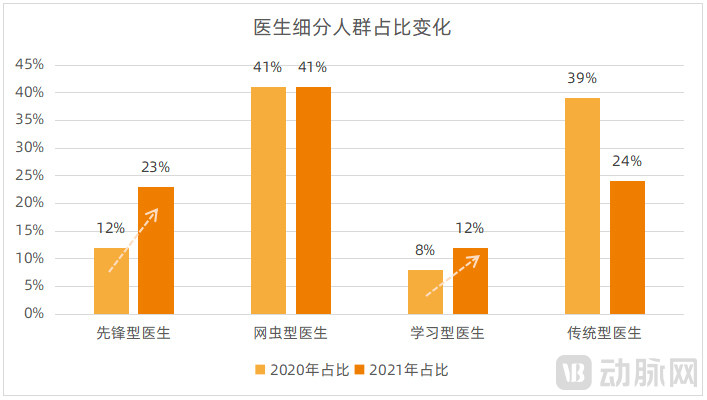 Changes in the Proportion of Doctors by Subgroup, Data Source: DXY 2020 and 2021 Reports
Expanding knowledge is the core and universal demand.
Although physicians engaging in online medical practices have distinct professional profiles, they share a common and most fundamental need: the expansion of knowledge. With medical knowledge continuously evolving, exploration and learning are endless. Few professions exhibit such a strong imperative for continuing education as medicine does.
According to the 2021 edition of the “Report” by DXY, among the three major categories of physicians’ online medical activities, proactive learning accounted for the largest proportion of time spent, at 50%; passive information acquisition accounted for 28%, which is also a means of knowledge acquisition.
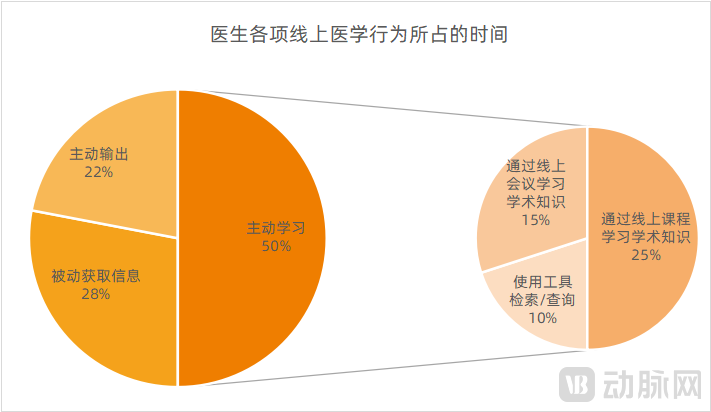 Time Allocation for Physicians’ Online Medical Activities, Data Source: 2021 Edition of the Report
From the perspective of segmented populations, regardless of physician specialty, “expanding knowledge” ranks first among their motivations for engaging in online medical activities.
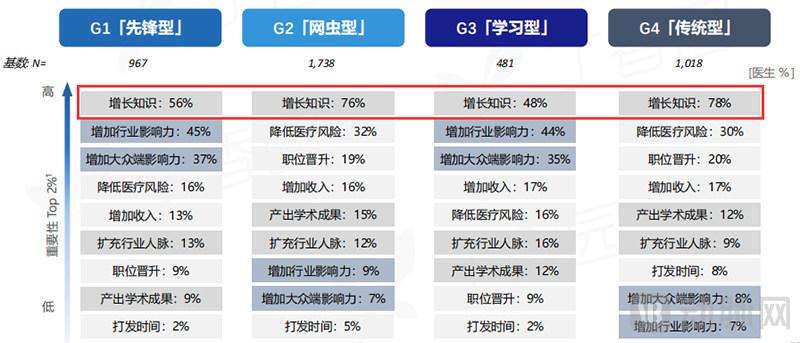 Ranking of the Demand for Online Medical Practices Among Various Subgroups of Physicians, Image Source: 2021 Edition of the "Report"
With regard to specific online medical activities, the objective is also geared toward the expansion of medical knowledge. For instance, drug search and retrieval constitute the primary scenario for physicians’ use of digital tools, followed by needs related to clinical guidelines and disease-specific information. Meanwhile, physicians’ demands for these tools have expanded from simple “database queries” to “clinical knowledge learning.”
Online consultations represent a form of proactive engagement by physicians. Even so, they have stimulated doctors’ desire for learning. Physicians hope that online consultation platforms will evolve into new learning hubs. More than 80% of doctors conducting online consultations expect the platforms to provide training content on advances in disease areas, sharing of new drugs and therapies, and case discussions, to further enhance their medical skills and proficiency. Meanwhile, a small subset of physicians also expresses a need for training on the platform’s evaluation system and operational procedures.
It is evident that physicians have high expectations for online platforms to enhance their knowledge and are actively putting this into practice.
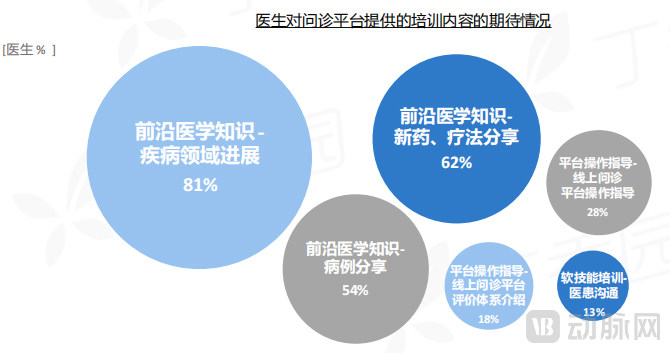
Doctors’ Expectations for Training Content Provided by Online Consultation Platforms, Source: 2021 Edition of the “Report”
"Online consultations by physicians still have significant room for growth."
As internet hospitals across China accelerate their development, the prevailing industry perception is that physicians are overwhelmed by both online and offline workloads. However, DXY’s 2021 Report, based on primary survey data, reveals that there is still substantial room for growth in online consultations.
Specifically, physicians currently engaged in online consultations are not satisfied with the current consultation volume. In addition to providing online consultations on internet healthcare platforms, nearly half of these physicians also conduct health education on topics such as disease management and medication usage, while approximately one-third engage in patient management via these platforms. Currently, the weekly number of inquiries received by physicians falls short of their expectations; they aspire to achieve a median weekly volume of 50 online consultations.
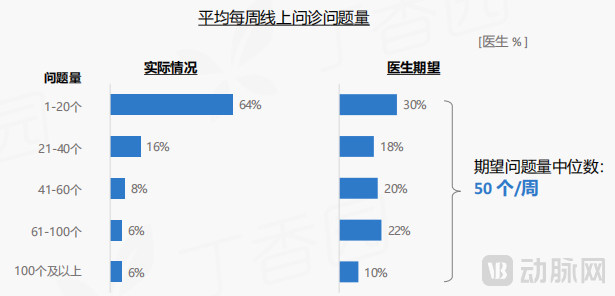
Number of online consultations conducted by physicians per week. Image source: 2021 Edition of the “Report”
Meanwhile, the Report also found that more than two-fifths of doctors conduct fewer than three hours of online consultations per week, with only 15% spending more than 20 hours on such consultations. In reality, doctors can readily allocate time for online consultations, indicating there is still room for growth in the volume of online consultations on platforms. Most doctors are willing to spend 10–20 minutes per consultation.
Gaining insights into the characteristics of physicians’ online medical practices can offer valuable implications for precision digital marketing.
First, comprehensive platforms should be leveraged to efficiently reach a broader physician audience, necessitating a diverse media mix.Given the diversity and continuity of physicians’ online medical activities, as well as their high loyalty to platforms with strong comprehensive capabilities, integrated platforms offering features such as fragmented information push, online conferences, online courses, teleconsultations, and public health education can rapidly reach a larger physician audience. By leveraging such platforms, it is also possible to grow alongside physicians, establishing long-term relationships that span from the knowledge acquisition phase to the output of professional achievements.
Meanwhile, given the current state of development of internet healthcare platforms, partnering with a single platform may not fully meet the need to reach physician users; companies must establish collaborative relationships with multiple leading platforms.
Secondly, cutting-edge academic achievements are delivered to physicians through highly professional knowledge platforms.Medical knowledge is highly specialized, and the primary objective of physicians’ online medical activities is to expand their expertise. When enterprises engage in digital marketing to convey knowledge about pharmaceutical or medical device products to physicians, they can ensure the professionalism of content related to their own offerings, which indeed aligns with physicians’ interests; however, the quality and quantity of such content are limited. What physicians truly need is cutting-edge academic research in disease treatment fields that integrates knowledge of pharmaceuticals or medical devices. Acquiring and screening these frontier achievements requires a high level of professional expertise.
Fully mobilize the enthusiasm of leading physicians to create a demonstration effect that influences more doctors.The Report has pointed out that both pioneer and learning-oriented physicians are senior-level practitioners whose primary aspiration is to enhance their influence, and they serve as the main force in knowledge dissemination. In digital marketing, fully addressing these physicians’ needs can set a demonstrative example for other physicians.
In addition, as the country promotes tiered diagnosis and treatment, it is placing significant emphasis on enhancing the clinical capabilities of primary care physicians. With the support of internet platforms, the dissemination of medical knowledge from large tertiary hospitals to grassroots levels will be accelerated. Enterprises can also seize this trend and formulate corresponding strategies for lower-tier markets.
There is still room for optimization in consultation channels.There is still room for improvement in physician users’ satisfaction with the services provided by current online consultation platforms. Platforms qualified as internet hospitals can create a closed-loop system that seamlessly integrates medical care and pharmaceutical services across the entire process, making them an indispensable channel for digital marketing. “Physician-driven patient acquisition” is a common strategy used by online consultation platforms to expand their base of physicians and patients. However, the 2021 edition of VCBeat’s report found that high consultation volumes and substantial income from consultations are key factors in attracting and retaining physicians on these platforms. This implies that while platforms rely on physicians to bring in patients, physicians are also more inclined to choose platforms with larger patient bases and higher consultation volumes.
Clearly, when implementing digital marketing strategies, one should not rely solely on the “physician-referral” model. A more effective approach is to identify platforms with a large patient base and strong appeal to physicians.
Changes in physicians’ behavioral habits are a long-term process. Gaining insights into their online behavior patterns and leveraging these trends for digital marketing does not necessarily yield immediate results. However, under the wave of digitalization, physicians’ online medical activities will undoubtedly become more frequent and diverse, and the resulting industry transformations will grow increasingly pronounced over time. Digital marketing must be both proactive and targeted. Failure to act is akin to rowing against the current: if you do not advance, you will fall behind.