

From Humble Pharmacy to Global Orthopedic Leader: Smith & Nephew's 160-Year Journey and Strategic Evolution

Smith and Nephew
Medical Device Manufacturer
Smith & Nephew is a British multinational medical device manufacturing company that holds a global leadership position in four key areas: orthopedic joint reconstruction, advanced wound management, sports medicine, and trauma. Its orthopedics division ranks fourth worldwide in revenue.
Smith & Nephew’s history can be traced back to the family business of Thomas James Smith, who opened a small pharmacy in Hull, UK, in 1856, marking 160 years of heritage. After his death in 1896, his nephew Horatio Nelson Smith took over the management of the company.
A few days after the outbreak of World War I in 1914, Horatio Nelson Smith met with the French President’s envoy in London. As a result, the company secured a contract to supply the French Army with surgical instruments and field dressings worth £350,000 within five months. During World War I, the number of employees grew from just over 50 to more than 1,200.
In 1937, Smith & Nephew was founded and listed on the London Stock Exchange under the ticker symbol SN. In 2001, it became a constituent of the FTSE 100 Index, meaning that Smith & Nephew was included among the 100 companies with the highest market capitalization on the London Stock Exchange.
In 1953, Smith and Nephew developed a special low-temperature plaster for the climbers who first summited Mount Everest, enabling them to seal and preserve their camera film. This research also facilitated the development of important industrial products.
In 1977, the first moist wound healing product—the OPSITE dressing—was developed. In 1986, major acquisitions were made of Richards, a specialized orthopedic medical company based in Memphis, USA, and Dyonics, a specialist arthroscopy company based in Andover, USA. In 1995, the acquisition of Acufex Microsurgical Inc. established the company as a market leader in arthroscopic surgical equipment.
By the late 1990s, Smith & Nephew had evolved into a diversified healthcare group with a global presence, encompassing a wide range of medical devices, personal care products, and both traditional and pioneering wound care therapies.
In 1998, Smith & Nephew announced a major restructuring, consolidating all its operations into three business lines: Wound Management, Endoscopy, and Orthopaedics.
In 1999, the Group was listed on the New York Stock Exchange under the stock ticker symbol SNN.
OXINIUM was first launched in 2001 to enhance the performance and extend the service life of total joint replacement systems; an Emerging Markets division was established in 2008 to expand understanding and research of advanced global medical technologies; and PICO, the first pocket-sized single-use system, was developed in 2011, revolutionizing the negative pressure wound therapy market...
Today, Smith & Nephew is a publicly listed company headquartered in London, with 18,000 employees and operations in more than 120 countries worldwide. As of August 18, 2021, the company’s shares traded at over $38 per share on the New York Stock Exchange, giving it a total market capitalization of $16.807 billion.
Smith & Nephew reported revenue of $5.138 billion in 2019, with a gross margin of approximately 74%. In 2020, impacted by the pandemic, its revenue fell to $4.560 billion. It is evident that the company’s annual revenue had been growing steadily for four consecutive years prior to the pandemic.
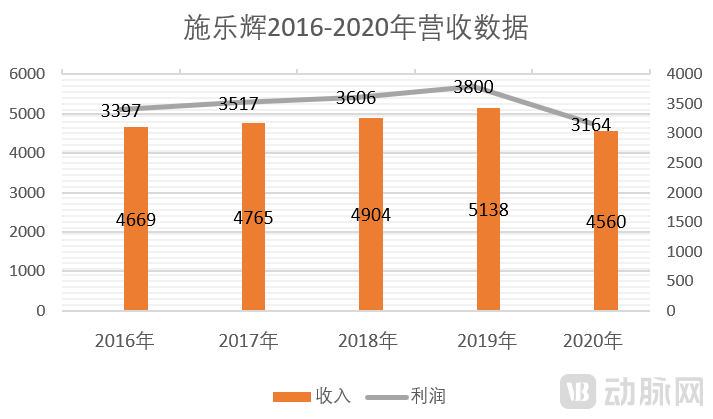
Smith & Nephew’s Revenue from 2016 to 2020 (in million USD); data sourced from the official website
According to the official website's Q2 2021 financial report, as of July 3, 2021, second-quarter revenue reached $1.335 billion, representing a 48% increase in sales. Revenue for the first half of the year amounted to $2.599 billion, a year-on-year growth of 27.8%. The company expects full-year 2021 revenue to grow by 10%-13%, surpassing the $5 billion mark once again.
Smith & Nephew currently has three major business lines: Orthopaedics Joint Reconstruction, Sports Medicine & ENT, and Advanced Wound Management. In 2020, Orthopaedics generated $1.917 billion in revenue, Sports Medicine & ENT $1.33 billion, and Advanced Wound Management $1.31 billion.
Orthopedic Reconstruction Products: Primarily include knee implant products for specialized knee replacement surgeries; hip implants for hip reconstruction; and trauma and extremities products.
Sports Medicine and ENT: Includes a comprehensive range of instruments, technologies, and implants required for minimally invasive joint surgery; arthroscopy-assisted technologies, including fluid management systems, high-definition cameras, digital image capture, and scopes to facilitate joint visualization; radiofrequency, electromechanical, and mechanical resection devices; and handheld instruments for the removal of damaged tissue; as well as ENT solutions.
Advanced Wound Management: Includes care products for the treatment and prevention of acute and chronic wounds, such as leg ulcers, diabetic ulcers, pressure ulcers, burns, and surgical wounds; advanced wound bioactives, including biological agents and other bioactive technologies for debridement and skin repair/regeneration, as well as regenerative medicine products; and advanced wound devices, such as conventional and single-use negative pressure wound therapy systems.
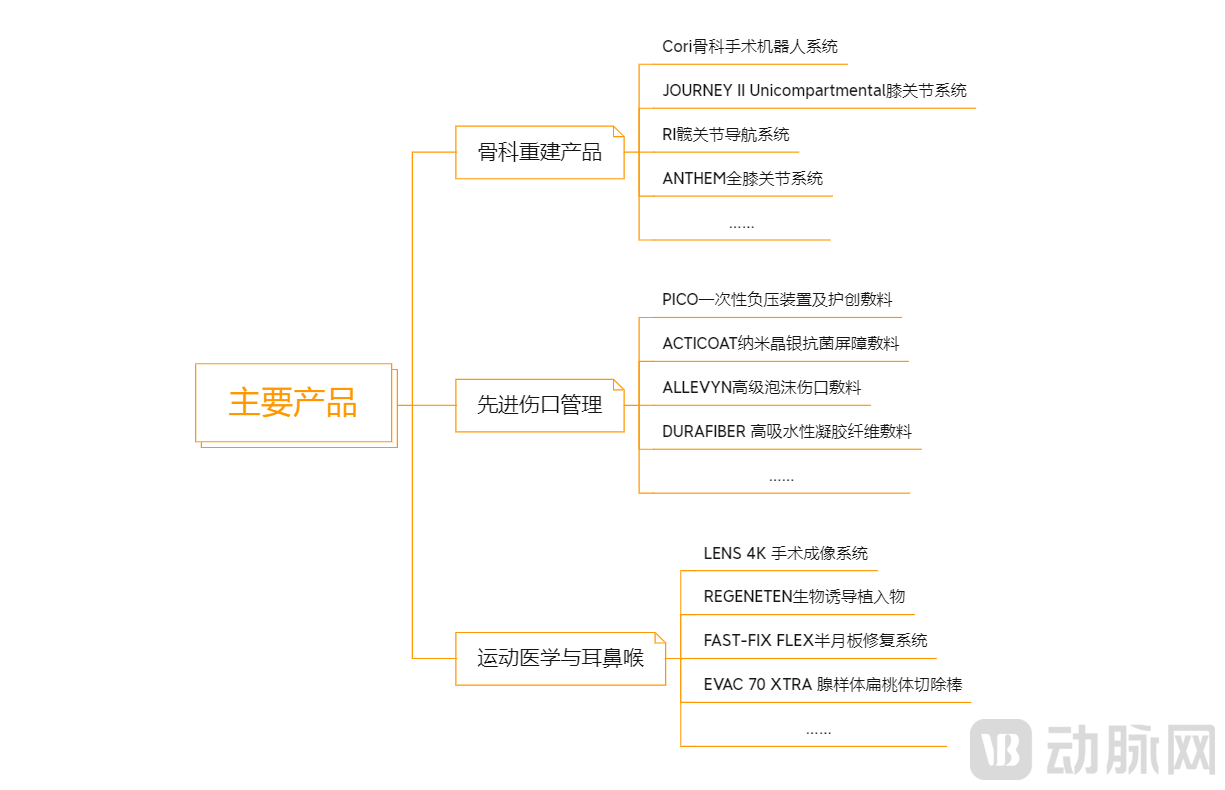
Core Products of Smith & Nephew’s Three Major Business Lines (Compiled from the Company Website)
To date, Smith & Nephew has over 509 registered trademarks globally and more than 120 products on the market. Its orthopedics division ranks fourth worldwide, and the company continues to increase its investments to expand its global market presence.
From a family-run pharmacy to an international giant with annual revenues nearing $5 billion, how did Smith & Nephew reach this stage? By analyzing Smith & Nephew’s product portfolio and market trends, we have summarized the following five strategic initiatives:
1Unlocking the Potential of Product Portfolios
Smith & Nephew adopts a related diversification strategy to unlock the potential of its product portfolio. By continuously enhancing and complementing the supporting infrastructure for its core products, the company has established a comprehensive product ecosystem that maximizes the functionality and efficiency of its core offerings, thereby securing a competitive edge in the international market.
For example: In July 2020, the new-generation orthopedic surgical robot system, Cori, received FDA clearance and was officially launched in the United States. Reportedly, Cori is indicated for total knee arthroplasty and unicompartmental knee arthroplasty. Compared with previous similar products, Cori offers higher operational efficiency and faster surgical procedures.
Building on this foundation, the company launched the Real Intelligence™ digital surgery solutions suite. It is an ecosystem that combines robotics, software, and data to improve outcomes and create a seamlessly connected care journey. “Real Intelligence embodies how Smith & Nephew thinks, innovates, and reimagines surgery,” said Skip Kiil, President of Smith & Nephew Orthopaedics.
The company also launched RI.INSIGHTS, a global data analytics platform designed to elevate the standard of care in robot-assisted joint replacement surgery. It is the world’s first platform enabling orthopedic surgeons to benchmark their robotic surgery experiences against those of other users, thereby optimizing surgical planning and improving Patient-Reported Outcome Measures (PROMs).
Previously, surgeons were unable to access complex robotic surgery data for individual patients or conduct benchmark comparisons with peers. RI.INSIGHTS collects intraoperative and postoperative data during robot-assisted surgeries and presents these data alongside postoperative patient outcomes, enabling surgeons to gain in-depth insights into their robot-assisted surgical procedures.
The RI.INSIGHTS platform is a significant addition to the Real Intelligence portfolio of products and solutions, which includes the CORI Surgical System. Skip Kiil stated, “The launch of RI.INSIGHTS further enhances the Real Intelligence platform and underscores our progress in digital health. We are excited that surgeons are beginning to leverage the clinical data collected by this platform to drive improvements in patient outcomes.”
“The RI.INSIGHTS platform maps out the future of robotics and digital surgery,” said Dr. Nathwani, Orthopaedic Consultant at Imperial College Healthcare NHS Trust and The London Clinic. “By leveraging the extensive personalized intraoperative and postoperative planning data provided by RI.INSIGHTS, we can analyze surgical parameters to deliver optimal, customized robotic solutions for our patients.”
2Acquire complementary companies to expand into high-growth sectors
In recent years, Smith & Nephew has been refining its industrial layout and supplementing its business lines through acquisitions. To date, the company has completed 24 acquisitions. The most recent acquisition occurred in September 2020, when the company acquired Integra Lifesciences Holdings Corporation’s extremities orthopedics business for $240 million in cash. This acquisition aligns with the company’s strategy of investing in high-growth segments. It significantly strengthens the extremities orthopedics business by adding specialized sales channels, complementary shoulder replacement and upper and lower limb product portfolios, and a new product pipeline.
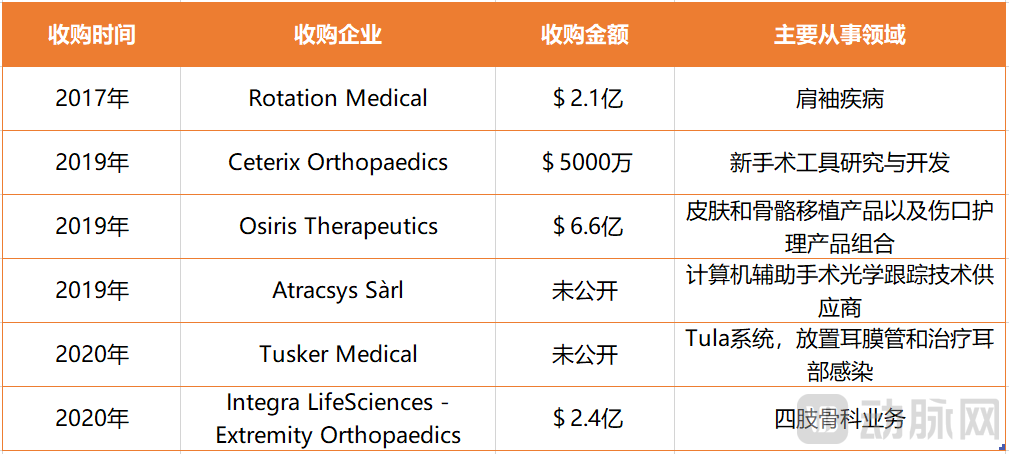
Smith & Nephew: Partial Corporate Acquisitions
In 2019, Smith & Nephew completed the acquisition of the U.S. orthopedic company Ceterix Orthopaedics and its meniscus repair system, NovoStitch Pro, for $50 million. Statistics show that over 1.2 million patients in the United States undergo surgical treatment for meniscal tears each year, with only 15%–20% receiving meniscus repair rather than meniscectomy. The company stated that, leveraging the advantages of products such as NovoStitch Pro and FAST-FIX 360, this proportion has the potential to double.
In the same year, Smith & Nephew announced the acquisition of U.S. medical product manufacturer Osiris Therapeutics and its regenerative medicine portfolio for $660 million, aiming to expand its presence in the medical products manufacturing sector. Osiris Therapeutics’ offerings include skin and bone graft products, as well as a wound care portfolio. This acquisition will enable the company to compete more effectively with large-scale U.S. corporations, including Johnson & Johnson.
Smith & Nephew CEO Namal Nawana stated, “Osiris Therapeutics’ significant presence in the rapidly growing regenerative medicine market will strengthen our product portfolio and advance our wound care business. In the future, Smith & Nephew is well-positioned to deliver more sustained innovation across additional channels and indications. We are seeking a rapidly growing portfolio backed by robust clinical evidence to address the urgent needs of the healthcare market.”
This acquisition also highlights Nawana’s excellence in strategic planning. It is understood that half of Smith & Nephew’s revenue comes from the U.S. market, and due to Nawana’s expertise in deal-making and his understanding of the U.S. market, he was appointed as the company’s Chief Executive Officer in April 2018.
3Establish Strategic Partnerships to Continuously Expand Global Influence
Due to the impact of the COVID-19 pandemic, approximately 250,000 patients worldwide were unable to undergo orthopedic surgeries as scheduled. To safely resume surgical services, on March 4, 2021, Smith & Nephew and the digital health company Huma launched a remote patient monitoring application for orthopedic surgery, enabling surgeons to prepare patients preoperatively through remote monitoring.
The application combines orthopedic expertise from Smith & Nephew with digital technology from Huma, enabling patients to safely undergo total joint replacement surgery. Patients receive preoperative guidance, access virtual rehabilitation resources, and can conduct video consultations with their surgical teams, while clinicians monitor patient recovery and utilize health data to assess surgical readiness. Importantly, a COVID-19 symptom tracker screens patients for signs of infection both before admission and after discharge, providing reassurance to both patients and healthcare staff.
Simon Tarry, Managing Director for the UK, Ireland, and Nordic regions at Smith & Nephew, stated: “We believe this significant development will have a direct impact on the field of surgery. In the short term, the application supports the safe resumption of surgical procedures for patients during the pandemic; in the long term, it has the potential to transform how surgeons and patients manage surgical pathways in the future.”
The application is currently being piloted at several hospitals in the UK, with plans to expand to an additional 10 NHS (National Health Service) and private hospitals in the coming weeks.
4Prioritizing Physician Training
In September 2019, Smith & Nephew announced a partnership with VirtaMed to provide surgical simulation training as part of its portfolio of surgical equipment training and educational products.
VirtaMed, headquartered in Switzerland, is a world-leading developer of arthroscopy simulation solutions and offers state-of-the-art simulators for minimally invasive surgical training. Smith & Nephew’s original surgical instruments will be adapted and integrated into new simulation modules for knee, shoulder, and hip arthroscopy, covering advanced surgical techniques such as rotator cuff repair and meniscal repair.
All of Smith and Nephew’s new simulators are accessible via Connect, the cloud-based management platform from VirtaMed. This enables physicians to continue their training online and gain a deeper understanding of the benefits of Smith and Nephew’s surgical techniques, even when they are away from the simulators.
In May last year, Smith & Nephew’s Global Digital Medical Education Program received accreditation from the Royal College of Surgeons of England. Launched in March 2020 in response to the COVID-19 pandemic, the program aims to support the professional development of surgeons by providing educational webinars on the safe and effective use of Smith & Nephew products and surgical techniques. Within the first month of its launch, the program attracted healthcare professionals from more than 110 countries, with each session drawing between 400 and 850 participants. In total, over 11,000 healthcare professionals attended the webinars to gain insights from industry-leading experts on topics related to the Orthopaedics and Sports Medicine franchises.
5Sustainable Development Strategy: Upholding Social Responsibility
In July 2021, according to the Tennessee Department of Environment and Conservation (TDEC), Smith & Nephew joined the Tennessee Green Star Partnership. The Tennessee Green Star Partnership is an environmental leadership program designed to recognize manufacturers committed to sustainability and continuous improvement throughout their operations.
The company stated that its sustainability strategy serves as the guiding framework for its five strategic priorities and forms the foundation of its medium-term value creation plan. “Our sustainability strategy reflects the importance of sustainability across social, environmental, and economic dimensions. As a for-profit enterprise, our challenge lies in fostering economic growth while simultaneously minimizing our impact on society and the environment.”
In early 2021, global orthopedics giant Johnson & Johnson’s DePuy Synthes announced that its orthopedic surgical robot product, VELYS™, had received U.S. FDA approval for market launch.
In recent years, competition in the orthopedic surgical robotics market has intensified. A year ago, Smith & Nephew’s next-generation orthopedic surgical robotic system, Cori, received FDA clearance and was officially launched in the United States. Other orthopedic giants, including Stryker, Medtronic, and Zimmer Biomet, have long entered the field with their robotic systems for joint and spine surgeries.
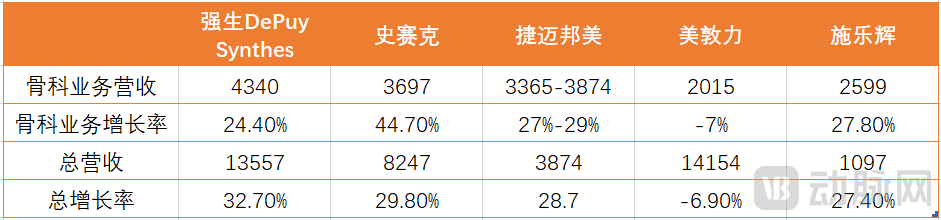
Revenue Performance of the Top Five Orthopedic Companies in H1 2021 Data Source: Official Financial Reports on Company Websites
As the first orthopedic giant to make substantial investments in robotic technology, Stryker has leveraged its MAKO joint robot as a “trump card” not only to propel its previously sluggish orthopedics business back onto a rapid growth trajectory but also to firmly establish its leadership position in the orthopedic surgical robotics industry.
Following the tremendous success of Stryker’s MAKO, Medtronic launched the Mazor X Stealth robotic-assisted spinal surgery platform, and Zimmer Biomet introduced the ROSA robotic-assisted total knee arthroplasty platform in 2019.
The increasing clarity of overseas markets has made domestic companies even more eager to enter them. In recent years, multiple Chinese companies have entered the robotics sector, with most still in the early stages of development, including Tinavi Medical Technologies, MicroPort Scientific Corporation, Weigao Group, and Rosenbot. Among these, Tinavi Medical Technologies has been developing orthopedic surgical robots for a relatively longer period; it is the first company in China and the fifth globally to commercialize orthopedic surgical robots.
In July 2020, Tinavi Medical Technologies officially listed on the STAR Market, becoming the first surgical robotics company on this board; prior to this, there were no publicly listed companies in this sector on China’s A-share market. To date, Tinavi has launched and commercialized two surgical robotic systems: “TiRobot 1.0” and “TiRobot 2.0.” Other innovative enterprises have also accelerated their R&D, clinical trials, and financing activities.
According to QYR’s survey results, the global orthopedics market size reached RMB 24.79 billion in 2018 and is projected to reach RMB 441.41 billion by 2025, with a compound annual growth rate (CAGR) of 4.4%.
Amidst the significant market growth trend, how should domestic companies secure a foothold in the unprecedentedly fierce market competition? Looking globally, answers may be found in the actions of multinational giants. Whether it is their pursuit of product differentiation, product portfolio strategies, market tactics, or R&D innovation, these areas offer valuable insights. As Dr. Nie Hongxin, Managing Partner at Shanlan Capital and a senior medical device investor, stated, over the past five years, mature multinational corporations such as Stryker, Medtronic, and Johnson & Johnson have engaged in internal incubation, external acquisitions, and strategic collaborations. What future trends in orthopedic robotics and artificial intelligence have they identified that we may have overlooked? These are phenomena worthy of attention from both the industry and investment communities.