

Yidu Tech Participates in NEJM Publisher's First China Medical AI Symposium: Human-AI Collaboration Holds Promise and Prospect
On August 29, 2021, at AIMS 2021—the inaugural medical AI symposium hosted in China by the publisher of The New England Journal of Medicine—Yan Jun, Chief AI Scientist at Yidu Tech; Liu Sidong, Researcher at the Australian Institute of Health Innovation; Guo Tiannan, Distinguished Researcher at Westlake University; Li Weimin, President of West China Hospital, Sichuan University; He Zhiyang, Dean of the iFlytek Medical Research Institute; Xu Qiang, Founder of GenomiCare; and Chen Hang, Co-founder of Xingkangyuan, participated in Session III. They provided an in-depth sharing of Yidu Tech’s experience in leveraging big data technologies to process de-identified electronic medical records from diverse sources.
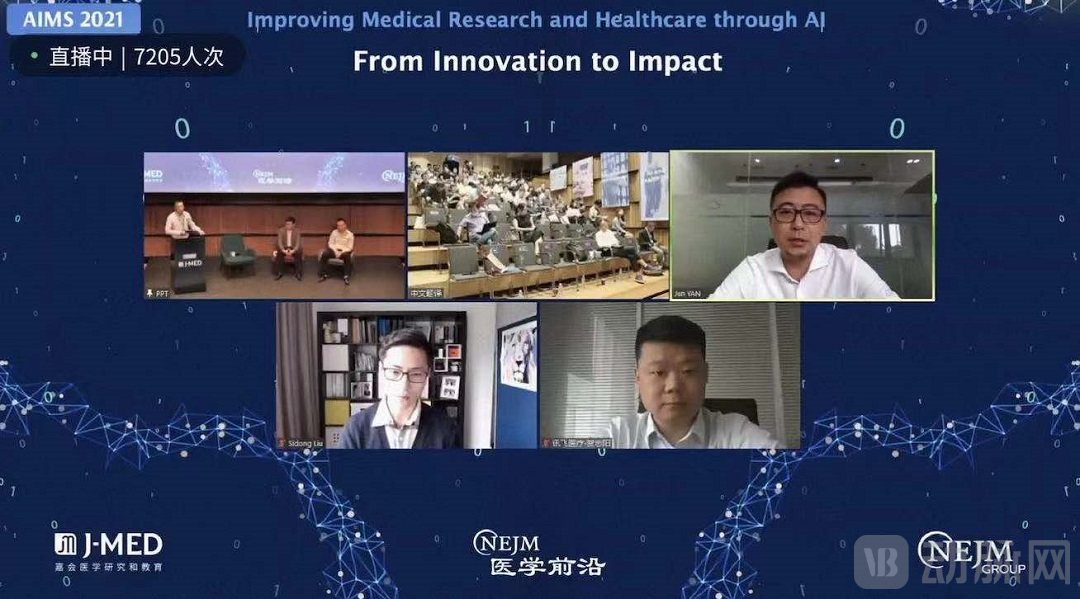
The medical AI market is vast and holds broad prospects, but its development faces significant challenges amid the current explosion of medical big data. For healthcare, data governance is the primary hurdle. Electronic medical records (EMRs) generated by different hospitals, different departments, and even different physicians within the same department vary greatly in format and content, making it highly difficult to achieve effective utilization of complex medical data. Yan Jun introduced that structured and standardized data governance is the key to enabling effective application, thereby laying the foundation for building AI models for intelligent healthcare.
To better assist medical institutions in carrying out lawful data governance of multi-source heterogeneous big data, Yidu Tech has collaborated with experts, research institutions, societies, and associations to publish more than ten standardized datasets. These include the Standardized Dataset for Colorectal Cancer, the Standardized Dataset for Gastric Cancer, the Standardized Dataset for Ophthalmology, the Standardized Dataset for Leukemia, the Standardized Dataset for Myelodysplastic Syndromes (MDS), the Standardized Dataset for Aplastic Anemia, the Standardized Dataset for Lymphoma, the Standardized Dataset for Myeloma, the Standardized Dataset for Thrombosis and Hemostasis, and the Standardized Dataset for Hematopoietic Stem Cell Transplantation, among others, with additional datasets currently being compiled.

Furthermore, a key challenge in data extraction is natural language processing. Yan Jun noted that hospital data are primarily recorded for clinical documentation rather than for research or AI model training. Manual field extraction is characterized by significant time and labor consumption, as well as poor accuracy. In addition to employing natural language processing technologies, Yidu Tech has incorporated medical reasoning to ensure the scientific rigor of identification and extraction. By applying extensive medical logic to the standardization and structuring processes, the company meets the requirements of medical research.
Medical AI is intrinsically linked to health and life-critical outcomes, distinguishing it from other industries. Therefore, how to better unlock the value of clinical data while safeguarding patient interests, thereby driving innovation and breakthroughs in medical AI, remains an indispensable theme in its development.
Although medical AI has made significant progress in recent years, it still faces many challenges in terms of consistency, transparency, and judgment in difficult cases within the healthcare field. Yan Jun stated that the challenges of medical AI mainly stem from two translation processes and one computational process.
First, how to assist medical institutions in transforming machine-unreadable data into computable data is precisely the direction in which Yidu Tech’s research and technology platform is striving. Second, regarding new drug development, how to comprehensively utilize dispersed data through a “usable but invisible” approach requires construction in both technology and mechanisms. Third, how to enable humans to understand the results generated by machines and solve problems collaboratively. In the foreseeable future, AI will require human-machine collaboration for a considerable period.
Yan Jun stated that collaboration in medical AI offers not only a promising landscape but also greater potential, and he expressed his belief that precision medicine will benefit everyone.
As a pioneer in the field of medical artificial intelligence, Yidu Tech has prioritized long-term development since its establishment in 2014. By investing substantial human and material resources into technology, the company has focused on addressing critical pain points in the intelligent transformation of the healthcare industry. It has developed its proprietary “Medical Brain”—YiduCore. Leveraging the integration of medicine and AI technologies, Yidu Tech provides comprehensive services to hospitals, government agencies, pharmaceutical and medical device companies, research institutions, insurance companies, and patients. These services span clinical practice, medical research, public health, new drug R&D, and health management, thereby driving digital transformation within the industry. Yidu Tech is committed to enhancing the quality and efficiency of medical services, facilitating the transition from “informatization” to “intelligentization,” and helping to build a new ecosystem for smart healthcare.
Through its deep engagement in the medical artificial intelligence industry, Yidu Tech leverages data governance and services as its technological engine to build an open platform for technical capabilities for hospitals, supporting multi-scenario applications and driving the transition of healthcare services from “informatization” to “intelligentization.” In response to the pandemic, Yidu Tech acted swiftly by launching a City Immunity Platform, which aided dynamic epidemic control and economic recovery in multiple regions.
Furthermore, Yidu Tech is actively participating in the digitalization of public health infrastructure across various regions, facilitating intelligent management and decision-making in regional healthcare. Currently, the level of technological innovation in the health and hygiene sector has become a key indicator of a nation’s overall scientific and technological prowess. Amidst the wave of “New Infrastructure” development, and with its growing capabilities and sustained investment in research and development, Yidu Tech is progressively expanding its boundaries and more robustly driving the advancement of the health industry.