

Fudan University and Tianyu Elder Care Forge Strategic Partnership to Deliver Professionalized Solutions for China's Aging Society
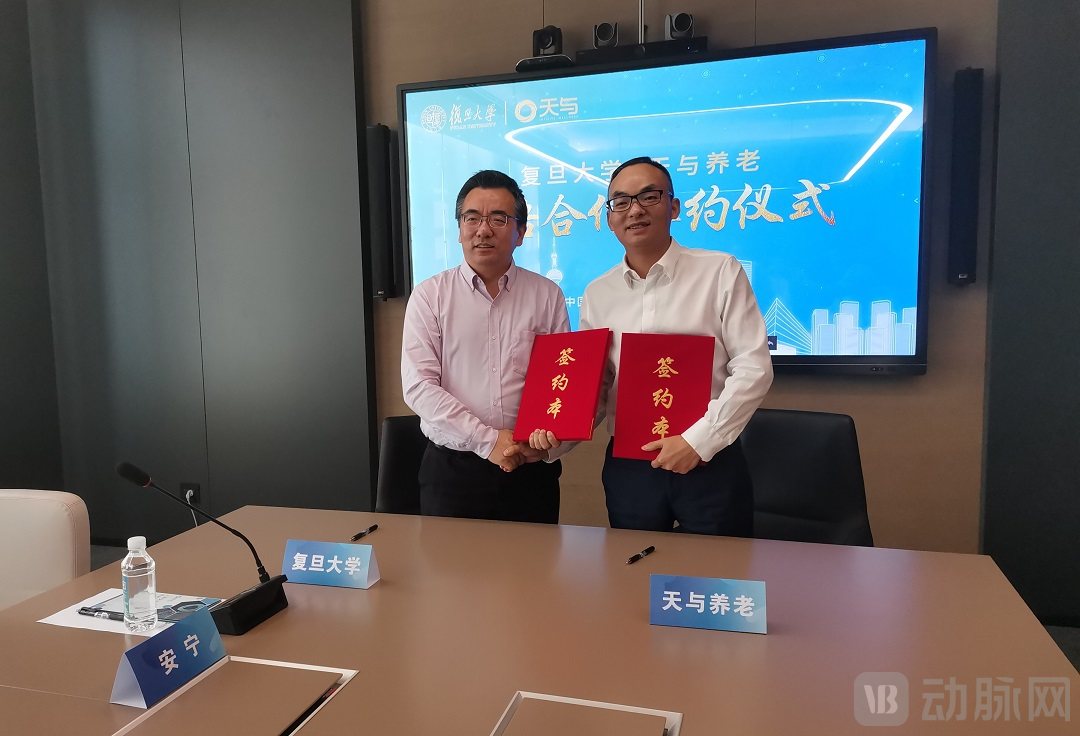
(2021Year(September 1) Fudan University, a top-tier academic institution in China, and Tianyu Elderly Care, a well-known domestic digital technology company specializing in elderly care, signed a strategic cooperation agreement in Shanghai. The two parties will leverage their respective strengths to work closely together, establishing specialized and systematic solutions for elderly care in China, which is rapidly aging.
The results of China’s Seventh National Population Census in May 2021 showed that the population aged 60 and above had exceeded 264 million, accounting for 18.70%. According to data released at a press conference by the Ministry of Civil Affairs in October 2020, China’s elderly population is projected to surpass 300 million during the 14th Five-Year Plan period. In response to the rapid onset of population aging, governments at all levels have attached great importance to elderly care services. They have formulated a national list of elderly care services for the entire elderly population, expanded the coverage of welfare subsidy systems for older adults, and promoted the orderly advancement of long-term care insurance pilots. Furthermore, they have called for accelerating the establishment of an elderly care service system that covers all older persons, provides universal and equitable access, features clear rights and responsibilities, and ensures sustainability. However, at the current stage, China’s elderly care service framework remains incomplete, with significant disparities in development between urban and rural areas. Social anxiety about aging is widespread, and “difficulties in elderly care” have become one of the most urgent and pressing concerns for the general public.
“The state attaches great importance to elderly care. As a professional academic and research institution, Fudan University needs to leverage its expertise to address many practical issues in China’s elderly care sector, such as an imperfect elderly care system and the lack of standards for elderly care services,” introduced Professor Chen Honglin from the School of Social Development and Public Policy at Fudan University. “Our in-depth collaboration with Tianyu Elderly Care is driven by their strong capabilities in developing digital elderly care systems, as well as their service framework that integrates home-based, community-based, and institutional care, supported by digital tools and a terminal network composed of thousands of elderly care assistants. On one hand, our expert team can conduct in-depth research on the front lines of various business models within the elderly care industry. On the other hand, our research findings can be rapidly implemented and receive feedback through Tianyu’s digital systems, tools, and service networks. In this way, our ‘Gold Standard System’ for elderly care possesses strategic height, breadth across all business sectors, and depth in practical implementation!”
Another key member of the project team is Professor An Ning, who serves as the head of the “Intelligent Elderly Care Information Technology Innovation and Talent Introduction Base” at Hefei University of Technology. This base has been designated by the Ministry of Science and Technology as a National International Science and Technology Cooperation Base for “Smart Elderly Care.” Professor An Ning stated, “Smart elderly care is an inevitable trend in the development of China’s eldercare industry. Tianyu Elderly Care has extensive experience in introducing and integrating global elderly care technologies and possesses advanced digital systems. Through deep industry-academia-research collaboration, we will apply more technologies to elderly care services and transform the entire traditional eldercare industry through digitalization and technological innovation. These efforts hold significant meaning and value for the rapid development of elderly care in China!”
Bu Jiangyong, founder of Tianyu Elderly Care, stated, “When discussing elderly care, prior to 2015, people primarily associated it with nursing homes and care beds. Today, home-based and community-based elderly care are gradually becoming the mainstream models in China. With the advent of the ‘silver tsunami,’ many sectors related to daily necessities—clothing, food, housing, and transportation—are ripe for reinvention. In the era of the ‘100-Year Life,’ elderly care is no longer merely about service provision; rather, it involves delivering multi-scenario, comprehensive solutions tailored to the aging process. Currently, the development of elderly care in China faces numerous challenges, such as an overreliance on labor-intensive basic services, incomplete service systems and standards, low levels of digitalization, and limited application of technology. Since its inception, Tianyu has been committed to exploring how its presence can drive progress and transformation within the elderly care industry. We have increased R&D investment, digitally transformed industry processes, and enhanced operational efficiency and service transparency. By introducing globally leading technologies, we aim to leverage technology to improve the quality of life for older adults. Through our deep collaboration with Fudan University and leveraging its top-tier expert think tank, we aspire to establish a scientific smart elderly care system from a higher strategic perspective, set gold standards for the elderly care service industry, and strive to provide high-quality health and wellness services for Chinese seniors.”
It is reported that the deep collaboration between Fudan University and Tianyu Elderly Care has assembled a robust, multidisciplinary team of experts. In addition to relevant expert teams from Fudan University, the group includes Vice Dean Wang Hong from the School of Rehabilitation at Shanghai University of Medicine & Health Sciences; Professor Yin You, Deputy Director of the Department of Neurology at Changzheng Hospital; and Fei Cailian, Head Nurse and Supervisor Nurse in the Department of Neurology at Changzheng Hospital, as well as a member of the Psychology Group of the Shanghai Nursing Association. The concerted efforts of these leading figures across multiple fields and disciplines, together with a pioneering enterprise in digital technology-enabled elderly care, signal that China’s elderly care sector is poised to embrace a future defined by professionalized solutions.