

From Unknown Entrepreneur to Orthopedic Titan: Zimmer Biomet's Century-Long Rise
Zimmer Biomet
Medical Device R&D Manufacturer
Warsaw, a small town in Indiana, USA, is the world’s largest cluster of orthopedic device manufacturers. The orthopedic industry in Warsaw and its surrounding areas employs 13,000 people and generates $40 billion in annual revenue, accounting for half of the global orthopedic manufacturing market. As a result, Warsaw is hailed as the “World Capital of Orthopedics.” Many top international orthopedic companies originated in Warsaw and have established their headquarters there, including Zimmer Biomet.
In 1927, Justin O. Zimmer served as the national sales manager at DePuy in Warsaw, a company manufacturing orthopedic splints. He had attempted to persuade his employer to add lightweight aluminum splints to the product line. However, after repeated unsuccessful attempts, a disheartened Zimmer resolved to start his own venture. Upon learning of Zimmer’s intentions, Mrs. DePuy, the widow of the founder, immediately poured cold water on his plan, stating, “You will never succeed in business; you are just a nobody.”
Today, Zimmer Biomet Holdings, once mockingly dubbed an “unknown,” is listed on the New York Stock Exchange (ticker symbol: ZBH). It operates in 25 countries worldwide, with products sold in more than 100 countries and regions. The company employs 17,500 people, reported sales exceeding $7 billion in 2020, ranked 414th on the Fortune Global 500, and has emerged as one of the top five global orthopedic companies.
Here, VCBeat attempts to outline Zimmer Biomet’s development strategy, inviting you to explore the growth trajectory of this orthopedic device giant.
A Glorious Journey of Exponential Performance Growth
In 1927, Zimmer secured two investors, and two of his colleagues decided to join him in the venture—one serving as factory manager and the other as secretary and bookkeeper. The first production facility was established in the basement of Zimmer’s home, marking the birth of Zimmer Manufacturing Company. Despite the modest startup conditions, Zimmer produced its first batch of products within two months. Mrs. DePuy, who had initially been dismissive, was quickly proven wrong by Zimmer’s early success.
In just seven months, Zimmer’s sales surpassed those of DePuy, reaching $160,000. With strong demand for its new aluminum splints, the company quickly relocated to a building on North Detroit Street in Warsaw and secured its first order from a Scottish surgeon, thereby entering the international market.
As the wheels of time rolled forward, the U.S. economy in the 1930s was impacted by the Great Depression and war, dragging most businesses into a slump and keeping unemployment rates persistently high in American society.During these challenging ten years, Zimmer Biomet chose not to lay off employees and maintained steady growth in sales performance.In 1930, Zimmer Biomet’s sales exceeded $200,000, and by 1942, they had surpassed the $1 million mark.
In 1951, Zimmer, the founder of Zimmer Biomet, passed away while vacationing in Florida, but the company bearing his name has continued to grow.That year, Zimmer Biomet’s sales exceeded $2 million, and Dr. Palmer Eicher developed theThe first hip prosthesis was sold by Zimmer BiometIn 1958, Zimmer also developed and manufactured the Harrington spinal instrumentation for the treatment of scoliosis, with annual sales climbing to $4 million by 1960.
With the establishment of its internal export department and the growth in overseas sales, Zimmer continued to expand and strengthen, planning in 1968 to enlarge its manufacturing facility in Warsaw. Two years later, Zimmer had a total workforce of 522 employees and achieved sales revenue as high as $27.2 million.
Such impressive performance is bound to attract significant market interest.In 1972, Zimmer was acquired in one fell swoop by Bristol-Myers, a healthcare company headquartered in New York., continued to develop new products and expand its business. In the 1980s, with the support of CAD/CAM technology, Zimmer BiometRateFirst, develop products such as hip prostheses and total knee systems.
In 1990, Zimmer established its new headquarters in Warsaw. In 1997, Ray Elliott, former Vice President of Bristol-Myers Squibb, joined Zimmer as President. Driven by new developments and the aging of the baby boomer population, Zimmer once again experienced rapid sales growth.
By 2000, Zimmer Biomet’s workforce had expanded to 3,200 employees, with sales approaching $1 billion, marking a new turning point:On August 7, 2001, Zimmer was spun off from its parent company, Bristol-Myers Squibb. After 30 years, Zimmer resumed operations as an independent company and began trading on the New York Stock Exchange, marking what was at the time the largest spin-off in the history of the orthopedic industry.
Zimmer Biomet at that timeBusiness includes knee implants and hip implantsand fracture management products, as well as other surgical products such as tourniquets and blood management systems. With a market capitalization exceeding $5 billion, the company embarked on a more than 20-year journey of growth through mergers and acquisitions, culminating in the 2015 acquisition of Biomet, a leading orthopedic medical device company, for $13.4 billion.Renamed Zimmer Biomet, it became the world's second-largest orthopedic company.
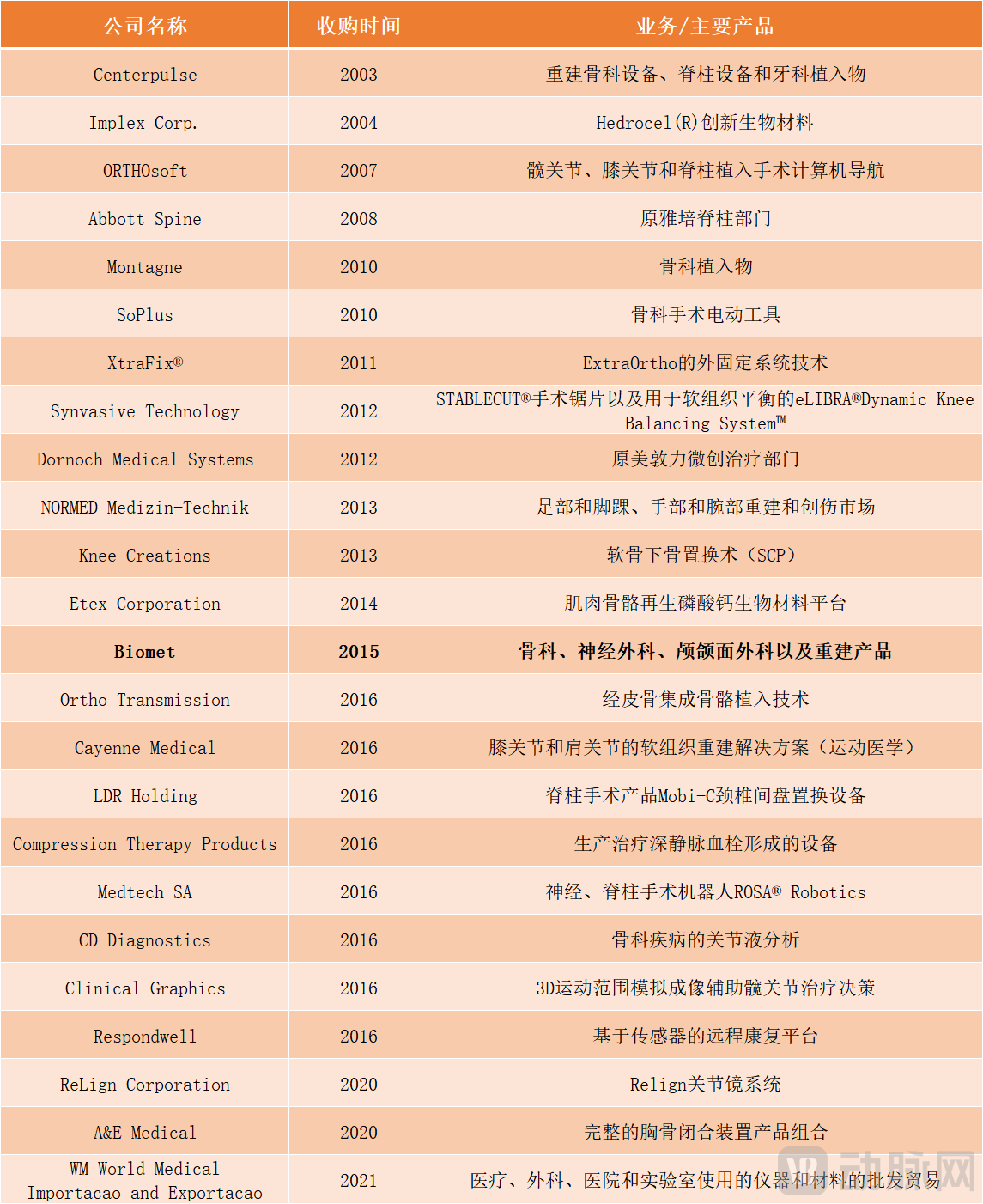 Zimmer Biomet's M&A History | Compiled by VCBeat
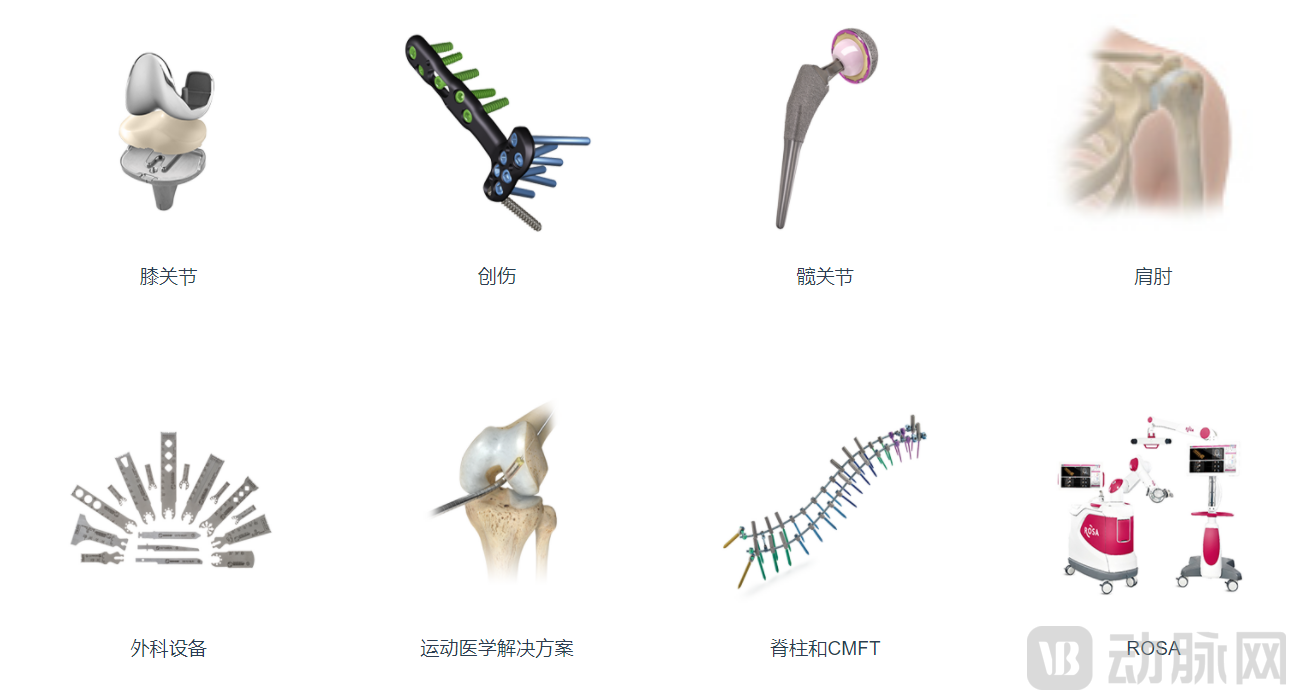 Zimmer Biomet’s Core Business. Image source: Zimmer Biomet (China) official website
Strategic Layout in Orthopedic Surgical Robots and Digitalization
It is evident that since the turn of the millennium, Zimmer Biomet has engaged in nearly annual acquisition activities. Particularly following its merger with Biomet, the company’s acquisition momentum remained strong; in 2016 alone, it completed eight acquisitions, a figure nearly equivalent to the total number of acquisitions made in the preceding decade. The most significant among these was the acquisition of Medtech, a company specializing in orthopedic surgical robots.
Orthopedics is one of the earliest fields to adopt surgical robots and remains a focal point for current research and industrialization. Consequently, surgical robots have frequently featured in the strategic layouts of major orthopedic companies in recent years, such as Stryker’s Mako, Medtronic’s Mazor, Johnson & Johnson’s VELYS, and Smith & Nephew’s Cori.
Zimmer Biomet followed suit. In 2016, Zimmer Biomet acquired the French surgical robotics company Medtech, owner of the ROSA Brain and ROSA Spine robot-assisted surgical platforms, for no less than $1.32 billion. Following the acquisition, Zimmer Biomet developed the ROSA ONE® based on the ROSA Brain and ROSA Spine platforms.
ROSA ONEIt is a dual-function robot that supports an application providing both neurosurgical and spinal surgical procedures on a single system, which can improve the utilization rate of surgical robot platforms, reduce procurement, service, maintenance, and costs, and simplify the overall learning curve for operating the robot.
Among them,ROSA ONE Spine(The Spine) system includes a robotic assistant and a suite of navigation technologies that enhance the accuracy and predictability of implant and instrument placement. The ROSA ONE Spine robotic arm features six degrees of freedom, enabling stable and flexible access to the surgical site, while its “dynamic tracking” capability allows the robot to move in real-time synchronization with patient movements.
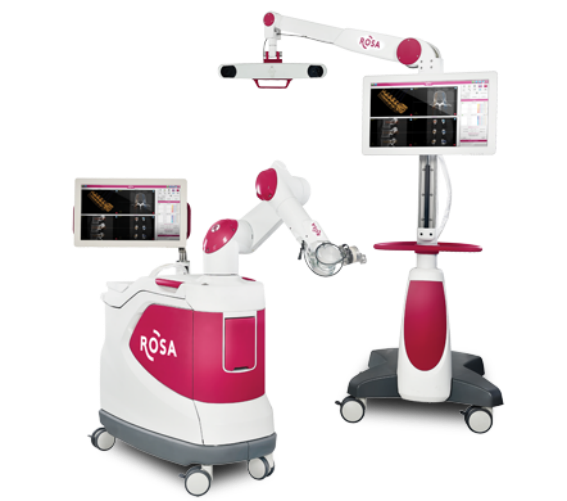 ROSA ONE Spine Image source: Zimmer Biomet official website
Furthermore,Zimmer Biomet has also developed in the knee and hip segments, which account for the largest business volume.ROSA® Knee System, ROSA® Partial Knee System, and ROSA® Hip System surgical robotsRosa® Orthopedic Surgical Robotics System enables continuous data analysis during knee and hip surgeries to assist in complex decision-making, allowing surgeons to control and maneuver surgical instruments using computer and software technologies.
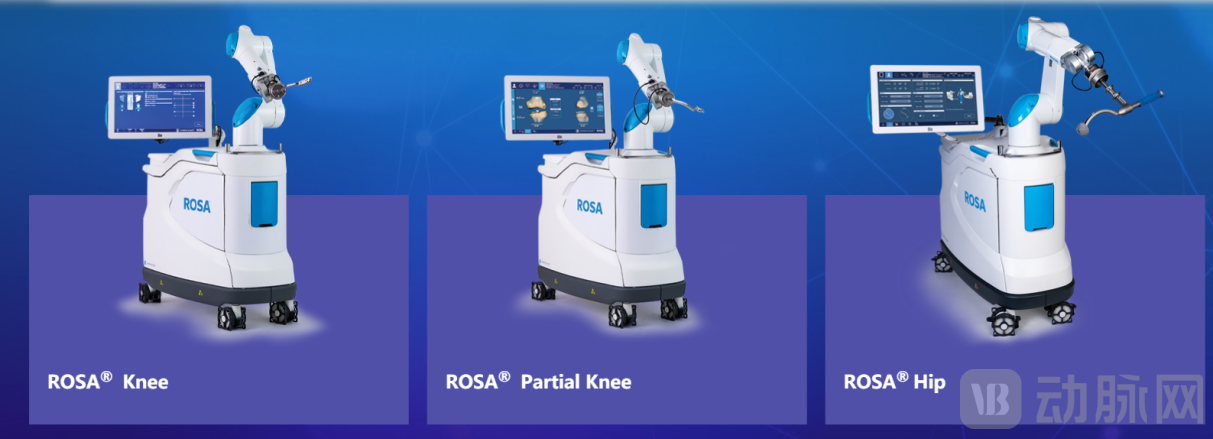 ROSA® Orthopedic Surgical Robot Series. Image source: Zimmer Biomet official website
As of Q1 2019, Zimmer Biomet’s ROSA Knee and ROSA One both received FDA approval, with ROSA Knee officially entering the knee joint market.Zimmer Biomet has thus become the first company to receive FDA approval for brain, spine, and knee surgical robots.。
Zimmer Biomet CEO Bryan Hanson also stated during the third-quarter earnings conference call on November 5, 2019: “Our innovation focus has shifted, with a more proactive turn toward technologies centered on implants, such as robotics, mini-robotics, informatics, and solutions that enhance operating room efficiency. Although implants remain at the core of our work, our vision is to deliver a complete, customer- and patient-centric ecosystem.”
In addition to developing hardware products such as surgical robots, Zimmer Biomet has long been committed to building digital platforms and software.
On March 31 this year, Zimmer Biomet announced the launch of the ZBEdge™ Connected Intelligence Suite, which integrates robotics and digital health technologies. The suite includes the ROSA® Robotic Platform, Signature™ ONE Surgical Planning, visualization and navigation systems such as Zimmer Biomet iAssist®, Mymobility® remote care and patient management system, OrthoIntel orthopedic data analytics intelligence platform, and the Omni™ Surgical Suite integrated operating room.
Among them, the MyMobility® application enables data-driven patient support through preoperative and postoperative procedures. Developed in 2018 by Zimmer Biomet in collaboration with Apple Inc., the program is compatible with Apple Watch and is designed to help improve recovery outcomes for patients undergoing joint replacement surgery.
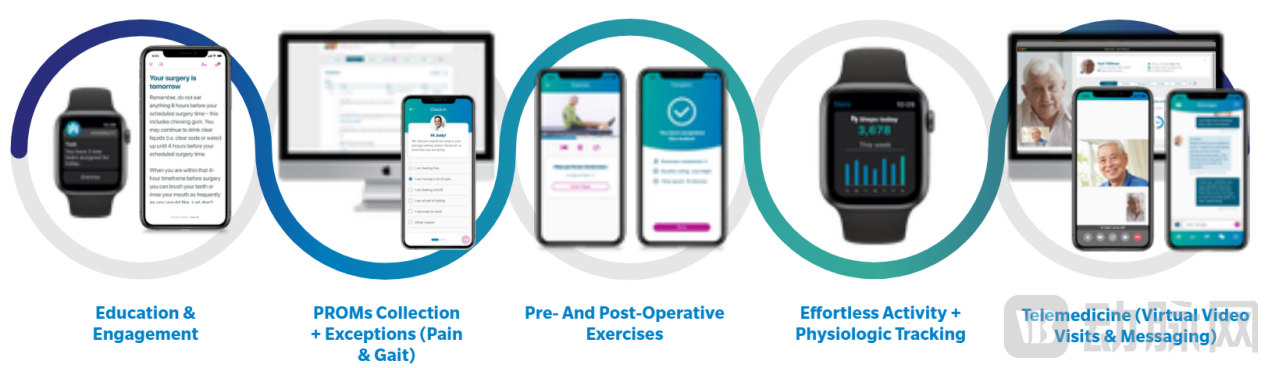 MyMobility also includes features such as patient education, data monitoring, activity tracking, and remote consultations.
Approximately 1 million knee and hip replacement surgeries are performed annually in the United States, a figure projected to rise to 3.5 million by 2035. Zimmer Biomet is one of the largest manufacturers in this field. In 2016, Zimmer Biomet acquired RespondWell, an interactive tele-rehabilitation business, which has also served as a significant driver for this initiative.
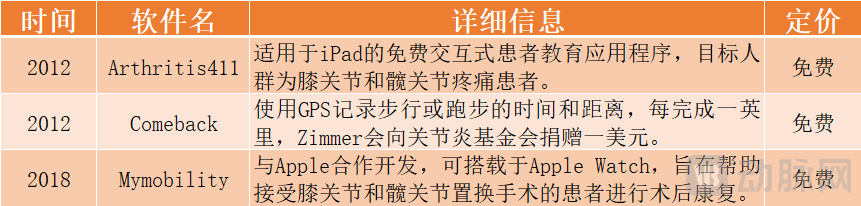
This is not the first digital software developed by Zimmer Biomet. As early as 2012, Zimmer Biomet successively launched the activity tracking app Comeback and the patient education platform Arthritis411. In January 2021, the FDA announced new regulations regarding Software as a Medical Device (“SaMD”) and Artificial Intelligence/Machine Learning (“AI/ML”), and Zimmer Biomet revealed that it would closely monitor developments in this field going forward.
Strategic Transformation: Spine Business to Be Spun Off for IPO
In recent years, impacted by supply chain disruptions and the COVID-19 pandemic, Zimmer Biomet’s sales performance has not seen significant growth. In 2020, the company experienced a notable decline in performance, with revenue dropping to $7.025 billion—the lowest in the past five years—representing a 12% decrease compared to 2019.
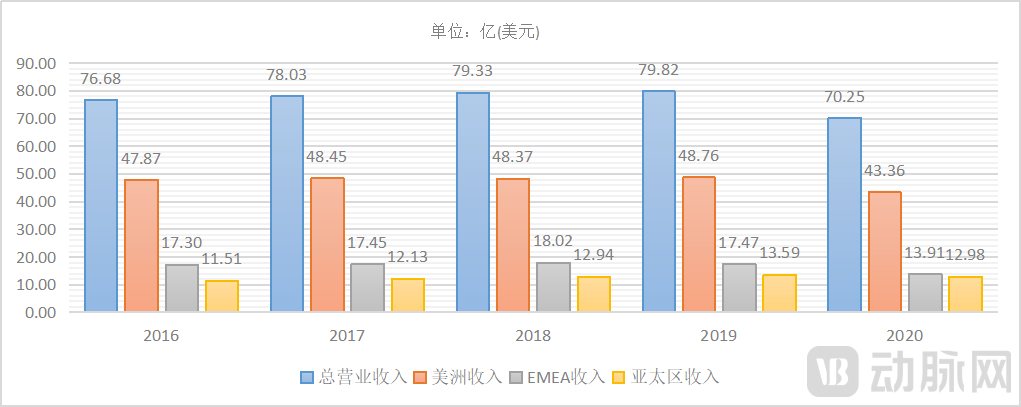
Zimmer Biomet’s Revenue Performance Over the Past Five Years | Data Source: Zimmer Biomet Annual Reports
In 2019, Zimmer Biomet shifted its focus away from acquisitions, concentrating instead on ensuring smooth operational performance and advancing product development. In August 2019, the company’s non-fusion scoliosis treatment system, The Tether, received FDA approval. In September, Zimmer Biomet launched the Persona Revision Knee System. By early 2021, all devices marketed by Zimmer Biomet in the United States had undergone FDA review or received FDA approval.
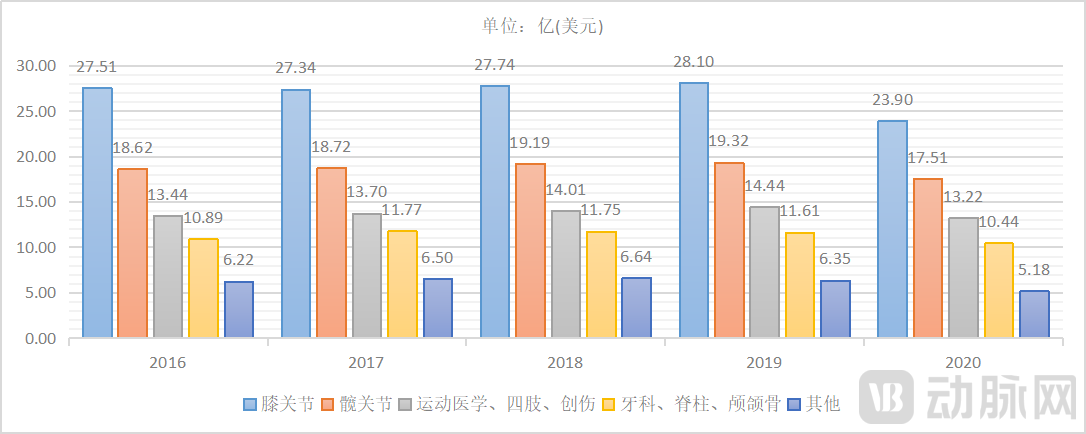 Zimmer Biomet’s Revenue by Business Segment Over the Past Five Years Data Source: Zimmer Biomet Annual Financial Reports
However, spinal revenue underperformed in 2019. At the end of the third quarter, Zimmer Biomet reported that net sales for the nine-month period increased by 1.9% to $5.8 billion. Sales in the Americas remained flat, while sales in the Asia-Pacific region grew by 6.3%. The company’s knee sales increased by 2.5%, and hip sales rose by 2.3%.Spine and craniomaxillofacial sales declined by 1.6%, making Spine the only division within Zimmer Biomet’s orthopedics business to experience a performance downturn.
At the time, Zimmer Biomet CEO Bryan Hanson stated that the situation would improve in 2020, saying, “We will complete the final step of integrating our spine business and leverage new product lines, such as the recently launched TrellOss 3D-printed interbody system, the upcoming ROSA Spine robotic technology, and the recently approved scoliosis correction system.”
However, impacted by the pandemic, Zimmer Biomet not only failed to achieve revenue growth in its spine business in 2020, but also saw an overall decline in total revenue. For Zimmer Biomet, it is crucial to rapidly emerge from the pandemic’s adverse effects and secure greater and more optimized resource allocation to drive innovation in its core profitable businesses. Thus,Zimmer Biomet Has Taken an Important Step Toward a More Streamlined Business:Business Spin-off。
The first step is to establish a new position, Chief Transformation Officer (CTO). On January 19, 2021,Zimmer Biomet announced that Ellison (Ellie) M. Humphrey, former Vice President of Business Transformation at Medtronic, will serve as Chief Transformation Officer,and reports directly to Bryan Hanson, President and Chief Executive Officer. Previously, Humphrey spent eight years at McKinsey & Company, providing consulting services to corporate clients with a focus on growth, commercial, operational, and business development strategies.
On February 5, 2021, concurrently with the release of its 2020 financial report,Zimmer Biomet Announces Spin-off of Spine and Dental Businesses to Merge and Form a New Independent Publicly Listed Company (NewCo) to optimize resource allocation and drive market leadership, enabling the company to focus more on high-growth, high-priority areas.
Zimmer Biomet noted that the gross margin of its combined spine, dental, and bone healing businesses was slightly below the company’s overall average. Following the spin-off, Zimmer Biomet will remain a leader in the orthopedic market segments, including knee, hip, sports medicine, extremities and trauma (SET), and craniomaxillofacial and thoracic (CMFT), which represent a total addressable market of $43.5 billion.
Zimmer Biomet expects the spin-off to improve the company’s financial position. The company reported pro forma revenues of $6.96 billion and $6.128 billion for 2019 and 2020, respectively. The transaction is expected to deliver approximately 50 basis points of revenue growth and increase the company’s adjusted EBITDA and operating margin by approximately 125 basis points during Zimmer Biomet’s five-year strategic transformation plan.
Zimmer Biomet in China
Zimmer Biomet is one of the earliest orthopedic companies to enter the Chinese market. In 2010, it acquired Beijing Montaigne Medical Device Co., Ltd., then the largest domestic manufacturer of artificial joints, thereby launching its local production model in China. The company’s China headquarters is located in Shanghai, with offices in Beijing, Chengdu, and Guangzhou, and manufacturing facilities in Zhejiang (formerly Biomet), Changzhou (formerly Biomet), and Beijing (formerly Montaigne).
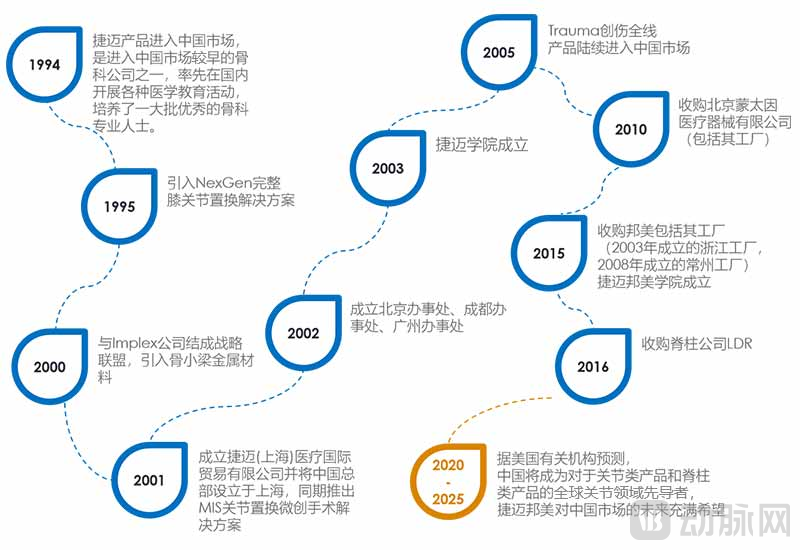 Zimmer Biomet’s Development Timeline in China | Source: Zimmer Biomet (China) Official Website
U.S. agencies predict that from 2020 to 2025, China will become the world’s largest market for joint and spinal products. Statistical data indicate that the domestic orthopedic device market is approaching a scale of RMB 50 billion, with joint devices accounting for a significant share; the market shares for joint and spinal products are 44.75% and 23.39%, respectively. As the global leader in the joint sector, Zimmer Biomet is highly optimistic about the future of the Chinese market.
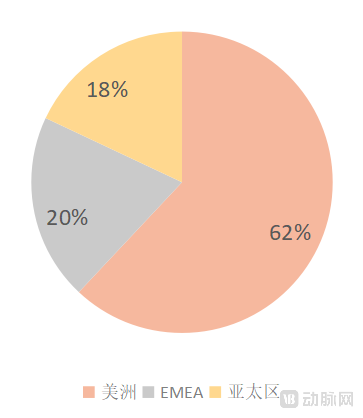
2020 Global Revenue Share Data Source: Zimmer Biomet Annual Report
However, the current landscape of centralized volume-based procurement for orthopedics in China is severe. Both domestic and international orthopedic giants are striving to identify a second growth curve and undergo strategic transformation, making the field of orthopedic surgical robots an inevitable arena for competition among orthopedic companies. Stryker’s Mako joint surgery robotic system has been widely used worldwide, capturing a 9% global market share, and has already obtained certification from the National Medical Products Administration (NMPA). In contrast, Zimmer Biomet’s joint surgery robotic system has not yet entered the Chinese market.
As fierce competition unfolds, how much market share will Zimmer Biomet capture in China’s orthopedic robotics sector? Can it streamline operations to drive revenue growth following its strategic transformation, and continue to lead the joint reconstruction field in the next era? Only time will tell.