Home Zhangjiang Pharma Valley Innovation Highlights: First Prescriptions, Clinical Approvals, and New Indications
Zhangjiang Pharma Valley Innovation Highlights: First Prescriptions, Clinical Approvals, and New Indications

Mar 30, 2026 17:34 CST Updated 17:34
Hansoh Pharma

Pharmaceutical Research, Production, and Sales

图片

Recently, Zhangjiang Pharm Valley's innovation achievements have accelerated further, with the first global prescription for a Class I innovative drug issued. In addition, several companies are speeding up the development of innovative drugs covering treatment areas such as oncology and immunology, promoting more Chinese innovations to benefit patients.


Image


Image

And誉 Pharma's Class 1 Innovative Drug Beijiemai® Accelerates Benefits for TGCT Patients

Recently,Zhangjiang Medipost and Yingshuo PharmaceuticalsHansoh Pharma's self-developed Class I innovative drug, Pimitinib Hydrochloride Capsules (Beijiemai®), has been prescribed for the first time globally, accelerating benefits for TGCT patients in China.


As the first and currently only Class I innovative drug approved in China for the treatment of TGCT, Beijiema® was approved by the NMPA for marketing in December 2025. It is indicated for adult patients with symptomatic TGCT for whom surgical resection may lead to functional limitations or severe complications. Previously,Beijiemai®Granted Breakthrough Therapy Designation by NMPA and FDA.


Professor Niu Xiaohui from Beijing Jishuitan Hospital, the principal investigator of the MANEUVER study, stated: “In the past, there were limited clinical treatment options for TGCT, especially for patients with recurrent tumors or those who could not undergo surgical resection, leaving them in long-term therapeutic dilemmas. The clinical application of Beijiemai® has filled this gap, offering the potential to transform TGCT from a difficult-to-treat disease heavily reliant on repeated surgeries into a chronic condition that can be managed in a standardized and comprehensive manner through oral targeted therapy, bringing hope for patients to return to a normal life.”


图片

Hansoh Pharma's Third Indication for Xinyue® Approved for Marketing in China

Recently,Zhangjiang Pharm Valley Enterprise Hansoh PharmaAnnounced, the innovative drug Inebilizumab Injection (Xinyue®)Third Indication Approved for Marketing by NMPAThe approved indication this time is: This product is used in combination with conventional therapeutic drugs for the treatment of adult patients with generalized myasthenia gravis (gMG) who are positive for anti-acetylcholine receptor (AChR) or anti-muscle-specific tyrosine kinase (MuSK) antibodies.


Xinyue® is a B-cell depleting agent targeting CD19, demonstrating positive results in gMG in the global pivotal Phase III MINT study: Inebilizumab treatment showed clinically meaningful and statistically significant efficacy in patients with AChR+ and MuSK+ myasthenia gravis. Related studies were successively published in The New England Journal of Medicine and as a late-breaking oral presentation at the 2025 American Academy of Neurology (AAN) Annual Meeting.


Previously, Sinuex® has been approved for the treatment of two rare diseases: Neuromyelitis Optica Spectrum Disorder (NMOSD) and Immunoglobulin G4-Related Disease (IgG4-RD). This approval for gMG marks the third rare disease indication for Sinuex® in China.


Image

Sethel擎 Non-Viral Vector CAR-T Approved for Clinical Trials

Recently,Zhangjiang Pharma Valley Enterprise CytoskeletonThe CG105 CAR-T cell injection developed by Hansoh Pharma has received clinical trial approval from the CDE for the treatment of relapsed/refractory multiple myeloma (RRMM).


CG105 CAR-T Cell Injection is developed based on the company's self-developed non-viral DNA technology platform, with its core adopting electroporation-mediated DNA delivery. This is a typical non-viral physical delivery method that forms transient nanopores in the cell membrane through short high-voltage electric pulses, allowing exogenous DNA to directly enter the cytoplasm, thereby achieving efficient, rapid, and virus-free gene delivery.


As an autologous CAR-T product, CG105 can complete the extraction and customization of patient antibody cells within an average of 8 days. The company plans to rely on this non-viral DNA platform to quickly validate efficacy in the field of hematological tumors, and subsequently advance the development of solid tumor and universal pipelines.


Image

AstraZeneca's Selumetinib Approved for New Indication in China
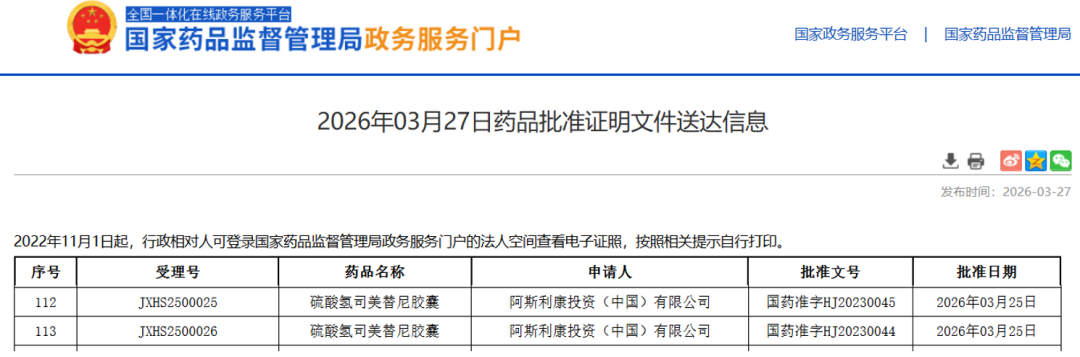
On March 27, the NMPA official website showed,Zhangjiang Pharm Valley Multinational AstraZenecaSelumetinib has been approved for a new indication. Based on clinical research progress, it is speculated to be for adult patients with symptomatic, inoperable neurofibromatosis type I (NF1) associated plexiform neurofibromas (PN).


0d84071b74218fc78545d566aef777ce.png

(Image Source: NMPA Official Website)


Selumetinib, developed by Array BioPharma (a Pfizer subsidiary), is a mitogen-activated protein kinase kinase 1 and 2 (MEK1/2) inhibitor. It was first approved for marketing in April 2020 under the brand name Koselugo. In December 2003, AstraZeneca entered into an agreement with Array BioPharma to acquire global rights to selumetinib. In July 2017, AstraZeneca collaborated with Merck to jointly oversee the global development and commercialization of selumetinib.


In May 2023, selumetinib was approved in China for the treatment of patients aged 3 years and older with symptomatic and/or progressive, inoperable neurofibromatosis type I (NF1) associated plexiform neurofibromas (PN).


Image

Daiichi Sankyo/AstraZeneca HER2 ADC New Indication Approved in China
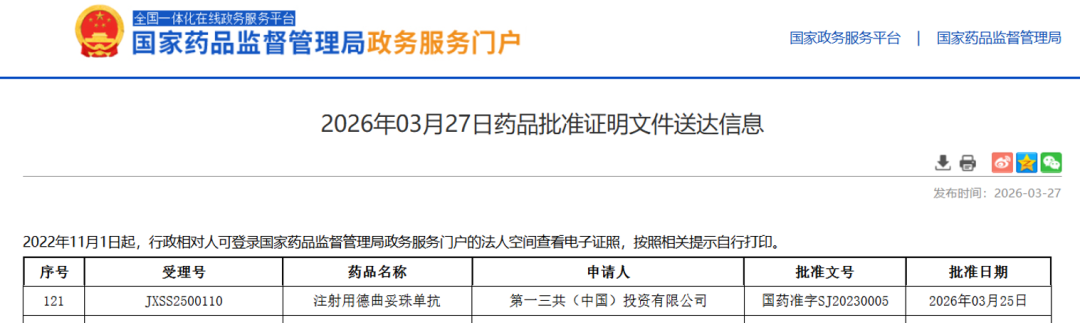
On March 27, the NMPA official website showed,Zhangjiang Pharma Valley Multinational Enterprise Daiichi SankyoAndAstraZenecaTrastuzumab Deruxtecan Approved for New Indication, Used for Neoadjuvant Treatment of HER2-Positive Breast Cancer Patients.


4429af5a01d8033dbca1768b5fc229be.png

(Image source: NMPA official website)


The PharmaCube database shows that previously, trastuzumab deruxtecan has been approved for six indications in China, three of which are breast cancer-related. These include: the treatment of adult patients with unresectable or metastatic HER2-positive breast cancer who have received one or more prior anti-HER2 therapy regimens; the treatment of adult patients with unresectable or metastatic HER2-low (IHC 1+ or IHC 2+/ISH-) breast cancer who have received at least one systemic therapy during the metastatic disease stage, or who have relapsed within six months after adjuvant chemotherapy or during adjuvant chemotherapy; and adult patients with unresectable or metastatic HR-positive, HER2-low (IHC 1+ or IHC 2+/ISH-) or HER2-ultra-low (IHC 0, with membrane staining present) breast cancer who have progressed after one or more lines of endocrine therapy in the metastatic disease stage.

Image


Source: Official WeChat accounts of various companies, PharmaCube Info, Frontiers in Cell Therapy