

OptoMedic Files IPO Prospectus: China's Fluorescence Endoscopy Leader Pioneering Global 4K Fluorescence Endoscopy Systems

OptoMedic
High-end Optical Medical Device R&D Manufacturer
This July, OptoMedic completed a Series D financing round worth hundreds of millions of yuan.
OptoMedic, an innovative company that applies aerospace optical technology and engineering expertise to the field of medical endoscopy, is committed to becoming a globally leading platform enterprise for minimally invasive endoscopic diagnosis and treatment.
Medical endoscopes are imaging devices that enter the body through natural orifices or small surgical incisions, providing real-time images of relevant anatomical structures to assist physicians in performing disease diagnosis or surgery under direct visualization, often referred to as the "eyes" of doctors. The core components consist of the endoscope scope, peripheral equipment, and endoscopic diagnostic and therapeutic instruments. Among these, the scope and peripheral equipment together constitute the endoscopy system.
With the global proliferation of minimally invasive surgery, endoscopes have undergone rapid development driven by diverse clinical needs. Data from China Business Information Network shows that the number of minimally invasive surgical procedures in China increased from 6.9 million in 2016 to 11.9 million in 2019, and is projected to reach 15.12 million in 2021. This substantial clinical demand has imposed higher requirements on endoscopic imaging, namely to enable physicians to visualize target anatomical sites with greater clarity and precision.
Precision has become one of the key directions for the advancement of endoscopic technology. Against this backdrop, fluorescence endoscopy has emerged. Fluorescence endoscopy primarily achieves imaging through two methods: injecting exogenous fluorescent dyes (fluorescent contrast agents) and detecting autofluorescence emitted by cells. The former involves selectively labeling exogenous dyes at lesion sites, then using near-infrared light to visualize anatomical structures. This makes difficult-to-observe structures or lesions visible, enabling physicians to access information imperceptible to the naked eye and facilitating intraoperative navigation.
After the first fluorescent endoscopy product received U.S. FDA clearance in 2013, it garnered widespread attention from the global medical community. In 2016, fluorescent endoscopy entered the Chinese market and began to develop gradually.
According to Frost & Sullivan’s analysis, China’s fluorescent rigid endoscopy market exhibited an oligopolistic landscape in 2019, dominated by competition between Stryker and OptoMedic, which held comparable market shares.
In 2018, OptoMedic launched the 2100 Series Fluorescence Endoscopy System; in 2020, OptoMedic’s 4K Fluorescence Laparoscope made its domestic debut in China.Based on this, VCBeat conducted an interview with Dr. An Xin, one of the founders of OptoMedic.
Fluorescence Navigation: The “Standard” Trend for Endoscopes
“If endoscopes are the eyes of physicians, and accompanying diagnostic and therapeutic instruments are their hands, then clear and accurate visualization is the prerequisite for any intervention.””
How can tumor tissue that is nearly indistinguishable from normal tissue be differentiated? How can iatrogenic injury be avoided while maximizing tumor eradication? These are critical considerations for surgeons during operative procedures. The advent of fluorescence endoscopy navigation systems has provided superior solutions to these challenges.
Fluorescence endoscopy navigation systems are widely used in hepatobiliary surgery, gynecology, gastrointestinal surgery, thoracic surgery, and other fields. They offer significant advantages in certain departments and have become an essential clinical requirement.
The fluorescent contrast agent widely used in current clinical practice is indocyanine green (ICG). Its imaging principle involves ICG entering the human body via local tissue or intravenous injection, where it binds to plasma lipoproteins. Upon excitation by near-infrared light at a wavelength of 805 nm, it emits fluorescence at a wavelength of 835 nm.The fluorescence imaging system captures fluorescence signals and generates images in real time, which are precisely overlaid in synchronization with white-light images of the same field of view, thereby achieving fluorescence localization and navigation.
China’s First Launch: 4K Ultra HD + Fluorescence Navigation
OptoMedic Fluorescence Endoscopic Navigation System enables real-time switching among high-definition white light, black-and-white fluorescence, and color fluorescence modes during surgery, facilitating real-time lymphatic system tracing, observation of tissue blood perfusion, and precise localization of tumor boundaries.
Compared with imported fluorescent endoscope products, OptoMedic’s 2100 Series Fluorescent Endoscopy System has broken the stereotype that “domestic equipment is inferior to imported equipment” through product upgrades and image optimization. The launch of the 4K Fluorescence Navigation Endoscopy System marks Chinese-made equipment as taking a leading position in the global endoscopy field, achieving technological leapfrogging.
Taking device sensitivity as an example, OptoMedic’s fluorescence navigation system demonstrates higher recognition validity under equivalent contrast agent doses.
The system, approved by the NMPA in July 2020, consists of an imaging system, light source, medical-grade monitor, endoscope, and surgical cart. It features four key characteristics that enable physicians to achieve clearer and more precise visualization.
First, 4K Ultra HD. The image resolution reaches 3840×2160p.
Second, patented dual-camera technology. Utilizing 4CMOS technology to reduce latency and signal crosstalk, resulting in clearer white light images and more sensitive fluorescence detection.
Third, proprietary image algorithms. Algorithms for color restoration, low-light enhancement, and real-time fusion improve image quality.
Fourth, multi-mode switching. Freely switch between four modes: 4K ultra-high-definition white light, 4K fluorescence, color fluorescence, and multimodal fluorescence, with auto-focus.
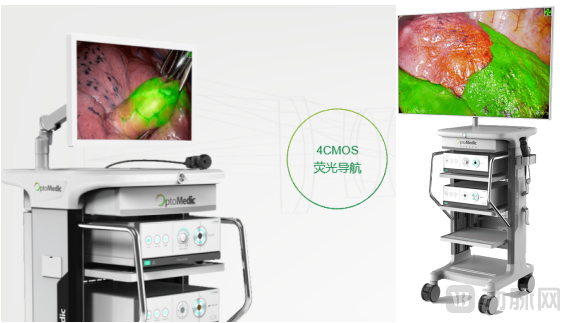
4K Fluorescence Navigation Endoscopy System Source: OptoMedic
Deepening Expertise in the Fluorescence Imaging Sector: A Comprehensive “Vertical and Horizontal” Strategic Layout
From obtaining its first NMPA registration certificate in 2018 to the domestic launch of its 4K fluorescence endoscopy system in 2020, OptoMedic’s equipment has been adopted by more than 400 Grade IIIA hospitals across China. During its three full years of sales, the company achieved installations in over 30 of the top 100 Grade IIIA hospitals nationwide.
Furthermore, OptoMedic stated that it would use the top 30 hospitals as a showcase to promote its products to general Grade A tertiary hospitals and county-level hospitals across China, gradually extending its reach to primary care institutions.
In addition to its “high, mid, and low” positioning in terms of product pricing and target markets, OptoMedic will also deepen its focus on surgical procedures, aiming to develop department-specific solutions. This entails tailoring more specialized and appropriately adapted medical tools to meet the specific needs of clinical departments.
In addition to providing clinicians with effective tools for clinical practice and collaborating with experts to promote and train on surgical techniques, OptoMedic engages in deep cross-disciplinary interactions between medicine and engineering with physicians, gathering application feedback and implementing targeted improvements to its devices. Currently, OptoMedic has established partnerships with more than ten leading Grade A tertiary hospitals across China.
Overall, due to high technical barriers, the global fluorescence endoscopy market is highly concentrated, with fluorescent navigation endoscopes currently positioned as high-end applications.
In Dr. An Xin’s view, although fluorescence navigation is not required for every surgical procedure, it will become an essential tool in minimally invasive surgery. Much like smartphone navigation, it may not be used at all times, but it is indispensable.
From the perspective of the role of fluorescence navigation endoscopy,Its breakthrough lies in visualizing tissue structures that are difficult to discern under white-light mode, providing device-based assistance to help surgeons perform procedures with greater accuracy and flexibility, thereby lowering the technical threshold and risks associated with surgery to a certain extent.
From an economic perspective,Fluorescence endoscopy systems combine white-light and fluorescence capabilities. Their all-in-one design helps reduce operating room setup requirements, lower equipment investment costs, and enhance departmental diagnostic and therapeutic capabilities.
From the perspective of national policy,In 2015, the General Office of the State Council issued the “Guiding Opinions on Promoting the Establishment of a Tiered Diagnosis and Treatment System.” In 2017, the National Health and Wellness Conference emphasized the need to vigorously advance the development of basic medical and health systems, striving to achieve breakthroughs in the construction of five fundamental medical and health systems, with the tiered diagnosis and treatment system as the priority.
Although fluorescence endoscopy is currently in a phase led by top-tier experts, with its clinical applications primarily concentrated in hepatobiliary tumor procedures at major Grade A tertiary hospitals, the gradual penetration of fluorescence endoscopy into primary care hospitals has become an inevitable trend, driven by national policies such as medical insurance cost containment and tiered diagnosis and treatment.
As the technology becomes more widely adopted, its applications will expand to include benign tumor resection, cholecystectomy, and other routine surgical procedures in gastrointestinal surgery, urology, and gynecology. This will further promote tiered diagnosis and treatment, guide patients to seek medical care appropriately, and alleviate the burden on primary healthcare institutions.
Build an engineering platform and refine technical granularity
“We are not content with cobbling together system solutions to create me-too products; instead, we are determined to build a robust underlying engineering platform to accumulate core technological capabilities.”
In the interview, Dr. An Xin stated that only by understanding the underlying logic and emphasizing the foundations of systems engineering can one achieve optimized system integration while fully comprehending application requirements.
Underlying technology serves as the foundation; only with a solid base can a skyscraper stand tall. OptoMedic has built its underlying engineering platform, implementing solutions down to the finest level of granularity, with all core technologies independently developed. This is the true reason behind the functional differentiation of OptoMedic’s endoscopes, and it also lays the groundwork for future upgrades and optimizations of its devices.
OptoMedic’s strong emphasis on independent original research and development and foundational innovation is inextricably linked to its founding team.
In 2011, during Tsinghua University’s anniversary celebrations, four former classmates with backgrounds in optical instruments came together. They discussed leveraging their engineering expertise in the healthcare sector to pursue a meaningful endeavor. It was this reunion that led to the formation of OptoMedic’s founding team.
In 2013, OptoMedic was founded, with its headquarters in Foshan, Guangdong. Leveraging its expertise in optics, the team strategically targeted the fluorescent endoscopy sector.
The founding team, with backgrounds in science and engineering, has instilled in the company a culture of “down-to-earth engineering.” After eight years of accumulation, OptoMedic has emerged as a leader in China’s fluorescence endoscopy field, breaking the monopoly held by foreign companies. According to Frost & Sullivan data, OptoMedic’s fluorescence endoscopy systems accounted for 48.6% of the domestic market share in 2019.
OptoMedic stated that its fluorescence navigation products do not rely on low pricing, competing at the same price point as imported brands while delivering superior performance.
Currently, the main players in China’s fluorescence endoscopy sector include Stryker, OptoMedic, Suzhou Meirunda Medical, and Shenzhen Mindray Bio-Medical Electronics. With the entry of other companies, China’s fluorescence endoscopy market is poised for a period of rapid growth. According to Frost & Sullivan analysis, the market for fluorescence rigid endoscopy equipment in China is projected to reach RMB 3.52 billion in 2024, with a compound annual growth rate (CAGR) of 99.6% from 2019 to 2024.
Fluorescence “Breakthrough”: Comprehensive Portfolio Deployment
Endoscopy: A “Low-Hanging Fruit” for Domestic Substitution. Guided by policies promoting domestic substitution, OptoMedic aims to create a “breakthrough effect” with its fluorescence navigation endoscope. By building brand reputation through its fluorescence navigation endoscopy system, the company seeks to further increase its market share in China and enhance penetration into grassroots healthcare institutions.
In terms of product internationalization, OptoMedic’s 2100 series has obtained EU CE certification, while other products are currently undergoing CE and FDA certifications. Meanwhile, OptoMedic’s Overseas Business Division has strengthened its organizational structure this year, and the global expansion of its fluorescence navigation product line is actively underway.
Currently, OptoMedic’s product portfolio covers white-light/fluorescence-navigated endoscopic systems, flexible endoscope systems, single-use endoscope systems, as well as ancillary instruments and fluorescent contrast agents.
Following its Series D financing, OptoMedic announced that it would translate its comprehensive strategic layout into tangible results across all business lines. Building on its “4K fluorescence” technology, the company will accelerate the development of innovative products and hasten the full realization of domestic substitution and internationalization.