

Mumian Files for IPO: Integrating Sleep Medicine with Digital Therapeutics to Build a Commercial Closed Loop
How Large Is the Market for Sleep, Which Occupies About One-Third of Our Lives?
From traditional home textiles and sleep-aid medications to the currently prevalent sleep technology products and sleep solutions, modern sleep needs have spawned a market worth hundreds of billions of yuan. According to publicly available information, the overall market size of China’s sleep economy grew from RMB 261.63 billion in 2016 to RMB 377.86 billion in 2020, covering sectors such as home textiles, sleep-aid apps, and sleep services. Products have become increasingly diversified, and the number of market participants has continued to rise.
Despite the vast market, public awareness of sleep medicine remains low. In fact, in the “Specialty Catalog for Standardized Residency Training (2019 Edition)” released by the Chinese Medical Doctor Association in 2019, sleep medicine was formally included in the training catalog, becoming an independent secondary-level discipline in China, on par with neurology, cardiology, and gastroenterology.
However, many products and services currently available on the market for sleep issues are not closely aligned with sleep medicine, lack evidence-based medical support, and have limited effectiveness in sleep intervention. To address sleep disorders, Beijing Mumin Medical Technology Co., Ltd. (hereinafter referred to as “Mumin”) leverages technologies such as the internet, the Internet of Things (IoT), and artificial intelligence (AI) to innovate and digitize sleep-related medical techniques and therapies. By integrating with upstream and downstream industry partners, Mumin connects experts in the field, hardware products, and offline scenarios to provide comprehensive sleep solutions for individual users and corporate clients.
Exploration: Integrating Sleep Medicine to Develop Digital Therapeutics for Sleep
Compared with foreign markets, China’s sleep health industry started relatively late, with solutions for sleep problems largely confined to the stage of aiding sleep and exhibiting low therapeutic attributes. MuMian has chosen to integrate sleep medicine into its products and services, a decision driven by the team’s professional expertise in medicine.
It is understood that Kong Xiang, the founder of Mumian, is a US-registered Registered Polysomnographic Technologist (RPSGT) and a member of the American Academy of Sleep Medicine (AASM), possessing systematic knowledge and understanding of sleep medicine. The core team consists of senior executives from companies such as Tencent Penguin Doctor and Tongrentang Health, as well as experts with professional medical backgrounds, providing comprehensive support for product design, research and development, and implementation. Furthermore, Mumian has established collaborative relationships with physicians from sleep medicine centers at numerous Grade A tertiary hospitals and international sleep experts, ensuring the professionalism of its product research and development.

Kong Xiang, Founder of Mumin
During its early stages, Mian primarily collected users’ sleep data through remote monitoring or hardware-based devices, recommending appropriate sleep improvement services based on the processed data. As digital therapeutics began to emerge and develop in China, the Mian team recognized that this modality was highly compatible with the company’s existing business operations. Consequently, the team gradually embarked on exploring sleep-focused digital therapeutics, planning to establish it as a key strategic direction for the company’s future growth.
Although some sleep products currently on the market can provide a certain degree of relaxation and sleep aid, they lack support from medical evidence in their product planning and design and are not well integrated with the discipline of sleep medicine.
Moreover, the functionality of certain products is relatively limited. In reality, sleep disturbances arise from multifactorial causes, and sleep itself exhibits distinct multidisciplinary, interdisciplinary, and systemic characteristics; therefore, single-target interventions are insufficient to effectively address sleep problems.
To address the aforementioned challenges, Muming has developed the 6D-SMART sleep solution for individuals with sleep difficulties by leveraging its digital therapeutic system for insomnia, Sleepower. This approach integrates hardware, data, and services, targeting six key dimensions: cognitive behavior, psychological stress, sleep environment, somatic factors, dietary health, and exercise health, thereby establishing a professional and convenient digital sleep platform. In the future, Muming plans to launch additional digital therapeutic products, including Musicalm, a music-based digital therapy, and Brainew, a digital therapy designed for Mild Cognitive Impairment (MCI).
Empowering B-side, Reaching C-side
Currently, treatment for insomnia is generally categorized into two approaches: Cognitive Behavioral Therapy for Insomnia (CBT-i) and pharmacological therapy. Among these, CBT-i is recommended as the first-line treatment by the American College of Physicians and the European Sleep Research Society. It is currently the most effective non-pharmacological intervention for insomnia and is also commonly used for self-management. CBT-i improves sleep by correcting maladaptive beliefs and attitudes about sleep, as well as unhealthy behavioral habits. Its core components include sleep hygiene education, relaxation therapy, cognitive therapy, stimulus control, and sleep restriction therapy.
Compared with pharmacotherapy, although CBT-I holds advantages and is gradually being implemented in China, its current penetration rate remains low due to the prolonged treatment course, limited availability of physicians, suboptimal patient adherence, and moderate patient experience.
By innovatively integrating CBT-i with music therapy and leveraging AI technology, Mian’s Sleepower digital therapeutic for insomnia establishes a unique intelligent MCBT-i system (Music-based Cognitive and Behavioral Therapy for Insomnia), enabling data-driven and intelligent services for users with insomnia. In addition to CBT-i techniques, Sleepower harnesses the value of music therapy to address the limitations of CBT-i by providing benefits in stress reduction, sleep aid, modulation of brain and nervous system excitability, and enhanced user engagement.
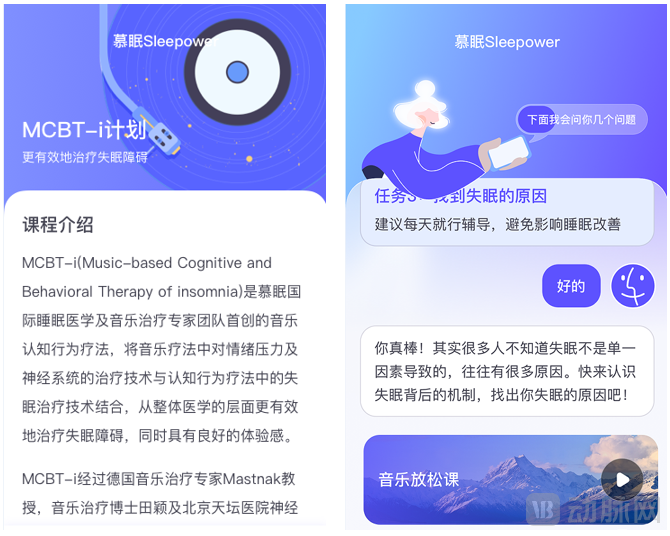
MuMian Sleepower User Interface
Simultaneously, intervention and treatment plans are customized, adjusted, and delivered based on sleep assessment data from users with insomnia, enabling them to avoid blind searches, reduce “trial-and-error costs,” and make the right choice from the outset. Professional physicians and sleep managers are also available to address the in-depth and specific needs of a subset of users, ultimately achieving precise and effective resolution of insomnia problems.
Existing implementation cases demonstrate that, following intervention with the Moomin digital therapeutic, users experienced a 30%–50% improvement in sleep efficiency, a 50% reduction in sleep onset latency, and a 40% increase in total sleep duration, resulting in significant alleviation of insomnia symptoms.
In terms of its business model, expanding into the B2B market is a crucial avenue for Mumin to accumulate resources. Leveraging its international and domestic expert teams as well as its capabilities in medical technology innovation, Mumin provides customized sleep solutions to enterprises such as platforms, hotels, and insurance companies. This model also enables Mumin to indirectly reach end consumers (C-end users), offering them continuous sleep management services that include sleep education, sleep monitoring, AI- and expert-interpreted reports, and health risk alerts.
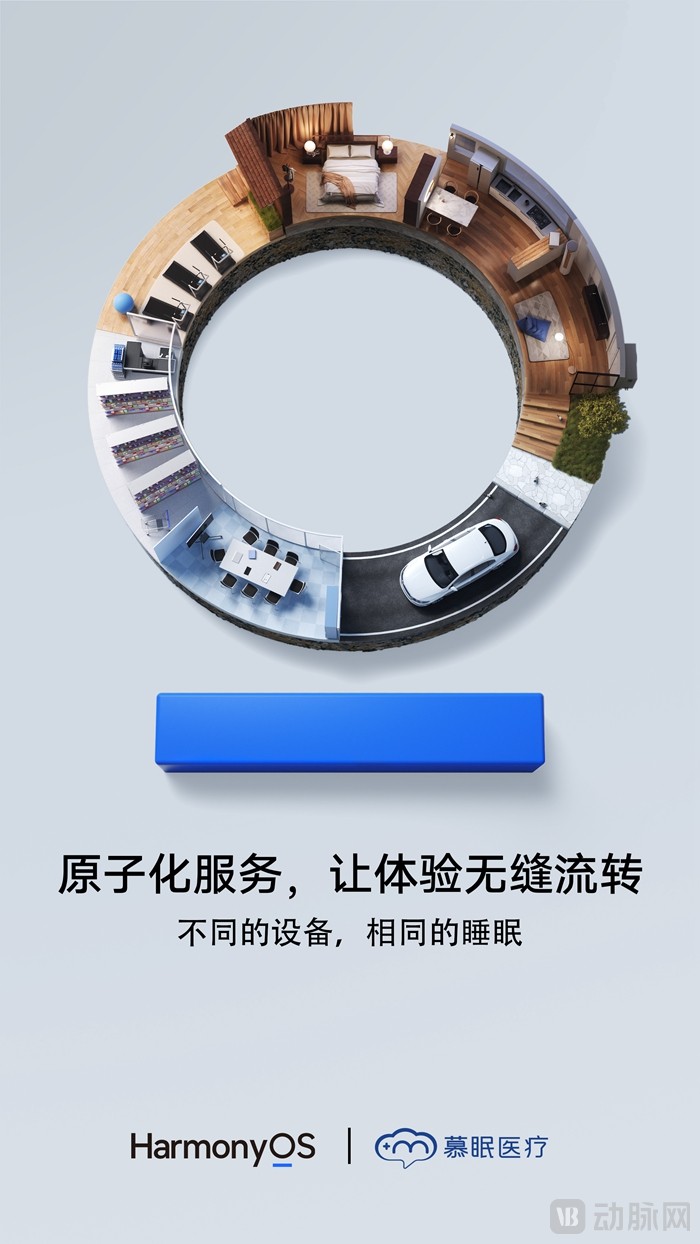
In addition, Mianmian offers technical API partnerships. Taking its previous collaboration with Huawei HarmonyOS as an example, Mianmian developed the HarmonyOS Feature Ability (FA) “Mianmian Sleepower” by integrating HarmonyOS with data from intelligent sleep terminals, providing customers with professional digital health and digital medical solutions for sleep.
For specific operations, Huawei smartphone users with HarmonyOS can swipe up from the bottom-right corner of the home screen to access “My Services,” search for “MuMian Sleepower,” and add the service widget to the system home screen. By tapping the “MuMian Sleepower” widget, users can enter the sleep management system to access sleep education resources, complete sleep assessments, and select personalized sleep training plans.
More importantly, through collaborations with B-side partners, Moomin can collect more user characteristic data to train its algorithmic models, thereby supporting subsequent product optimization and iteration. It is understood that Moomin has currently established partnerships with multiple enterprises and platforms, including Huawei, Lifesense Medical, BOE Health, and Penguin Almond Doctor Group. In the future, Moomin will continue to intensify its efforts in expanding B-side business operations to reach a broader population.
Actively Expanding the Boundaries of Digital Therapeutics
Although the sleep economy is gradually emerging in China, it is undeniable that the short development history of sleep medicine in the country and the shortage of high-quality professional talent remain challenges for the industry’s growth.
In response, Muxian has partnered with sleep and psychology experts from three domestic hospitals to jointly develop a training curriculum system. By closely integrating clinical knowledge and skills related to insomnia and psychological disorders, the program aims to cultivate comprehensive professionals in sleep counseling, sleep training, and sleep management, thereby providing a high-quality talent reserve for the sleep health and broader wellness industries.
Moving forward, Muming will continue to innovate in sleep medicine technology while integrating industry, academia, and research to translate and promote more high-quality innovative technologies to the market. Meanwhile, it will advance clinical trials for its existing digital therapeutics products, laying the groundwork for subsequent medical device registration applications.
In terms of products, Moomin will also increase its research and development and promotion efforts for professional medical functional music applied to the treatment of insomnia, stress reduction, anxiety, depression, and related fields. It is understood that Moomin has already reached in-depth cooperation with Huawei and the Huohuo Yinyue platform regarding music. In addition, Moomin will also attempt to combine brain science and neurology knowledge to expand digital therapeutics into areas such as Alzheimer's disease.
As a critical foundation for the design and application of Moomin’s products, data will also be a key strategic focus for Moomin moving forward. Moomin will engage in deep collaboration with sleep monitoring devices—including wristbands, smartwatches, rings, and EEG headsets—to integrate objective and subjective sleep data, unlock the value of data, optimize sleep assessment and analytical algorithmic models, and establish standards for the collection, analysis, management, and application of sleep data.
Mumian adheres to the core values of professionalism, innovation, focus, and long-termism. Looking ahead, Mumian seeks to partner with capital investors who share its philosophy, in order to support product research and development as well as market expansion.