

Ciyun Health Differentiates Itself in Enterprise Health Management Through Data-Driven Stratification and Tailored Resource Allocation
What is the current state of the health management industry?
On the one hand, according to Frost & Sullivan’s “2021 China Health Management Industry Research Report,”The market size of China's health management industry has grown from RMB 248.0 billion in 2015 to RMB 850.3 billion in 2020, and is projected to reach RMB 2,189.8 billion by 2025, with a compound annual growth rate (CAGR) of 20.8%., the market size has grown significantly, and with the continuous advancement of national policies and the heightened health management awareness spurred by the COVID-19 pandemic, numerous investment opportunities in domestic health management have emerged.
On the other hand, according to VBInsight’s “Global Digital Health – Value Trend Report on Chronic Disease Management,” a total of 62 financing deals occurred globally in the digital health chronic disease management sector in 2020, with cumulative funding amounting to nearly $1.6 billion. In contrast, China recorded only nine financing deals in 2020, totaling approximately $180 million, indirectly reflecting that capital remains cautious and adopts a wait-and-see approach toward the domestic health management sector.
What are the underlying reasons? Factors likely include high homogeneity, unclear business models, the need for deeper integration across industry segments, and patients’ reluctance to pay for ancillary services. Against this backdrop, companies in the sector are actively seeking viable pathways—whether by partnering with insurers to streamline payment mechanisms, shifting focus to the primary care market, or leveraging big data analytics to deliver customized services.
Unlike health management models targeting consumers with chronic diseases, CICC Cloud Health focuses on providing differentiated health management solutions to enterprises and public institutions in sectors such as transportation, aerospace, and energy. Why is its service positioning oriented toward enterprises and public institutions? What are the core demands of these clients regarding health management? How does CICC Cloud Health ensure and meet these demands? What challenges arise in the course of service delivery? In response to these questions, VCBeat interviewed Liang Liaohui, CEO of CICC Cloud Health, to provide answers.
“The term ‘Ciyun’ originates from the Jizhi Ji (Collection of Chicken Feet), which states, ‘The Tathagata’s compassion is like a vast cloud.’ Specifically for the company, ‘Ci’ (compassion) represents the attitude toward health management services, while ‘Yun’ (cloud) signifies the technological means to achieve service objectives,” said Liang Liaohui.
CICC Cloud Health Technology Co., Ltd. was established in August 2014,Centered on big health data, we specialize in the R&D of digital health management technologies and service integration, providing scenario-based and precision health management services to medical institutions, enterprises and public institutions, insurance companies, and other stakeholders.
Leveraging big health data as the entry point, this initiative stems from the genetic legacy of its parent company, CICC Data Group.
VCBeat has learned that CICC Data Group, established in 2005, is one of the earliest enterprises in China to independently plan, invest in, construct, and operate Tier IV data centers (the highest level under national standards). The company has gradually built a data-centric business ecosystem, forming two major business systems: data center facility services and industry data application services. It is a leading comprehensive provider of digital infrastructure in China’s industry.
Furthermore, CICC Data Group has successively provided services to numerous large state-owned banks, national-level government agencies, and leading internet enterprises, gradually establishing its brand advantage. It has participated in the drafting of national standards such as the General Requirements for IT Service Management and the Maturity Model for Data Center Service Capability in Information Technology Services, thereby forming a robust industry barrier.
CICC Cloud Health, which carries forward its parent company’s DNA, set its sights on the health management sector from the very beginning.
“At the time, when the group was strategizing its entry into the broader health industry, there was a consensus that the combination of data and healthcare held immense development potential. Therefore, we decided to leverage our own strengths and use health management as the entry point,” said Liang Liaohui. “We anticipated at the time that the barrier to entry for health management might be relatively low.”
But, is the barrier to entry for health management truly low?
After seven years of navigating the industry, Liang Liaohui offers a completely different answer.
“From the current perspective, the entry barrier to the health management industry is actually quite high,” Liang Liaohui remarked with emotion. “This has been my greatest impression since the establishment of CICC Cloud Health Technology Co., Ltd.”
A major shift in cognition and attitude may stem from the “cold reception” encountered during the early stages of entrepreneurship.
“In fact, it was not until two years after its founding that CICC Cloud Health secured its first contract with a public hospital,” shared Liang Liaohui. At that time, collaborations between medical informatics systems and hospitals typically relied on on-premises deployment, which differed from CICC Cloud Health’s cloud-based approach to health management. “Peking University Aerospace Center Hospital conducted multiple rounds of evaluations of CICC Cloud Health. Only after carefully assessing data security, product functionality, and clinical pathways did the hospital decide to adopt CICC Cloud Health’s model for operating its health management services. This was quite a challenging achievement at the time.”
This incident also made Liang Liaohui realize that the health management industry is, in fact, a high-barrier sector.
“Unlike clinical medicine, which focuses on single diseases and requires only cause-specific and symptomatic treatments, health management services necessitate a multidisciplinary integrated approach to maintain individual health status,”In practice, we frequently observe that users not only suffer from chronic diseases but also present with concurrent issues related to mental health, nutrition, and exercise.“Only through comprehensive, multidisciplinary application can users’ health levels be effectively managed,” said Liang Liaohui. “This is no easy task.”
Therefore, to successfully execute this “challenging endeavor,” CICC Cloud Health initially conducted a global search for referenceable models, ultimately adopting Japan’s health management service philosophy and tailoring the implementation to the characteristics of domestic users.
Liang Liaohui stated that this decision was based on three considerations:
First, enterprises and public institutions in sectors such as shipping and energy have health management needs, with their core objective being to ensure the normal conduct of production and business operations;
Secondly, “In the process of cooperating with these enterprises and public institutions, we have found that, unlike traditional corporate culture building in the past, more and more organizations and companies regard the construction of health management systems as a higher-level organizational development initiative,”“Because this not only safeguards employee health, but also meets the needs of team building.”
Finally, some enterprises and public institutions hope to establish effective health management pathways, requiring the management process to be digitalized and visualized to achieve business collaboration, thereby creating a demonstration effect across the industry.
However, it is evident that the health management (physical examination) centers of current medical institutions are constrained by their own capabilities and thus fail to meet the in-depth health management demands of such enterprises and public institutions.
“However, CICC Cloud Health identified and firmly capitalized on this latent market demand, ultimately delivering tangible solutions,” said Liang Liaohui.
Furthermore, according to Liang Liaohui, as of now, the user base of CICC Cloud has covered many key industries such as shipping, aerospace, energy, and telecommunications. Among them,The “e-Police Health” project for a healthy police force in a certain city in Guangdong Province, constructed and serviced by CICC Cloud Health, has been honored with the “First Prize in the Smart New Police Force Innovation Competition of Guangdong Public Security Organs” and the “First Prize for Scientific and Technological Innovation of the Ministry of Public Security.”
“The biggest fear in health management services is spreading resources too thin.”Liang Liaohui told VCBeat.
To achieve “non-scattershot” health management,CICC Cloud Health has established a core product system of “One Platform, Two Applications.”
Specifically, the “one platform” refers to the “Data Intelligence Platform,” which aggregates, cleanses, transforms, and intelligently annotates physical examination data, medical technology test data, health monitoring data, and more. The “two application products” refer to the “Health Management SaaS Application for Medical Institutions” and the “Health Management SaaS Application for Enterprises and Public Institutions.”
Leveraging this core product portfolio, CICC Cloud Health provides health management solutions tailored to medical institutions, enterprises, and public institutions.
Specifically, the CICC Cloud Health digital health management platform for medical institutions leverages a data intelligence platform to provide physicians with services such as patient management, follow-up management, health interventions, and chronic disease management via the physician portal. The user portal offers pre-visit services including appointment scheduling for medical consultations and physical examinations, as well as intelligent triage; in-visit services such as online payment; and post-visit services including report retrieval and health consultations. Meanwhile, the hospital portal provides services for service activation, service statistics, performance management and assessment, and health data management.
Furthermore, CICC Cloud Health’s digital health management solution enables seamless collaboration across five platforms—hospital, user, physician, enterprise, and device endpoints—thereby enhancing customer service experience. It also provides personalized and intelligent follow-up care and health management plans, significantly improving the efficiency of medical services.
Meanwhile, CICC Cloud Health’s digital health management solution for enterprises and institutions is even more distinctive.
Specifically,CICC Cloud Health has established an integrated management model of “platform + devices + services + operations” for enterprises and public institutions.
According to Liang Liaohui,This health management platform currently aggregates hospital physical examination data and data from professional health monitoring devices, while integrating third-party service platforms such as Haodf and Ping An Health. It provides customers with services including report inquiry, health consultation, appointment scheduling, stratified population risk alerts, and specialized health programs.
In addition, CICC Cloud Health has partnered with Huawei and other companies on smart wearable devices, and established health and fitness centers centered around AI body assessment all-in-one machines and AI coaching machines. Equipped with a team of professional healthcare physicians and collaborating with local medical institutions, it has built an integrated service system combining medical services, health promotion, psychological counseling, and affordable community life services, thereby making health management services more comprehensive and multidimensional.
In this digital health management solution, the most notable feature is its ability to stratify populations for health alerts based on health data, enabling differentiated allocation of resources and services.
Taking a health management service project at an organization in Hunan Province in 2020 as an example, CICC Cloud Health conducted stratification of populations requiring health alerts based on historical health data. In this classification, blue indicates the sub-health population, yellow indicates the overweight population, orange indicates the population with chronic diseases characterized by the “three highs” (hypertension, hyperglycemia, and hyperlipidemia), and red indicates the high-risk alert population.
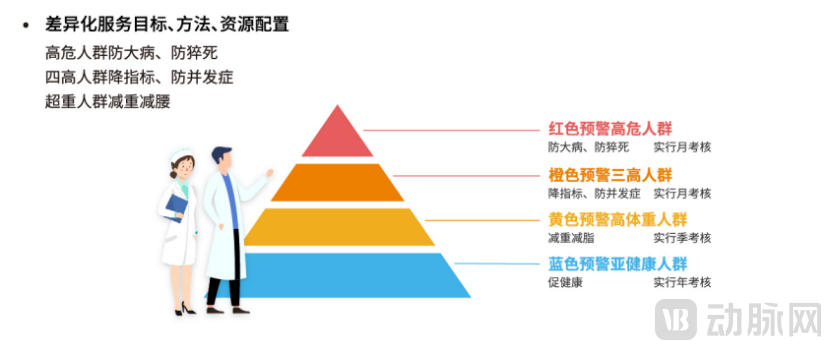
Schematic Diagram of Population Stratification and Early Warning for Health Management by CICC Cloud Health (Image provided by CICC Cloud Health)
CICC Cloud Health has developed personalized health management plans for different population segments. For individuals in a sub-health state, the focus is on health education; for those with high body weight, it employs an integrated online-offline approach to provide precise weight-loss supervision; and for high-risk groups, CICC Cloud Health adopts a "dedicated case manager, offline-centric" management model.
“This way, health management services can avoid a ‘scattergun approach,’ and customers will not feel harassed,” said Liang Liaohui, who believes that delivering targeted health services through data-driven insights is what customers truly want.
For example, while providing health management services to a branch of the Beijing Municipal Public Security Bureau, CICC Cloud Health also implemented stratified early warning systems for police officers and promptly conducted health interventions for those identified as high-risk (red-alert) individuals. This approach aims to minimize uncontrollable high-risk health incidents among officers through precise health management, thereby enhancing the overall health resilience and operational effectiveness of the police force.
“The sub-bureau forwarded to us numerous letters of appreciation from police officers,” Liang Liaohui remarked with emotion. “This is precisely the value of the health management services we provide.”
Furthermore, this digital health management solution integrates a three-tier administrative structure and provides corresponding incentive measures to enhance user adherence.
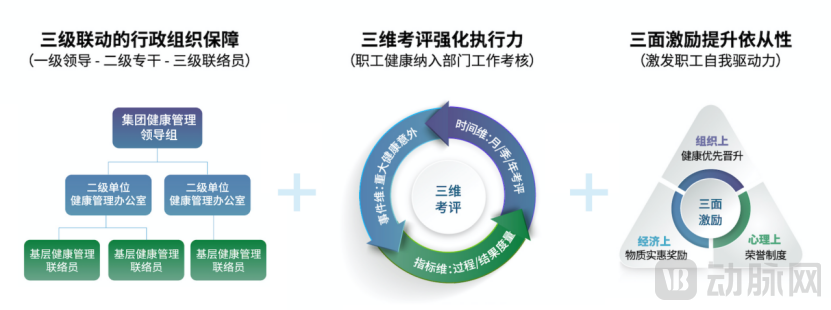
Schematic Diagram of an Enterprise Health Management Organizational Model (Image provided by CICC Cloud Health)
For example,Under this management model, CICC Cloud Health Technology Co., Ltd. (CICC Ci Yun) will establish a three-tier administrative structure—comprising the Group Leadership Team, the Health Management Offices of secondary units, and grassroots health management liaisons—to ensure the smooth implementation of health management initiatives. Furthermore, metrics such as platform data upload rates, activity participation rates, and health improvement rates will be incorporated into departmental performance assessments, with an added health dimension in performance evaluations, thereby enhancing user engagement.
For a long time, health management companies have seemed to be trapped in a “free-for-all,” with no effective business model yet emerging.
As national policies continue to advance and health awareness rises, enterprises and public institutions in relevant specialized industries are demonstrating an increasingly clear willingness to pay for health management services. Their demands for such services are becoming more diversified, indicating that market potential remains to be further tapped, potentially establishing health management as a truly high-growth segment within the industry.
However, providing health management services to enterprises and public institutions is no easy task.
The core reason lies in the stricter requirements for qualifications and capabilities imposed on health management enterprises, and due to the special attributes of certain entities, there are also specific requirements for these enterprises.
“Each occupational group has its own specific management approaches and pathways.”Liang Liaohui shared that, for example, in a health management project in Qinghai by CICC Cloud Health Technology Co., Ltd., the relevant authorities required that the management and prevention of high-altitude diseases be integrated into the service system.“Health management services must be tailored to the occupational characteristics of the target population.”
Furthermore, the presence of high-quality collaborative case studies is also a key consideration for enterprises and public institutions when selecting health management partners. The numerous successful cases have helped CICC Cloud Health build a strong reputation within the industry.
“Whether serving medical institutions or corporate clients, CICC Cloud Health has developed a comprehensive methodology and service system through repeated practice.”Liang Liaohui stated,In serving these clients with “high standards and strict requirements,” CICC Cloud Health has accumulated extensive practical experience,“And this holds significant reference value for the entire industry.”
In addition,Backed by CICC Data Group, CICC Cloud Health Technology Co., Ltd. naturally boasts formidable data technology and product capabilities.
According to Liang Liaohui,CICC Cloud Health Management’s philosophy is data-driven. Through its intelligent data platform, it analyzes and evaluates health conditions, matching users with precise service solutions only after gaining a thorough understanding of their specific situations. “This is the technical capability of CICC Cloud Health.”
In addition, the two major health management platforms currently deployed by CICC Cloud Health in medical institutions and enterprises/public institutions can empower each other and provide mutual reinforcement.
“During the use of the platform, medical institutions will provide professional suggestions for the iterative design of the platform, supporting continuous optimization of the platform in terms of professionalism; and when enterprise and institutional clients require services from medical institutions, CICC Cloud Health will also coordinate service resources,” said Liang Liaohui., the corporate and institutional business lines empower and synergize with each other, forming a closed loop across both supply and demand ends. “This is the product capability of CICC Cloud Health.”
Regarding future strategic planning, Liang Liaohui disclosed to VCBeat that CICC Cloud Health will continue to advance the development of its core product system, “One Platform, Two Applications,” with the aim of achieving a leading position in certain specialized industries.
Secondly, CICC Cloud Health Technology Co., Ltd. will actively collaborate with wearable device manufacturers, including Huawei, to integrate medical data with wearable device data, thereby establishing specialized models and further enhancing the disciplinary professionalism of its products.“We hope to establish models or evaluation systems that benefit the entire Chinese population based on these data, particularly models tailored to different occupational groups.”
Finally, CICC Cloud Health also hopes to make some beneficial explorations for the construction of the entire discipline.“Currently, CICC Cloud Health Technology Co., Ltd. has collaborated with the Health Management Branch of the Chinese Medical Association and the China Health Promotion Foundation on multiple research projects, with the aim of contributing to the development of the health management discipline in the industry.”