

DeepVoxel Health's Guo Na: Chinese AI Advancing Global Health for 7 Billion People
HY Medical
Provider of Medical Imaging and Oncology Radiotherapy Platforms
On September 2, the HKEX 2021 Biotech Summit kicked off virtually. Laura Cha, Chairperson of Hong Kong Exchanges and Clearing Limited (HKEX), and Charles Li, Group Chief Executive Officer of HKEX, delivered opening remarks at the summit. Notable speakers included Dr. Jennifer Doudna, recipient of the 2020 Nobel Prize in Chemistry, and Neil Shen, Founding and Managing Partner of Sequoia Capital China. As a representative of medical artificial intelligence enterprises, Guo Na, Co-founder and Chief Operating Officer of HY Medical, was invited to attend the summit, where she shared insights on the latest developments in medical AI and HY Medical’s commercial practices with industry experts.
According to forecasts by research institutions, the medical AI software market will grow to over RMB 188 billion in 2025. In the face of external expectations and optimism regarding medical AI, HY Medical holds a deeper understanding of the industry. “HY Medical’s development of AI in healthcare focuses on the ‘integration and full-cycle coverage of screening, diagnosis, and treatment,’ with limitless potential for its product development and payer capacity,” said Guo Na.
HY Medical believes that the most valuable aspects of the healthcare industry are diagnosis and treatment, which are critical for disease identification, elimination, and alleviation, and also influence the overall progress of medical care. “Patients are willing to visit Peking Union Medical College Hospital and the Chinese PLA General Hospital precisely because these renowned institutions can provide more precise diagnoses and better treatments. Regardless of whether the customers targeted by the business model of medical AI are pharmaceutical companies, governments, or large and small hospitals, the core focus is essentially on diagnosis and treatment.” Based on this strategic positioning, the payers for HY Medical’s AI healthcare products cover hospitals at all levels, health examination centers, pharmaceutical companies, and government entities.
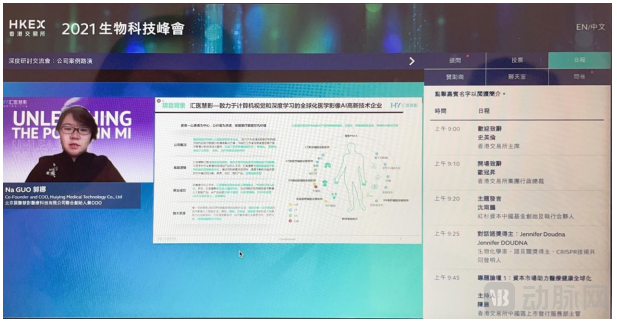
HY Medical Co-Founder and COO Guo Na Attends the Hong Kong Stock Exchange 2021 Biotech Summit
HY Medical’s partners include the Xiamen Municipal Health Commission, the Jincheng Municipal Health Commission, iKang Guobin—a major domestic chain of health examination centers—hospitals at all levels across China, and international collaborators. “China conducts over 7 billion imaging examinations annually. The 14th Five-Year Plan will continue to prioritize and intensify investment in the development of regionalized, tiered diagnosis and treatment systems. If just 30%–40% of the population can receive diagnostic capabilities comparable to those of Peking Union Medical College Hospital (PUMCH) and high-quality medical services through artificial intelligence, thereby improving efficiency and reducing costs, then everyone can access top-tier healthcare close to home. This constitutes tangible service delivery to every citizen. As population aging accelerates, the annual volume of 7 billion imaging exams is projected to surge to hundreds of billions within five to ten years. Will this lead to earlier detection, diagnosis, and treatment of more cases of tuberculosis, lung cancer, and breast cancer? Behind every disease lies a patient and a family. In my view, AI’s steadfast commitment to advancing the health of the world’s 7 billion people holds immense value,” said Guo Na.
From January 2020 to July 2021, a total of 15 products obtained Class III medical device registration certificates in China. AI products that have secured these certifications are now eligible to charge patients, signaling the dawn of an era characterized by commercialization and large-scale implementation for medical AI enterprises. As Neil Shen, Founding and Managing Partner of Sequoia Capital China, stated at the summit, “‘In China for Global’ has entered its 2.0 era, with local biotech companies truly stepping into the spotlight.” HY Medical, holding EU CE certification, NMPA Class II, and NMPA Class III certifications, has already begun its global commercial expansion.
In 2020, when the novel coronavirus struck, HY Medical keenly recognized the significant role that artificial intelligence could play in COVID-19 screening. Leveraging its accumulated algorithmic models and deep medical insights from previous years, the company’s R&D center swiftly developed an AI-assisted screening system for viral pneumonia within two months. This system can identify lesions in seconds, differentiate between COVID-19 and common pneumonia, and achieve an accuracy rate of over 98%. This unexpected product development experience allowed Guo Na to witness the leading position of China’s AI healthcare technology. “Whether in terms of data richness or the cooperative willingness demonstrated by hospitals, domestic institutions show greater enthusiasm than their foreign counterparts. With the dual surge of national policy support and corporate technological innovation, we can confidently state that China’s AI healthcare sector is at the forefront globally.”
"As technology draws closer to clinical practice, addressing tasks that previously could not be perfectly completed manually, HY Medical's AI globalization strategy seems 'a natural outcome.'"
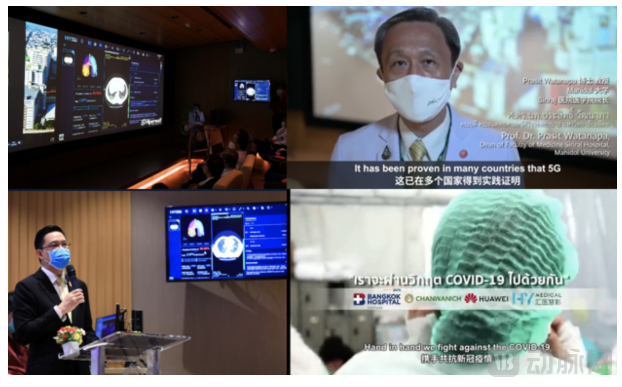
HY Medical, in partnership with Huawei and the Ministry of Digital Economy and Society of Thailand, has entered into a collaboration to provide AI-assisted solutions powered by 5G technology to Siriraj Hospital, Ramathibodi Hospital, and other major public hospitals in Thailand.
The global standardization of medical imaging naturally lends itself to data-driven digital healthcare development powered by deep learning. During the 2020 pandemic, HY Medical emerged as an industry benchmark for commercial success, expanding into markets across 50 overseas countries within just a few months and deploying its solutions in over 100 hospitals nationwide in countries including the United Kingdom, Belgium, Turkey, Brazil, Ecuador, and Colombia. While the pandemic inflicted economic shocks, it also demonstrated to the world the possibilities that technology offers in emergency medical situations. “This served as excellent artificial intelligence education for hospitals globally, because people previously considered medical AI dispensable. For instance, since radiologists can detect pulmonary nodules, why should machines do it? Would machines be more accurate than humans? Even if machines proved more accurate than humans, would they hold commercial value?” recalled Guo Na.
Artificial intelligence helps physicians interpret data from multiple dimensions, enabling earlier and more comprehensive clinical judgments. Such application scenarios are widespread in medical practice. By leveraging AI algorithms such as deep learning and machine learning, repetitive tasks can be automated, allowing physicians to focus more on tackling complex treatment challenges. As technology advances, AI applications can be rapidly deployed worldwide. HY Medical recognizes the immense medical, commercial, and social value inherent in this trend.
As technology becomes more closely aligned with clinical practice and diagnosis and treatment, it delivers substantial value and impact to doctors, patients, and the public health system. By enabling lower costs, faster deployment, and more accurate screening, it reaches both developed and developing countries, offering greater possibilities for the health of the world’s 7 billion people.
“I firmly believe that technology, as a productive force, will drive significant transformation across the entire industry. Healthcare, in particular, is a field driven by profound social responsibility. Early screening and diagnosis, as well as precise diagnostics for every disease, hold immense significance for every family and individual,” said Guo Na. HY Medical, a Chinese AI healthcare company with an interdisciplinary team, has adhered to its mission of “unlocking the extraordinary value of medical data” since its inception. Starting from meticulous annotation of every imaging dataset and refinement of each algorithm, the company has visited hospitals of all sizes across China to learn from clinical expertise. Rooted in China, HY Medical is now setting its sights on the global market.
This view aligns with that of Neil Shen from Sequoia Capital: “Looking ahead, we are more confident than ever in the development of the healthcare industry. Since the outbreak of the COVID-19 pandemic, innovation in the global healthcare sector has accelerated significantly, particularly in areas such as mRNA technology, gene editing, cell therapy, and telemedicine. More importantly, many of these cutting-edge technologies originate from China. In the coming years, the trend of ‘being based in China while serving the global market’ deserves close attention.”
Behind the industry’s major boom lies a dual dividend of technological breakthroughs and commercial implementation. Guiding the creation of new social value through technological innovation, and striving to “forge ahead for the health of 7 billion people worldwide” as envisioned by HY Medical, represents the original aspiration and practical commitment of China’s domestic AI healthcare enterprises.