

Zhongke Zhikang's Pathway-Based Digital Therapeutics for Chronic Disease Management: Building a Closed-Loop Ecosystem Centered on Patient Empowerment
According to data released at the press conference for the "Report on the Nutritional Status and Chronic Diseases of Chinese Residents (2020)" held by the State Council Information Office, the number of patients with chronic circulatory system diseases in China reached 340 million in 2019. The prevalence of other chronic conditions also remained high, with deaths attributable to chronic diseases accounting for 88.5% of all deaths. A multi-billion-dollar internet-based chronic disease management market is gradually taking shape.
Chronic disease management companies have sprung up like mushrooms after rain. However, in China, "Internet Plus" chronic disease management is still in its early stages of development. The current market offerings for chronic disease management services suffer from serious homogenization, with the core business of most enterprises still focused on "selling medications" and "prescribing during follow-up consultations."
It is evident that the core of “prescription renewal during follow-up visits” lies in competing for limited physician resources to build a corporate “moat,” whereas “drug sales” position the company as a pharmaceutical distributor in the upstream segment of the service industry. For internet-based chronic disease management enterprises, how to break away from this model and implement genuine “chronic disease management” aimed at empowering patients, thereby achieving sustainable revenue, has become a widely debated issue within the industry.
“No matter what the business model is, the core remains the demand for chronic disease management among patients.” From the perspective of Zhongke Zhikang’s founding team, there is still a gap in providing chronic disease management services tailored to patient needs. This gap represents a significant incremental market opportunity.
Established in 2020, Zhongke Zhikang recognized the aforementioned issues and, from its inception, began centering on patient needs to develop intelligent and refined chronic disease management solutions, while exploring the construction of its own chronic disease management ecosystem and business model.
Technology-Empowered Medical Services: Building a “Patient-Centered” Chronic Disease Management System
For chronic diseases, medication is neither the sole metric nor the only intervention for treatment. Taking diabetes and cardiovascular diseases as examples, numerous studies have shown that these chronic conditions are closely linked to patients’ lifestyles. Relying solely on pharmacological control often fails to achieve optimal disease management, and poor management may even lead to severe complications. Better outcomes can be achieved by combining drug therapy with the cultivation of healthy lifestyle behaviors. From a data perspective, the hundreds of millions of patients with diabetes and cardiovascular diseases present substantial market potential. This is the fundamental reason why Zhongke Zhikang has chosen to enter the chronic disease management sector by focusing on diabetes and cardiovascular diseases.
The accelerating pace of population aging is an unavoidable topic in chronic disease management. Currently, there are over 180 million elderly individuals with chronic diseases in China (according to the latest data provided by the National Health Commission on July 31). Diabetes and cardiovascular diseases are precisely the most prevalent chronic conditions among middle-aged and older adults. In addressing this specific demographic, Zhongke Zhikang has fully integrated “age-friendly” considerations into both its chronic disease management product design and services. From streamlined UI interface designs and simplified operational workflows to establishing community platforms and offering training courses on “How to Use Chronic Disease Management Apps,” the company is taking step-by-step measures to help older adults bridge the “digital divide” characterized by difficulties in accessing the internet and navigating digital interfaces.
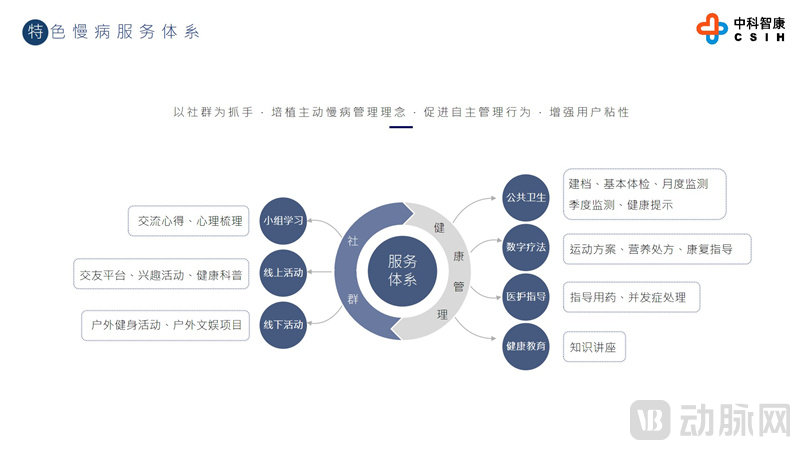
“Our founding team members also frequently make time to participate in offline community activities, personally addressing questions from middle-aged and older adults about using smart devices and leading them in activities such as brisk walking and fitness exercises.” Xue Yifan, Chief Medical Officer of Zhongke Zhikang, told VCBeat that providing patients with ongoing health education on disease knowledge, medication, nutrition, diet, and exercise through professional medical staff, and establishing an online-offline integrated patient community management system, is a crucial component of Zhongke Zhikang’s chronic disease management services. This approach helps cultivate the concept of proactive health and promotes patients’ self-management behaviors.
With the advancement of AI, cloud computing, and big data technologies, the biomedical model is gradually shifting from a cognitive-behavioral intervention approach to a psychodynamic activation model. The core objective is transitioning from being “disease-centered” to providing whole-lifecycle health management services encompassing “prevention, treatment, and wellness.”
The “prescriptions” received by patients are no longer limited to pharmaceuticals; they may also include software and hardware products with functions such as remote monitoring, diagnosis, and education, all aimed at promoting health. In the post-pandemic era, digital therapeutics, as a novel digital health solution, have begun to enter the public spotlight. Unlike other disease categories, patients with chronic conditions have a stronger demand for out-of-hospital management. Digital therapeutic “prescriptions” can cover a spectrum ranging from pharmacological treatment to lifestyle and behavioral interventions, thereby tightly linking in-hospital and out-of-hospital intervention strategies.
How to Maximize the Empowerment of Technology in Healthcare Services: Zhongke Zhikang’s Ongoing Exploration into Providing Full-Lifecycle Chronic Disease Management for Patients
AI + Big Data: Opening the Door to Digital Therapeutics Exploration
“Since its inception, the company has been dedicated to building and applying the foundational capabilities for digital chronic disease management,” said Huang Bangyu, Chief Technology Officer. As a chronic disease management enterprise, Zhongke Zhikang aims to provide patients with personalized, refined, and comprehensive chronic disease management services. By leveraging AI and big data technologies, Zhongke Zhikang connects specialists, dietitians, and health managers to deliver long-term, effective prevention and treatment services for chronic disease patients. These services include establishing patient records, stratified assessment, supervision and management, indicator feedback, alerts and reminders, personalized intervention plans, and treatment regimen adjustments. Additionally, through community-based management, the company promotes patients’ self-management behaviors.
On the physician side, intelligent tools such as AI-assisted diagnosis, smart follow-up, intelligent prescription, and structured data analysis have been developed to create an efficient chronic disease management system. This approach reduces in-hospital labor costs, enhances out-of-hospital patient engagement, and ultimately improves hospitals’ capacity for managing patients with chronic diseases.
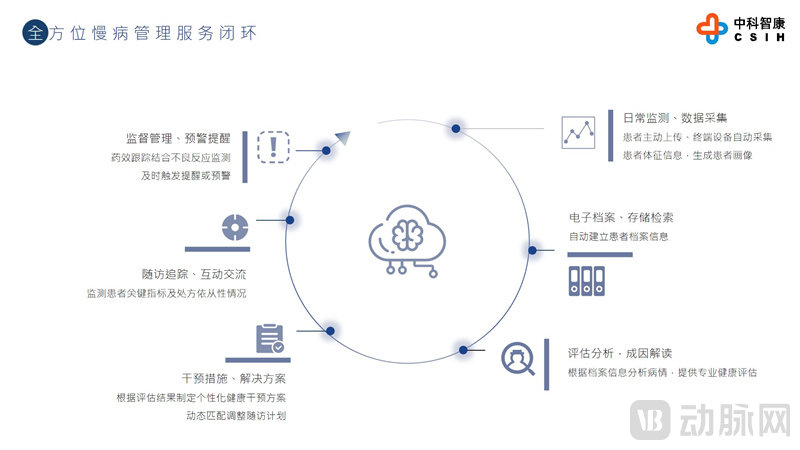
Aligned with the company’s existing business strategy, Zhongke Zhikang will initially focus on health management and lifestyle guidance/intervention, prioritizing the development of digital therapeutics (DTx) in three key areas: nutrition, psychology, and exercise. The company aims to build an AI- and big data-driven DTx platform for chronic disease management, centered on three core functionalities: sustainable multi-dimensional data tracking, hierarchical health risk analysis, and generation of personalized intervention plans. This approach will facilitate a PDCA (Plan-Do-Check-Act) cycle, establishing a closed-loop system for pathway-based chronic disease management and services. Specifically, this includes developing a nutrition-focused DTx solution grounded in nutritional science and Behavior Change Techniques (BCT); a psychological management DTx solution based on Cognitive Behavioral Therapy (CBT); and an exercise management DTx solution leveraging algorithmic technologies such as motion capture.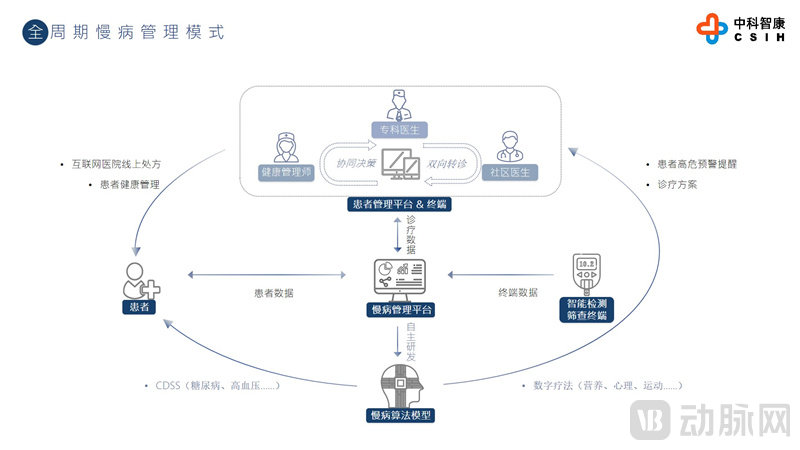
Currently, Zhongke Zhikang has leveraged AI technology to integrate medical literature data across multiple disciplines and specialties, enabling the identification of risks and risk factors for various chronic diseases in patients. It provides early warnings for diseases and complications, along with treatment recommendations. Furthermore, through research collaborations with renowned domestic institutions such as Peking University Health Science Center and Ruijin Hospital, it validates clinical efficacy.
In the field of “Internet +” healthcare, data silos in medical big data and industry usage standards remain to be standardized. Huang Bangyu believes that in the process of achieving tiered diagnosis and treatment and collaborative management both inside and outside hospitals, the fundamental core issue that technology must address is “interconnectivity”—specifically, the interconnectivity of patient data and the bridging of data silos. From an operational perspective, this includes legally acquiring patient data, establishing mechanisms for data cleaning and structuring, and streamlining data flow channels.
Zhongke Zhikang has partnered with multiple capable vendors based on real-world service scenarios to jointly build a chronic disease management ecosystem. For instance, it collaborates with Airdoc, which has obtained the Class III medical device certification for its “Auxiliary Diagnostic Software for Fundus Images of Diabetic Retinopathy,” to establish standardized screening processes. In the future, Zhongke Zhikang will empower grassroots applications of precision chronic disease screening by deploying cutting-edge innovative screening equipment in primary care communities, while integrating patient disease risk screening into the standard operational framework of chronic disease management.
Furthermore, Zhongke Zhikang is engaging in technical exchanges and collaborations with numerous experts by joining the Digital Therapeutics Association, seeking to further refine the pathway for a systematic, closed-loop chronic disease management system through digital therapeutics.
A Glimpse into the Landscape: Business Strategies in the “Sweet Spot” Era
However, chronic disease management involving only doctors and patients struggles to form a closed loop. Without an appropriate payer, the business model for chronic disease management cannot be effectively implemented. Xue Yifan believes that in the past, companies in this sector faced significant development challenges primarily because medical insurance funds were prioritized for treatment payments rather than prevention. In his view, the current core issue lies in whether medical insurance reimbursement policies will shift their focus from single-disease treatment toward comprehensive chronic disease management. With further optimization of medical insurance payment methods, chronic disease management enterprises are expected to benefit in the future. Therefore, entering the market now presents an opportune moment.
As for how to establish a viable business model, it is essential to start from the perspective of “addressing the pain points of patients with chronic diseases.”
Among these issues, poor adherence to health management is prevalent among patients with chronic diseases. Due to scarce medical resources, patients’ strong demand for long-term out-of-hospital health management remains unmet in the current healthcare landscape. This is particularly evident in lifestyle interventions; compared with the high expectations placed on physicians’ reputations and the “verbal orders” provided by doctors, patients with chronic diseases urgently need more scientific, effective, and cost-efficient intervention methods, as well as greater consistency and reliability from their physicians. From a corporate perspective, the key challenges to address are the optimization of medical resource allocation and the integration of fragmented traditional healthcare service processes.
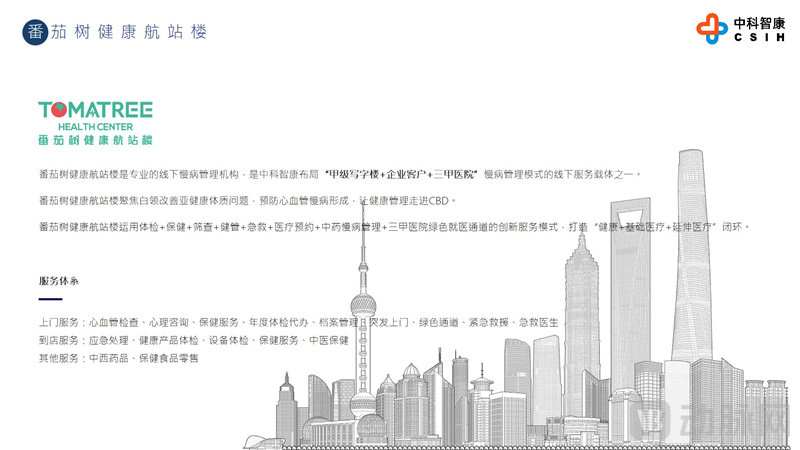
Currently, Zhongke Zhikang has pioneered an innovative service model integrating “Grade A office buildings + corporate clients + tertiary hospitals.” The Tomato Tree Health Terminal at Shanghai Tower serves as the offline platform through which Zhongke Zhikang extends its health management capabilities to white-collar workers with suboptimal health status and into workplace settings. Leveraging a B2B2C business model to reach users, it helps them avoid the hassles of traditional hospital registration and queuing. In this premium office environment, a comprehensive cardiovascular-related check-up can be completed within 15 minutes, with immediate assessment of cardiovascular disease risk levels. For high-risk individuals, a green channel to Dongfang Hospital is provided. Zhongke Zhikang offers white-collar workers with suboptimal health a comprehensive, continuous suite of health and medical services, encompassing healthy lifestyle education, health management, primary care, extended medical services from tertiary hospitals, pharmaceuticals, and end-to-end health management.
“The Community + Tertiary Hospital” model is also one of Zhongke Zhikang’s key strategies for addressing the issue of limited medical resource allocation through tiered diagnosis and treatment. Leveraging health manager services and a digital management platform as its entry point, Zhongke Zhikang has reached a cooperation intent with Peking University First Hospital to jointly establish in Beijing’s Xicheng District a tiered chronic disease management system anchored by community service stations, community hospitals, and tertiary hospitals. Additionally, it has co-established a chronic disease management center with Xinlicheng Yankuang General Hospital in Jining, Shandong Province. By providing personalized services and internet technology support to facilitate the implementation of tiered diagnosis and treatment, Zhongke Zhikang further contributes to the development of an intelligent disease control and prevention system.
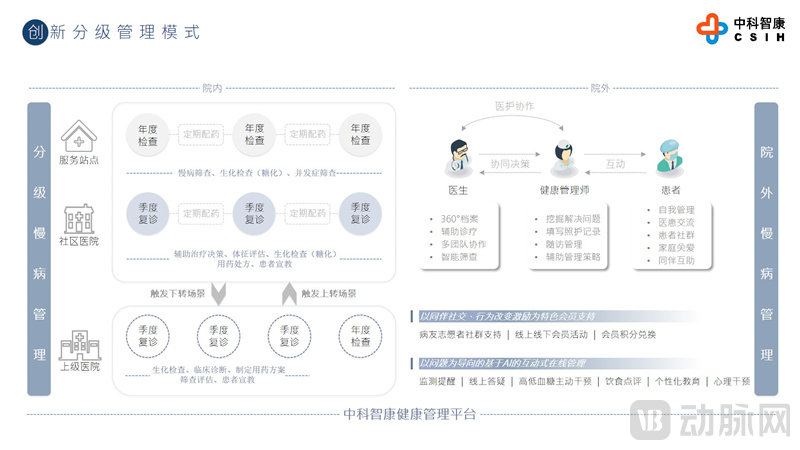
Next, Zhongke Zhikang also plans to launch projects in cities such as Chengdu and Qingdao, achieving rapid expansion through model replication.
“In the future, health services are more likely to be provided to patients as ‘derivative services,’ serving as a means for medical institutions, pharmacies, pharmaceutical and medical device manufacturers, and commercial insurers to enhance service value and diagnostic and treatment efficiency, rather than as a direct source of revenue. Examples include using hospital SaaS solutions to help hospitals manage chronic disease patients within the facility, leveraging pharmacy SaaS platforms to meet chronic disease patients’ needs for out-of-hospital consultations and prescription services, and providing digital marketing services to pharmaceutical and medical device manufacturers,” Xue Yifan told VCBeat. The goal of Zhongke Zhikang is to “provide solutions centered on patients and focused on chronic disease management for all key participants across the healthcare industry chain.” This implies that in today’s competitive landscape of chronic disease management and even the broader internet healthcare sector, competition extends beyond mere traffic acquisition; it increasingly hinges on the ability to integrate medical resources and deliver higher-quality healthcare services to patients.
It is worth noting that the two key figures leading Zhongke Zhikang’s medical services and technology divisions are both highly accomplished professionals with deep expertise in the healthcare sector. Chief Medical Officer Xue Yifan holds degrees in Health Services Management and Clinical Medicine from the University of Adelaide in Australia. With a formal medical background, he is also a practicing cardiologist. He has previously held positions at Dalian Wanda Group’s health industry subsidiary and China Resources Medical Holdings Co., Ltd., and served as president of three large and medium-sized hospitals. During his tenure, he completed investment due diligence for more than 10 hospitals, oversaw the acquisition of two tertiary hospitals, and managed the post-investment integration of over 20 medical institutions.
Huang Bangyu, Chief Technology Officer and Head of the Technology Division, is a core architect of the chronic disease management system. He brings decades of R&D and operational expertise in digital health products and solutions. A graduate of Fudan University with a degree in Computer Software, he previously served as CTO of the Health Sector at Fosun Group and as General Manager of the Digital Technology Innovation Department at Fosun Pharma, earning numerous industry accolades.
Leveraging a founding team with deep industrial and technical expertise, Zhongke Zhikang anchors its strategy in medical services and technological innovation. By collaborating with numerous leading experts, the company is exploring chronic disease management models tailored to China’s specific context, as well as developing competitive, sustainable business pathways suited to its own strengths.
“We believe that by delivering high-quality chronic disease management services, user stickiness will naturally follow, allowing us to further explore and refine our business model.” For a startup that has been in operation for only one year, everything is just beginning. Zhongke Zhikang started with diabetes and cardiovascular disease management and remains committed to its strategy of leveraging cutting-edge technology to support the development of chronic disease management systems. After obtaining an internet hospital license, the company plans to further strengthen and optimize its online and offline management chains, gradually expanding into the broader field of internet healthcare. Its ultimate goal is to build a patient-centric, multi-stakeholder smart healthcare ecosystem that creates shared value for all parties involved.