

Medtronic Launches MAZOR X Robotic Guidance System in China, Accelerating the Transformation of Orthopedic Surgery
In recent years, the wave of innovation-driven development in the orthopedics industry has been accelerating.
Driven by factors such as population aging, rising consumer demand, and continuous improvements in medical care standards, the penetration rate of orthopedic surgeries has increased accordingly. In 2021, the number of orthopedic surgeries was projected to reach approximately 4.6 million. In light of the current substantial volume of orthopedic procedures and growing treatment demands, there is an urgent need to address the pain points associated with traditional orthopedic surgery. As the trend toward precision medicine continues to gain momentum, robotic-assisted orthopedic surgery holds significant potential for substitution, offering promising prospects for industry development.
As can be seen, major medical device companies worldwide have actively deployed their strategies in the field of orthopedic surgical robots. A noteworthy and high-quality example is the Mazor Robotic-Assisted Surgery (RAS) system for spine surgery, acquired by Medtronic, a global leading medical technology company. This system forms an integrated intelligent orthopedic surgical solution by combining Medtronic’s spinal implants, navigation, and intraoperative imaging technologies.
On August 29, Medtronic officially launched its flagship product—the MAZOR X Intelligent Navigation Robot for Spinal Surgery. This robotic system has achieved breakthroughs in three key dimensions: precision, safety, and efficiency.
On the same day, Medtronic’s “1st Summit on Intelligent Spine Surgery and Surgical Robotics Technology” was also held, bringing together experts from six locations across China and the United States to discuss the future of intelligent spine surgery. This marks another milestone in Medtronic’s efforts to deepen its comprehensive strategy in China and expand its localized innovation ecosystem.
The MAZOR X intelligent navigation robot for spinal surgery, unveiled at this summit, was officially approved in China in April of this year. Previously, the MAZOR product series had accumulated 18 years of clinical application experience abroad, with over 50,000 successful surgeries performed and 250,000 screws implanted, thereby amassing extensive clinical data and expertise.
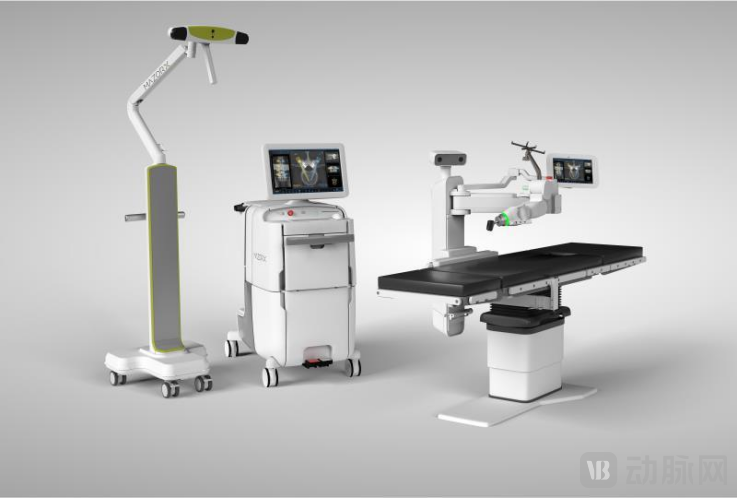 MAZOR X Intelligent Navigation Robot for Spinal Surgery
What sets MAZOR X apart as it rapidly enters the Chinese market? How will it drive the development of the orthopedic industry? And how will Medtronic’s localization strategy in China evolve in the future? VCBeat will address and analyze these questions below.
In the global spine and neurosurgery sector, Medtronic is the undisputed leader, boasting world-leading technologies and a comprehensive product portfolio. Following its 2018 acquisition of MAZOR Robotics, an Israeli spinal surgery company, Medtronic has further accelerated its push into the top tier of the global spinal surgical robotics market.
As the culmination of Medtronic’s robotic and surgical navigation technologies for spinal surgery, MAZOR X is a comprehensive robotic-assisted system for spinal procedures that integrates preoperative planning, intraoperative robotic arm positioning, and real-time navigation.
Compared with traditional spinal surgery, the use of MAZOR X robot-assisted surgery can achieve functions such as AI preoperative surgical planning, precise intraoperative robotic manipulation, and navigated surgical visualization. It is applicable to various types of spinal surgical procedures, including conventional open surgery, minimally invasive surgery, and complex scoliosis surgery. This technology effectively helps surgeons overcome the limitations of “freehand” techniques, such as restricted visual fields, operational blind spots, and inaccurate positioning, thereby enhancing surgical safety and precision.
Furthermore, MAZOR X-assisted surgeries can help patients reduce intraoperative blood loss by 47.8%. The use of MAZOR X not only improves postoperative recovery efficiency but also shortens hospital stays by more than 57.2%, effectively enhancing hospital ward turnover rates and medical service capabilities. Meanwhile, it shortens the learning curve for physicians, accelerates the development of professional talent teams, and expands medical staffing resources, thereby providing impetus for hospitals to transition from mere scale expansion to quality- and efficiency-oriented growth.
Medtronic has grown alongside China for over three decades, consistently supporting healthcare system reforms aimed at enhancing diagnostic and therapeutic efficiency and improving clinical outcomes. The new concept and standards of “Integrated Smart Orthopedic Surgery” introduced in recent years reflect Medtronic’s profound insight into the clinical needs in China.
This concept will foster synergistic collaboration among surgical robot platforms, imaging and navigation systems, energy and power devices, as well as various instruments including intraoperative neuromonitoring systems, implants, and surgical tools. By complementing physicians’ professional expertise, it will create a powerful synergy that achieves an effect greater than the sum of its parts (1+1>2). It aims to provide comprehensive coverage of the entire orthopedic surgical workflow, encompassing all functions and surgical procedures, thereby safeguarding both clinicians and patients.
The official launch of MAZOR X in the Chinese market will accelerate the implementation of Medtronic’s “integrated intelligent orthopedic surgery” concept, set a new benchmark for domestic orthopedic robotic platforms, and facilitate the upgrading of intelligent spinal surgery concepts as well as the overall enhancement of clinical diagnosis and treatment standards.
Orthopedics primarily involves hard tissues, and with the relatively mature application of image-guided interventions and adjunctive technologies, it is better positioned to leverage the precision advantages of robotic systems, thereby further enhancing the accuracy and safety of surgical procedures. Consequently, orthopedic robotics has become one of the earliest entered and most developed fields in surgical robotics, and remains a focal area for current research and industrialization efforts.
From a market size perspective, research report data indicates that global sales of orthopedic surgical robots will reach $2 billion in 2027, with a compound annual growth rate (CAGR) of 18.08%. Currently, the penetration rate of orthopedic surgical robots in China is less than 1%, indicating substantial future market potential.
From a policy perspective, not only does “Made in China 2025” list surgical robots as a key area for development, but the Beijing Healthcare Security Administration has also announced that, effective October 23 this year, robot-assisted orthopedic surgeries will be included in Beijing’s Category A medical insurance reimbursement list (eligible for 100% reimbursement), while disposable robotic-specific instruments will fall under Category B medical insurance coverage (eligible for partial reimbursement). This marks the first time that orthopedic surgical robots, as an emerging medical technology, have been incorporated into the medical insurance system, bringing significant benefits to the industry’s supply chain.
Orthopedic surgical robots are gradually gaining market favor, entering a fast lane driven by intelligent and refined development as well as favorable medical insurance policies. However, current realities in China—such as the demand for personalized medicine and the healthcare system’s goals of improving quality and efficiency—are placing higher demands on the pace of orthopedic innovation, with a clear trend toward intelligent upgrades emerging.
It is understood that following the official introduction of MAZOR X into China, Medtronic will collaborate with ecosystem partners to jointly develop localized innovative solutions tailored to the needs of the Chinese market. By joining forces with top-tier hospitals in China and renowned academic institutions such as Shanghai Jiao Tong University, the company aims to create products that better meet local market demands. Through integrating the industry-academia-research-clinical practice chain, this initiative will not only facilitate the localization of innovative products but also drive comprehensive upgrades across the entire industrial chain, from research and development and manufacturing to service delivery.
Ms. Yu Jing, Vice President of Medtronic and General Manager of the China Neurosurgery and Orthopedics Group, stated, “The concept of an innovation ecosystem requires the participation and support of all stakeholders, including clinical practitioners, research institutions, enterprises, and investment funds, to achieve scalable impact from zero to one, then to ten, a hundred, and a thousand. With the launch of the MAZOR X Spine Surgery Intelligent Navigation Robot, Medtronic is eager to collaborate with clinicians, research institutions, and industry partners to jointly advance the development of China’s robotic innovation ecosystem and promote the establishment of an integrated ‘industry-academia-research-clinical practice’ framework.”
“With the launch of MAZOR X, we will accelerate our strategic deployment in the robotics sector and leverage our established localized platform to drive its robust development. As the application of robotic systems continues to expand in China, a substantial volume of clinical cases and experience will be accumulated, which can then be ‘reverse-exported’ to global platforms for sharing and discussion. This will serve as a significant catalyst not only for the development of China’s robotics industry but also for the advancement of robotic technology worldwide,” added Ms. Yu Jing.
In 2012, Medtronic’s acquisition of Kanghui represented a significant investment in China and marked an important step in Medtronic’s localization strategy in the country. For the Chinese market, Medtronic will continue to adopt a dual-brand synergy strategy, leveraging both the “Medtronic” and “Kanghui” brands. The Medtronic brand will focus on introducing global innovative technologies, while the Kanghui brand will be responsible for the research, development, and promotion of locally innovated technologies. By combining innovative technologies with a comprehensive product portfolio, Medtronic aims to meet the needs of different market segments. While accelerating the introduction of Medtronic’s globally renowned products to serve the high-end market, the company will also advance Kanghui’s localized R&D efforts to address the needs of primary healthcare markets and improve accessibility. Currently, Kanghui-branded products are available in more than 60 countries and regions worldwide.
Looking ahead, Medtronic will leverage the localized innovation of its dual brands, “Medtronic” and “Kanghui,” to introduce advanced technologies into China and serve Chinese clinical customers. Through the Belt and Road Initiative, these solutions will also extend to other countries, addressing their clinical needs and creating health value for more orthopedic patients.