

Medical Device Giants Go on Buying Spree: Over $100 Billion Deployed in Just Six Months – Which Segments Are Attracting the Most Investment?
Acquisition was a high-frequency term in the medical device industry in 2021.
Although mergers and acquisitions (M&A) are commonplace in the medical device industry, 2021 witnessed an astonishing pace of new deal announcements, with a backlog of multiple billion-dollar transactions across the sector. According to data from Ernst & Young, the medical device industry recorded 33 M&A deals in the first half of 2021 alone, surpassing the total of 33 deals for the entire year of 2020. It is worth emphasizing that amidst the global wave of medical device M&A, Chinese companies have also emerged as active buyers, continuously acquiring overseas assets and introducing them into the Chinese market.
A market capitalization of billions relies on business operations, tens of billions on mergers and acquisitions (M&A), and hundreds of billions on core explosive businesses combined with M&A. This statement is particularly applicable to the medical device sector. In the past, due to insufficient scale and limited management capabilities, among other factors, Chinese medical device companies were not active in overseas acquisitions.
In recent years, the medical device industry has seen intensifying hyper-competition. Volume-based procurement policies under healthcare cost-containment measures have placed growth pressure on mature business lines. Meanwhile, the rapid acceleration of product iteration in the medical device sector has further compounded survival challenges for companies. In this context, mergers and acquisitions (M&A) offer a swift means to break through corporate growth ceilings and capture high-potential niche markets. As a result, M&A and license-in strategies have become an essential fast track for the development of medical device enterprises.
What factors drove the wave of mergers and acquisitions (M&A) in the medical device sector this year? Among the numerous overseas M&A targets, which sectors attracted the most capital? How will the products acquired by industry giants through substantial investments reshape the competitive landscape? VCBeat (WeChat ID: vcbeat) has analyzed the major M&A transactions in the medical device field in 2021.
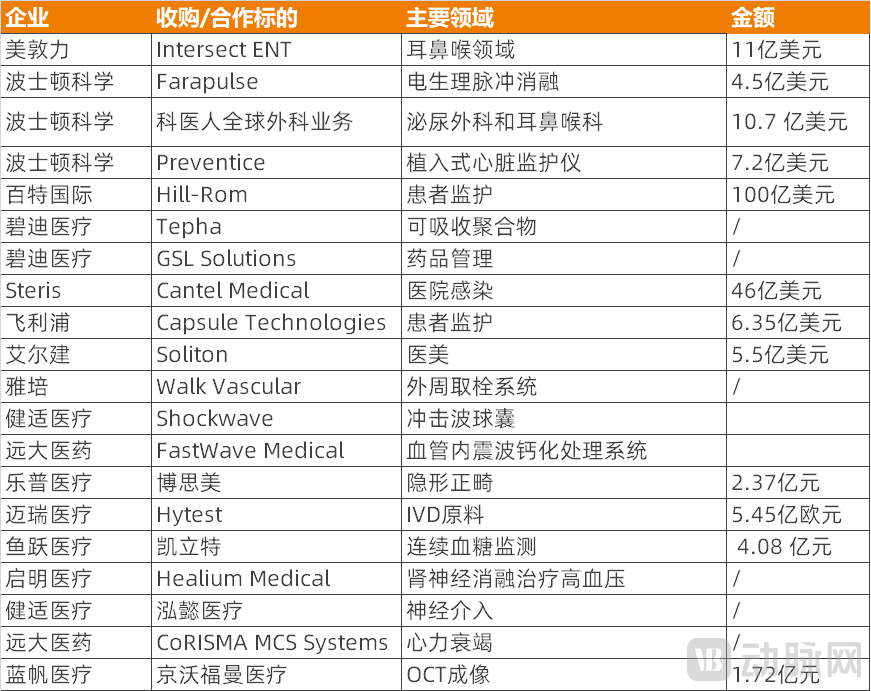
Major Acquisitions and Partnerships in the Global Medical Device Industry in 2021
In the development history of medical device enterprises, mergers and acquisitions (M&A) are a fundamental capability; indeed, the medical device sector has a greater need for M&A compared to other sub-sectors within the healthcare industry. From the perspective of product characteristics, the medical device industry is characterized by fragmentation and discrete manufacturing, with significant barriers between various niche segments. Product technologies are also undergoing rapid iteration, where new technologies often have a disruptive impact on older ones. From a market standpoint, the growth ceiling in each medical device niche is clearly defined. If companies fail to further expand their market share, intense external competition will quickly lead to a decline in their market position.
This year, however, the drivers behind the acquisition sprees among domestic and international medical device companies have differed. Globally, the primary reason for the surge in mergers and acquisitions has been ample cash flow in the post-pandemic era. As Ernst & Young noted in a report, many medical device companies shook off the effects of uncertainty in 2021, accumulated substantial cash reserves, and began deploying these funds toward acquisitions.
Ample cash flow is evident from the latest financial reports of global giants. According to the first-half 2021 annual reports released by these industry leaders, all top 10 global medical device companies achieved revenue growth. In addition to the rapid expansion of diagnostic businesses closely tied to the pandemic, the high-value consumables segment also staged a strong rebound. Abbott’s medical devices business generated $6.986 billion in revenue, a year-on-year increase of 30.3%. Data from Medtronic’s fourth-quarter fiscal 2021 report (covering February 1 to April 30, 2021) showed that its Cardiovascular segment recorded $2.908 billion in revenue, up 45.1% year on year. In the first half of 2021, BD (Becton, Dickinson and Company) reported revenue of $10.222 billion, representing a 21% year-on-year increase. The operations of major industry players have rebounded robustly, and the sector is gradually returning to normalcy.
The drivers behind the shift from a cold to a hot M&A market for medical devices in China differ from those overseas. In China’s previous market environment, mergers and acquisitions (M&A) and consolidation within the medical device industry were not the norm. In 2019, cross-border M&A activity involving Chinese medical device companies once plummeted to a standstill.
It is argued that the primary reason for the infrequency of mergers and acquisitions (M&A) in the past is that China’s medical device market continues to grow at a rate significantly higher than that of mature international markets, allowing companies to maintain rapid development through organic growth alone. Due to factors such as business practices, asset valuations, and the capital market environment, acquiring high-quality domestic assets remains relatively challenging; consequently, numerous projects are seeking independent listings, and M&A consolidation among already-listed companies is even more difficult. Furthermore, the capital market’s acceptance of growth via M&A has not yet reached the level observed in mature international markets.
Why Have Overseas M&A Activities by Chinese Companies Rebounded from the Bottom in the Post-Pandemic Era? This Trend Is Linked to Changes in China’s Industrial Development Environment. Although the Chinese medical device market continues to maintain high growth, the era of effortless profits for manufacturers of high-value consumables has come to an end due to volume-based procurement (VBP) policies implemented under healthcare cost containment measures. VBP has reshaped the existing rules of the industry and will alter the original market distribution landscape. Judging from current policy directions, volume-based procurement is expected to become a normalized practice across multiple sub-sectors.
Currently, the cardiovascular high-value consumables segment is the most significantly impacted by the centralized volume-based procurement (VBP) policy. The coronary stent market was the first to implement national-level VBP in China. Although the policy has been in effect for over a year, its severe impact on the coronary stent industry is only beginning to manifest. Even companies that primarily focus on stents and successfully win bids in the procurement process are facing substantial operational pressures.
Jiwei Medical’s drug-eluting stent system, a subsidiary of Blue Sail Medical, won bids in the national volume-based procurement program. However, according to Blue Sail Medical’s 2021 H1 financial report, although the sales volume of its winning Xinyue stents exceeded 220,000 units in the first half of 2021, representing a year-on-year increase of over 430% and a significant rise in market share, Jiwei Medical’s revenue amounted to only RMB 85.14 million, a year-on-year decrease of 61.23%. Meanwhile, Blue Sail Medical’s cardiovascular device business generated RMB 364 million in revenue in the first half of 2021, also reflecting a year-on-year decline of 28.6%.
Under pressure on traditional business fronts, medical device companies have had to open up new battlegrounds. This is why, among the many acquirers in mergers and acquisitions, companies specializing in high-value consumables for vascular interventions are the most active and frequent buyers.
Major medical device M&A transactions in 2021 exhibited several key characteristics:
First, major M&A activities are primarily concentrated in the cardiovascular field.Domestic medical device companies are beginning to expand their industrial chains comprehensively and broaden their product portfolios. The primary focus of corporate mergers and acquisitions (M&A) should be on capturing market share within their respective sectors, with target selection prioritizing synergy with existing distribution channels. Taking Blue Sail Medical as an example, in 2021, the company invested in Nanjing Volkmann, a domestic brand of optical coherence tomography (OCT) systems. OCT imaging can provide precise guidance for percutaneous coronary intervention (PCI) procedures. Previously, Blue Sail Medical’s cardiovascular product offerings were predominantly concentrated in the therapeutic segment. Following the investment in Volkmann, the company integrated Volkmann’s novel diagnostic technologies into its established sales platform for cardiovascular products.
Second, in terms of target preferences, within the cardiovascular sector where Chinese companies are frequently active, intervention-without-implant solutions are the most sought-after by domestic enterprises.The commercial potential of "intervention without implantation" has been validated. In the first half of 2021, Lepu Medical’s portfolio of intervention-without-implantation products, including bioresorbable scaffolds, drug-coated balloons, and cutting balloons, generated RMB 364 million in revenue, representing a year-on-year increase of 1,951.55%, thereby becoming a new growth pillar for Lepu Medical following the centralized procurement of stents.
"Intervention Without Implantation" has emerged as a favored new strategic frontier for high-value medical consumable companies, as it emphasizes restoring vascular blood flow without leaving permanent metallic implants in the patient’s body. Representative products of this approach include drug-coated balloons, bioresorbable scaffolds, and atherectomy devices. Among these, intravascular lithotripsy balloons were the most sought-after single product category in the 2021 M&A trends.
Shockwave balloon is a powerful technology that combines shockwave lithotripsy with angioplasty. The so-called intravascular shockwave lithotripsy technique refers to the placement of a shockwave generator inside a balloon for the treatment of calcified vascular lesions. This technology, adapted from kidney stone treatment, has been safely applied in nephrolithiasis management for over 30 years. Intravascular shockwave calcium modification technology treats intimal and medial calcified lesions using acoustic pressure waves generated within a low-pressure dilated balloon, thereby improving vessel compliance and enabling safer dilation.
In this emerging field, Shockwave Medical of the United States was the first company to launch a shockwave balloon. Its C2 catheter for treating coronary artery calcification has demonstrated significant clinical value in a series of clinical studies and received FDA approval for market release in February 2021.
Shockwave’s shockwave balloon technology was acquired by Jian Shi Medical. In March 2021, Jian Shi Medical entered into a partnership with Shockwave: the two parties jointly established a joint venture controlled by Jian Shi Medical to introduce intravascular lithotripsy technology to China, benefiting Chinese patients. Building on this joint venture, Jian Shi Medical will establish a production line in China for the localization and manufacturing of Shockwave’s products.
In the promising segments of the medical device industry, competition is always fierce. The shockwave balloon catheter market is no longer dominated solely by Shockwave; FastWave Medical has also entered this competitive landscape and secured strategic investment from Grand Pharma in August 2021. With domestic companies also engaged in R&D of shockwave balloon catheters, the launch of these products in the Chinese market is expected to face intense competition.
The third major characteristic is that, as the growth ceiling for traditional businesses becomes increasingly apparent, cross-industry mergers and acquisitions have become the norm, with some companies beginning to pursue cross-sector M&A to break through industry ceilings.On the one hand, established domestic manufacturers of high-value medical consumables are venturing into consumer healthcare products; on the other hand, the domestic high-value medical consumables sector is beginning to welcome a more diverse range of participants.
In 2021, Lepu Medical entered the clear aligner orthodontics market by acquiring the loss-making company Bosimi for over RMB 200 million. Beyond this move, Lepu Medical is comprehensively expanding into dentistry, not only entering the fields of orthodontic appliances, digital solutions, and professional 3D scanning (intraoral scanning) through mergers and acquisitions, but also independently developing dental implants. Regarding its overall expansion into the dental sector, Lepu Medical stated that it was primarily driven by the impact of centralized volume-based procurement (VBP). As VBP has become normalized, the gross profit margin of Lepu’s core business—coronary stents—has declined. In the first half of 2021, the gross profit margin of Lepu Medical’s medical device business was 61.03%, a decrease of 10.63 percentage points year-on-year. To ensure sustainable performance growth, Lepu Medical chose to enter the high-margin clear aligner orthodontics market, thereby stepping into the consumer healthcare sector.
Venus Medtech, the leading player in heart valve solutions, has entered the field of interventional hypertension therapy by establishing a joint venture, Renaly Ltd., with Israeli high-tech company Healium Medical Ltd. This partnership aims to introduce Healium’s next-generation innovative renal denervation (RDN) devices and to conduct global research and development, manufacturing, and commercialization of RDN products.
Amid the fierce competition among Chinese enterprises in overseas mergers, acquisitions, and collaborations, it is evident that the business model combining license-in of medical devices with independent R&D has become highly active, which will also impact the landscape of medical device innovation in China. First-mover advantage is crucial in the medical device industry. As domestic companies increasingly introduce overseas products, competition among enterprises will intensify. With the growing popularity of the license-in model, the window for Chinese companies to pursue me-too innovation will shorten, imposing higher demands on their innovation capabilities and differentiation. Domestic innovation must not remain at the stage of mere imitation; mastering forward-thinking perspectives and strategic vision is even more essential for Chinese innovative enterprises.
Undoubtedly, as competition intensifies, some companies will fall behind, and mergers and acquisitions among listed companies in the medical device sector will become increasingly frequent.
Domestic M&A trends are largely influenced by the volume-based procurement (VBP) policy, affecting both the acquiring companies and their strategic directions. In contrast, M&A activities by overseas giants are less impacted by policy factors and are primarily driven by assessments of products and markets. The M&A strategies of foreign enterprises reflect these industry leaders’ perceptions of market dynamics.
From the perspective of acquisition trends, as industry concentration increases, mergers and acquisitions between major players are relatively rare. Instead, these giants are consolidating their market positions in specific segments and enhancing their product solutions through acquisitions, while also capturing emerging high-growth niche markets.
From a statistical analysis perspective, the field most favored by industry giants is the ENT (ear, nose, and throat) device market. ENT disorders are common conditions in daily life, such as allergic rhinitis, vocal cord polyps, tinnitus, and snoring. The medical device subsector for otolaryngology boasts a broad market that remains underdeveloped.
Industry insiders told VCBeat, “China’s ENT market has experienced exponential growth over the past five years.” In China, the incidence of ENT-related diseases has been rising steadily in recent years. Statistics show that more than 100 million people suffer from chronic rhinosinusitis. The volume of ENT and head and neck surgeries was estimated at approximately 2 million cases in 2021, compared to just 500,000 cases five years earlier, representing an annual growth rate exceeding 30%. Meanwhile, driven by the accelerating expansion of market demand, the ENT healthcare market is expected to maintain robust high-speed growth.
Products in the otolaryngology field include otoendoscopes, nasopharyngolaryngoscopes, hearing aids, ablation devices, and lasers. Medtronic’s acquisition of Intersect ENT was primarily driven by its sinus implants; specifically, its bioabsorbable steroid-eluting sinus stents can open sinus passages and deliver anti-inflammatory steroids to facilitate healing. By integrating these products with Medtronic’s navigation systems, powered instruments, and existing tissue health portfolio, Medtronic aims to offer a broader suite of solutions to help surgeons treat patients with chronic rhinosinusitis (CRS).
Meanwhile, another industry giant, Boston Scientific, acquired Lumenis for its laser and fiber-optic solutions used in minimally invasive urological and otolaryngological procedures. The Lumenis CO2 laser surgical system enables minimally invasive transoral treatment of early glottic laryngeal cancer, allowing patients to avoid neck incisions and tracheostomy, better preserve laryngeal function, and improve quality of life.
In addition, the patient monitoring sector has also attracted significant attention from industry giants. Philips acquired Capsule Technologies, a provider of medical device integration and data technology solutions for hospitals and healthcare institutions. Boston Scientific acquired Preventice, a company specializing in mobile cardiac health management solutions, with a product portfolio that includes the Body Guardian® remote wearable cardiac monitor. This monitor utilizes a fully integrated cloud-based platform supported by independent diagnostic testing facilities, where insights provided by clinical technicians and artificial intelligence algorithms can enhance clinical diagnosis. Boston Scientific had previously been an investor in this company. During the pandemic, remote cardiac monitoring solutions gained popularity, and Boston Scientific remains optimistic about the rapidly growing market for ambulatory electrocardiogram (ECG) devices.
Mergers and acquisitions (M&A) are an inevitable path for the growth of the medical device industry. The rapid iteration of product technologies and the limited size of niche markets dictate that M&A can help companies quickly break through growth ceilings; indeed, all existing global medical device giants have become industry leaders through M&A. In the medical device sector, M&A is regarded not merely as a strategy for expansion but also as a matter of survival—like sailing against the current, where failure to advance means falling behind. Intense external competition can rapidly erode market share, while M&A offers a pathway to swift breakthroughs. However, not all M&A transactions succeed, and there is no shortage of failed cases in the medical device field. As the era of M&A arrives, it is worth emphasizing that strengthening endogenous capabilities forms the foundation for successful large-scale mergers and acquisitions.
Reference Article:
Marking the Boat in Perilous Waters, Seeking the Sword in the Wrong Scene — A Reconsideration of and Practical Lessons from the M&A Path of Global Medical Device Giants — Guangzheng Hengsheng