

Xynomic Pharmaceuticals Taps into China's Biotech Boom with A-Share IPO Filing Following NASDAQ Delisting
In the past two years, with the passage of the U.S. Holding Foreign Companies Accountable Act, the trend of Chinese concept stocks returning to the A-share and Hong Kong markets has continued to gain momentum. In late March this year, the news that the final amendments to the Holding Foreign Companies Accountable Act had been passed dealt a heavy blow to many Chinese concept stocks in the U.S. capital market, with more than 40 such stocks dropping by over 10%. This indicates that many Chinese concept stocks are unable to achieve desirable valuations in the U.S. capital market.
In contrast, within China, the reform of the listing system in the Hong Kong stock market over the past two years, along with the continuous improvement of the institutional mechanisms in the A-share market, has led to increasingly inclusive listing standards for innovative companies with dual-class share structures and pre-profit biotech firms. This has enhanced the attractiveness of public listings, fueling sustained momentum in the return of Chinese concept stocks to the A-share and Hong Kong markets.
Xynomic Pharma (Nanjing) Co., Ltd. (hereinafter referred to as “Xynomic Pharma”) is one of the companies that have joined the wave of returning to list in China. As a high-quality biotechnology company focused on developing innovative small-molecule drugs, Xynomic Pharma develops novel small-molecule anti-tumor drugs based on three major technology platforms: epigenetics, kinase inhibition, and gene fusion. As early as May 2019, Xynomic Pharma announced its listing on the main board of the NASDAQ Stock Exchange in the United States, merely two years after the company’s establishment.
How Xynomic Pharma Achieved the Leap from Startup to Public Company in Just Two Years: A Testament to Team Strength and TimingThe ability to complete the transition from a small startup to a publicly listed company in merely two years is not only a demonstration of the strength of Xynomic’s team but also a result of their alignment with the pulse of the times. An overview of the company’s development model reveals it as a typical example of the “dual-engine” strategy combining in-house R&D with license-in partnerships.
Since its inception, Xynomic Pharma has introduced promising product pipelines from major multinational pharmaceutical companies, including Pharmacyclics/AbbVie and Boehringer Ingelheim, for further development. Leveraging its team’s expertise in small-molecule drugs, the company has also actively pursued the research and development of its own proprietary product pipelines.
Currently, Xynomic Pharma has a pipeline of innovative small-molecule drugs comprising three candidates in clinical stages and two in preclinical stages. Among these, abexinostat, a Class 1 new drug, is the only HDAC inhibitor currently effective against both B-cell and T-cell lymphomas. It has received two Fast Track designations from the U.S. FDA and has applied for Breakthrough Therapy designation in China, with approval for marketing in China expected in 2022. In the same year as the anticipated product launch, Xynomic Pharma aims to list on the STAR Market under the fifth set of listing criteria and is currently undergoing its final round of financing prior to domestic listing.
It was the strength of the Xynomic Pharma team that enabled it to engage in dialogue and build trust with multinational giants from its inception, thereby acquiring multiple high-quality product pipelines in a single stroke.
On How to Earn the Trust and Favor of Multinational Pharmaceutical Companies,Xu Yinglin, Co-Founder and Chairman of Xynomic PharmaTwo points are of critical importance: first, the team’s capabilities—specifically their experience and expertise in new drug development; second, the team’s integrity, with honesty being paramount. For large pharmaceutical companies, the upfront payment for out-licensing a product pipeline is not the primary consideration. According to Xu Yinglin, since major pharmaceutical firms generally have confidence in their own drug pipelines, they place less emphasis on upfront payments for licensed products and instead prefer to maximize returns during the subsequent commercialization and sales phases.
In this way, large pharmaceutical companies are willing to license their products to teams with strong R&D capabilities through transaction structures with deferred payment schedules. Considerations of team integrity form the foundation for subsequent successful collaboration and achieving a win-win outcome. For small and medium-sized enterprises (SMEs), obtaining product licensing for R&D at relatively favorable prices during the early development stage, when cash flow is not abundant, represents a rare and valuable opportunity.
Regarding the talent advantages of Xynomic Pharma’s core team, Xu Yinglin elaborated on three key areas to VCBeat: preclinical research, clinical development, and the development and control of product CMC processes.
Within each module of its talent framework, Xynomic Pharma has assembled top-tier scientists alongside industry veterans with extensive experience and distinguished track records, and has engaged world-class scientific and medical advisors to support the research direction of its product pipeline. However, this alone does not fully capture the appeal of Xynomic’s talent team.
Over the course of two years, from founding to ringing the opening bell at its IPO, Xynomic Pharma’s success has been driven by the exceptional execution capabilities of Xu Nuo’s team. So, what lies at the heart of this remarkable execution? In an interview with VCBeat, Xu Yinglin shared: “When recruiting and building our team, we did not place particular emphasis on individuals’ ‘glamour’ from large corporations; instead, we prioritized hands-on operational competence. We have a strong preference for talent who can demonstrate outstanding execution skills in small- and medium-sized startups.”
Xu Yinglin believes that an individual’s success at a large corporation does not necessarily reflect their true capabilities; rather, it is largely attributable to the capabilities and resources of the team to which they belong. For startups, which operate under constraints of limited resources, tight timelines, heavy workloads, and high pressure, individuals who can survive in such challenging environments and demonstrate exceptional execution are rare and valuable. Such talent is key to the ultimate success of a startup.
Most members of Xynomic Pharma’s core team not only have years of experience working at large corporations but also possess direct hands-on experience gained from startups. This combination is the key to the team’s strong execution capability. The choice of such a “recruitment” and “talent management” approach is based on insights derived from Xu Yinglin’s extensive experience navigating the healthcare industry over many years.
Xynomic Pharma marks Xu Yinglin’s third entrepreneurial venture. As a distinguished serial entrepreneur, Xu co-founded two China-U.S. biopharmaceutical companies and achieved successful exits, with the companies being acquired by Pharmaron and Pharmacyclics, respectively. His repeated entrepreneurial successes stem from his deep industry expertise accumulated over many years, as well as his profound understanding of the prevailing macroeconomic landscape and market pain points.
Xynomic Pharma’s product pipeline, acquired through “license-in” arrangements, includes three drug candidates: abexinostat, XP-105, and XP-102. According to Xu Yinglin, Xynomic Pharma holds exclusive global rights for the development, manufacturing, and commercialization of these drugs.
Abexinostat is currently the company’s most advanced product pipeline. This product was licensed by Xynomic Pharma in 2017 from Pharmacyclics, a subsidiary of AbbVie, the world’s third-largest pharmaceutical company. The drug is currently undergoing a global pivotal Phase III clinical trial in combination with pazopanib for the treatment of renal cell carcinoma, as well as a China-based pivotal Phase II clinical trial as monotherapy for non-Hodgkin lymphoma.
It is understood that abexinostat is an innovative histone deacetylase (HDAC) inhibitor with a superior safety profile compared to approved HDAC inhibitors, holding best-in-class potential. It has been recognized as one of the leading global therapies, particularly for relapsed or refractory follicular lymphoma. The drug was expected to receive marketing approval in China in 2022.
XP-105 is a novel anticancer agent licensed by Xynomic Pharma from Boehringer Ingelheim in late 2018. As an ATP-competitive mTORC1/2 inhibitor, it demonstrates efficacy against various solid tumors and has currently entered Phase II clinical trials, with breast cancer and small cell lung cancer as the targeted indications. Recent clinical data indicate that XP-105, when used in combination with paclitaxel, shows a significant advantage in disease control rate compared to similar products on the market.
XP-102, another clinical-stage asset licensed by Xynomic Pharma from Boehringer Ingelheim, is a highly potent, highly selective pan-Raf inhibitor that binds to the inactive DFG-out conformation. Xynomic Pharma states that this drug has the potential to become the best-in-class second-generation pan-Raf inhibitor. Preclinical data indicate that, compared with first-generation inhibitors, XP-102 offers an improved therapeutic window and achieves more pronounced and durable pathway inhibition, thereby enhancing efficacy. The candidate drug is being developed for the treatment of colorectal cancer and non-small cell lung cancer.
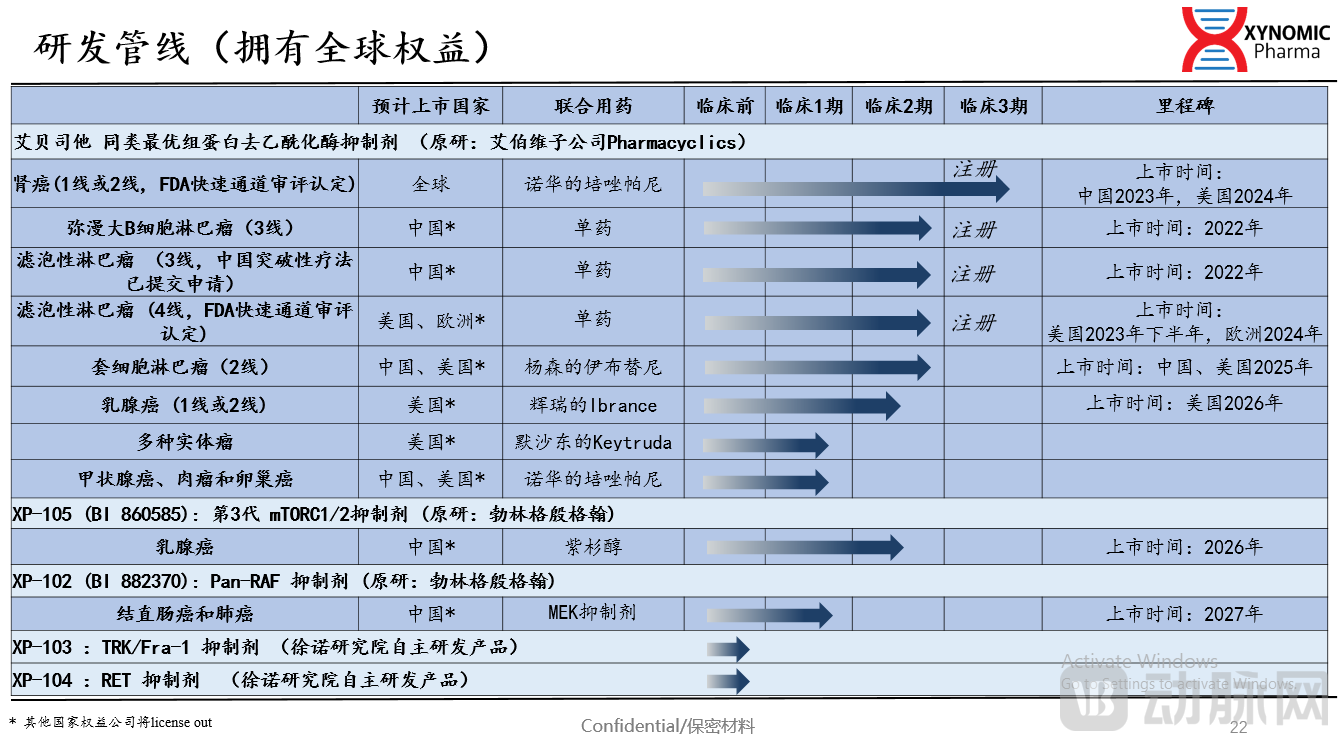
Xynomic Pharma’s Product Pipeline (Image source: Provided by the company)
While actively introducing high-quality external product pipelines, Xynomic Pharma has leveraged its R&D team’s technical expertise in small-molecule drugs and closely addressed unmet clinical needs to develop two self-developed innovative small-molecule drugs, aiming to sustain the company’s competitiveness in small-molecule oncology therapeutics. These candidates are currently in the preclinical research stage.
An examination of Xynomic Pharma’s overall product development portfolio reveals a strategically structured pipeline. Abeostat is primarily developed for lymphoma, while the pipeline comprising XP-105, XP-102, XP-103, and XP-104 is mainly focused on solid tumors. This allocation closely mirrors the global oncology market structure. According to Chairman Xu Yinglin, hematologic malignancy products account for approximately 40% of global oncology drug development, whereas solid tumor products represent about 60%.
In consideration of the company’s long-term development, Xynomic Pharma adheres to the following strategic approach in pipeline in-licensing and the selection and development of product indications: In terms of therapeutic area selection, Xynomic Pharma “focuses on its core competencies,” fully leveraging the team’s technical advantages in small-molecule drug research. Regarding indication development, the company strives to avoid crowded therapeutic areas and refrains from direct head-to-head competition with multinational corporations (MNCs). Instead, it prioritizes other indication segments characterized by unmet clinical needs and greater market opportunities.
Xu Yinglin stated that due to the extremely fierce competition in product pipelines targeting major indications, companies face higher development risks despite the larger market resources available. Redirecting effective resources toward medium-sized indications with unmet clinical needs actually presents better market opportunities for small and medium-sized enterprises. For Xynomic Pharma, which aims to become a Big Pharma company, seizing first-mover advantage and striving to capture the largest share of market resources are crucial to its long-term development.
On July 15, 2021, Xynomic Pharma announced the official opening of its Nanjing Research Institute in the Bio-Medicine Valley of Nanjing Jiangbei New Area. This milestone will accelerate the construction of the company’s global headquarters and the R&D and commercialization of its product pipeline, while also driving Xynomic Pharma’s future expansion into the development and strategic layout of products beyond its oncology portfolio.
Looking ahead, Xynomic Pharma plans to build its own production facilities compliant with international cGMP standards and establish promotional and sales teams in China and the United States, striving to become an integrated pharmaceutical enterprise encompassing R&D, manufacturing, and commercialization.
For Xynomic Pharma, whether ringing the opening bell on NASDAQ or listing on China’s main board, the secondary market is merely a new starting point for the company’s development. According to Xu Yinglin, the most critical priority is to return to the core of product development by launching high-quality medicines that deliver tangible benefits to clinical patients. This commitment reflects the original mission of the Xynomic team.