

Lancet Robotics Secures New Funding Round to Accelerate Domestic Development of Orthopedic Joint Replacement Surgical Robots

Lancet Robotics
Developer of Robotic Systems for Orthopedic Joint Replacement Surgery
Shenzhen Lancet Robot Co., Ltd. (hereinafter referred to as “Lancet Robot”) recently announced the completion of a new round of financing amounting to tens of millions of yuan. This investment was made by the SME Development Fund managed by Oriental Fortune Capital. The proceeds will be primarily used for clinical studies of the company’s multiple surgical robots and the research and development of new products.
Previously, Lancet Robot completed an angel round of financing jointly invested by Yuansheng Venture Capital and Qianhai Fund of Funds, as well as a Pre-A round of financing invested by Haibang Fenghua.
Lancet Robot, founded in 2018, is a technology-driven enterprise dedicated to advancing orthopedic surgery towards intelligence, minimally invasive techniques, and precision. The company’s vision is to become a leader in technological innovation for orthopedic surgical robots. Its independently developed total knee arthroplasty (TKA) robotic system features the globally pioneering Lancet-KBAS system for quantitative assessment of soft tissue tension, spearheading technological advancements in the new generation of joint replacement surgical robots. This technology has received high acclaim from numerous clinicians and experts. Furthermore, Lancet Robot continuously innovates around customer needs, providing customized intelligent surgical solutions for orthopedics, and has established strong collaborative partnerships with multiple publicly listed companies.
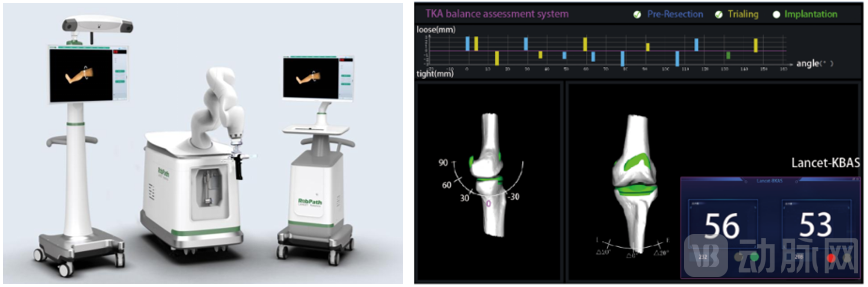
Lancet Knee Arthroplasty Surgical Robot (left), Lancet-KBAS System (right)
Multiple New Products Have Initiated Registration Clinical Trials
As population aging intensifies, the incidence of orthopedic diseases has been increasing year by year, making China the second-largest joint replacement market after the United States. However, the total annual number of total knee arthroplasty (TKA) procedures in China remains less than one-third of that in the U.S., failing to meet the urgent demand for high quality of life among a large patient population, particularly the elderly. The primary role of robotic systems in total knee arthroplasty is to standardize, enhance precision, minimize invasiveness, improve efficiency, enable intelligence, and personalize this technically demanding and operationally complex procedure, thereby empowering more surgeons to benefit a broader patient population.
The application of orthopedic surgical robots can significantly improve surgical precision. After decades of development, orthopedic surgical robots have successfully integrated modules for preoperative planning, intraoperative real-time positioning and navigation, and postoperative simulation-based evaluation. They cover the entire process of joint replacement surgery, providing a comprehensive intelligent solution for precise bone resection, accurate implant placement, and realistic assessment of postoperative outcomes.
However, contradicting clinical demand, no domestically produced joint replacement surgical robots have yet received regulatory approval for registration in China, and among imported products, only one joint replacement surgical robot has been approved for market launch in the country, indicating substantial potential for domestic substitution.
Currently, the Lancet hip replacement surgical robot has been successfully used to perform robot-assisted hip arthroplasty at multiple renowned Grade A tertiary hospitals, including the Affiliated Drum Tower Hospital of Nanjing University Medical School. In addition, RobPath, the total knee arthroplasty surgical robot independently developed by Lancet Robot, has officially commenced clinical trials for registration in China.
Digital Orthopedic Software Receives Regulatory Approval, Accelerating Entry into the Digital Orthopedic Surgery Sector
In recent years, with the growing clinical demand for precision medicine, digital orthopedic technologies and products have gradually gained recognition and wider adoption in clinical practice. By enabling precise visualization of the complex three-dimensional (3D) structures of normal or pathological bones, facilitating measurements of reconstructed 3D models, supporting clinical auxiliary diagnosis, and assisting in surgical planning and simulation, digital orthopedics has emerged as a new developmental direction that closely integrates orthopedic clinical practice with computer-based digital technologies.
Recently, the digital orthopedic software product developed by Lancet Robot has successfully obtained the NMPA Class II medical device registration certificate. It is applicable to the processing of orthopedic joint image information and assists in better performing joint replacement surgeries.
Ji Feng, Investment Director at Orient Fortune Capital, stated“Joint replacement surgery is a procedure that many elderly individuals are likely to undergo. With advancing age, joints gradually wear down, and since articular cartilage cannot regenerate, some patients with joint diseases must undergo replacement to achieve recovery. Traditional surgeries rely heavily on the surgeon’s experience, and due to the limitations of human vision and manual dexterity, errors are inevitable. The Lancet Joint Replacement Surgical Robot enables precise preoperative planning based on preoperative CT data and achieves surgical visualization through efficient intraoperative registration technology, thereby improving surgical accuracy, particularly in narrow anatomical regions. This results in shorter incisions, less tissue damage, reduced bleeding, and faster postoperative recovery for patients. We remain optimistic about the company’s future development in this sector.”
About Oriental Fortune Capital
Oriental Fortune Capital is committed to investing in target companies with growth potential and IPO prospects, and actively provides value-added services to its portfolio companies, striving to help them maximize corporate value through IPOs and other means. Since its establishment, Oriental Fortune Capital has managed funds totaling nearly RMB 25 billion, with 52 funds under management and approximately 500 projects invested in to date.