

Jiaao Tech Files IPO Prospectus: Pioneering Affordable, Self-Developed Surgical Robotics and Navigation Systems for Widespread Hospital Adoption

KEYIN
Intelligent Surgical Robot Developer
Data on urban aging in China show that the proportion of the population aged 65 and above has exceeded 14% in 149 prefecture-level and higher cities nationwide, indicating entry into deep aging. As the aging process accelerates, the prevalence of orthopedic conditions such as joint and spinal disorders will also rise. Furthermore, with improvements in living standards and growing demand for diagnosis and treatment, surgical procedures are increasingly becoming minimally invasive, intelligent, and precise.
Compared with traditional open surgery, robotic surgery not only features smaller incisions, less pain, faster recovery, and lower infection rates, but also enhances the capability to perform complex procedures. It offers advantages such as flexibility and precision, resistance to fatigue and radiation, a wide and clear visual field, tremor filtration, minimal bleeding and fewer complications, intuitive and natural operation, and ease of learning.
Amid this trend, major multinational medical device giants are increasingly investing in surgical robots and focusing their efforts on the Chinese market. However, surgical robots currently available on the market are generally expensive, affordable only to the top 100 hospitals in China; they are also bulky and impose stringent requirements on operating rooms. As a result, the current penetration rate of surgical robots remains low.
To address these pain points, Shanghai Jiaao Information Technology Development Co., Ltd. (hereinafter referred to as “Jiaao Tech”), an emerging leader in the surgical robotics sector, has chosen a development path centered on the independent research and development of core technologies and components, with the aim of creating China’s most practical intelligent surgical robot.
Ma Kewei, Founder and CEO of Jiaao Technology, is a true serial entrepreneur.
After graduating from university, Ma Kewei spent ten years working in marketing management and investment development at Fortune Global 500 companies such as Ping An Insurance, Nippon Life Insurance, and Greenland Group. Having accumulated extensive experience and resources through years of hands-on practice, Ma decided to start his own business. In 2010, he decisively resigned from his position and established a brand marketing company, securing several contracts worth tens of millions in its first year and earning his initial entrepreneurial capital.
Over the subsequent seven years, Makovey’s brand marketing company gradually and smoothly expanded to a workforce of one hundred. However, given the volatile nature of the capital markets, Makovey, being deeply immersed in this environment, began to proactively contemplate “how to transition from low-value-added industries to high-value-added industries.”
In 2016, after conducting detailed research and trials across several industries, Ma Kewei focused his attention on the field of new medical technologies. “First, the integration of emerging technologies with the healthcare industry can benefit and enhance the sector itself, such as by shortening surgical times and increasing success rates; this is its value. Second, the healthcare industry exhibits strong counter-cyclical resilience, making it an attractive sector.”
After firmly committing to this vision, Ma Kewei swiftly recruited talent and launched his second startup in early 2017, establishing Jiaao Technology to enter the field of new medical technologies. To focus on current priorities, Ma also completely divested from his previously lucrative brand marketing company.
When discussing the strategic layout for surgical robots, Ma Kewei explained, “In fact, our development has been progressive. We initially started with medical imaging and big data analytics, gradually expanding into the field of navigation systems. We determined that it was essential to develop a surgical robot along with its associated consumables, thereby establishing a relatively complete product chain.”
Currently, Jiaao Technology focuses on providing comprehensive solutions for surgical robots and navigation, covering modules such as preoperative planning, surgical navigation, and surgical robotics. By reconstructing image data to build human body models, it enables doctors to conduct more intuitive preoperative planning and quickly locate cutting positions during surgery, thereby improving surgical precision.
Ma Kewei explained, “Taking orthopedic surgical robots as an example, there are still many pain points in the market. First, surgical robots are too expensive, making them unaffordable for the vast majority of hospitals. Second, they are complex to operate, resulting in low surgical efficiency. Moreover, their large size imposes stringent requirements on the operating room environment.”
Under the guidance of Professor Xiao Jianru, Dean of the Orthopedic Hospital affiliated with Changzheng Hospital of the Second Military Medical University, and multiple orthopedic experts, Jiaao Technology has developed a new generation of intelligent spine navigation surgical robots. By employing self-developed optical positioning systems and robotic arms to replace imported products, the company has achieved independent research and development of core technologies and components, enabling cost control at the source and establishing a price advantage.
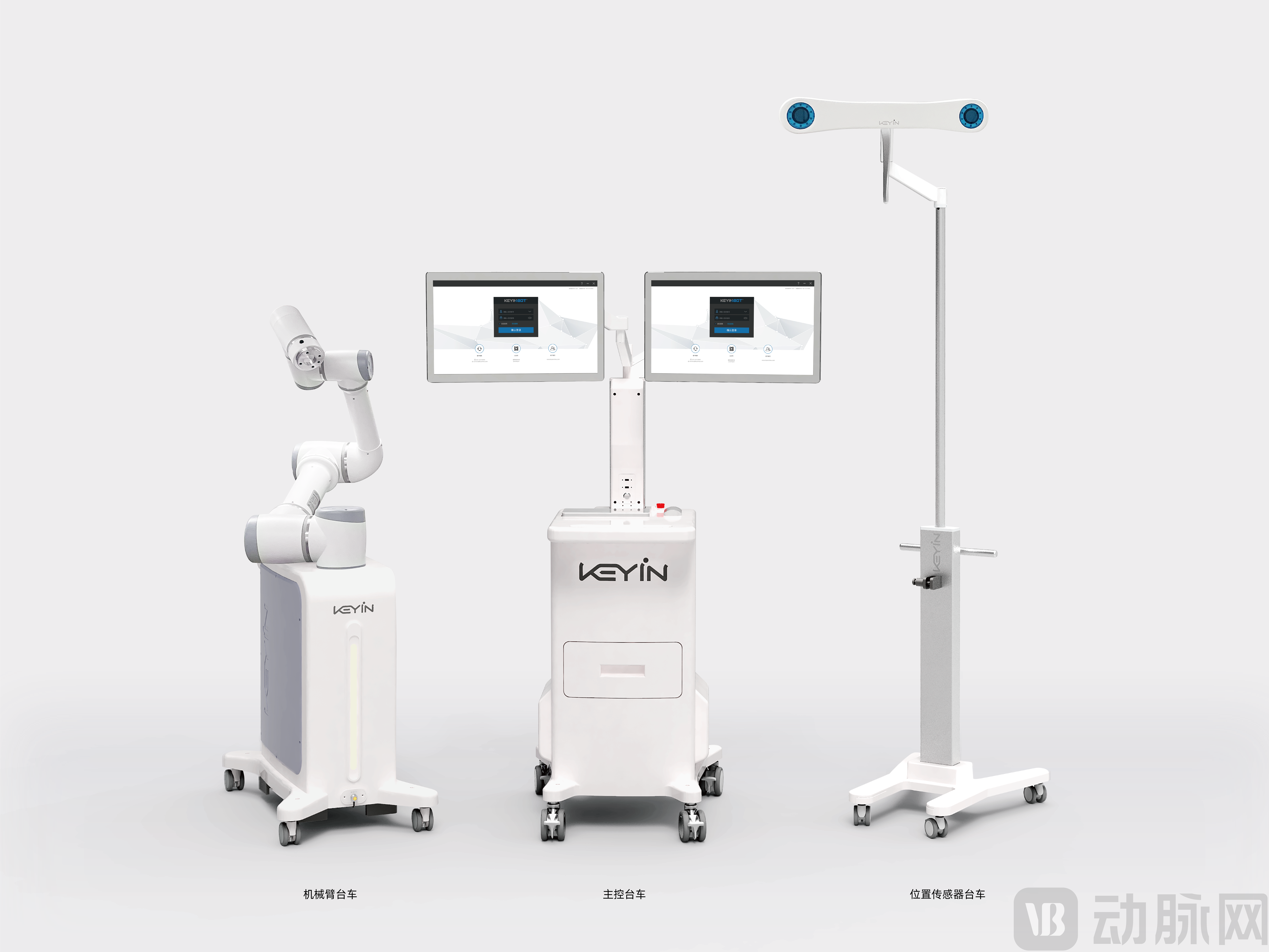
Jiaao Technology’s Intelligent Spinal Navigation Surgical Robot. Image source: Jiaao Technology
This product is indicated for open and minimally invasive pedicle screw placement, vertebroplasty, and trauma applications in the thoracic, lumbar, and sacral segments of the spine. The device enables real-time monitoring of patient positioning, provides planned trajectories for screw insertion, helps surgeons reduce surgical risks and radiation exposure, improve surgical success rates, and minimize the likelihood of postoperative complications.
Makowie stated, “Jiaao Technology’s image registration technology upgrades traditional 3D-to-3D registration to 2D-to-3D, enabling compatibility with standard 2D C-arm systems and making it accessible to hospitals at all levels. This represents a significant improvement in cost control, surgical efficiency, and product performance.”
Despite its lower cost, the performance of Jiaao Technology’s spinal navigation surgical robot is not compromised. Following product testing by the National Institutes for Food and Drug Control (NIFDC) for electromagnetic compatibility (EMC), electrical safety, and performance, Jiaao Technology’s spinal navigation surgical robot demonstrated industry-leading system accuracy of less than 0.9 mm. It also features an intelligent operation module that helps shorten the learning curve for physicians, facilitates ease of use, and thereby reduces both robot preparation time and minimally invasive surgery duration.
The orthopedic surgical robot market in China is currently experiencing a surge of activity, with surgical robot products from multinational orthopedic giants successively entering the Chinese market, while domestic orthopedic surgical robot companies are also making frequent appearances.
Faced with such a competitive landscape, Ma Kewei, Founder and CEO of Jiaao Technology, stated: “Our products have evolved through three generations. The first generation, named ‘Voyager,’ was optimized for local performance based on the characteristics of existing market products. The second generation, named ‘Challenger,’ saw significant changes in both cost and performance. We define our third-generation product as the ‘Game Changer,’ expecting it to possess the capability to determine the market landscape.”
“But at this stage, none of the products currently on the market possess the capability to determine the future market landscape. What the market needs right now is a product with sufficiently low cost, strong performance, and broad distribution channels,” Ma Kewei added.
In the short term, Jiaao Technology will advance the clinical trials of its intelligent spine navigation surgical robot to accelerate its market entry. In the future, Jiaao Technology will continue to pursue a strategy centered on the independent research, development, and manufacturing of core technologies and components, aiming to create intelligent surgical robots with the highest cost-performance ratio. Its product pipeline will expand from spine navigation robots to trauma and joint surgery robots, extending its reach from orthopedics to other specialties such as neurosurgery.
Currently, Jiaao Technology has engaged in multiple “industry-academia-research-clinical” collaborations with institutions such as Shanghai Changzheng Hospital, the Chinese PLA General Hospital, Renji Hospital Affiliated to Shanghai Jiao Tong University School of Medicine, Shanghai Ninth People’s Hospital, Yijishan Hospital (the First Affiliated Hospital of Wannan Medical College), Changzhou No. 1 People’s Hospital, Shanghai Jiao Tong University, and Fudan University Shanghai Medical College. In the long term, Jiaao Technology aims to rapidly expand its reach into lower-tier markets and achieve a leading market share in China.