

From Breast AI to Broader Clinical Impact: How Yizhun Intelligence Identifies the Next High-Throughput Medical Imaging Scenario

MEDICAL AI
AI-Assisted Medical Imaging Diagnosis System Developer
For medical artificial intelligence, 2021 was an extraordinary year.
Within nine months, one company went public and four filed prospectuses. Coupled with the acquisition of the high-profile startup Yitu Healthcare by Deepwise Medical, the medical AI sector has taken clear shape after a long haul.
In the new landscape, expanding product pipelines has become an urgent priority for leading enterprises. However, hospitals, as end users, are not concerned with the breadth of a company’s pipeline; they care only about whether artificial intelligence is sufficiently “deep,” whether it aligns with clinical workflows, and whether it delivers rapid and accurate interpretations.
In other words, the prerequisite for medical artificial intelligence to enter a new competitive arena is that it must address genuine clinical needs and resolve practical pain points in healthcare.
Today, MEDICAL AI, a leading enterprise in the AI sector, is well aware of this. Starting with “Chest AI” and “Breast AI,” MEDICAL AI places particular emphasis on hospitals’ clinical needs and pain points as it seeks new growth avenues. It has consciously expanded from traditional radiology toward comprehensive imaging AI, with “AI + Ultrasound” being one of the key scenarios it has developed in recent years.
There are very few enterprises in China engaged in AI + ultrasound research. According to statistics from the VBInsight database, there are as many as 480 companies with artificial intelligence technology tags, among which 98 are engaged in radiology-related businesses, while only more than 10 enterprises have extended their research directions to ultrasound, and among them, the number of enterprises choosing dynamic ultrasound image processing is extremely limited.
Compared with the traditional AI medical imaging sector, ultrasound medicine has its natural barriers. First, the data generated by ultrasound examinations have an additional time dimension compared to the two-dimensional data of CT and DR. This means that the separation between image acquisition and image analysis in radiology cannot exist in ultrasound diagnosis; ultrasound examinations require both examination and diagnosis to be completed simultaneously. Furthermore, there may be a large number of frames without diagnostic significance throughout the entire ultrasound examination process. AI must be able to discern the value of each frame, compare them with one another, and extract the responsible sections at specific moments to conduct effective image analysis.
Second, the standardization and normalization of ultrasound data remain unresolved issues that heavily test physicians’ experience and judgment.For the same case, inter-observer or intra-observer variability often exists.In this context, there are few publicly available ultrasound datasets and AI algorithms on the market for enterprises to leverage for secondary development; establishing training datasets also requires companies to proactively build dynamic ultrasound training datasets, which is time-consuming and labor-intensive.
To address the aforementioned challenges, two key elements are essential: a clear R&D strategy and sufficient financial investment. Lü Chenchong, Founder and CEO of MEDICAL AI, told VCBeat, “Algorithms used by traditional medical imaging AI companies are typically derived from open-source image algorithms. However, ultrasound images are generated through ultrasonic imaging, and the sonographic features of lesions vary depending on the imaging plane. Consequently, lesion analysis cannot be based on a single static image; instead, real-time detection and analysis of dynamic video align with the clinical workflow of ultrasound medicine. Globally, research in the field of real-time dynamic AI for ultrasound is severely lacking, and there are no widely recognized, mature algorithms. Therefore, solving the problem of real-time dynamic lesion detection and analysis based on ultrasound images has become a major pain point in the industry.”
Based on this logic, MEDICAL AI has continuously explored and innovated over the past two years, ultimately developing a real-time dynamic AI-assisted diagnostic model for ultrasound. By employing Neural Architecture Search (NAS) and leveraging industry-leading high-performance computing GPUs, the model achieves a processing speed of 64 frames per second with a detection latency of less than 0.09 seconds, enabling precise capture of lesions that flash by in mere milliseconds. Furthermore, the system provides real-time classification of lesion benignity and malignancy, intelligent BI-RADS categorization, and simulates 3D reconstruction through convolutional neural network feature fusion, thereby delivering quantitative analysis of benign and malignant characteristics across the entire cross-sectional view obtained during the ultrasound scanning process.
Furthermore, compared with conventional AI ultrasound products, MEDICAL AI’s real-time dynamic intelligent analysis system for breast ultrasound excels in “dynamic real-time detection.”
“Ultrasound diagnosis requires identifying key planes, but physicians cannot determine whether a captured image represents the optimal key plane based on a single static image,” said Lv Chenchong. “Therefore, MEDICAL AI’s artificial intelligence system can perform frame-by-frame comparison during the examination process, automatically identifying the image with the largest cross-sectional area throughout the entire ultrasound scan, thereby assisting physicians in extracting critical diagnostic information.”
The level of hospital adoption serves as a direct indicator of AI capabilities. Currently, MEDICAL AI’s ultrasound AI products have been widely deployed across various tiers of medical institutions, including Grade 3A hospitals, primary care facilities, and health examination centers. In clinical trials involving a total of 600 cases at two Grade 3A hospitals, the detection rate of MEDICAL AI’s ultrasound AI was approximately95%, the accuracy rate for determining whether tumors are benign or malignant is approximately 90%, a figure comparable to that of senior physicians.
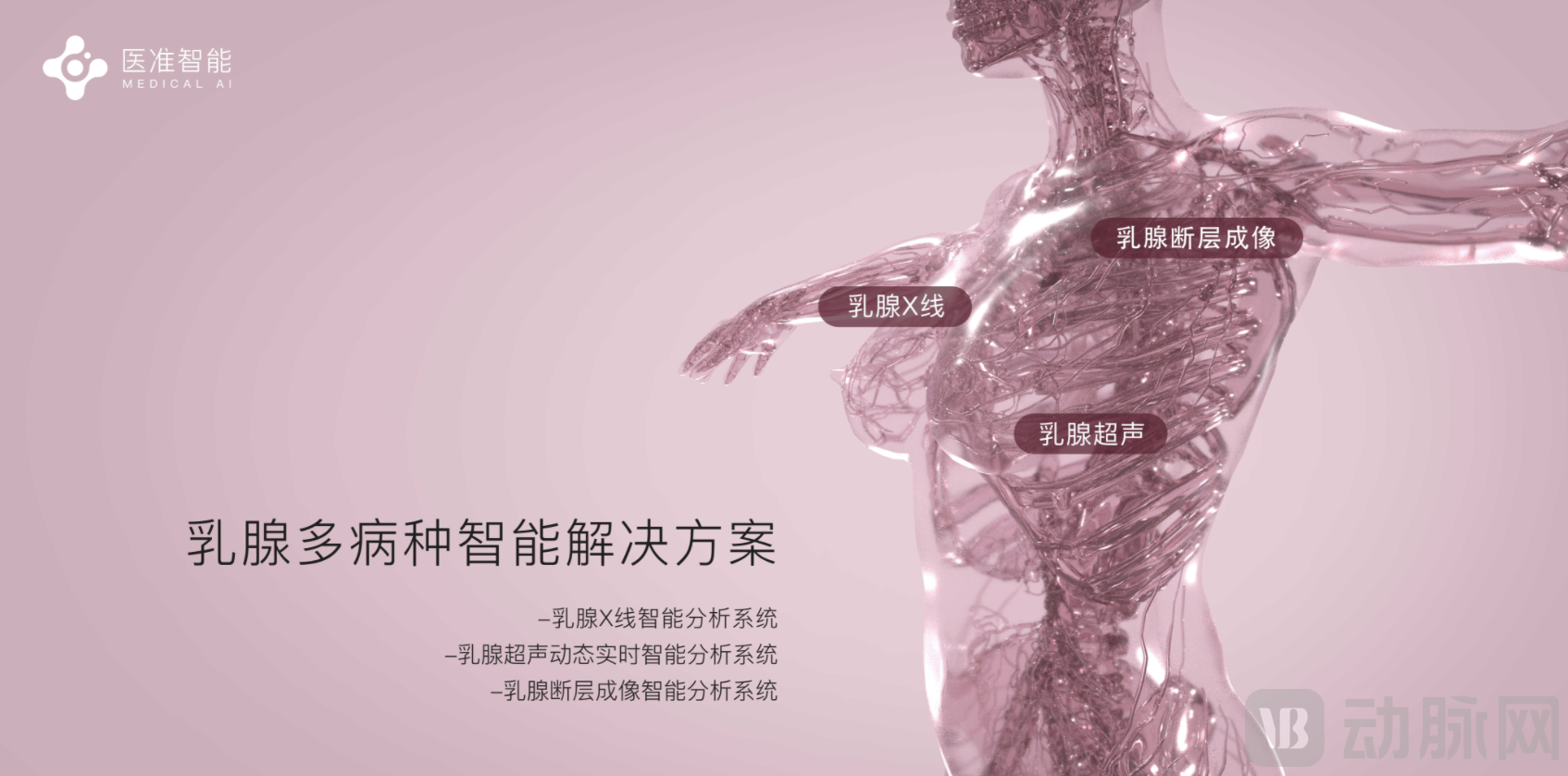
MEDICAL AI Intelligent Solution for Multiple Breast Diseases
While diagnostic testing is a prominent application scenario for ultrasound, it is by no means the only one. Within hospitals, ultrasound is utilized across various clinical departments, including Anesthesiology, Emergency Medicine, and the Intensive Care Unit (ICU). It facilitates real-time surgical guidance and intraoperative assessment, enabling physicians to make more accurate evaluations. This enhances the efficiency of diagnosis and treatment for life-threatening critical conditions, while effectively supporting basic life function monitoring and regulation, as well as the protection and support of vital organs.
Taking neurosurgery as an example, ultrasound image navigation can provide accurate craniotomy sites, lesion localization, and surgical planning, becoming an important tool for minimally invasive neurosurgery, especially "keyhole" surgery. The basis for improving the quality of neurosurgery and reducing collateral damage is accurate localization. In breast surgery, the use of ultrasound can improve the efficacy of breast-conserving surgery, significantly reducing the tumor retention rate, re-excision rate, and the volume of excised specimens.
To further ensure the precision of surgical navigation and minimize localization errors, MEDICAL AI’s Real-Time Dynamic Intelligent Analysis System for Breast Ultrasound has also become a navigational tool for clinical surgical assistance. Its real-time dynamic detection capability provides guidance for procedures such as vacuum-assisted biopsy (“mammotome”) and needle biopsy. Supported by ultrasound AI, breast surgeons face significantly reduced decision-making complexity, achieving more precise tumor resection and a notable reduction in operative time.
This product marks the expansion of its coverage from the ultrasound department to clinical departments. In terms of the diagnosis and treatment workflow, examination is merely one step; for medical AI to realize greater value, it must penetrate deeply into clinical practice.
Many AI companies often treat accuracy as the sole objective for their products; however, in primary healthcare settings, pursuing “accuracy” alone clearly fails to meet the requirements of clinical examinations.
MEDICAL AI has found that while it is important for primary care hospitals to improve metrics such as “accuracy” and “efficiency,” a regulatory process is also needed to ensure quality control throughout the entire examination process. This is particularly critical for imaging examinations at the primary care level, where radiologic technologists often perform inaccurate patient positioning during scanning, resulting in suboptimal image quality. It is not until the images are reviewed the following day that it becomes apparent that accurate diagnosis cannot be performed.
Addressing this need, MEDICAL AI has incorporated an image quality control function into its AI system. “While physicians are scanning patients, the AI simultaneously evaluates image quality and provides feedback within seconds. This allows any quality issues to be identified and addressed with a repeat examination before the patient even leaves the department.”
“Teaching a man to fish is better than giving him a fish.” To enhance efficiency while ensuring quality, MEDICAL AI has developed a breast imaging training system that fundamentally addresses quality issues in primary healthcare. Specifically, after logging into the system, primary care physicians can engage in cloud-based simulated image diagnosis, with MEDICAL AI’s AI providing scoring feedback on their diagnostic performance. Additionally, physicians can search for diagnostic cases within the case library to identify types of lesions frequently missed and learn appropriate diagnostic approaches for these scenarios.
To date, MEDICAL AI has developed a full-stack intelligent breast health solution that integrates image quality control, computer-aided diagnosis, clinical treatment, and teaching and research, thereby addressing physicians’ needs across diverse scenarios. However, MEDICAL AI’s capabilities extend far beyond this scope.
Compared to other medical imaging AI companies, MEDICAL AI entered this sector relatively late but quickly rose to the forefront.
“The company’s first round of financing took place in November 2017. By that time, 53 medical imaging AI companies had already secured funding, making us the 54th,” recalled Lv Chenchong. “Over the past four years, as a latecomer to the industry, our survival has hinged on the ‘resilience’ demonstrated through our exploration of technology and innovation.”
With this resilience, MEDICAL AI will continue to delve deeply into two directions: first, to develop comprehensive imaging AI; and second, to expand coverage into clinical scenarios, uncovering new value for medical AI.
Every path ahead is fraught with challenges, but fortunately, MEDICAL AI holds a favorable position as it enters the second half of the AI era. Amidst the prevailing trend of capital concentration, MEDICAL AI, having secured greater financial support, may indeed be able to gradually bring its vision to fruition.