

MRG003, a First-in-Class EGFR-Targeted ADC, Showcases Promising Efficacy in Advanced Solid Tumors at ESMO 2021: Insights from Principal Investigator Prof. Rui-Hua Xu
This article is reprinted from the Oncology Channel of Yixuejie.
In recent years, antibody-drug conjugates (ADCs) have become a key focus of research and development in oncology. Professor Xu Ruihua from Sun Yat-sen University Cancer Center served as the principal investigator (PI) leading the Phase I clinical trial of MRG003, an EGFR-targeting ADC developed by Lepu Biopharma, in patients with advanced solid tumors. Preliminary results presented at the 2021 European Society for Medical Oncology (ESMO) Congress showed an overall objective response rate (ORR) of 30% and a disease control rate (DCR) of 63%. Among patients with squamous cell carcinoma of the head and neck (SCCHN) and nasopharyngeal carcinoma (NPC), the ORRs were 40% and 44%, respectively, while the DCRs reached 80% and 78%, respectively. MRG003 demonstrated favorable efficacy and manageable safety. On this occasion, “Medical World” invited Professor Xu Ruihua for an exclusive interview on MRG003-related topics, and the following is a summary for our readers.
In ADC drug development, target selection is a critical step. Currently, target development in the field of solid tumors is becoming increasingly diversified. How do you view the development value of ADC drugs targeting EGFR?
Professor Xu Ruihua:In recent years, the development of antibody-drug conjugates (ADCs) for solid tumors has progressed rapidly. There have also been an increasing number of novel attempts in the selection of drug targets. Among these, the EGFR signaling pathway is closely associated with tumor cell proliferation. Overexpression of EGFR and its binding to specific ligands, such as EGF and TGF-α, can lead to aberrant activation of EGFR. Activated EGFR further activates and regulates multiple signal transduction pathways, thereby inhibiting tumor cell apoptosis, promoting tumor cell proliferation and migration, and facilitating tumor angiogenesis by mediating VEGF expression. Consequently, EGFR plays a critical role in tumorigenesis, progression, malignancy, and prognosis. Therefore, blocking EGFR-mediated signal transduction pathways can achieve therapeutic effects against tumors [1,2].
Given these characteristics, EGFR has become a highly favored therapeutic target in the field of antibody-drug conjugate (ADC) development. Currently, ADC drugs targeting EGFR are primarily being developed for squamous cell carcinoma of the head and neck (SCCHN), nasopharyngeal carcinoma (NPC), and non-small cell lung cancer (NSCLC). The EGFR positivity rates in these tumor types are approximately 86.5%, 82.7%, and 60.0%, respectively, indicating significantly higher expression compared to normal tissues. This suggests that EGFR is a promising and ideal target for ADC drug development [1].
As the principal investigator, you led the Phase I clinical trial of MRG003 in patients with EGFR-positive advanced solid tumors. The interim results of this Phase I trial were presented at ESMO 2021. Please provide your interpretation of the relevant study data.
Professor Xu Ruihua:This trial by Lepu Biopharma is an open-label, multicenter Phase I clinical study in patients with advanced solid tumors [3], comprising a Phase Ia dose-escalation stage and a Phase Ib dose-expansion stage. As of December 11, 2020, the Phase Ia clinical trial had enrolled 22 patients (doses ranging from 0.1 to 2.5 mg/kg), and the Phase Ib clinical trial had enrolled 39 patients with EGFR-positive solid tumors, including those with recurrent or metastatic squamous cell carcinoma of the head and neck (SCCHN; n=13), nasopharyngeal carcinoma (NPC; n=14), and colorectal cancer (CRC; n=12). The median ages of patients in the Phase Ia and Phase Ib cohorts were 56.5 and 52 years, respectively. The median number of prior lines of therapy was three. This trial was conducted to (i) determine the maximum tolerated dose (MTD) and the recommended Phase 2 dose (RP2D); and (ii) evaluate the safety, pharmacokinetics, immunogenicity, and preliminary efficacy of MRG003 in the treatment of advanced solid tumors.
For Phase Ib, the confirmed RP2D was 2.5 mg/kg. Among the 22 patients in Phase Ia, 18 underwent tumor assessment, yielding an ORR of 6% and a DCR of 33%. Among the 39 patients in Phase Ib, 27 were evaluable for efficacy; those achieving best objective response (BOR) included 11 with partial response (PR, including 8 confirmed cases) and 9 with stable disease (SD), resulting in an ORR of 30% and a DCR of 63%. Specifically, patients with SCCHN had an ORR of 40% and a DCR of 80%, while patients with NPC had an ORR of 44% and a DCR of 78%. Enrollment for the Phase Ib dose expansion has been completed, and patient follow-up is ongoing. The preliminary efficacy data presented at this ESMO Congress are encouraging. Furthermore, regarding safety, most adverse events observed in this trial were manageable through dose adjustments and symptomatic treatment, indicating overall good tolerability among patients.
The breakthrough in the efficacy of MRG003 is closely tied to its unique structure and innovative mechanism of action. As a next-generation antibody-drug conjugate (ADC), please discuss the key characteristics of MRG003.
Prof. Ruihua XuAs a novel ADC drug, Lepu Biopharma's MRG003 can specifically recognize and bind to EGFR on the surface of tumor cells, and then internalize into tumor cells through EGFR-mediated endocytosis. After the linker is cleaved by lysosomal proteases, the cytotoxic payload is released into the cytoplasm, exerting an anti-tumor effect.
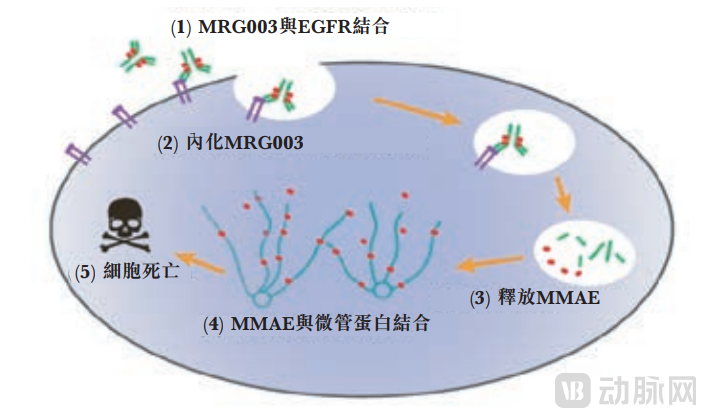
Figure 1. Mechanism of Action of MRG003
Structurally, MRG003 consists of a humanized antibody linked to MMAE (a monomethyl auristatin E derivative) via a cleavable linker. In vitro studies have demonstrated that the antibody component of MRG003 facilitates rapid internalization into tumor cells due to its high binding affinity for EGFR. As a potent antitumor toxin, MMAE has been shown to exert cytotoxic effects and a bystander effect in various tumor cell lines; it effectively inhibits tubulin polymerization, thereby disrupting mitosis and leading to tumor cell death. MRG003 has demonstrated potent antitumor activity in both preclinical and clinical studies.
Currently, there are no EGFR-targeted antibody-drug conjugate (ADC) drugs approved for market launch globally. Although several biotechnology companies in China have made strategic moves in this area, only Lepu Biopharma’s MRG003 has entered the clinical trial stage. In light of this, please discuss the application prospects of MRG003.
Professor Ruihua Xu:EGFR is overexpressed in a variety of tumors and has become an active target for multiple successfully marketed therapeutic agents, including monoclonal antibodies and targeted small-molecule drugs such as EGFR-TKIs [4]. MRG003 is currently the first-in-class anti-EGFR antibody-drug conjugate (ADC) under clinical investigation in China. It holds promise for addressing the unmet medical needs of patients with EGFR-positive advanced or metastatic solid tumors (including head and neck squamous cell carcinoma [HNSCC], nasopharyngeal carcinoma [NPC], and advanced non-small cell lung cancer [NSCLC]) who have failed EGFR-targeted therapies and second-line or subsequent systemic treatments, thereby demonstrating broad clinical application prospects. Notably, lung cancer ranks first in both incidence and mortality among malignant tumors in China, with EGFR mutations being one of the most common mutation types. Inevitable resistance develops after treatment with conventional EGFR-TKIs; MRG003 can effectively overcome resistance induced by EGFR-TKI therapy, potentially providing a new therapeutic option for patients who have developed resistance and offering hope for further prolongation of survival.
Phase II clinical trials of MRG003 monotherapy for recurrent or metastatic advanced head and neck squamous cell carcinoma (HNSCC), advanced non-small cell lung cancer (NSCLC), biliary tract cancer (BTC), and nasopharyngeal carcinoma (NPC) are currently underway in China, with promising preliminary results already observed. These findings have bolstered our confidence in further exploring MRG003 in additional indications, with the aim of benefiting more patients with EGFR-positive advanced solid tumors.

Professor Ruihua Xu
Prof. Ruihua Xu
M.D., Director of Sun Yat-sen University Cancer Center, President of the Hospital, Director of the Institute, Director of the State Key Laboratory of Oncology in South China, Professor, and Doctoral Supervisor.
Vice President of the China Anti-Cancer Association (CACA), President-Elect of the Chinese Society of Clinical Oncology (CSCO), Founding Chairman of the Committee on Targeted Therapy of CACA, Chairman-Elect of the Committee on Chemotherapy of CACA, Chairman of the Colorectal Cancer Committee of CSCO, Editor-in-Chief of Cancer Communications, and Editor-in-Chief of the graduate textbook Oncology.
With over 30 years of experience in clinical medical oncology, I have achieved breakthrough results: 1. Improved the early diagnosis rate of digestive system tumors by applying liquid biopsy technologies such as ctDNA methylation; 2. Established new, highly efficient, and low-toxicity treatment protocols and systems for advanced gastrointestinal tumors, which have become new international standards; 3. Made breakthroughs in research on tumor metastasis and drug resistance, innovated cancer immunotherapy strategies and combination regimens, and enhanced the efficacy of immunotherapy. The five-year survival rate of my gastrointestinal cancer patients has reached an internationally leading level. I am one of the most influential academic leaders in medical oncology in China. As the corresponding or first author, I have published 199 SCI papers in top-tier international journals, including Nature Materials, Nature Medicine, and Lancet Oncology, and have been consecutively listed among China’s Highly Cited Researchers. As the principal investigator, I have received two Second-Class National Awards for Progress in Science and Technology and six First-Class Provincial and Ministerial Awards. I have been selected for the Nan Yue Top 100 Talent Training Program, the National Hundred, Thousand, and Ten Thousand Talents Project, and recognized as a National Outstanding Young and Middle-Aged Expert by the National Health and Family Planning Commission.
References:
[1] Lepu Biopharma Prospectus
[2] Yang Yaqiong, Li Zonghai. Research Progress on Molecular Targeted Anticancer Drugs Targeting EGFR[J]. China Biotechnology, 2012, 32(5):91-91.
[3] Qiu M, Guo Y, Guo W, et al. FIH Phase I dose escalation and dose expansion study of anti-EGFR ADC MRG003 in patients with advanced solid tumors. 2021 ESMO. Abstract 1834.
[4] Wang Mingxue, Li Zhuanglin. Research Progress on Antitumor Therapy Targeting Epidermal Growth Factor Receptor[J]. Journal of Pharmaceutical Research, 2019(10):584-589.