

Hearyou Medical Technology Files IPO Prospectus Highlighting Its Comprehensive SPD Solutions for Top-Tier Hospitals Including Xiangya Hospital
In recent years, with the introduction and implementation of new healthcare reform policies such as volume-based centralized procurement, the separation of prescribing from dispensing, and the zero-markup policy for pharmaceuticals, domestic hospital management models and supply chain systems have urgently needed to undergo transformation, bringing the SPD (Supply, Processing, and Distribution) in-hospital logistics management system back into focus.
SPD, which can be traced back to the post-World War II era, is a lean material management model built on the foundation of supply chain management.
In the medical field,SPD is an information technology-driven approach that, from the perspective of the pharmaceutical supply chain and leveraging barcode technology along with IoT and internet technologies, enables refined management with full traceability of medical supplies within healthcare institutions—from procurement to patient use. This management model can reduce hospital operational costs, improve collaboration efficiency across all stages, and help hospitals achieve refined management.
However, it is worth noting that while SPD has reached a relatively mature stage of development abroad, it remains in its early stages in China.
Data from the China Government Procurement Network shows that as of July 14, 2021, there were a total of 25 tender projects for SPD (Supply, Processing, and Distribution) supply chain services in China. The earliest was the tender for the SPD supply chain service system software project by Henan Pharmaceutical Co., Ltd. in 2017. Subsequently, the number of SPD tender projects increased year by year, rising from one in 2017 to two in 2018, six in 2019, eight in 2020, and eight in the first half of 2021. According to previous reports by relevant media, since the second half of 2019, multiple hospitals have begun evaluating SPD supply chain projects, indicating a gradual awakening of the intra-hospital SPD supply chain market.
Meanwhile, as the industry remains in its early exploratory stage, there are few companies with strong capabilities. Therefore,How to enhance the management of medical supplies and the software development capabilities for information technology, how to shift away from a business model solely reliant on software sales, how to address the practical needs of hospitals and upstream suppliers, and how to anticipate and adapt to industry trends by making proactive strategic arrangements have become hot topics of concern within the industry.With these questions in mind, VCBeat interviewed Zhang Wei, General Manager of Haiyu Medical Technology Co., Ltd., a pioneer in the SPD industry, in an attempt to find answers.
“When I was teaching computer science at a university, I accidentally came into contact with clients from pharmaceutical companies during a part-time job. They hoped we could provide some services related to hospital logistics,” Zhang Wei revealed to VCBeat. After extensive research, we discovered that hospitals abroad have adopted a new supply chain model known as SPD.
“It is highly valuable to identify such a new model and technology to assist hospitals in management. In the past, hospital informatization was driven by customer needs: we would leverage computing technologies to implement whatever ideas or approaches customers proposed,” said Zhang Wei. “However, the SPD (Supply, Processing, and Distribution) management system can address customer challenges in a more comprehensive, intelligent, and efficient manner.”
Haiyu Medical Technology was thus born.
Image courtesy of Haiyu Medical Technology
According to Zhang Wei,Haiyu boasts a professional SPD technical team specializing in medical consumables, with its staff size doubling over the past two years. Haiyu’s predecessor, Haiyu (Shanghai) Software Co., Ltd., is a nationally recognized high-tech enterprise and software enterprise. It has also undertaken research projects commissioned by the Shanghai Municipal Science and Technology Commission and serves as a joint R&D partner of Shanghai University, indirectly reflecting Haiyu’s robust capabilities in software research and development.
However, to truly achieve refined hospital management, relying solely on software is insufficient; information technology software platforms, intelligent hardware teams, and professional management service teams are equally important.Only enterprises that possess capabilities in software development, supporting intelligent hardware, and management services can achieve long-term success.
Zhang Wei has also publicly stated that whether the capabilities, experience, and financial strength of SPD service providers can meet hospital needs is a primary concern for hospitals today and one of the major issues currently hindering the development of in-hospital logistics in China.
“SPD vendors should not merely provide software; instead, they should focus on delivering a comprehensive and effective SPD service system,” said Zhang Wei. Therefore, Haiyu’s positioning today is no longer just as a company providing SPD software support, but as one dedicated to offering innovative and intelligent supply chain solutions.
Guided by this philosophy, Haiyu has established a comprehensive in-hospital logistics management service system. This system not only provides technical support and refined management services for hospital logistics but also delivers a complete suite of solutions through an integrated service model encompassing “consulting + Internet + software + intelligent hardware.”
For example, Haiyu has established a professional service team that leverages its proprietary SPD and SCC platforms, along with intelligent equipment, to enhance business collaboration between hospitals and pharmaceutical distribution enterprises, improve hospital logistics management, ensure the clinical safety of medical supplies, and strengthen relationships between hospitals and suppliers.
Specifically, Haiyu has independently developed the Haiyu In-Hospital Intelligent Service Management Platform (SPD), the Haiyu Supply Chain Cloud Platform (SCC), the Haiyu In-Hospital Intelligent Equipment Control Platform (WCS), and the Haiyu Off-Site Warehouse Logistics Management Platform (DCM), providing medical supply management and pharmaceutical supply chain solutions for pharmaceutical companies and hospitals.
Taking SPD as an example, Haiyu’s SPD management solution primarily comprises five layers: the business consulting services layer, the internet services layer, the business operations services layer, the smart hardware services layer, and the value-added services layer.
Among them,Business consulting services include providing pharmaceutical supply chain, SPD business planning, and innovative business model consulting to pharmaceutical distribution enterprises and hospitals.;
Internet services refer to achieving high-level business synergy between hospitals and suppliers, as well as electronic license management, through the “Pharmaceutical SCC Internet Service Cloud Platform”;
Business operational services provide hospitals with professional SPD management and services for medical supplies, including pharmaceuticals, low-value consumables, and high-value consumables, through the “In-Hospital SPD Management Platform.”
Furthermore, Haiyu can also be accessed via“The In-Hospital WSC Management Platform” efficiently integrates intelligent hardware devices to enhance their application efficacy, and provides hospitals with value-added services such as hospital WeChat/APP solutions, in-hospital IoT, and smart healthcare.
“In the past, in the absence of a supply chain collaboration platform, pharmaceutical distribution companies and hospitals operated in a relatively blind manner.”“To ensure supply, hospitals tend to stockpile inventory, resulting in relatively high inventory levels and significant capital tie-up. For pharmaceutical distribution companies, if newly launched products offer better cost-effectiveness and superior clinical outcomes, existing products may face sluggish sales, leading to supply chain inefficiencies,” said Zhang Wei.Haiyu’s SPD platform can enhance supply chain efficiency, reduce inventory levels, and enable more precise supply assurance. “This is the value we are committed to delivering through supply chain collaboration.”
“Haiyu was among the early adopters and a major promoter of the SPD (Supply, Processing, and Distribution) management model in Chinese hospitals; therefore, Haiyu holds certain advantages in terms of SPD concepts, standards, and system development,” said Zhang Wei.
VCBeat has learned that in the international community, pharmaceutical commercial markets in developed Western countries and regions such as the United States, Japan, and the European Union have become highly mature, with business models characterized by large-scale operations and oligopolistic structures. Among these, the United States leads in pharmaceutical supply chain development. Driven by a highly concentrated market and relatively low net profit margins, U.S. pharmaceutical distribution companies have provided hospitals with extensive value-added services centered on the pharmaceutical supply chain, thereby accumulating substantial experience in implementing SPD (Supply, Processing, and Distribution) models.
This also provides a reference for the formulation of national SPD industry standards.
“When we first encountered the SPD model, we thoroughly reviewed all relevant domestic and international literature and benchmarked against international best practices,”Haiyu has established a comprehensive SPD development system encompassing concepts, boundaries, and basic infrastructure frameworks, and is actively promoting it across the industry.Zhang Wei introduced that, at present, this set of standards has also gained widespread recognition from all parties in the industry.
In addition, VCBeat has learned thatIn 2021, the China Federation of Logistics & Purchasing will apply to the Ministry of Commerce to initiate the development of industry standards for SPD.This Federation is a national industry organization established with the approval of the State Council. It is voluntarily formed by national or provincial, autonomous regional, municipal, and sub-provincial city-level professional associations specializing in logistics and the circulation of means of production; enterprises engaged in the circulation of means of production and logistics operations across various economic sectors; wholesale markets; as well as related scientific research and educational institutions.
In accordance with its Articles of Association, the business scope and primary functional responsibilities of the China Federation of Logistics & Purchasing include organizing and implementing industry surveys and statistics, as well as proposing recommendations for industry development plans, industrial policies, and economic legislation.Participate in the formulation and revision of national and industry standards related to commodity circulation and logistics.
As a member of the preparatory committee, Haiyu will also participate in the drafting of industry standards.
It is precisely due to Haiyu’s accumulated expertise in industry standards and practices, as well as its advantages in SPD software development, that many large Grade A tertiary hospitals have chosen Haiyu for their SPD infrastructure projects.
As of nowHaiyu’s SPD+SCC supply chain cloud platform has served dozens of large public Grade 3A hospitals in China, including renowned institutions such as Xiangya Hospital of Central South University, The Second Xiangya Hospital of Central South University, The Third Xiangya Hospital of Central South University, Shanghai General Hospital, and The First Affiliated Hospital of Guangxi Medical University.
“The healthcare industry, particularly the hospital sector, exhibits a strong demonstration effect,” Zhang Wei told VCBeat. Haiyu’s well-known case studies have earned it a solid reputation among peers, making it a partner of choice for many hospitals.
Furthermore,For the tough nut to crack that is “operating room logistics,” Haiyu has also provided its own solution.
“Operating room logistics is one of the most complex yet high-value segments within a hospital’s internal supply chain, demanding exceptional accuracy. However, historical management of operating room logistics has been relatively rudimentary, relying primarily on manual processes, which not only lacks professionalism but also frequently encounters staffing shortages.”Zhang Wei stated,Operating room logistics has long been a challenging aspect of hospital internal logistics. Haiyu has been dedicated to providing solutions and successfully implemented a comprehensive operating room logistics system at Xiangya Hospital of Central South University this year, ensuring the precision of operating room logistics.
Taking the SPD logistics solution for operating rooms implemented by Haiyu at Xiangya Hospital of Central South University as an example, the specific process is as follows: Preoperatively, physicians select surgical procedure kits based on surgical requirements and personal preferences; nurses choose surgical drapes, schedule surgeries, and submit kit requests. SPD operations personnel then prepare the kits according to the requests from physicians and nurses, and place them in the kit cabinets before surgery.
Furthermore, during this process, surgical consumables are linked individually to details such as the procedure name, the recipient, and the patient’s name. This not only enables comprehensive tracking and management of surgical consumables throughout the entire workflow but also provides a more intuitive and clear overview of their usage.
Notably, the SPD logistics solution for this operating room will be staffed with dedicated logistics personnel to provide intraoperative support. “This is the most distinctive feature of Haiyu’s SPD logistics solution for operating rooms.”
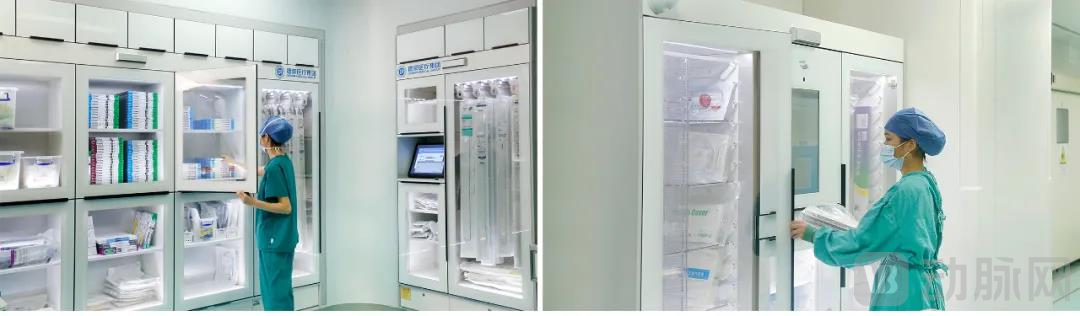
Image courtesy of Haiyu Medical Technology
Under this solution, logistics personnel will replace surgical instrument supplier staff in providing intraoperative stocking support. They will perform consumable access verification based on the Unique Device Identification (UDI) of medical devices, and achieve end-to-end traceability across the supply, sterilization delivery, and billing stages through complete UDI code segments. Scanning for billing and clearing/returning instruments can be completed directly within the operating room.
Overall,The Haiyu Operating Room SPD Logistics Solution enables systematic classification and digital management of complex operating room consumables by interlinking surgical procedures, supplies, and inventory. This approach not only effectively addresses key management challenges—such as tracking high-value consumable kits, managing individual item communications, conducting stocktakes, and minimizing losses due to expiration—but also streamlines pre-operative kit preparation, intra-operative retrieval, and billing processes. Furthermore, it reduces nursing workload to a certain extent, supports data-driven decision-making through BI intelligent reporting, and enhances the hospital’s overall image.
“Next,Haiyu will invest approximately RMB 16 million in R&D to further advance its IoT technology research, and actively seek collaborations with hardware manufacturers to embed Haiyu’s software into these smart devices. Through this “inside” model, it integrates various intelligent devices into a unified system, providing hospitals with more refined logistics management solutions.“Operating room logistics is a key component,” said Zhang Wei. He emphasized that only by continuously developing future technologies and products can Haiyu achieve sustainable growth in the medical supply chain sector.
Furthermore,Data-driven supply chain finance is also part of Haiyu’s future strategic layout.“Between the upstream and downstream segments of the supply chain, there exist not only property-rights-based supply chain relationships but also financial relationships involving accounts receivable and payable.”"As Haiyu continues to deepen its presence in the industry, accumulating a growing number of typical cases and extensive industry experience, it will also launch data-driven supply chain finance services in the future."Zhang Wei added.