

InBrace Files for IPO Following $102 Million Series D Funding to Redefine Invisible Orthodontics
Novo Ventures
Private Venture Capital Firm

RTW Investments
Biopharmaceutical Investment Institutions

INBRACE
Invisible Oral Medical Device Developer

Endeavour Vision
Private Equity Firms Specializing in the Healthcare Sector

MVM
Venture Capital Firm

Marshall Wace
Alternative Investment Management Firm

Farallon Capital Management
Venture Capital Firms

Soleus Capital
Healthcare Investment Firms

BlackRock
Financial Investment Company
Invisible orthodontics has become one of the hottest trends in the dental industry.
Orthodontics is the practice of correcting teeth and resolving malocclusions and deformities. It primarily focuses on the etiological mechanisms, diagnostic analysis, prevention, and treatment of dentofacial anomalies, with the goal of achieving aesthetic dental alignment. The English term for orthodontics is derived from a combination of three Greek roots meaning “tooth,” “straightening,” and “discipline,” which collectively correspond to what is commonly known as “teeth straightening.”
Data shows that the global clear aligner orthodontics market grew from $5 billion in 2016 to $12.2 billion in 2020, with a compound annual growth rate (CAGR) of 24.98%.
Founded in 2014 and headquartered in California, USA, InBrace is a startup specializing in the research and development of dental medical devices. The company primarily develops diagnostic and therapeutic equipment for dental conditions such as malocclusion, providing patients with new treatment options. InBrace is committed to leveraging its advanced technology to enhance patient care experiences and reduce healthcare costs.
InBrace Announces Oversubscribed $102 Million Series D FinancingThis round of financing was co-led by Farallon Capital Management, L.L.C. and Marshall Wace. New investors included funds and accounts managed by BlackRock, Endeavour Vision, MVM Partners, RTW Investments, LP, and Soleus Capital, while existing investors Vivo Capital, Novo Ventures, and venBio participated through their respective funds.The company intends to leverage the proceeds from its Series D financing to accelerate growth by expanding its sales force, launching new marketing initiatives, and driving further support for and integration with new and existing orthodontic suppliers across the United States.
Clear aligner orthodontics is a revolutionary, multidisciplinary innovation that integrates computer science, biomechanics, clinical dentistry, 3D printing, and materials science. As a key application area of digital dentistry, it leverages CAD/CAM technology, intraoral scanners, and cone-beam computed tomography (CBCT) to provide more comprehensive and optimized treatment planning and workflows. This approach particularly enhances therapeutic outcomes in orthodontics and dental implantology, while improving the efficiency of dental practitioners.
As clear aligner therapy eliminates the wires and brackets used in traditional orthodontic treatment, it offers aesthetic advantages and is increasingly favored by patients seeking cosmetic dental improvements. In the United States, there are 2 million new orthodontic cases annually, with 10%–20% of patients opting for clear aligner treatment. Among the approximately 9,000 orthodontists in the U.S., about 7,000 utilize bracket-free orthodontic techniques. Additionally, of the roughly 120,000 general dentists in the country, approximately 24,000 employ bracket-free orthodontic methods.
Invisible orthodontics is generally categorized into three types: aligner-based (bracketless), bracket-based, and lingual appliances. For aesthetic reasons, adults typically opt for bracketless invisible aligners. In children, the choice between removable and fixed appliances—or even no treatment at all—is determined by the specific orthodontic needs, as orthodontic appliances can influence and alter their growth and development.
According to data from the China Commercial Industry Research Institute, the global clear aligner market grew from $5 billion in 2016 to $12.2 billion in 2020, representing a compound annual growth rate (CAGR) of 24.98%.Among them, the global clear aligner market grew from USD 1.1 billion in 2016 to USD 2.8 billion in 2020, with a compound annual growth rate (CAGR) of 27.42%.
From the perspective of the domestic market size,China’s clear aligner market became the world’s second-largest in 2019, with its size growing from USD 400 million in 2016 to USD 1.5 billion in 2020, at a compound annual growth rate (CAGR) of 39.2%, and is expected to reach USD 2 billion in 2021.Among these, the number of orthodontic cases treated with clear aligners increased from 47,000 in 2015 to 335,500 in 2020, representing a compound annual growth rate (CAGR) of 47.7%, and is projected to reach 3.8 million by 2030. Meanwhile, the market size for clear aligners grew from USD 100 million in 2016 to USD 300 million in 2020, at a CAGR of 31.6%, and is expected to reach USD 500 million in 2021.
Nowadays, clear aligner therapy has become mainstream, but its drawbacks are frequently criticized by both patients and clinicians.Conventional orthodontic techniques can only apply pushing forces, not pulling forces, to teeth, thereby reducing their efficacy by half; in some special cases, these techniques are not even applicable. Furthermore, although removable clear aligners offer patients convenience in eating and oral hygiene, issues such as loss of aligners, forgetfulness, insufficient wear time, and non-compliance remain prevalent.. Consequently, patients require multiple mid-course adjustments or fine-tuning, which prolongs the treatment cycle and ultimately leads to treatment abandonment. This not only compromises patient experience but also adversely affects the reputation of dental hospitals.
In recent years, lingual orthodontic technology has gained increasing popularity in the international orthodontic market. Since 3M launched the Incognito Appliance System, a customized lingual orthodontic device, in the United States in 2004, more than 100,000 patients had received customized lingual orthodontic treatment by 2013. In China, the proportion of bimaxillary protrusion cases and extraction cases is significantly higher than that in developed countries such as those in Europe and the United States. For these types of cases in China, customized lingual appliances offer distinct advantages over existing clear aligners on the market.
Lingual orthodontic technique is a method of performing orthodontic treatment on the lingual (tongue-facing) surfaces of the teeth. In addition to its aesthetic advantages, lingual orthodontics can reduce the incidence of dental caries, decrease the likelihood of post-treatment relapse, and prevent lip injuries caused by labial appliances during physical activities. This technique achieves orthodontic correction through the gentle, elastic forces exerted by nickel-titanium archwires, which align more closely with the biomechanical principles of orthodontics. Lingual orthodontic technology offers greater advantages over conventional fixed appliance therapy in aspects such as bite opening and control of vertical tooth movement.
According to INBRACE data, approximately 6 million people in North America alone begin traditional orthodontic treatment each year. However, as many as 178 million North Americans could still benefit from orthodontic care but have not yet started treatment, as they seek a solution that does not disrupt their lifestyle and offers greater comfort, health benefits, and faster results.
In response to this market landscape and patient demand, InBrace has developed INBRACE—an automated orthodontic system featuring a personalized Smartwire™ concealed behind the teeth.
This is inseparable from the founding team of InBrace.John Pham, Co-founder and CEO of INBRACE, graduated from the University of California, Los Angeles. He was formerly an aerospace engineer and is a licensed orthodontist., with valuable experience in orthodontic treatment methods, practice development, and healthcare software systems. Additionally, Pham serves as an orthodontist in the Department of Orthodontics at Bristol Dental, and as Co-Principal Investigator for the USC Advanced Orthodontics and Viterbi Engineering Group.Tong Hongsheng, Co-Founder and Chief Orthodontic Scientist of INBRACE, is a Clinical Assistant Professor at the Ostrow School of Dentistry of USC and a Diplomate of the American Board of Orthodontics, having treated nearly 10,000 patients., has conducted extensive research on the biomechanics of tooth movement and is responsible for technological innovation and clinical development at InBrace.Jeffrey Nardoci, Chief Operating Officer and President of INBRACE, previously served as Chief Operating Officer of HydraFacial and brings over 25 years of leadership experience., specializing in healthcare and medical devices, partnering with FMGs, multinational corporations, and industry leaders.
Unlike conventional lingual braces,INBRACE is the first orthodontic medical device company to utilize programmed anti-slip mechanics.. The InBrace system is fundamentally different from traditional edgewise or straight-wire appliances that utilize sliding mechanics. While sliding mechanics are effective in labial orthodontics, there is a general consensus that they do not achieve optimal therapeutic efficiency on the lingual side. This is because lingual sliding mechanics are more difficult and time-consuming, leading to inaccurate bonding, insertion, ligation, and adjustment, as well as archwire dislodgement and reduced inter-bracket distances, thereby prolonging patient treatment time.
The InBrace system employs a new paradigm in orthodontic mechanics, known as Programmed Non-Sliding Mechanics (PNM), by utilizing its proprietary Gentleforce™ technology.PNM can generate shape-memory changes; the preset correction lines enable automated treatment, minimizing the need for clinician intervention.
Another component of PNM that enhances treatment efficiency is the InBrace appliance design.InBrace archwire, also known as Smartwire™, is a programmed, multi-loop NiTi archwire that enables InBrace to customize design and digitally manufacture for each patient while completely hiding the braces behind the teeth.Smartwire is designed to operate autonomously for several months at a time, eliminating the need for patients to visit their orthodontist monthly for check-ups and tightening procedures, or to regularly replace aligner trays. Furthermore, its wavy design avoids positioning the wire directly in the interdental spaces, allowing patients to eat, drink, brush, and floss normally, without the concern of losing or forgetting to bring it.
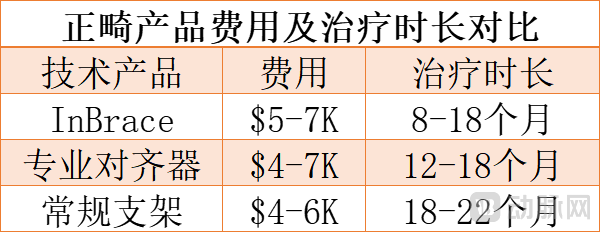
Compared with traditional orthodontic appliances and other orthodontic methods, INBRACE treatment requires a shorter duration, while the cost is generally at the same level as or slightly higher than the industry average.
In 2018, INBRACE obtained FDA registration. It also secured patent protection licensed by the University of Southern California.Currently available only in the U.S. market. In the United States, an increasing number of renowned orthodontic programs and private clinics are adopting INBRACE.
On September 8, 2021, InBrace, a developer of orthodontic medical devices, announced the completion of an oversubscribed Series D financing round amounting to $102 million. The round was co-led by Farallon Capital Management, L.L.C. and Marshall Wace. New investors included funds and accounts managed by BlackRock, Endeavour Vision, MVM Partners, RTW Investments, LP, and Soleus Capital, while existing investors Vivo Capital, Novo Ventures, and venBio participated through their affiliated funds.
Prior to this round of financing, InBrace had completed five previous funding rounds, including a $45 million Series C in 2019, a $20 million Series B in 2018, and three earlier undisclosed rounds, bringing the total amount raised to $172.6 million.
“The Series D funding further validates InBrace’s ability to attract new consumers—those who previously opted against orthodontic treatment due to a lack of options compatible with their lifestyles. As a company founded by orthodontists, we developed InBrace to help orthodontists enhance the teeth-straightening experience,” said John Pham, CEO and Co-Founder of InBrace.