

Deshang Yunxing Launches 'Ultrasound AI Industry-Academia-Research Alliance' to Tackle Development Challenges Amid AI Boom
Amidst the wave of industrial transformation driven by artificial intelligence, the healthcare industry is attempting to complete the transition from traditional medical paradigms through intelligent upgrades. As one of the most rapidly accessible, radiation-free, and cost-effective diagnostic tools available to practicing physicians, ultrasound not only aligns with the “tiered diagnosis and treatment” policy but also serves as a high-volume entry point for hospital examinations.
However, in practice, medical institutions, research universities, and sci-tech innovation enterprises commonly face pain points such as non-standardized data, time-consuming annotation, a lack of suitable algorithms, and difficulties in integrating industry, academia, and research. Amid these risks, it is crucial to establish relevant data standards for medical artificial intelligence (AI), accelerate the integration of industry, academia, and research, and ensure the healthy development of medical AI.
From September 16 to 19, the “14th Congress of the Asian Federation of Societies for Ultrasound in Medicine and Biology (AFSUMB) and the 21st National Congress on Ultrasound in Medicine of the Chinese Medical Association,” hosted by the Chinese Medical Association and its Branch of Ultrasound in Medicine, was held in Zhuhai, Guangdong. The congress established an Ultrasound AI Forum themed “Ultrasound AI: Leading the Future with Intelligence.” It invited academicians from the Chinese Academy of Sciences, experts from renowned hospitals both in China and abroad, scholars from prestigious Chinese universities, and numerous industry elites to jointly explore new milestones in the iteration of artificial intelligence and the ultrasound industry, and to integrate and establish a resource-sharing mechanism combining industry, academia, and research.
This AI forum is hosted by Deshang Yunxing, a leading enterprise in ultrasound AI. Deshang Yunxing focuses on the research and development as well as the application of cutting-edge medical products, including ultrasound AI, healthcare big data, and 3D precision surgery. In the field of ultrasound AI, it has developed the AI-SONIC series for applications involving the thyroid, breast, pelvic floor, liver, and carotid artery.
Establish an Ultrasound AI Industry-Academia-Research Alliance to Promote the Integration of Industry, Academia, and Research
On September 17, the “Ultrasound AI Industry-Academia-Research Alliance” (hereinafter referred to as the “Alliance”), led by four institutions including Zhejiang University and Zhejiang Deshang Yunxing Medical Technology Co., Ltd., was officially established at the “Ultrasound AI Forum.” Headed by Professor Liang Ping, Chair of the Ultrasound Branch of the Chinese Medical Association, the Alliance was jointly founded by renowned domestic experts in ultrasound and artificial intelligence, along with the Data Governance Working Group of the AI Innovation Platform under the Center for Medical Device Evaluation of the National Medical Products Administration.
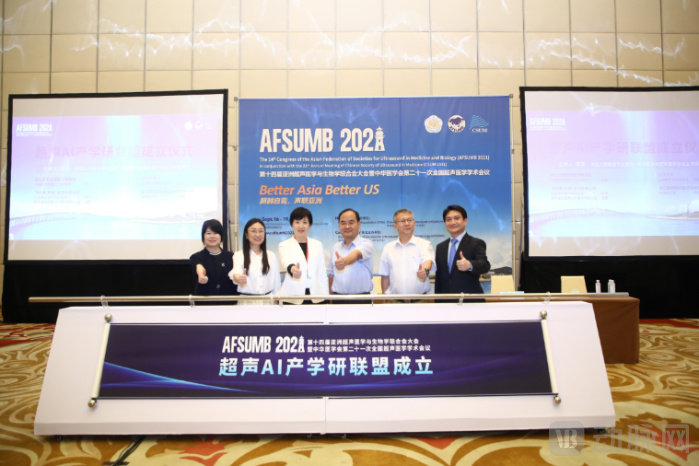
“Ultrasound AI Industry-Academia-Research Alliance” Inauguration Ceremony
Following its establishment, the alliance willJointly establish data standards for ultrasound artificial intelligence (AI) in China; co-build a third-party evaluation database for ultrasound AI medical devices with the Center for Medical Device Evaluation of the National Medical Products Administration (NMPA); collaborate with the NMPA’s Center for Medical Device Evaluation to formulate national review standards for ultrasound AI medical equipment in China and develop promotion strategies for countries participating in the Belt and Road Initiative. Work alongside R&D institutions and manufacturers of ultrasound AI devices to accelerate the integration of industry, academia, and research, jointly propelling China’s intelligent medical equipment to the global forefront.
The four founding members of the Alliance are Zhejiang University, Zhejiang Qiushi Institute of Mathematical and Medical Sciences, Philips (China) Investment Co., Ltd., and Zhejiang Deshang Yunxing Medical Technology Co., Ltd. (hereinafter referred to as “Deshang Yunxing”).
According to reports, the Zhejiang Qiushi Institute of Mathematical Medicine is a provincial-level research institution dedicated to addressing major scientific and technological challenges in mathematical medicine and closely related fields, including medical big data, artificial intelligence, and intelligent medical equipment, as well as developing high-tech products. It also serves as a construction unit for the National Health Commission’s Medical Imaging Database. The institute’s accession to this alliance is of significant importance.
At the subsequent conference, Professor Liang Ping, Academician of the Chinese Academy of Sciences; Tang Tao, President of UIC; Kong Dexing, Qiushi Distinguished Professor at Zhejiang University, Director of the Institute of Applied Mathematics, and Dean of the Zhejiang Qiushi Institute of Mathematical Medicine; Liang Tao, Marketing Director of the Ultrasound Business Unit at Philips (China) Investment Co., Ltd.; Yuan Chen, Director of Solutions Marketing at Philips (China); and Yan Yeen, CEO of Zhejiang Deshang Yunxing Medical Technology Co., Ltd., each took the stage to deliver remarks, offering insights into the establishment of artificial intelligence data standards, the integration of industry, academia, and research, and the development of intelligent medical equipment in China.
Key to AI Ultrasound “Breaking the Bottleneck”
After years of development, the medical AI sector has shed its hype and gradually stabilized, with the industry showing a trend of steady growth. Against this backdrop, Professor Liang Ping highlighted at the conference the key factors driving the advancement of AI in ultrasound imaging and overcoming its critical challenges.
Professor Liang Ping stated:“‘AI + Ultrasound’ represents a developmental trend. By leveraging intelligent software for assisted diagnosis and treatment, the ultrasound examination workflow can be streamlined, diagnostic efficiency improved, and the precision of ultrasound-guided therapies enhanced. This approach is particularly effective in significantly elevating the diagnostic capabilities of primary-care and junior physicians, thereby reducing the rates of misdiagnosis and missed diagnoses, and enabling patients to receive more accurate diagnostic recommendations and personalized treatment plans. However, due to objective factors such as variations in scanning techniques, differences in color Doppler ultrasound equipment, and non-standardized data, constructing algorithmic models is no easy task. Therefore, to advance the future development of intelligent ultrasound, it is essential to integrate ultrasound imaging with post-processing techniques and combine traditional methods with deep learning, all built upon a foundation of standardized data collection and processing, in order to gradually overcome these challenges.”
Academician of the Chinese Academy of Sciences and President of UIC, Tang Tao, believes that the application of artificial intelligence in the field of ultrasound has received particular attention from the industry.
At the meeting, Tang Tao cited Deshang Yunxing as an example to highlight the importance of innovative technologies in ultrasound applications:“Deshang Yunxing has not only launched outstanding AI-powered ultrasound products but is also engaged in the research and development of medical robots. In particular, it has achieved breakthroughs in the underlying algorithmic framework—a critical strategic capability often referred to as a ‘chokepoint’—by developing a non-open-source algorithm framework with independent Chinese intellectual property rights, an accomplishment that is rare on a global scale. We hope that colleagues from the mathematics and medical communities will join hands to establish collaborative mechanisms in the field of artificial intelligence, fostering more organized, efficient, and responsible innovation to promote the healthy development of medical AI and jointly cultivate new drivers for healthy economic growth.”
Kong Dexing, Qiushi Distinguished Professor at Zhejiang University, Director of the Institute of Applied Mathematics, and Dean of the Zhejiang Qiushi Institute of Mathematical Medicine, believes that the development of artificial intelligence is currently in a period of opportunity.He stated, “In recent years, China has introduced the ‘Artificial Intelligence Plan’ and ‘Healthy China 2030.’ These two initiatives are in fact mutually integrated and reinforcing, combining artificial intelligence with the improvement of public health. This reflects a national strategy and presents a significant development opportunity. AI offers a rare opportunity in the field of ultrasound; radiomics in ultrasound imaging has already gained momentum in China and holds a competitive advantage internationally.”
Meanwhile, Kong Dexing also highlighted the importance and significance of establishing this collaboration.“The hallmark of AI in healthcare is its interdisciplinary nature. The greatest pitfall in such cross-disciplinary fields is the lack of a shared vocabulary; only by establishing a common language can mutual respect be truly earned. The establishment of this collaboration represents a critical step in the strategic deployment of ultrasound AI within the healthcare sector. The formation of the Ultrasound AI Industry-Academia-Research Alliance has brought together leading AI companies, top-tier domestic technical talent, clinicians with extensive practical experience, numerous nationally recognized experts, and corporate representatives from AI-related industries. This platform will facilitate the exchange and sharing of cutting-edge technologies and typical application cases in medical imaging AI, strengthen and refine research and guidance on industrial policies for medical imaging AI applications, explore the legal frameworks and clinical workflows governing AI use in medical imaging, and summarize and share insights on how multi-party collaboration among industry, academia, and research institutions can break through barriers and promote the healthy development of the artificial intelligence industry.”
As one of the world’s top three suppliers of medical imaging equipment, Philips continuously integrates diverse innovative resources across the healthcare industry chain, delivering “holistic solutions” to the Chinese market that directly address critical pain points and precisely alleviate burdens.
Liang Tao, Director of Marketing at Philips Ultrasound Business Unit, stated:“Philips is committed to meaningful innovation aimed at improving people’s lives and health. AI-assisted screening solutions serve as an additional pair of eyes, enabling us to process more information in less time while simultaneously enhancing the efficiency and quality of diagnosis and treatment. We look forward to delivering better healthcare solutions through collaborative AI innovation.”
Yuan Chen, Director of the Solution Marketing Department at Philips Ultrasound Business Division, introduced“Digitalization and artificial intelligence are Philips Ultrasound’s strategic innovation directions. We aim to enrich local clinical expertise by integrating global innovation resources and engaging in multi-dimensional, cross-sector collaborations with domestic partners, thereby better translating experience into intelligence to support the Healthy China 2030 initiative.”
Founded in 2013, Deshang Yunxing is one of the earliest companies in China engaged in AI ultrasound research. It took only three years for the company to overcome the challenges associated with AI-assisted ultrasound diagnosis. Deshang Yunxing offers unique insights into resolving the technical hurdles in AI ultrasound.
At the conference, Yan Yeen, CEO of Deshang Yunxing, stated“One of the prominent features of AI development in medical imaging is the need for interdisciplinary and cross-industry collaboration, leveraging respective expertise and advantages to jointly drive innovation. Close integration among industry, academia, research, and clinical application is essential. As the ultimate endpoint of clinical medicine, healthcare institutions must collaborate closely with research and translational partners. This not only promotes balance between the supply and demand sides but also facilitates the orderly and efficient flow of innovative resources. The integration of industry, academia, and research is both a necessity for technological innovation and a catalyst for its advancement. We are committed to working with all stakeholders to ensure that artificial intelligence takes root, flourishes, and bears fruit in the medical field. We believe that AI in medical imaging will lead the way in development, ultimately serving clinical practice, improving healthcare quality and efficiency, and benefiting the general public. Deshang Yunxing will fully support the work of the Ultrasound AI Industry-Academia-Research Alliance, contributing to the accelerated translation of major scientific and technological achievements, promoting the implementation of industry-academia-research projects, and fostering deep collaboration among these sectors.”
As a council member and founding organization of the alliance, Deshang Yunxing has established this platform to facilitate closer communication with clinical experts. Through joint efforts, we aim to generate more innovative ideas and practices, transforming them into products and patents, thereby contributing to the advancement of medical AI.
Nowadays, the principle of “from clinical practice, back to clinical practice” has become the primary development paradigm for medical products, with corresponding transformations and advancements also seen in AI-assisted healthcare.The establishment of the alliance holds profound significance for fostering interaction and exchange between medical experts and artificial intelligence talents, achieving the organic integration of healthcare big data and deep learning, promoting collaboration between industrial capital and innovative companies, and facilitating complementary sharing of high-quality resources among alliance members.