

Can AI-Integrated Robotic Ultrasound Systems Overcome Primary Care Challenges? — Hanwei Intelligent Medical's IPO Prospectus Highlights
Breast cancer has become the most common cancer worldwide, making early screening crucial.
This year, the International Agency for Research on Cancer (IARC) of the World Health Organization released a set of data revealing this grim reality. The data show that in 2020, there were 2.26 million new cases of breast cancer worldwide, surpassing the 2.2 million new cases of lung cancer and making breast cancer the most common cancer globally. In light of this situation, relevant studies indicate that accurate diagnosis of breast diseases, particularly early detection and treatment of breast cancer, has a decisive impact on prognosis, with clinical cure rates for early-stage breast cancer reaching over 90%. Effective screening for breast diseases has thus become key to addressing this issue.
In breast examinations, ultrasound is arguably the most routine and optimal screening method. It also represents a significant breakthrough in addressing challenges such as limited access to care and high medical costs at the primary care level, holding substantial value for the diagnosis of breast diseases.Compared with diagnostic modalities such as mammography, conventional breast MRI, and imaging-guided histological biopsy of breast tissue, ultrasound examination offers numerous advantages, including being non-invasive, having high sensitivity, providing real-time imaging, and being relatively cost-effective. It is also one of the medical diagnostic tools that practicing physicians can access most rapidly, which is radiation-free and comparatively inexpensive.
However, on the other hand, ultrasound examination has long been plagued by two major pain points.First, unlike the static images produced by CT and MRI, ultrasound offers lower-resolution imaging that requires interpretation during dynamic scanning. This introduces a degree of subjectivity in the examination process performed by sonographers, leaving standardization challenges unresolved. Second, due to the subjective nature of image interpretation by sonographers and the presence of numerous confounding factors in dynamic imaging, ultrasound diagnostic results are highly dependent on physician expertise, highlighting an urgent need to address the shortage of highly skilled practitioners.
Intelligent assisted diagnosis simplifies the ultrasound examination process, enhances diagnostic efficiency, improves treatment precision, and strengthens the diagnostic capabilities of primary-care and junior physicians. By providing patients with more accurate diagnostic recommendations and personalized treatment plans, it has become the key to addressing standardization challenges, bridging the gap in high-quality medical personnel, and achieving quantification in breast ultrasound examinations.
In recent years, China has successively introduced strategic initiatives such as the “Artificial Intelligence Plan” and “Healthy China 2030,” highlighting the value of applying artificial intelligence (AI) to the medical field in facilitating the transition from traditional experience-based medicine and improving national health outcomes. Currently, while there is already a foundational accumulation in ultrasound radiomics in China, AI presents a rare opportunity for ultrasound imaging, with its undeniable value.
AI + Robotics: Solving Ultrasound Screening Challenges
Medical imaging is a key area for the application of AI technology. According to 2021 data from the VCBeat database, there were as many as 480 companies with “artificial intelligence” tags, 98 of which were engaged in radiology-related businesses. However, due to objective factors such as varying scanning methods, differences in ultrasound equipment, non-standardized data, and the numerous influencing factors associated with dynamic imaging, building algorithmic models for ultrasound is no easy task.
For enterprises, entering this sector is no easy feat due to the high technical requirements and the lack of standardized training data. Building standardized databases, overcoming technical bottlenecks, and integrating traditional techniques with deep learning have become key to surmounting these challenges.
In 2018, Shenzhen Hanwei Intelligent Medical Technology Co., Ltd. (hereinafter referred to as “Hanwei Medical”) was established in Shenzhen, creating a one-stop solution with population-based breast cancer screening as its entry point. In simple terms, Hanwei Medical’s approach to overcoming the challenges of breast cancer screening centers on clinical breast care.Leveraging AI Data as a Bridge and Robotics as a Platform to Build a Comprehensive Breast Cancer Screening System
In the interview, Sun Xi, founder of Hanwei Medical, told VCBeat:“Products previously developed in the healthcare sector were termed ‘tools,’ designed for use by physicians. However, if there is a shortage of physicians, even an abundance of tools can only enhance efficiency and empower care within a limited baseline capacity. Currently, the most critical challenges in breast cancer screening are poor accessibility, low coverage, and a significant shortage of physicians. Hanwei Medical aims to address these issues through its product-based solutions.”Our key breakthrough lies in the integration of humans and machines. By resolving the challenge of human-machine integration, we deliver services directly, making screening accessibility independent of the number and quality of physicians.”
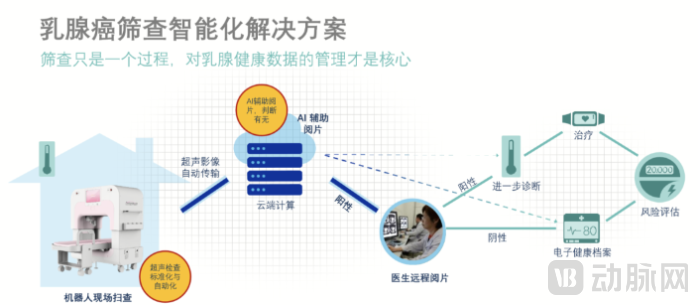
Intelligent Solutions for Breast Cancer Screening
Hanwei Medical integrates software and hardware, layers AI algorithms onto robotic technology, and further incorporates networked collaboration to establish systemic competitive advantages. The company has independently developed AIBUS, the world’s first intelligent breast ultrasound robot, and built the Aiwei Nebula Intelligent Full-Process Management Platform for screening cervical and breast cancers in women. By enabling intelligent robots to perform ultrasound examinations, Hanwei Medical achieves standardization and automation of breast ultrasound scans, generating standardized breast ultrasound imaging data. This approach mitigates the current reliance on physicians’ expertise in ultrasound technology and addresses challenges such as limited experience in image interpretation among primary-care and young physicians.
The specific workflow by which this product addresses breast cancer screening can be divided into three stages.
Phase IHanwei Medical addresses the workforce shortage in breast cancer screening through its robotic technology, eliminating the need for on-site sonographers. By utilizing robots to perform scans and acquire standardized, dynamic whole-breast ultrasound imaging data, it enhances the accessibility of screening services.
Phase IISpecifically, algorithms and AI technologies are leveraged to address the challenge of efficient interpretation. Relevant ultrasound images are automatically transmitted to cloud-based computing servers, where AI-assisted image analysis is performed to determine whether screening subjects have any lesions.
Phase IIISubsequently, a human-machine collaborative approach is employed to further verify the diagnostic results. After initial machine-based screening, physicians remotely review and interpret the imaging findings. For negative results, electronic health records are established for the screened individuals; for positive results, patients undergo further diagnosis and treatment. This model significantly enhances screening service capacity on a large scale while ensuring both quality and quantity.
Sun Xi elaborated on its business logic:“We have always believed that in future business competition, complete product suites delivered through systems thinking operate on a higher competitive dimension than individual products or technologies alone. Only by integrating and innovating two complementary technologies can problems be addressed at their root. The future of intelligent healthcare is also entering such an era: by combining mainstream medical imaging technologies with robotics, artificial intelligence, and other advanced tools to create intelligent, human–machine integrated products that directly deliver service outcomes, we can fundamentally resolve issues such as the shortage of primary care resources. Our positioning is clear: to address fundamental public health challenges, including primary healthcare and overall wellness, cancer prevention, and more.”
Validated by relevant clinical trials, the Hanwei Medical Intelligent Breast Ultrasound Robot AIBUS System demonstrated a sensitivity of 71.4%, specificity of 96.1%, and positive predictive value of 5.03% in breast cancer screening, showing no significant difference compared to a control group of conventional ultrasound physicians with 5–10 years of experience. The comparison between the AIBUS System and ultrasound physicians with 5–10 years of experience yielded a Kappa value of 0.724 (P=0.005), indicating that the AIBUS System achieves the average performance level of ultrasound physicians with 5–10 years of experience at tertiary hospitals in breast cancer screening scenarios. When used for breast cancer diagnosis, AIBUS demonstrates excellent diagnostic efficiency.
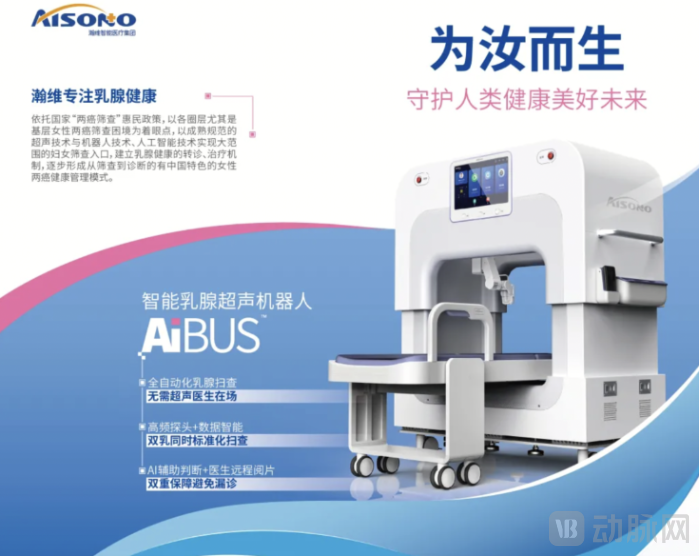
Hanwei Medical Intelligent Breast Ultrasound Robot AIBUS System
To date, Hanwei Medical has established collaborations with institutions including the PLA General Hospital (301 Hospital), Sun Yat-sen Memorial Hospital of Sun Yat-sen University, the General Hospital of the Northern Theater Command, West China School of Public Health, Shenzhen Science and Technology Innovation Commission, the Second Xiangya Hospital, and Zhejiang Provincial Maternity and Child Health Care Hospital. These partnerships focus on researching key technologies and industrialization strategies for intelligent ultrasound scanning and diagnostic analysis; comparing results from robotic scanning combined with physician interpretation against those from sonographer interpretation; and developing and clinically validating key technologies for large-scale breast cancer screening systems in primary care settings, thereby achieving deeper insights and breakthroughs in critical technologies.
The implementation plan for its intelligent screening system requires approximately 3 minutes per scan, enabling the screening of around 120 cases per day. Statistics show that under the traditional model, a single physician can screen approximately 1,000 cases annually, whereas Hanwei Medical’s AIBUS can complete approximately 15,000 case screenings per year. Based on relevant projections, Hanwei Medical’s medical products can achieve an 80% screening coverage rate within two years without increasing physician resources.
Dual Horizontal and Vertical Engines: Expanding the Commercialization Radius
The closed-loop solution for the ultrasound technology system has been established; the next step is to address commercialization, with Hanwei Medical targeting the primary healthcare market.
Addressing potential issues that may arise during the specific commercialization process, such as product implementation, Sun Xi explained: “In the future, primary healthcare will inevitably shift toward procuring services rather than purchasing equipment. Our strategic approach is straightforward: our revenue is derived from service-sharing agreements. By delivering outsourced services, we expand the scope of medical screening while alleviating the financial burden on primary care institutions associated with equipment procurement, thereby establishing a foothold in the primary healthcare sector.”
Through this strategy, Hanwei Medical has provided screening services in regions including Guangdong, Fujian, Shenzhen, Zhejiang, Jiangsu, Sichuan, Guizhou, and Hebei. In the first half of this year alone, it conducted over 99 screening events, serving a cumulative total of more than 100,000 individuals.In the future, Hanwei Medical will continue to drive sustainable corporate development by leveraging screening technologies and robotics combined with artificial intelligence, while progressively enhancing its core platform for intelligent ultrasound robots.At the same time, leveraging this core technology as a foundation, the company will expand its product portfolio of ultrasound robot series to include applications in thyroid imaging, carotid artery assessment, fetal monitoring, and hysteroscopic surgical navigation, thereby gradually expanding its overseas market presence.
Moreover, Hanwei Medical will continue to uphold its “Dual Horizontal and Vertical Engines” strategy, with breast health services as the vertical ecosystem., establishing partnerships with industry leaders such as iKang Guobin, AstraZeneca, Roche, and Mammotome, thereby raising the company’s technological barriers in the field of breast cancer screening. On the other hand,Establish horizontal collaborations based on the national “Two-Cancer Screening” strategy and the women’s health-related ecosystem., established partnerships with companies such as Daan Gene, KingMed Diagnostics, and BGI Genomics to expand the scope of technological applications and enhance their scalability.
At the end of the interview, Sun Xi discussed his vision:“We aim to leverage the widespread application of ‘Internet + intelligent screening technology’ to establish a big data-driven insurance ecosystem for breast health. By using breast cancer screening as the entry point for population-wide prevention and management, we seek to create a closed-loop system encompassing referral, diagnosis, treatment, and rehabilitation, integrated with upstream resources such as mammography, pathology, and specialist breast physicians. This approach effectively implements a tiered diagnosis and treatment framework for breast cancer, leveraging our technological and strategic advantages to address the challenges of grassroots-level screening. Furthermore, based on population distribution, we flexibly combine fixed-point examinations at community health centers with mobile screening units, enabling large-scale, boundary-free population-based breast cancer screening.”
In The Innovator’s Prescription, Clayton Christensen points out that most disruptions are driven by three factors: simplifying technology, business model innovation, and disruptive value networks. Perhaps the integration of algorithms and AI technologies with intelligent terminal technologies such as robotics is still underway. However, as long as there are people forging ahead on this path, a breakthrough from zero to one will inevitably be achieved, ultimately leading to the widespread adoption of these technologies. The prescription offered by Hanwei Medical undoubtedly holds significant meaning.