Nearly Half of Internet Hospitals Now Connected to National Health Insurance: Is Digital Healthcare Taking Off?
Two years ago, a document issued by the National Healthcare Security Administration instantly stirred up the internet healthcare industry. Document No. 47 [2019] of the National Healthcare Security Administration explicitly stated for the first time that internet medical services could be included in medical insurance payment.
Two years on, survey data from VCBeat’s “2021 Internet Hospital Report” shows that 43% of operational internet hospitals have integrated with medical insurance payment systems; among hospital-led internet hospitals, the medical insurance coverage rate has reached 53%. Additionally, public statistics indicate that in some provinces, medical insurance reimbursements for internet hospital services have amounted to tens of millions of yuan, with an average reimbursement of over 200 yuan per visit.
How Does Health Insurance Reimbursement Promote the Development of Internet Healthcare? What Issues Remain to Be Addressed? In the Aftermath of the Pandemic, It Is Necessary to Revisit These Questions.
Since 2019, the National Healthcare Security Administration has repeatedly led the issuance of policies related to medical insurance reimbursement for internet-based healthcare. To date, 26 provinces have followed suit by formulating corresponding implementation opinions or detailed rules. Internet-based follow-up consultations, remote consultations, remote monitoring, and remote diagnosis constitute the main categories for pricing and medical insurance reimbursement in internet-based healthcare, with internet-based follow-up consultations becoming a standard covered service.
Implementation of the New “Two Designated Measures” Clarifies Designated Status for Internet Hospitals
From the perspective of top-level design, medical insurance payment policies for internet healthcare are becoming increasingly refined, with greater certainty across all stages.
In 2020, health insurance reimbursement for internet-based medical services played a positive role during the epidemic prevention and control period. In November, the "Guiding Opinions of the National Healthcare Security Administration on Actively Promoting Health Insurance Reimbursement for 'Internet+' Medical Services" stipulated that medical institutions applying for supplementary health insurance agreements for "Internet+" medical services must meet six basic conditions, marking the entry of health insurance reimbursement for internet-based medical services into the practical implementation phase. Since 2021, health insurance reimbursement for internet-based medical services has been incorporated into multiple high-level policy documents.
Effective February 1, 2021, the Interim Measures for the Designated Management of Medical Institutions under Medical Security and the Interim Measures for the Designated Management of Retail Pharmacies under Medical Security (hereinafter referred to as the “Two Designated Measures,” with designated medical institutions and designated retail pharmacies under medical security collectively referred to as “designated institutions”) came into force. This marks the first comprehensive and systematic restructuring of the designated agreement management system for medical security since the establishment of the national designated agreement management system in 1999.
“Designated Institutions” are key entities within the medical insurance system. With the rapid development of the healthcare service system, the number of medical institutions has increased significantly, and new forms such as internet-based healthcare have emerged, presenting new challenges for the management of designated medical insurance providers. In response, the new “Measures for the Administration of Designated Medical Institutions and Designated Retail Pharmacies” simplify application requirements, optimize evaluation processes, and improve negotiation mechanisms, thereby helping to expand the supply of medical resources. According to regulations, internet hospitals may apply to sign supplementary agreements through their affiliated physical medical institutions. Expenses incurred from medical services provided by these internet hospitals that fall within the scope of medical insurance coverage shall be settled by the handling agencies in the pooling regions with the affiliated physical medical institutions in accordance with relevant regulations.
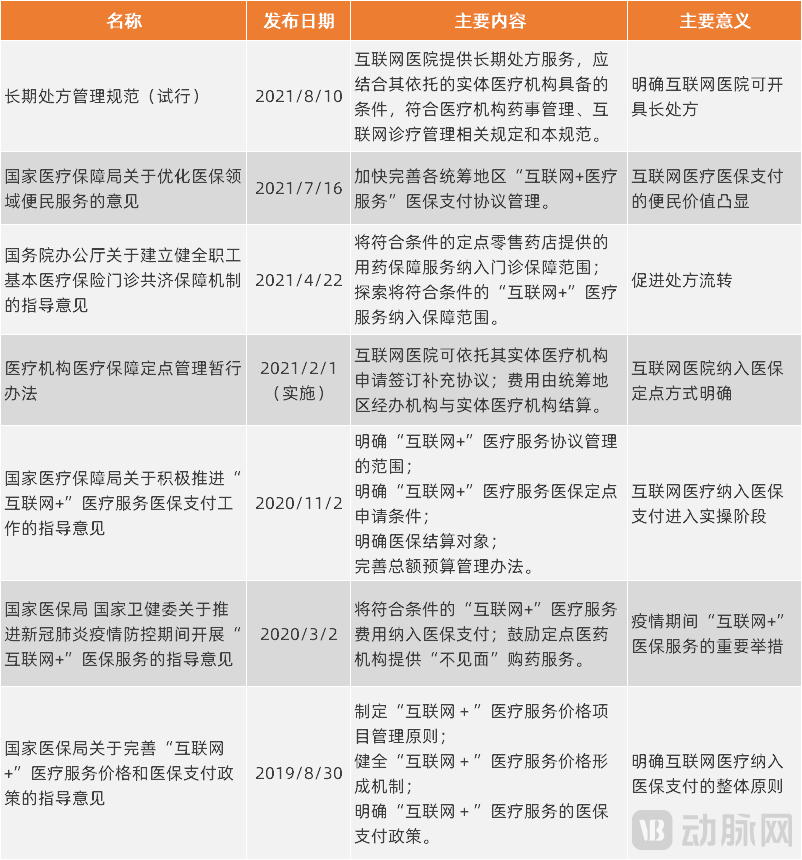
Internet Healthcare Payment Policies Led by the National Healthcare Security Administration. Source: Official Website of the National Healthcare Security Administration; Graphic by VCBeat.
Furthermore, the "Opinions of the National Healthcare Security Administration on Optimizing Convenient Services in the Field of Medical Insurance," released in July 2021, proposed that medical insurance departments in all pooling regions should accelerate the improvement of management regarding medical insurance payment agreements for "Internet + Medical Services." In August 2021, the "Standard for Management of Long-Term Prescriptions (Trial)," formulated under the organization of the National Health Commission and the National Healthcare Security Administration, required that internet hospitals providing long-term prescription services must align with the capabilities of their affiliated physical medical institutions, comply with relevant regulations on pharmaceutical administration in medical institutions and internet-based diagnosis and treatment, as well as this Standard, and strengthen supervision over medical quality and safety.
Overall, internet healthcare medical insurance payment is further integrating into the medical insurance system.
Rapid Local Implementation, with Significant Regional Disparities in Projects and Pricing
As the National Healthcare Security Administration continuously refines its top-level design, provinces have been swift in implementation.
In July 2020, the Shandong Provincial Healthcare Security Administration released the "Shandong Province Internet Hospital Medical Insurance Designated Agreement Text (Trial)" (hereinafter referred to as the "Designated Agreement"), which was the first provincial-level medical insurance designated agreement text for internet hospitals in China. The "Designated Agreement" clarifies the rights and obligations of medical insurance handling agencies and designated internet hospitals in terms of access standards for medical insurance designation, management of diagnosis and treatment services, scope of services, fee settlement, drug management, responsibilities and obligations, and the validity of the agreement. It encourages large medical institutions to innovate chronic disease medical insurance service models, effectively reduce queue waiting times, strengthen chronic disease management, promote the integration of online and offline services, and accelerate the diversion from offline consultations to online follow-up visits.
Zhejiang Province has successively issued the "Opinions on Accelerating the Development of 'Internet + Medical Insurance' and Promoting the Digital Transformation of Medical Insurance" and the "Notice on Improving the Pricing of 'Internet +' Medical Services and Medical Insurance Payment Policies." It announced the first batch of "Internet +" medical service price items, incorporating follow-up consultation fees for chronic diseases and medication costs into the scope of medical insurance coverage. Furthermore, internet-based medical insurance payment services have been launched at select tertiary hospitals, secondary hospitals, and community health centers in the provincial-level jurisdiction and eight prefecture-level cities, including Hangzhou, Ningbo, Wenzhou, Jiaxing, Jinhua, Quzhou, Taizhou, and Lishui.
At the April 2021 press conference on the Zhejiang Provincial Medical Security Regulations, the Zhejiang Provincial Healthcare Security Administration stated that it would further intensify efforts to promote “Internet + Medical Insurance,” expand its coverage to all pooled insurance areas, gradually include eligible designated medical institutions capable of providing internet-based medical services into the medical insurance network, and progressively incorporate appropriate internet-based diagnosis and treatment services into the reimbursement scope.
To date, 26 provinces have issued guidance policies on “Internet Plus” medical insurance; among them, 16 provinces have established standards for internet-based medical service items, pricing, and reimbursement.
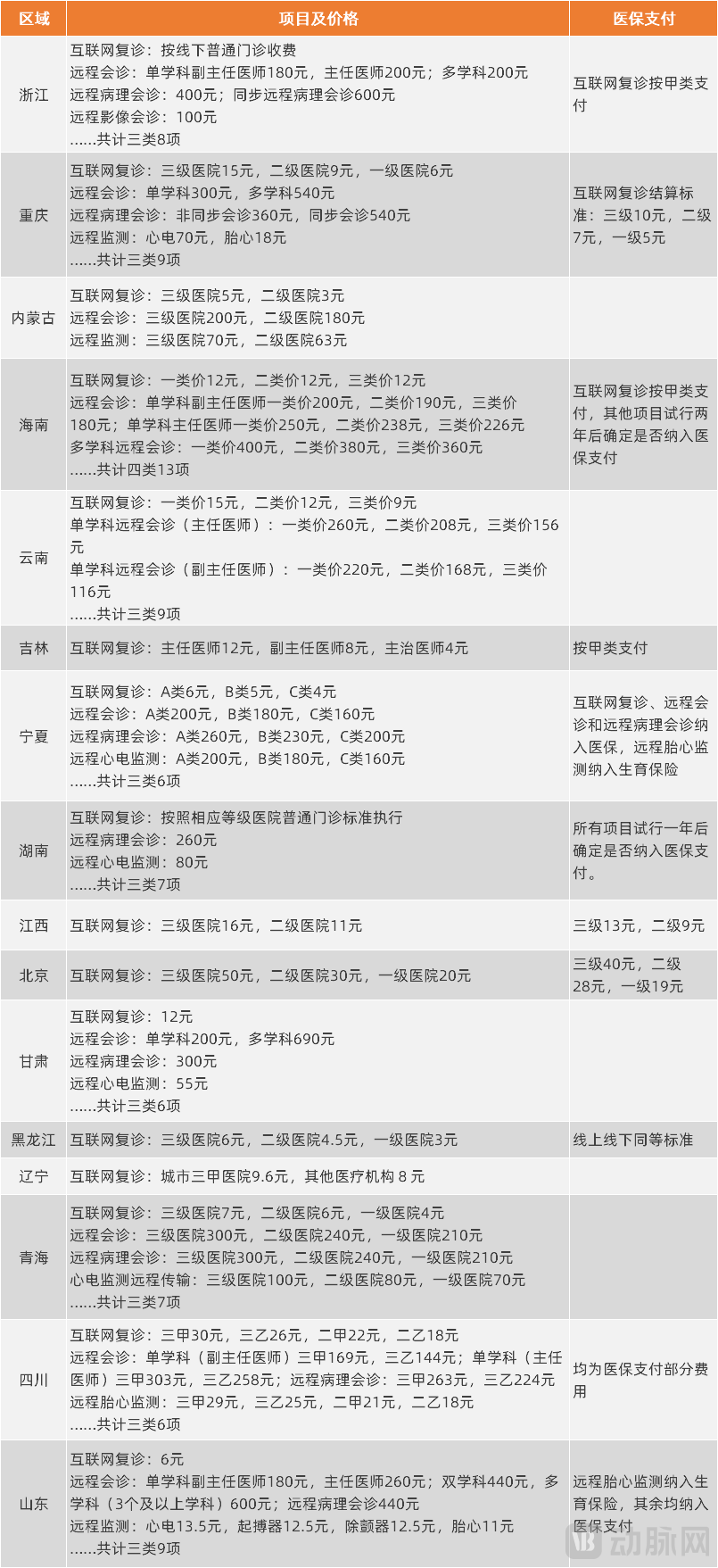
Prices of Internet Medical Service Items and Health Insurance Payment Standards by Province, Source: Official Websites of Local Healthcare Security Administrations; Graphic by VCBeat
The established fee items for internet-based medical services mainly fall into four categories: online follow-up consultations, remote consultations, remote monitoring, and remote diagnosis, with online follow-up consultations being the standard offering.
Meanwhile, significant regional disparities exist in the formulation and pricing of specific healthcare services due to variations in economic development levels, distribution of medical resources, and actual demand. For instance, Gansu and Hunan provinces have included online psychological counseling as a billable service, allowing medical institutions to set their own prices; Ningxia has listed remote sleep apnea screening tests as a billable item and established standardized pricing; in Liaoning, Heilongjiang, Shandong, and other regions, fees for single online follow-up consultations at tertiary hospitals are capped at RMB 10, whereas such consultations at tertiary hospitals in Sichuan and Beijing cost tens of yuan.
Most regions have established a 1- to 2-year trial period for medical service items and their pricing. Upon expiration of this trial period, adjustments will be made based on factors such as the clinical value of the items, price levels, and the payment capacity of medical insurance funds.
During the pilot phase of integrating internet-based healthcare services into medical insurance payment systems, several settlement processes have emerged due to differences in patient access points and system integration methods.
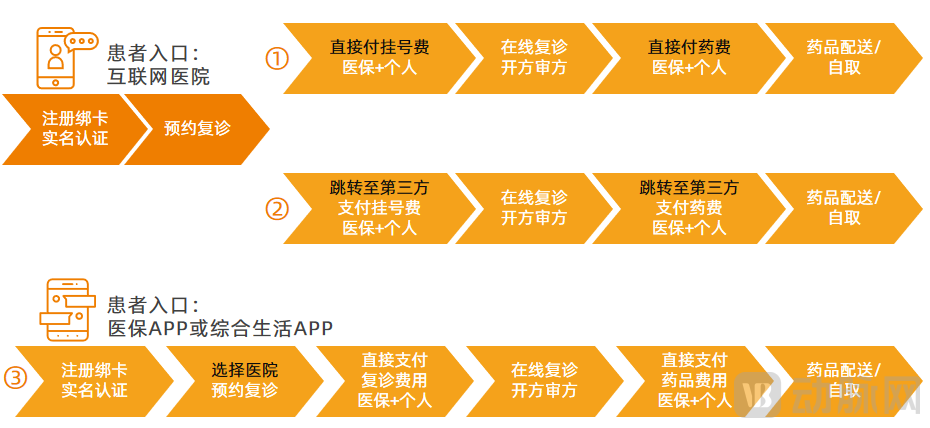
Several Processes for Internet Healthcare Medical Insurance Settlement, Chart by VCBeat
The first type is direct settlement through internet hospitals as the entry point.During the consultation, patients can directly complete medical insurance settlement and out-of-pocket payment for follow-up visit fees and medication costs through the internet hospital system.
For example, when visiting the Internet Hospital of Guangdong Provincial People’s Hospital, eligible patients with chronic diseases can initiate an online prescription renewal request. The system retrieves and displays the patient’s in-hospital prescription records from the past three months. The patient selects a physician for the renewal and directly pays the consultation fee. Upon receiving the renewal request, the attending physician issues the prescription. After the pharmacist reviews and approves the prescription, the patient completes the payment through online medical insurance settlement and out-of-pocket payment.
The Children’s Hospital of Chongqing Medical University has also adopted this approach. Pediatric patients with designated special diseases, such as hypertension and diabetes, who receive treatment at this hospital can settle their medical insurance claims online through the internet hospital. Before using online medical insurance payment for the first time, parents or guardians must register and have the patient’s information verified at the hospital; thereafter, they can use online medical insurance coverage for follow-up consultations via the internet hospital.
The second type is third-party redirected payment via internet hospitals as the entry point.Specifically, when patients at internet hospitals need to make payments through medical insurance, the system redirects them to third-party apps or mini-programs, typically the official medical insurance service platform of their place of enrollment or a comprehensive lifestyle service platform led by local government authorities.
In 2020, the Internet Hospital of Chengdu Second People’s Hospital launched the “Special Outpatient Clinic” feature, providing online follow-up consultations, prescription renewals, and medical insurance reimbursement services for patients with special outpatient diseases covered by the Sichuan Provincial Medical Insurance who receive designated treatment at the hospital. To access care, patients enter the “Special Outpatient Clinic” section of the Internet Hospital, select the corresponding insured individual under the Sichuan Provincial Medical Insurance plan for special outpatient diseases, choose a physician for a follow-up consultation, communicate with the physician, and obtain prescriptions for specified medications. Patients then proceed to the “Sichuan Medical Insurance APP” to complete payment, and upon successful payment, return to the platform to view their special outpatient prescriptions.
In July 2021, the Internet Hospital of Shanghai Children’s Medical Center launched online medical insurance payment services. After scheduling a follow-up visit, patients covered by Shanghai medical insurance are automatically redirected to the “Suishenban” mini-program to settle the registration fee for the follow-up consultation via medical insurance. Once the physician issues the follow-up prescription and it passes review, the prescription is pushed to the patient. Patients covered by Shanghai medical insurance are then redirected again to the “Suishenban” mini-program to complete the online payment for medication costs.
The third method is direct settlement via the national health insurance app or integrated lifestyle apps.This approach integrates internet hospitals and other convenient services into a single platform, allowing patients to select follow-up consultations at hospitals and subsequently complete medical insurance payments through the platform’s unified data interface.
In March 2020, the Internet Hospital of Nantong Sixth People’s Hospital in Jiangsu Province officially launched on the Nantong Medical Insurance APP, providing insured patients with end-to-end services spanning pre-consultation, consultation, and post-consultation phases across more than 20 departments, including internal medicine, surgery, and pediatrics. By clicking on the “Internet Hospital Zone” on the homepage of the Nantong Medical Insurance APP, insured individuals can complete the entire process, including online appointment registration, video consultations and text-and-image consultations, online prescription issuance, online payment, and home delivery of medications via courier.
Jiangsu Province Hospital’s Internet Hospital enables online medical insurance payments through the local integrated lifestyle service platform, “My Nanjing.” Patients covered by Nanjing’s medical insurance scheme can download the “My Nanjing” app, tap on “Hospital Services,” and select Jiangsu Province Hospital to activate online medical insurance payment and link their patient cards. After completing an online follow-up consultation, patients can use the “Cloud Payment” feature within the app to settle their medical insurance claims online.
Overall, the aforementioned processes all facilitate rapid online settlement. Similar to online appointment registration in hospital informatization, there are both individual hospital portals and platform-based entry points, thereby meeting patient needs through multiple channels.
According to the survey results of the "2021 Internet Hospital Report," 43% of internet hospitals that have been put into operation have realized medical insurance payment. Among them, more than 50% of hospital-led internet hospitals have opened medical insurance payment. The improvement of medical insurance payment can support the development of internet medical care from many aspects.
First, improve hospital operational efficiency.
Survey data reveal significant disparities in operational metrics among hospital-led internet hospitals, depending on the availability of health insurance reimbursement. As illustrated in the figure below, among hospitals with health insurance coverage, only 28.2% reported an average daily patient volume of fewer than 50 visits, while 20.5% handled more than 500 visits per day. In contrast, among hospitals without health insurance coverage, a substantial 51.4% recorded fewer than 50 daily visits, and only 11.4% exceeded 500 visits per day. These findings clearly demonstrate that integrating health insurance reimbursement facilitates the development of patient usage habits and enhances the operational efficiency of internet hospitals.
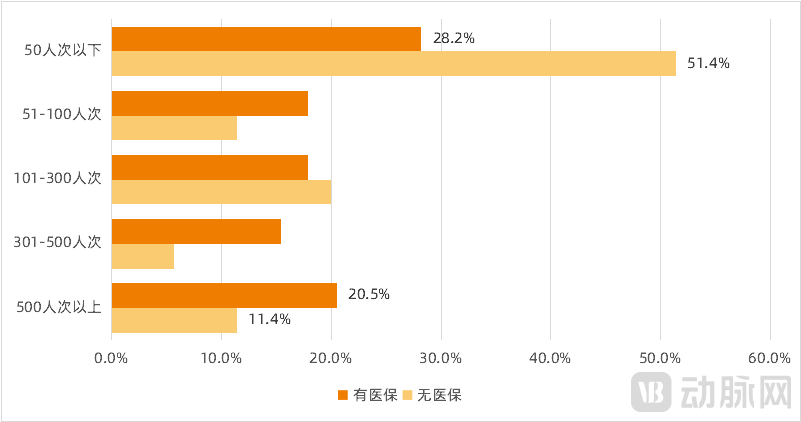
Comparison of Consultation Volumes with Medical Insurance Coverage in Hospital-Led Internet Hospitals; Data Source: Hospital Surveys, Chart by VCBeat
Second, establish a closed-loop business ecosystem for the enterprise.
In addition to hospital-led internet hospitals, large enterprises are also integrating their locally established internet hospitals with local medical insurance systems to achieve a closed-loop business model encompassing healthcare, pharmaceuticals, and insurance.
Establishing and operating internet hospitals in multiple regions has become a key strategy for digital health companies to strengthen their integration with offline medical resources, enhance localized service capabilities, and improve the conversion of offline patient traffic. It is also a fundamental prerequisite for enabling local medical insurance reimbursement.
Ping An Good Doctor’s 2021 interim results report revealed that it has obtained qualifications for self-built internet hospitals in 10 cities and has signed agreements with 205 hospitals to jointly build internet hospital platforms. Among these self-built and co-constructed projects, medical insurance payment integration has been achieved in two regions—Hubei Province and Yinchuan, Ningxia—as well as at Shunde Hospital Affiliated to Jinan University, Dongguan Traditional Chinese Medicine Hospital, and Fuzhou Traditional Chinese Medicine Hospital.
JD Health has launched internet hospitals in cities including Yinchuan (Ningxia), Tianjin, Zhengzhou (Henan), and Zigong (Sichuan). Among them, Nankai JD Internet Hospital has integrated with the medical insurance payment system.
Currently, WeDoctor has connected with 7,800 hospitals across China. Among the 27 internet hospitals it has built and operates, 17 support medical insurance payments.
Furthermore, Haier Sen Internet Hospital, under the Yilian umbrella, has enabled payment via Chengdu’s individual medical insurance accounts; meanwhile, Yinchuan Miaoshou Internet Hospital, part of the Yuanxin Technology Group, has been designated as a reimbursable provider under the national medical insurance scheme.
Finally, deliver efficient and convenient public services.
During the implementation of medical insurance for internet-based healthcare services, multiple provinces have released data on medical insurance settlements.
Since 2020, the Beijing Municipal Healthcare Security Administration has identified and designated 11 batches of medical institutions providing “Internet+” healthcare services as eligible for basic medical insurance reimbursement. As of August 2021, internet-based diagnosis and treatment services from a total of 30 hospitals were included in the scope of medical insurance payment, including the internet hospitals of major Grade A tertiary hospitals such as Peking Union Medical College Hospital and China-Japan Friendship Hospital.
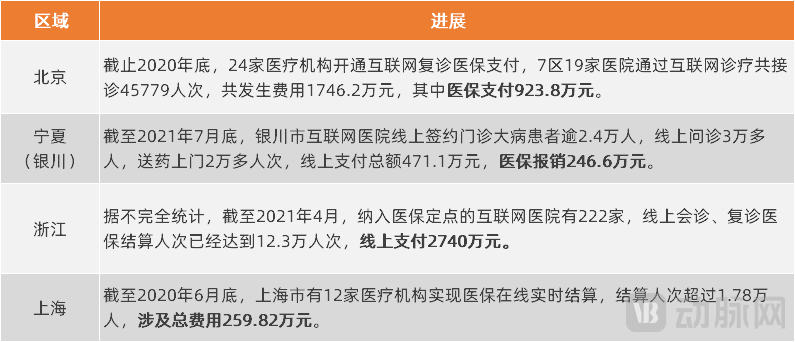
Medical Insurance Reimbursement for Internet Healthcare Services in Selected Regions. Source: Public reports; Chart by VCBeat
According to data released by the National Healthcare Security Administration, as of the end of 2020, 19 hospitals in Beijing had conducted 45,779 internet-based medical consultations, with total costs amounting to RMB 17.462 million, of which RMB 9.238 million was covered by medical insurance.
Furthermore, online medical insurance payment systems in Zhejiang, Ningxia, Shanghai, and other regions have demonstrated tangible results. As of April 2021, there were 222 internet hospitals designated for medical insurance reimbursement in Zhejiang Province, with the number of online consultations and follow-up visits covered by medical insurance reaching 123,000, totaling RMB 27.4 million in online payments. By the end of July 2021, over 24,000 outpatients with major chronic diseases had registered online with internet hospitals in Yinchuan, Ningxia; more than 30,000 individuals had conducted online consultations, resulting in RMB 2.466 million in medical insurance reimbursements. Data from several regions that have disclosed medical insurance settlement costs indicate that the average reimbursement per patient visit ranges from tens of yuan to RMB 200, delivering practical convenience and value to patients.
Of course, there are still obstacles to be overcome in the payment of medical insurance for internet healthcare.
First, there is the calculation of service costs. For patients, online follow-up visits eliminate transportation expenses and waiting times associated with hospital visits, thereby genuinely reducing the cost of care. For physicians, the time required for online consultations is theoretically equivalent to that of in-person visits; indeed, many doctors believe that online consultations may actually demand more time than offline ones. This is because digital communication is more convenient and the consultation window is extended, potentially prompting patients to initiate multiple rounds of dialogue within the valid period, thus increasing the time physicians must devote to responding. For hospitals, significant costs are incurred in establishing internet hospitals, integrating medical insurance payment interfaces, assigning operational staff, and formulating incentive schemes for online physicians.
Currently, in accordance with medical insurance policies, public medical institutions conducting online follow-up consultations are required to charge fees based on the pricing standards for general outpatient consultation services, regardless of the professional rank of the medical personnel providing the care. This implies that despite incurring higher costs, physicians and hospitals struggle to achieve commensurate revenue, which has, to some extent, dampened their enthusiasm.
Therefore, further optimization is needed in the cost assessment and pricing of internet medical services. Currently, payment policies across various regions are primarily implemented on a pilot basis; that is, issues identified and experience accumulated during the pilot phase will influence future policy directions. It is worth considering whether internet medical services can adopt a combined model of general outpatient and special-needs outpatient care in the future, so as to ensure the operational safety of the basic medical insurance fund, maintain balanced hospital revenues, and fully reflect the value of physicians’ professional labor.
Next is the utilization of designated medical insurance provider credentials. Policies have explicitly stated that internet hospitals may apply to sign supplementary agreements by leveraging their affiliated physical medical institutions. This poses little difficulty for internet hospitals led by physical hospitals, as it essentially involves shifting a portion of medical insurance reimbursements from offline to online channels. For enterprise-led internet hospitals, clarifying cooperative relationships is also straightforward when a single internet hospital is affiliated with one physical medical institution. However, if multiple internet hospitals are affiliated with the same physical medical institution for application purposes, how should the allocation of medical insurance funds between online and offline services be rationalized? This remains an area requiring further exploration.
However, beyond considering the benefits brought by medical insurance reimbursement, internet healthcare should place greater emphasis on leveraging technological capabilities to safeguard the security of medical insurance funds. By employing technologies such as artificial intelligence and big data to enhance efficiency and control costs within the medical insurance system, the industry can achieve sustainable development.
For detailed survey data on internet hospitals mentioned in this article, please refer to the “2021 Internet Hospital Report.” Scan the mini-program code below to download the full report.