

Digital Therapeutics from 0 to 1: The Six Strategic Pillars for Founding Success
PrefaceA butterfly flapping its wings in the remote Amazon rainforest could, by chance, trigger a storm in Texas, United States, two weeks later. As the "butterfly" of this era, COVID-19 will undoubtedly become a "dancing" black death butterfly in human medical history—no, in human history at large. The pandemic has accelerated the fragmentation of the world, yet in other dimensions, it has fostered global integration. However, all of this is shifting from the physical world to the digital realm. If terms like "Metaverse," "Third Space," and "Second Life" sound somewhat unfamiliar to you, then phrases such as "Health Kit," "online courses," and "Zoom" are certainly well-known. At the height of the pandemic, even elementary school students participated in physical education classes via screens, following their teachers' instructions—a bizarre scenario that would have been incomprehensible in the "pre-pandemic world."
People often regard certain special and significant historical events as markers dividing the flow of time, yet frequently debate the appropriateness of such demarcations. When humanity looks back in years to come, the pre-pandemic and post-pandemic eras will undoubtedly serve as new milestones in the course of civilization. Digital therapeutics, meanwhile, are poised to become a new milestone in the field of healthcare, actively shaping people’s daily health and well-being in the foreseeable future.
As practitioners in the field of digital health, we bear the responsibility of driving the industry toward a healthier, faster, and more mature future. We also hope that more like-minded professionals will join the effort to build digital health infrastructure, igniting the beacon of victory for a healthy and fulfilling digital life for all humanity.
From the perspective of China’s national digital health strategy, achieving a perfect balance between healthcare accessibility and cost control, given the country’s vast population base, presents a significant test of governance capabilities. Digital therapeutics undoubtedly offer a novel approach to addressing this challenge. World-leading telecommunications infrastructure, top-tier mobile device supply chain capabilities, and the most extensively covered mobile software ecosystem globally provide ideal conditions for digital therapeutics to emerge and thrive in China. Furthermore, digital therapeutics feature high intervention accessibility, low costs, and ease of use, while placing greater emphasis on patients’ quality of life alongside treatment. These attributes align perfectly with the outline of the Healthy China strategy we are implementing.
Consequently, we have observed that since 2020, hailed as the inaugural year of digital therapeutics (DTx), an increasing number of enterprises, investors, and practitioners have begun to focus on and engage in this field. Some even propose that DTx represents a once-in-a-lifetime dark horse in the research and development of pharmaceuticals and medical devices, poised to unlock a brand-new trillion-dollar market as it evolves. Amidst this fervor, however, we have also witnessed growing debates and divergent opinions. Critics argue that due to differences between the Chinese and U.S. healthcare systems—with insurance companies covering costs in the U.S. while China’s national medical insurance does not—DTx lacks fertile ground in China, rendering its success in Europe and the United States unreplicable here. In our view, as long as digital therapeutics can meet treatment needs and function as a product that users are willing to purchase and utilize, any bullish or bearish narratives that disregard business models and long-term strategic decisions are merely opportunistic attempts to ride the wave of hype.
The digital therapeutics (DTx) industry in China is still in its relatively early stages, with a significant scarcity of talent and resources. To foster the collective growth and advancement of the industry, and to attract more talent and enterprises by highlighting the immense potential and possibilities of DTx, our team has synthesized our preliminary research into the “Six Meridian Swords” framework for strategic decision-making in DTx companies. This framework elucidates the essential path from inception to market entry for DTx enterprises, focusing on key aspects including industry analysis, indication selection strategy, regulatory registration strategy, business models, organizational functions and structure, and return on investment. The content is derived from the insights and summaries accumulated by the author and their team during the product development process of digital therapeutics. We welcome constructive criticism and corrections from industry peers.
First Form: Shaoshang Sword — Characterized by its powerful and vigorous swordplay, it carries the momentum of earth-shattering force and an approaching storm.
The emergence of digital therapeutics has been nothing short of groundbreaking, creating a storm of activity. Keen-sensed investors, entrepreneurs, and multinational pharmaceutical companies have begun to enter the fray. However, the line between pioneers and martyrs is often blurred. Entering the market early does not necessarily bring one closer to success; despite first-mover advantages, companies may face challenges such as an immature industry ecosystem, low awareness, and high educational costs, ultimately failing and paving the way for others. Google, for instance, was the 19th company to develop a search engine yet achieved tremendous success. Therefore, for digital therapeutics companies to succeed, they must first pass the test of rigorous market research: What is the market size for different diseases? Is policy support sufficient? Has industry recognition and acceptance reached an appropriate stage? Clarifying why and when to embark on this journey is crucial.
Digital therapeutics are currently the darlings of the healthcare investment community. In 2016, digital therapeutics gradually came into the spotlight of investors. By 2020, digital therapeutics companies had secured over 50 rounds of financing, with disclosed transaction amounts exceeding $700 million. Star companies such as Livongo, Pear Therapeutics, and Propeller Health have raised funds multiple times, with each round accompanied by the launch or scale-up of one or more products.
A 2020 McKinsey research report indicated that investment in the digital therapeutics market has grown continuously at an annual rate of over 40% for nearly the past decade. In China, only a few companies secured financing between 2016 and 2020. Among them, Shangyi Information Technology, developer of the “Shukang” product, raised a total of more than RMB 40 million across two funding rounds. Since late 2019, numerous investment institutions have begun establishing digital health funds, many of which include dedicated sub-sectors for digital therapeutics.
Let us further examine the market size and competitive landscape in China. Rough estimates suggest that the domestic market for digital therapeutics could reach hundreds of billions of yuan. It is estimated that there are currently 330 million people in China with cardiovascular disease, and approximately 114 million patients with diabetes. The obesity rate among adults aged 18 and above rose from 4.8% in 2002 to 11.9% in 2012. Furthermore, there is a significant gap in the management of major modifiable risk factors for cardiovascular disease through lifestyle interventions, including hypertension, dyslipidemia, diabetes, obesity, smoking, physical inactivity, and unhealthy dietary habits. An analysis of 16,100 medical records of acute myocardial infarction (AMI) in China between 2001 and 2011 revealed that most discharged patients did not receive five key recommendations: dietary modification, exercise, weight control, regular lipid monitoring, and smoking cessation. As of 2011, more than half of AMI patients had not received any such advice.
Currently, China has yet to identify out-of-hospital lifestyle and behavioral interventions that are closely linked with in-hospital physician prescription interventions. However, the vast patient population in China creates an urgent demand for such lifestyle and behavioral interventions. Digital therapeutics may offer an effective solution to this challenge by extending the scope of prescriptions from medications to include lifestyle and behavioral interventions, thereby establishing a seamless connection between in-hospital and out-of-hospital care.
Currently, there are no more than 100 companies in China engaged in the research and development of digital therapeutics. These companies are distributed across various fields, including cardiovascular diseases, endocrinology, oncology, respiratory conditions, dermatology, neuropsychiatry, weight management, and rehabilitation. The number of R&D enterprises within any single disease area is relatively small. With few products currently on the market, the level of market competition remains very low.
At the policy level, the Outline of the 14th Five-Year Plan for National Economic and Social Development and the Long-Range Objectives Through the Year 2035 (Draft), newly released during the Two Sessions in 2021, explicitly proposes comprehensively advancing the construction of a Healthy China. It places safeguarding people’s health at a strategic priority, adheres to the principle of prevention first, deeply implements the Healthy China Initiative, improves national health promotion policies, strengthens the national public health protection network, and provides all-around, full-lifecycle health services for the people. Meanwhile, it embraces the digital era, unlocks the potential of data as a key factor of production, advances the building of a cyber powerhouse, and accelerates the development of the digital economy, digital society, and digital government, thereby driving comprehensive transformations in production, lifestyle, and governance through digital transformation.
The promulgation and implementation of the new Regulations on the Supervision and Administration of Medical Devices in 2021 dedicated significant space to discussing how to support innovation in the medical device industry at the national level, while also introducing new regulatory requirements for software-based medical devices. It is evident that alongside encouragement, more standardized and clearly defined management will become the norm. In summary, enterprises involved in the research, development, production, and market launch of digital therapeutics will have legal frameworks and guidelines to follow, which is overall a positive development.
Beyond the question of “whether or not to develop digital therapeutics,” “which disease area should we target?” is often the most critical issue considered by many emerging digital therapeutic teams. In fact, prior to that, it is more important to reflect on one’s own strengths and how they can facilitate the effective implementation and commercialization of digital therapeutics in specific indications. Three key capability dimensions can serve as reference points:
1. Market Size: This encompasses the market size within a single indication area, the competitive landscape, purchasers’ ability to pay, and the availability of suitable monetization pathways. A low disease prevalence does not necessarily imply a small market size. Ultimately, the addressable market for a company is jointly determined by multiple dimensions, including patient population size, the proportion of patients amenable to digital health solutions, purchasing power, intensity of competition, and monetization capability. Therefore, when selecting indications, companies must conduct a comprehensive analysis and make decisions based on these key dimensions.
2. Disease Characteristics: Evaluate the existing conventional (guideline-recommended) treatment modalities for the target disease to determine whether they consist of surgical intervention alone or involve multimodal therapy. Diseases that can be cured by surgery alone are clearly unsuitable for digital therapeutics. For conditions requiring multimodal therapy, further analysis is needed to identify which specific treatment components possess the potential for digitization. This demands that companies have deep insights into the disease itself.
3. The company’s inherent commercialization capabilities: Within the selected indication area, does the company possess the ability to integrate the pharmaceutical and medical device supply chain? Some may ask, “Isn’t digital therapeutics (DTx) itself a product? Why is supply chain integration necessary?” Digital therapeutics is a digital product, and the ecosystem of ancillary products built upon it can be highly diverse. Taking weight management as an example, individuals seeking weight loss require not only professional guidance but also a range of supporting products such as exercise equipment, meal replacements, and smart scales. These ancillary products represent significant potential for future monetization of DTx offerings. Beyond supply chain integration, it is essential to assess whether the company has sufficient commercial promotion capabilities to support the business model of digital therapeutics.
By following our summarized indication screening strategy, companies can first assess their core competencies and work backward from their end goals to select the most suitable development path. Developing a high-quality product is merely the first step; the true measure of success lies in passing the test of the market and earning user adoption through their purchasing decisions.
Many enterprises often put the cart before the horse in the development of digital therapeutics (DTx). They first immerse themselves in studying diseases to develop products, then conduct clinical trials after the product is ready, followed by applying for medical device registration. Only afterward do they consider business models, monetization pathways, and promotion strategies. Some may ask, “Isn’t this the correct approach?” While this sequence may seem logically sound, it is almost a disastrous “path to failure.” Digital therapeutics possess both software product attributes and medical attributes; they may either require or be exempt from clinical trials. All of this depends on your initial decision—specifically, your business model—because different commercial pathways determine your regulatory strategy, which in turn guides your entire product development process.
From Day 1 of product research and development, it is essential to determine the medical device classification of the product and identify the applicable registration regulatory requirements. Once the classification is established, the next step is to decide whether to apply for a Class II or Class III medical device registration certificate. Currently, all existing digital therapeutics products in China fall under the Class II category. A key consideration is whether clinical trial exemptions can be applied for during Class II registration to reduce costs. After these determinations are made, the entire product development process must comply with medical device registration regulations. For instance, the preparation of the Product Requirements Document must align with medical device registration requirements. Additionally, documents such as the Development Plan, Architecture Design Specification (if applicable), Detailed Software Unit Design Specification, Unit Testing Specifications, Unit Test Cases, Unit Test Reports, Integration Testing Specifications (if applicable), Integration Test Cases (if applicable), Integration Test Reports, List of Development Tools (including name, model, version, and manufacturer), Change History of Development Tools (release notes), and Bug Fix Records during development must all adhere to the Quality Management System regulations for medical device supervision. Furthermore, periodic communication with regulatory authorities during the development process is crucial to stay informed of changes in regulatory requirements, ensuring that the product closely meets approval criteria before submitting the registration application. This approach not only reduces the risk of rejection but also significantly accelerates business progress, thereby enhancing competitive advantage in the future.
The end users of digital therapeutics are undoubtedly patients or individuals requiring health interventions. However, the payers may also include pharmaceutical and medical device companies that deploy digital therapeutics to supplement their pipelines and mitigate competitive pressures. Other potential payers include insurance companies or large corporate employers seeking to provide value-added services and leverage big data actuarial analysis. Finally, government health insurance programs may also serve as payers, provided that digital therapeutics can demonstrate through health economics evidence that the aforementioned “break-even point” offers superior value compared to the current healthcare system. Thus, from the perspective of business model selection, there appear to be only three approaches to reaching users.
The first approach involves driving traffic from public domains to build private domain traffic and brand equity, thereby selling directly to end users. This model places significant demands on team capabilities, primarily in terms of product strength, branding, channel management, pricing, and promotion. Key success factors include precise target audience positioning and the ability to manage traffic operations and conversion. This model requires substantial advertising expenditure. In direct-to-consumer sales originating from public domains, intermediary channel and advertising costs are exceptionally high. It is understood that for a comprehensive digital therapy solution, along with associated pharmaceuticals and medical devices, the overall gross margin from sales via public domain platforms is only 10%.
The second model involves indirectly prescribing products to patients or users through hospitals. The capabilities required for this approach are similar to those possessed by traditional pharmaceutical and medical device companies, such as physician channel management, hospital relationships, and corporate business development (BD) capabilities.
The third model involves selling digital therapeutics products to large employers, thereby providing health interventions for their employees or customers. This model demands significantly different capabilities from commercialization teams compared to those of traditional pharmaceutical companies. B2B sales often require a deep understanding of large employers’ strategic plans and close alignment with the value proposition offered by digital therapeutics to secure orders on a long-term, sustainable basis.
(Government reimbursement will not be discussed until the digital therapeutics industry fully demonstrates its value and the relationship between cost and the current status quo.)
Ultimately, whether the product is marketed directly to consumers, recommended by physicians, or purchased and endorsed by large employers, its intrinsic value remains the core determinant. Before persuading end-users, it is essential to first secure the acceptance of these “recommenders.” Moreover, such recommenders often rely on “positive feedback” from users to maintain the confidence needed for continuous promotion, thereby establishing a virtuous cycle. Business model decisions must be made prior to product development, as different customer segments dictate distinct product philosophies and forms. Once product development commences and medical device certification is obtained, there will be limited room for subsequent modifications.
A severe talent shortage is currently a major challenge facing the digital therapeutics (DTx) field. As products developed at the intersection of multiple disciplines—including medicine, pharmaceuticals and medical devices, software, big data, psychology, and patient behavior research—DTx solutions have a substantial demand for interdisciplinary composite talent. To date, it is nearly impossible to find a product manager in the market who has led the end-to-end (“0-to-1”) design of a DTx product. This implies that you are unlikely to find a DTx product manager who possesses medical knowledge, experience in mobile product design (preferably for patient-management apps), artistic aptitude, expertise in interaction design and UI design (ideally game UI), and prior experience with medical device regulatory submissions.
Until anyone discovers such an all-encompassing “jack-of-all-trades,” the development of digital therapeutics will have to rely on efficient team collaboration, involving talent that spans at least one or two disciplines. Therefore, the construction of team functions and collaborative systems should be based on two principles: “cross-disciplinary” and “complementary.” We have outlined the requirements for teams and organizational structures under two different business models in the table below, for reference only.
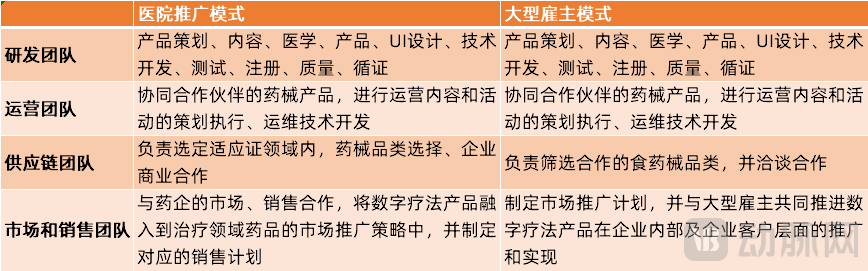
For enterprises, any investment should be based on a sound return-on-investment (ROI) analysis. As an innovative business model, digital therapeutics requires even more rigorous and detailed financial analysis to support managers in making strategic decisions.
In the fiercely competitive market landscape, high-quality investment is an essential weapon for every enterprise’s survival and development. Making such investments requires a systematic review and forecasting of both internal and external conditions. For an innovative company specializing in the emerging field of digital therapeutics, factors such as unclear industrial policies, insufficient market competition, limited public awareness, and immature related technologies necessitate a more grounded approach. It is crucial to conduct solid analyses and assumptions based on known realities, leveraging available resources and stage-specific objectives, while making reasonable predictions about the unknown. Ultimately, outcomes should be compared across multiple dimensions. All this information should be consolidated under the leadership of financial return-on-investment analysis, resulting in an investment analysis report with clear data metrics that can reliably support investment decisions and provide a documented basis for post-investment management.
Conduct thorough financial return-on-investment (ROI) analysis: clarify key factors before investment and review performance clearly afterward. Even a small venture can grow into a mighty industry leader. Common methods for financial ROI analysis include the Net Present Value (NPV) method and the Internal Rate of Return (IRR) method. If the capital investment cycle is not considered, the simple ROI calculation may be used. Practical investment applications and problem-solving approaches should encompass market outlooks, proposed solutions, strategic trading recommendations, feasibility studies, investment opportunity assessments, and risk-return analyses. An investment plan should specify entry rationale and pricing, position-sizing ratios and steps, target prices, as well as take-profit and stop-loss levels. Regardless of the method employed, assumptions are inevitable. However, these assumptions should not be arbitrary; instead, metrics such as pricing, penetration rates, and market share must be calibrated to align with the company’s scale and capabilities. Only then will the financial model have logical underpinnings and provide a sound basis for decision-making. Once a company makes the decision to enter the market, it should combine prudence with the boldness and momentum characteristic of the “Zhongchong Sword” style—decisive, expansive, and powerful. Only through decisive decision-making, courageous innovation, and committed investment can new industries be invigorated and first-mover advantages be secured.
There has long been a saying in the martial arts world: “In all under heaven, only speed is invincible.” Yet in the realm of digital therapeutics, we believe it is time to slow down. We must not be swayed by hype, influenced by capital, or carried away by traffic trends. Instead, we should solidify our fundamentals, gain deep insights into the underlying logic of diseases, and address patients’ most urgent needs. Guided by human dignity, the meaning of life, the value of health, and the Hippocratic Oath, we believe that only in this way can we uphold the true essence of medicine in an impetuous world obsessed with “speed,” and thus remain invincible in any arena.
Finally, I quote Zhang Zai’s “Four Sentences of Hengqu” from the Northern Song Dynasty as a conclusion, hoping it will serve as an enduring aspiration for all healthcare professionals in their pursuit of the cause of health: “To ordain conscience for Heaven and Earth; to secure life and fortune for the people; to continue lost teachings for past sages; and to establish peace for all future generations!”

Special Acknowledgements: Thanks to Mr. Guo Lei of CITIC Capital Ventures for his assistance and support!