

A Decade in the Making: Focus on Ophthalmic Digital Therapeutics — Shijing Medical Redefines Amblyopia and Strabismus Treatment Solutions

DOBOSO
Intelligent Medical Platform Provider
Amblyopia, commonly known as "lazy eye," refers to a condition in which the best-corrected visual acuity in one or both eyes is below the age-appropriate norm, despite the absence of organic pathology on ocular examination. It is one of the leading causes of visual impairment in children. The global prevalence of amblyopia is as high as 3%. If not prevented and treated in a timely manner, the affected eye(s) will suffer permanent visual deficits, thereby compromising quality of life.
Current treatment modalities primarily include optical correction, occlusion therapy, and pharmacological penalization to blur vision in the dominant eye, thereby forcing the patient to use the amblyopic eye. However, in clinical practice, many children find these methods uncomfortable and poorly tolerated, leading to poor adherence and significantly compromised therapeutic efficacy.
In 2020, the global pharmaceutical giant Novartis acquired Amblyotech, a U.S.-based life science software development company, with the aim of transforming Amblyotech’s software into a game-based digital therapeutic for amblyopia treatment, thereby overcoming the limitations of traditional therapies. The product underwent proof-of-concept studies in the second half of 2020. Israel, known as a “powerhouse” of global medical device innovation, has also given rise to NovaSight, an innovative company specializing in digital therapeutics for optometry and ophthalmology.
China currently has 15 million children with amblyopia and a large target population suffering from other visual function deficiencies, indicating the potential to become a market worth hundreds of billions of yuan. International innovators in ophthalmic digital therapeutics are making frequent moves. How is this company providing a Chinese solution? And how does it establish itself in China while expanding globally? To address these questions, VCBeat interviewed Zhou Mosheng, Founder and Chairman of Guangzhou Shijing Medical Treatment Software Co., Ltd. (hereinafter referred to as “DOBOSO”).
Shortly after graduating from university in 2000, Zhou Mosheng forged a connection with the ophthalmic software industry. He first joined a company specializing in vision therapy for strabismus and amblyopia, where he gained experience in product development, marketing, sales, and promotion. Later, he moved to an ophthalmic medical device enterprise, engaging deeply with hospitals and clinical departments to further his understanding of ophthalmology.
During this period, Zhou Mosheng observed that traditional amblyopia treatments were primarily confined to clinical settings, with prolonged treatment courses; even the most responsive cases required three to four years, while slower-progressing ones could take five to six years. Furthermore, conventional therapeutic regimens were often monotonous, leading to poor patient adherence. In light of these pain points and his assessment of the market landscape, Zhou Mosheng resolved to establish DOBOSO in 2008 and independently developed an innovative visual training product—Duobaoshi.

Zhou Mosheng, Founder and Chairman of DOBOSO
Zhou Mosheng once explained that the development of amblyopia primarily stems from issues involving retinal neurons, visual pathway neurons, and cortical cells in the brain, specifically manifesting as impairments in information reception, transmission, and processing. Traditional treatments for amblyopia act solely on the fundus oculi and are unable to modify the visual neural pathways or the visual cortex.
DOBOSO leverages the plasticity of the brain’s nervous system, based on mathematical models of the receptive fields of visual neurons, through “Multimedia Biofeedback + Visual Perception Training"This approach opens up the patient's visual pathway, directly reaching the central visual system, improving the information processing function of the neural visual system. At the same time, it trains the patient's 'visual acuity,' 'cognitive ability,' and 'hand-brain-eye' coordination to achieve the goals of treating strabismus and amblyopia, as well as enhancing visual function."
DOBOSO can generate nearly 1,000 types of high-intensity stimuli based on factors such as fixation characteristics, age, refractive status, and the presence or absence of nystagmus from the case data center.Multimodal Bio-Stimulation Mode, also paired withRich Visual Training Content, including 6 major training modules, 8 categories of training functions, 172 training items, 216 stimulation patterns, and 1,772 training modes.
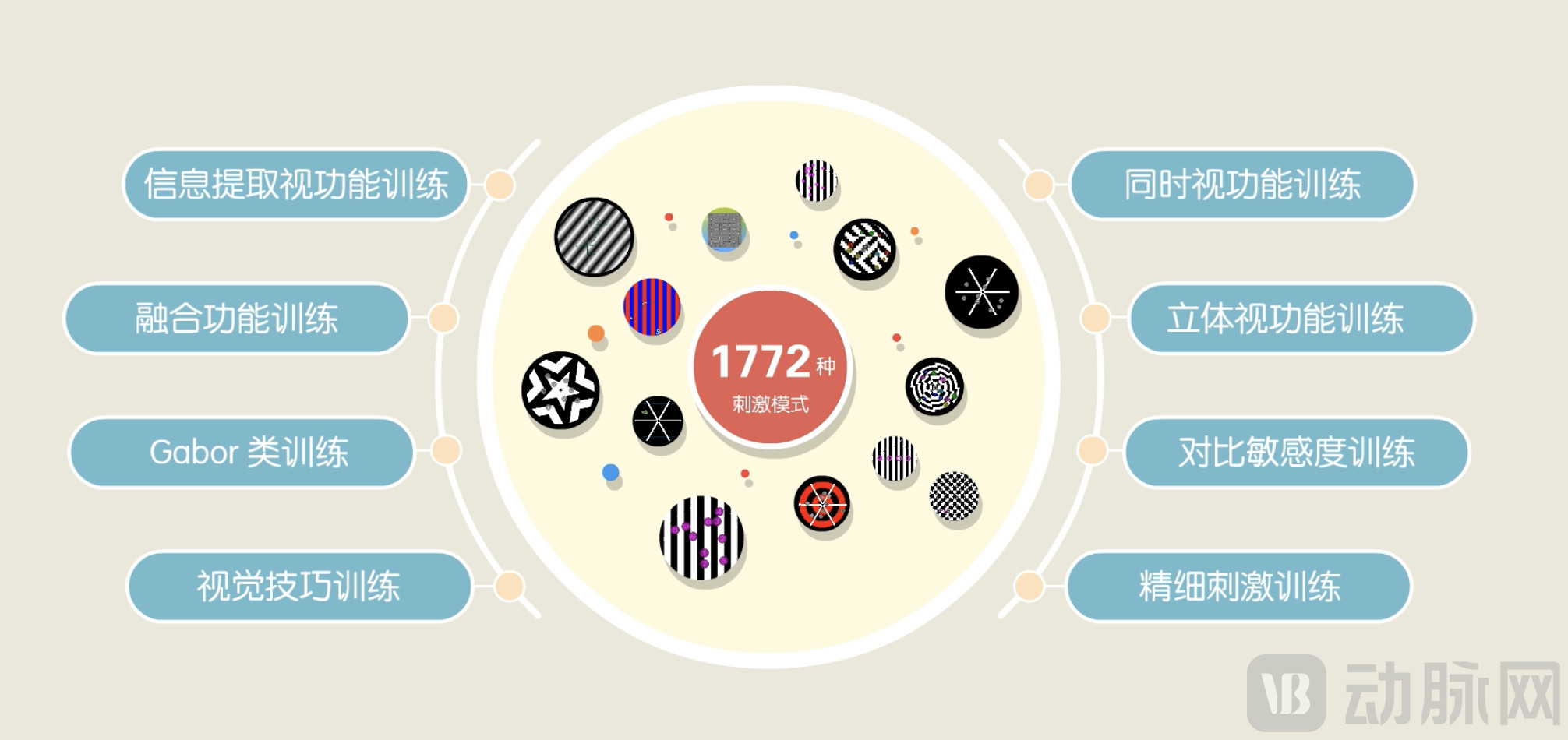
In addition, DOBOSO has also adopted “Full Screen” product R&D strategy, developing Duobaoshi into a diverse portfolio of models and specifications, including CD-ROM, USB drive, network-based, web-based, mobile, polarized light pre-installed, mobile pre-installed, and VR versions, with the commitment to ensuring that all patients in need have access to Duobaoshi products.

With the development of digital healthcare technology, DOBOSO products can also achieveWhole-Course Disease Management, integrating patient training management, electronic medical record management, and performance management for healthcare professionals in amblyopia programs, thereby helping to improve the work efficiency of healthcare professionals.
Statistical data indicate that traditional amblyopia treatments, such as occlusion therapy, penalization training, and devices like grating stimulators and infrared therapies, have an efficacy rate of 50%-70%. Their application is primarily confined to clinical settings, with significant room for improvement in patient compliance, engagement, and treatment duration.
DOBOSO has expanded into home-based scenarios by leveraging its expertise in visual training software development, making treatment more engaging and part of daily routines, shortening the treatment cycle to 12–18 months, and enabling home-based therapy and remote follow-up through diverse sales models.
From 2009 to 2019, DOBOSO conducted clinical collaborations with multiple hospitals in China, including the Ophthalmology Center of Peking University First Hospital, the Department of Ophthalmology at Peking University Third Hospital, Beijing Friendship Hospital affiliated with Capital Medical University, and Fuzhou Southeast Eye Hospital. Clinical trial data demonstrated that the Duobaoshi Visual Function Training Treatment Software was effective for treating amblyopia in children, improving binocular visual function, and facilitating postoperative visual functional recovery in strabismus patients.The overall response rate can reach 88%.。
In addition to ensuring product efficacy, DOBOSO has long been strategically investing in channel development.Currently, the company has established a closed-loop ecosystem spanning both in-hospital and out-of-hospital settings, achieving interconnectivity among “hospitals–ophthalmology departments–patients–optometry centers” to meet patients’ diverse treatment needs. This framework supports resource coordination and patient referral across healthcare institutions at various levels, ensuring the continuity and coherence of treatment plans.
Currently, all versions of DOBOSO’s commercially available products have obtained Class II medical device certifications. With a nationwide penetration rate exceeding 85%, its solutions cover 30 provincial-level regions and more than 2,000 partner hospitals, including mainstream public general hospitals, specialized ophthalmic hospitals, and pediatric specialty hospitals. Having served over 200,000 patients to date, DOBOSO holds a leading market share that continues to expand.
Strabismus and amblyopia are functional eye disorders without organic pathology, with their pathogenesis primarily rooted in the brain. However, given the current limited understanding of the human brain, there remains significant room for advancement in both the treatment and research of these conditions.
By examining the product features of DOBOSO, it becomes evident that digital therapeutics in the field of amblyopia not only facilitate patient management but also offer direct effects, rapid efficacy, and high cure rates. Furthermore, they enable the collection of real-world data from patients, which benefits the development of therapeutic products and even foundational disease research. Empowering ophthalmology with digital therapeutics is a promising direction worthy of attention, with significant future prospects.
When discussing the company's future plans, Zhou Mosheng also stated: “First, we will continue to focus on the development of products for strabismus and amblyopia, aiming to fully leverage big data and AI technologies to provide more personalized treatment plans for patients, thereby further shortening treatment duration and reducing out-of-pocket expenses for families. Additionally, we aim to offer visual training methods based on VR and AR technologies that are more interactive and engaging, in order to improve patient adherence and enhance treatment outcomes.”
“Meanwhile, academically, we also hope to facilitate the development of clinical practice guidelines and expert consensus in the industry, thereby promoting the growth of digital therapeutics in ophthalmology. Building on our success in addressing strabismus and amblyopia, we will leverage our strengths to explore new clinical indications for digital therapeutics,” added Zhou Mosheng.
It is understood that DOBOSO’s vision training products have obtained EU CE certification. DOBOSO will sequentially submit certification applications to the U.S. FDA and Japan’s PMDA, further expanding its international market presence. The company is currently preparing for a new round of financing, aiming to advance product research and development, academic research, brand promotion and operations, as well as channel maintenance and expansion.