

Sniper Medical Secures Nearly RMB 200 Million in Series B Funding, Pioneering the Era of Fully Automated Digital PCR
VCBeat has learned that Sinaford Medical Technology recently announced the completion of its Series B financing round, raising nearly RMB 200 million. The round was led by Huimei Capital, with participation from Xingze Capital and Huangpu Pharmaceutical Fund. Existing investors Kaifeng Venture Capital, Yahui Investment, and Hetang Capital also increased their stakes, setting a new record for the largest single financing transaction in this sector.
As a leading enterprise in the digital PCR sector, Sinaford launched China’s first fully automated digital PCR instrument in the first half of 2020, nearly simultaneously with industry giants Qiagen and Bio-Rad, thereby achieving a breakthrough from zero for China in the high-end fully automated digital PCR tier. Benefiting from its fully independent manufacturing capabilities and outstanding product technological advantages, Sinaford has cumulatively installed nearly 100 units. In the high-end fully automated digital PCR tier, its domestic market installation volume has far surpassed that of competitors, ranking first.

The principle of digital PCR (dPCR) was proposed by scholars as early as 1988, even preceding real-time quantitative PCR (qPCR). However, limited by the technological capabilities of the time, which made it difficult to perform massive sample partitioning, the technology remained dormant for nearly two decades. Meanwhile, qPCR technology flourished and gradually became the mainstream solution for nucleic acid detection. With advancements in microfluidics and microfabrication technologies, two major technical pathways—microfluidics and microchambers—emerged, enabling stable sample partitioning. Consequently, digital PCR technology has progressively moved toward industrialization.
In fact, the industrialization trajectory of digital PCR (dPCR) technology has closely mirrored that of quantitative PCR (qPCR). A review of qPCR development reveals four distinct stages: Stage 1, the “multi-tool manual assembly phase,” characterized by purely manual operations and focused primarily on proof-of-concept; Stage 2, the “separate amplification and detection phase,” utilizing thermal cyclers combined with gel electrophoresis equipment, mainly dedicated to early-stage clinical scenario development; Stage 3, the “integrated amplification and detection phase,” employing real-time quantitative PCR instruments (such as the ABI 7500), primarily aimed at clinical implementation; and Stage 4, the “assembly-line phase,” featuring fully automated sample pre-processing integration (such as the Cobas 8800), enabling large-scale deployment.
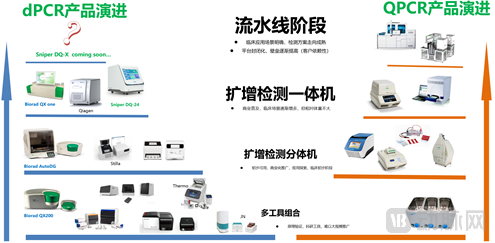
Industrialization Development Stage of PCR Technology (Source: Provided by Interviewees)
For a long period after its introduction, digital PCR (dPCR) products remained in a “multi-instrument combination” stage that required extensive manual operation, hindering significant breakthroughs in the promotion and clinical adoption of dPCR technology. Specifically, the three steps—sample partitioning, amplification, and detection—required coordination among three separate instruments and involved complex manual procedures, necessitating continuous user attendance throughout the nearly five-hour testing process. Compared with the mature quantitative PCR (qPCR) technology, the cumbersome manual operations and high cost of microfluidic consumables associated with dPCR have repeatedly impeded its market adoption. The market has even questioned where the future application scenarios for dPCR technology truly lie, and which applications could possibly tolerate such an unfriendly product format.
However, it is necessary to distinguish between “product form” and “technology platform,” as one cannot simply use the “product form” of a historical period to define the future of a “technology platform.” This is akin to the early days of computing, when computers occupied several rooms; this did not mean that “computer technology” could only be applied to scientific research computing. As digital PCR products enter a relatively mature “integrated” stage, complex manual operations will no longer be required, and the user experience will become largely consistent with that of qPCR. At that point, the technical advantages of single-molecule detection sensitivity and absolute quantification will be fully realized, and the application scenarios for digital PCR will gradually become clear.
As a representative of the microfluidics technology pathway, Bio-Rad launched the QX100 in 2009, marking the entry of the digital PCR (dPCR) industry into the proof-of-principle stage. In 2014, Bio-Rad introduced the Auto DG and obtained the first FDA clearance for dPCR, propelling the industry into the early stage of clinical scenario development. In 2020, with the market launch of Bio-Rad’s QX One, China’s dPCR industry entered the era of integrated amplification-and-detection systems. Over more than a decade, Bio-Rad advanced the product form of dPCR to a stage comparable to that of the classic qPCR instrument, the ABI 7500. Furthermore, in 2020, Qiagen launched its fully automated dPCR system, QIAcuity, through acquisition; this system represents the highest level of microwell chamber technology and leapfrogged directly to the third stage. Consequently, dPCR products from international giants have entered the “all-in-one” era, ushering in new prospects for dPCR development and providing the necessary product support for its clinical implementation.
China began exploring the industrialization of digital PCR technology around 2014, but most efforts have remained at the level of Bio-Rad’s QX100 or Thermo Fisher’s QuantStudio 3D systems. In terms of product generation gaps, domestic technological capabilities lag behind the global state-of-the-art by nearly a decade. Furthermore, digital PCR technology presents extremely high technical barriers. Overseas manufacturers, leveraging more than ten years of technological accumulation, have filed a vast number of patents and established comprehensive patent portfolios. This creates significant obstacles for latecomers, who face extensive patent restrictions along their technological development paths.
In 2014, the Sinaford team embarked on the development of a droplet generation method independent of microfluidic chips—the “Vibrational Injection” technology—and applied it to digital PCR (dPCR) for technological translation. Through continuous efforts, Sinaford launched its fully automated dPCR product, the Sniper DQ24, in 2020, pioneering a novel “Vibrational Injection” technical route. As the first domestically produced integrated dPCR instrument and the third such product globally to reach the market, it has elevated China’s dPCR technology to a world-leading level. With the three major platforms—microfluidics, microwells, and vibrational injection—all launching integrated dPCR systems in 2020, dPCR technology has officially entered its third phase, characterized by “integrated amplification and detection systems,” thereby becoming truly viable for clinical implementation.
It is understood that Sinaford has completed the construction of a 2,500-square-meter instrument R&D laboratory, a 3,200-square-meter equipment manufacturing workshop, and a 1,900-square-meter GMP-certified reagent production facility. The company has established a full industry chain spanning from the processing and manufacturing of core underlying components to complete system assembly, and from precision injection molding of consumables to the production of IVD testing reagents. This round of financing will be utilized for clinical scenario development and market expansion by Sinaford, accelerating the clinical implementation of its digital PCR products.
Huimei Capital is a specialized fund focused on healthcare investment. Leveraging the ecosystem advantages of Huimei Medical Group, it invests in the healthcare ecosystem through multi-dimensional and comprehensive approaches, striving to build a professional investment platform with international vision and local execution capabilities. It helps early-stage and growth-stage healthcare companies achieve rapid development, having already invested in companies such as Nanomicro Technology, NuoSige, MicroPort MedBot, Pricer, GemPharmatech, Bio-Logistics, and GenFleet Therapeutics.
Founded in 2015, Xingze Capital’s management team comprises more than 20 professionals and advisors with extensive investment experience in the healthcare sector, possessing expertise in life sciences, pharmaceuticals, finance, and law. Since its inception, Xingze Capital has focused on investing in high-quality early-stage and growth-stage enterprises in the healthcare industry, with its portfolio spanning biopharmaceuticals, life sciences, medical devices, healthcare services, and diagnostics.
Its portfolio includes a large number of star companies such as Junshi Biosciences, China Antibody, Ambrx, HeartTone Medical, Sinocelltech, ImmuneOnco, PhenixHealth, BioTrans Logistics, and PharmaCube, with investment returns ranking among the leading positions in China’s venture capital industry.
Huangpu Biopharmaceutical Industry Investment Fund Management Co., Ltd. is a professional private equity investment firm, with its primary sponsors being Guangzhou Development District Holding Group, Leading Capital, BeiGene, and SDIC Venture Capital. Leveraging BeiGene’s R&D strengths in biologics, the industrial resources of Guangzhou Development District, and Leading Capital’s expertise in capital operations, Huangpu Biopharmaceutical Industry Investment initiated and established the Kaide Phase I Biopharmaceutical Fund. The fund systematically invests in areas such as biologics, in vitro diagnostics (IVD), and innovative medical devices, aiming to build a top-tier specialized healthcare investment fund in China.