

Huawei Makes a Grand Debut at CIC, Showcasing How Tech Giants Empower Pharmaceutical Enterprises on Their Digital Transformation Journey
For the many players in the pharmaceutical and healthcare industry, digital transformation is no longer just a buzzword but has become an urgent strategic imperative.
Since 2015, healthcare reform has entered a critical phase, marked by the intensive rollout of various pharmaceutical industry policies. Meanwhile, digital technologies represented by big data, AI, cloud computing, IoT, and 5G have been accelerating their penetration into the pharmaceutical sector, driving the entire industry into a new landscape through their ongoing integration.
Currently, the entire pharmaceutical industry chain is primarily divided into two major sectors: pharmaceutical manufacturing and pharmaceutical distribution. Pharmaceutical manufacturing encompasses raw material supply, research and development (R&D), and production; whereas pharmaceutical distribution includes pharmaceutical commerce, marketing, and services.
From the perspective of internal industry drivers, although the pharmaceutical industry’s supply chain has gradually matured, issues across various segments have also emerged. In particular, following the implementation of a series of policy measures such as the Two-Invoice System, healthcare reforms, and centralized volume-based procurement, traditional models like “funding healthcare through drug sales” and the role of pharmaceutical representatives have been disrupted. Market factors, including price and cost pressures, are compelling the pharmaceutical industry to undertake self-assessment and restructuring.
According to the "Quarterly Journal of Digital Innovation in Healthcare: Framework for Digital Transformation in the Pharmaceutical Industry" released by VCBeat, we can gain a general understanding of the key issues that need to be addressed across various segments of the pharmaceutical industry.
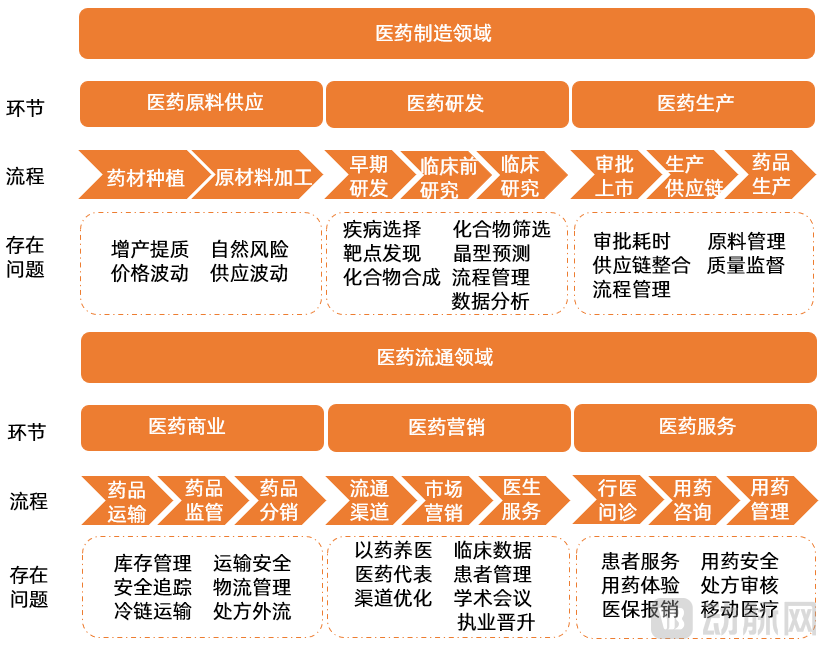
Key Issues to Be Addressed Across All Segments of the Pharmaceutical Industry, Chart by VCBeat
From an external perspective, the active adoption of digital technologies by pharmaceutical companies is driven by policy support, technological advancements, and market expansion.
Policy Tailwinds:
Since 2015, the pharmaceutical industry has become one of the key sectors under national policy focus, with a series of healthcare reform policies bringing unprecedented challenges to the pharmaceutical industry chain.
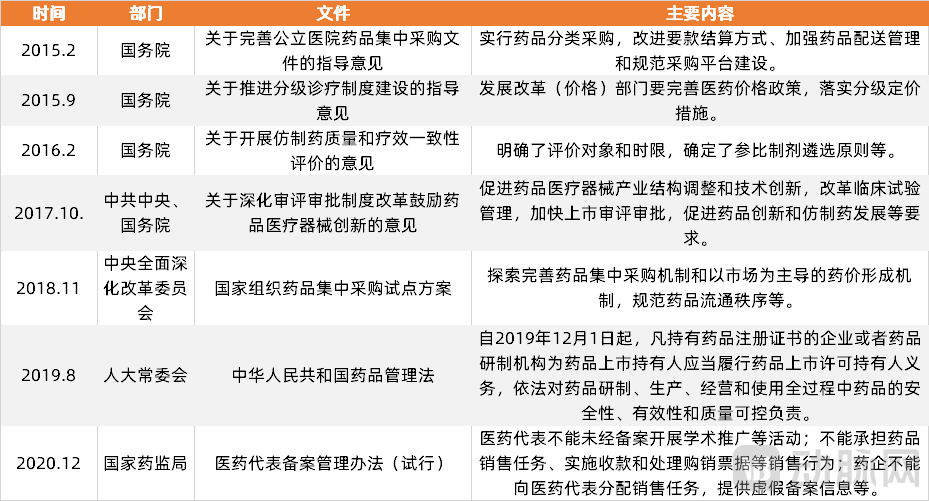
Relevant Policies in the Pharmaceutical and Healthcare Sector
On the one hand, the government has intensified its support for digital healthcare development by improving the population health information service system and promoting the application of big data in health and medical care. On the other hand, with the establishment of the National Healthcare Security Administration and the introduction of a series of policies—including the “Two-Invoice System,” the consistency evaluation of generic drugs, and the “4+7” volume-based procurement program—cost containment and price reduction have become the central themes of pharmaceutical reform. These developments are driving pharmaceutical companies to adopt digital technologies to enhance efficiency and reduce costs.
Technology-driven:
In recent years, a wave of digital technologies, represented by artificial intelligence (AI) and big data, has been rapidly gaining momentum. Within this trend, the power of technological innovation is increasingly valued and continues to permeate high-value sectors such as healthcare and wellness. Leveraging their existing technological infrastructure, tech giants have also incorporated the health and wellness industry into their business portfolios.
Take Huawei as an example. As a global technology giant, Huawei has long established a comprehensive presence in the healthcare sector and proposed its “Platform + Ecosystem” strategy. Huawei’s extensive internet business lines can ensure partners have ample access to consumer-side (C-end) information sources; its self-developed cloud platform provides enterprises with high-quality database services and application development support; while its mature “Platform + Ecosystem” model empowers enterprises with resource incubation and automation capabilities.
Huawei Cloud’s EIHealth is a full-stack, open, and professional AI R&D platform for the pharmaceutical industry. Leveraging Huawei Cloud’s advantages in AI and big data technologies, it provides specialized AI R&D platforms for three key areas: genomic analysis, drug discovery and development, and clinical research. Currently, Huawei Cloud is actively cultivating its ecosystem, boasting over 20,000 partners, more than 4,500 applications on its cloud marketplace, and a developer community of over 1.8 million. Looking ahead, Huawei Cloud will continue to collaborate with partners to co-create, share, and achieve mutual success, accelerating the intelligent transformation of the pharmaceutical industry.
Market Expansion:
Amid the wave of digitalization, continuous support from policies and capital is attracting a growing number of innovative enterprises to seize emerging opportunities, thereby bringing greater imagination and possibilities to the unfolding new landscape of digital transformation in pharmaceutical companies. According to forecasts by the international analytics firm Forrester, the global pharmaceutical market size was estimated at RMB 9 trillion in 2020, with a projected compound annual growth rate (CAGR) of 4.3% through 2024. Of this, China’s pharmaceutical market size was estimated at RMB 1.7 trillion, accounting for approximately 19.1% of the global total. China’s pharmaceutical market is expected to achieve a CAGR of 6.8% by 2024, outpacing the global growth rate.It is projected that by 2024, China's pharmaceutical market will account for 20.9% of the global pharmaceutical market size.
Moreover, the COVID-19 pandemic has brought about a series of impacts, such as changes in residents’ social awareness and healthcare-seeking behaviors, restrictions on offline production activities, and impaired corporate productivity. Pharmaceutical companies of all types have also gained a deeper understanding of the importance of digital transformation for the future of the pharmaceutical industry.
The expansion of market space is driven by the joint efforts of policy, technology, and industry stakeholders. As the level of digitalization in the pharmaceutical sector continues to rise, pharmaceutical companies will increasingly embrace digital transformation, while digital technologies will provide deeper reciprocal benefits to the industry.
Anticipating that the application of digitalization would drive higher-speed growth in the pharmaceutical industry, both pharmaceutical companies and technology firms have entered the arena in recent years, pursuing digital application practices and their commercialization from various perspectives.
Since the advent of the world’s first central processing unit, the 8086, in Silicon Valley, USA, in 1971, we have now entered the fifth wave of technological transformation. Looking back at the development of the global healthcare industry, each key milestone has been closely tied to major technological advancements.
However, transformation often entails significant risks. Every stage of the process, from technical validation to market launch, serves as a test for those entering the field. Thus, we find that behind breakthroughs in the pharmaceutical and broader healthcare industries lies an indispensable regional ecosystem characterized by industrial cluster advantages and deep collaborative synergy.
Consequently, many regions have begun to allocate resources to attract and support the steady growth of pharmaceutical companies by hosting events such as summits. Amidst this wave of driving innovative development, the industry standing of the Xipu Conference is evident.
CHEO, short for China Health Industry (International) Ecological Conference, is hosted by Zhongkang Technology and stands as one of the most prestigious, large-scale, and influential forward-looking industry conferences in China’s health sector.
As a prestigious industry ecosystem conference, the Westlake Pharmaceutical Conference (Xipu Hui) has always been committed to “leading industrial innovation and integration.” Guided by this principle, it has successfully held thirteen sessions, attracting over 50,000 representatives from various sectors of the health industry. The event brings together Fortune Global 500 companies, multinational corporations, listed enterprises, and numerous innovative unicorn companies. It is also one of the must-attend annual events for more than 1,200 mainstream enterprises and institutions in fields such as pharmaceutical R&D, capital investment, clinical expertise, medical services, and finance and insurance.
In fact, Xipu Hui is not merely a connector of resources. As a leader in the medical and health industry, Xipu Hui aims to convey much more through its “Efficiency Revolution.” Thus, we can see that Xipu Hui is continuously strengthening its deep integration with the entire industry chain by collaborating with key industry stakeholders.
At the Health Industry Ecosystem Conference held on the afternoon of the 24th, Li Hao, Executive Deputy General Manager of the Commercial Big Data Division of Sinopharm Technology, the organizer of the Westphal Conference, officially released "Sinopharm Cloud," a digital and intelligent solution for the life sciences sector.
Zhongkang Cloud integrates data resources across the entire health industry chain, comprising a Smart Decision-Making Cloud for pharmaceutical companies, a Smart Retail Cloud for retail enterprises, a Smart Healthcare Cloud for medical institutions, and a Health Management Cloud for third-party organizations. At the technical level, Zhongkang Cloud combines in-depth exploration of AI-driven medical applications with cloud-based technologies, leveraging Huawei Cloud’s EI HEALTH medical AI agents and its underlying cloud infrastructure platform services.
It is understood that Zhongkang Technology will integrate its “Zhongkang Cloud” with industry platforms centered on the “Xipu Conference,” “Xiding Conference,” and “Meisi Conference” to deliver three core business offerings: data insight solutions, SaaS cloud platforms, and data-driven publishing and events.
It was also at this conference that Zhongkang Technology and Huawei Cloud reached a comprehensive strategic partnership to jointly build an empowerment platform for the pharmaceutical and healthcare industry, aiming to gather industry ecosystem resources and accelerate digital transformation in the sector.
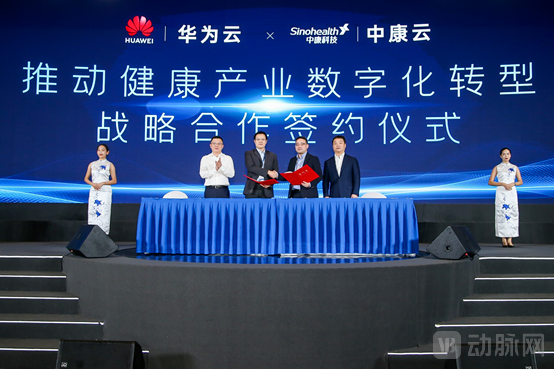
At the Health Industry Ecosystem Conference held on the afternoon of the 24th,Huawei Cloud and Sinopharm Sign Strategic Cooperation Agreement to Jointly Build a Pharmaceutical and Healthcare Empowerment Platform, Co-creating an aPAaaS Solution for the Pharmaceutical Industry. Huawei Cloud CEO Zhang Ping'an Attended as a Witnessing Guest, while Huawei Cloud Vice President Kang Ning Signed the Agreement.
Collaboration Deepens Value—Only two parties with inherent complementary strengths can achieve a “1+1>2” outcome through cooperation. Through this partnership, both sides will integrate Huawei Cloud’s leading platform and technological advantages with SinoHealth’s pharmaceutical data and ecosystem strengths to build an empowering platform that naturally connects the entire industry chain, ensuring security, stability, sustained leadership, and an open ecosystem. This will aggregate retail and pharmaceutical enterprise customers as well as industry solution partners within the sector, accelerating the digital transformation of the pharmaceutical industry.
Within this empowerment platform, Sinocom Technology has opened up its master data capabilities and industry-specific intelligent algorithms for the pharmaceutical sector, Huawei Cloud has contributed its AI-driven drug discovery platform, and Huawei Terminal Cloud has provided HMS Core, the essential component suite for applications. Other ecosystem partners can also share their respective capabilities on the platform, leveraging this industry empowerment infrastructure to develop more new scenarios and high-value industry applications.
Kang Ning, Vice President of Huawei Cloud, stated in his keynote address that to support the implementation of China’s national Healthy China strategy and ensure better health protection for everyone, it is essential to integrate innovative technologies into the industry ecosystem. Zhongkang Technology exerts strong influence through its comprehensive healthcare data and ecosystem connectivity, and its strategy of building an industry empowerment platform aligns with Huawei Cloud’s strategic direction of collaborating with partners to create industry momentum platforms. “Therefore, our partnership with Zhongkang was only a matter of time.”
For Huawei Cloud, Zhongkang Technology’s deep understanding of the pharmaceutical and broader healthcare industry, along with its access to top-tier pharmaceutical companies in Guangdong and across China—such as Guangzhou Pharmaceutical Holdings and BeiGene—can further expand Huawei Cloud’s “pharmaceutical industry partner ecosystem.” For Zhongkang Technology, migrating its entire business operations to the cloud is expected to unlock an annual business volume potential of approximately RMB 5–10 million.
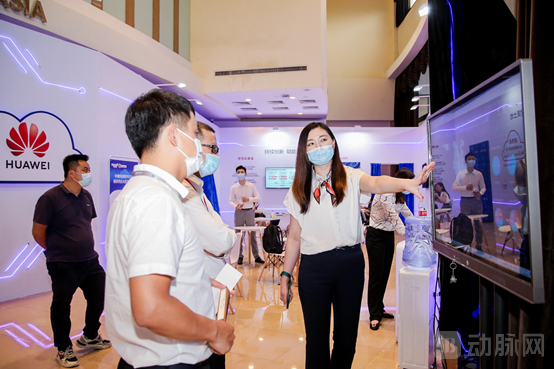
At this Xipu Conference, Huawei Cloud also set up a 200-square-meter interactive experience zone, divided into sections for Huawei Cloud, Zhongkang Cloud, and a jointly built area, to showcase the application results it has developed in deep collaboration with Zhongkang Technology in the medical and health sector.
Whether it is the enthusiasm of tech giants for “AI + drug discovery,” the digital transformation of pharmaceutical companies currently in the spotlight, or the increasing complexity of business models driven by stricter regulatory oversight, all these phenomena indicate that the pharmaceutical industry is ushering in a “wave” of transformation.
In this context, building a platform that integrates resources across the upstream, midstream, and downstream segments of the industry chain represents a highly strategic move. The collaboration between Huawei Cloud and Zhongkang Cloud sends a clear signal to the industry: win-win outcomes are achieved through cooperation. With the joint efforts of both parties, the industrial ecosystem is expected to undergo further upgrades, enabling patients to access higher-quality medical resources and services.
Overall, the pharmaceutical industry, as a fertile ground, carries the multifaceted expectations of the government, the industry, and society. It may face more unknown changes in the coming years, while also holding the promise of yielding greater achievements. It remains to be seen what new initiatives tech companies such as Huawei Cloud and Zhongkang Technology will launch in the pharmaceutical sector, a development worthy of our anticipation.