

Suzhou Singlera Genomics Achieves Breakthrough with 10-Minute On-Site Nucleic Acid Testing Technology
Since the outbreak of the global COVID-19 pandemic, nucleic acid testing, originally confined to specialized laboratories, has gradually become widely recognized by the general public. Meanwhile, the urgent need for rapid on-site testing to control the pandemic has driven global diagnostic companies to accelerate technological innovation.
For example, Cue Health in the United States has successfully developed compact and convenient nucleic acid testing devices that do not require a laboratory environment or specialized operators. The test can be completed in approximately 20–30 minutes, enabling at-home testing for SARS-CoV-2. With advancements in technology,Molecular diagnostic tests, such as microbial detection and early cancer screening, have become feasible in home settings.
Recently, VCBeat has observed that domestic companies have long been making strategic moves in the fields of rapid nucleic acid testing and home-based diagnostics. The simplicity and portability of point-of-care testing (POCT) instruments have made home nucleic acid testing feasible.
This is from an innovative Chinese enterprise—Suzhou Xianda Gene Technology Co., Ltd. (hereinafter referred to as “Xianda Gene”), which relies on its independently developedNew Era Nucleic Acid Detection Technology (New ERA), supporting facilitiesMicro Fluorescence Detector(Gene Mirror, GENEYE®), creating a“10-Minute Integrated Nucleic Acid Testing Solution”, requiring no complex sample processing and featuring simple operation. It holds promise for widespread use in pathogen detection scenarios such as hospital bedside testing, primary care clinics, field settings, schools, airports, and households, and may even be applied to early screening for conditions like cancer and Alzheimer’s disease.
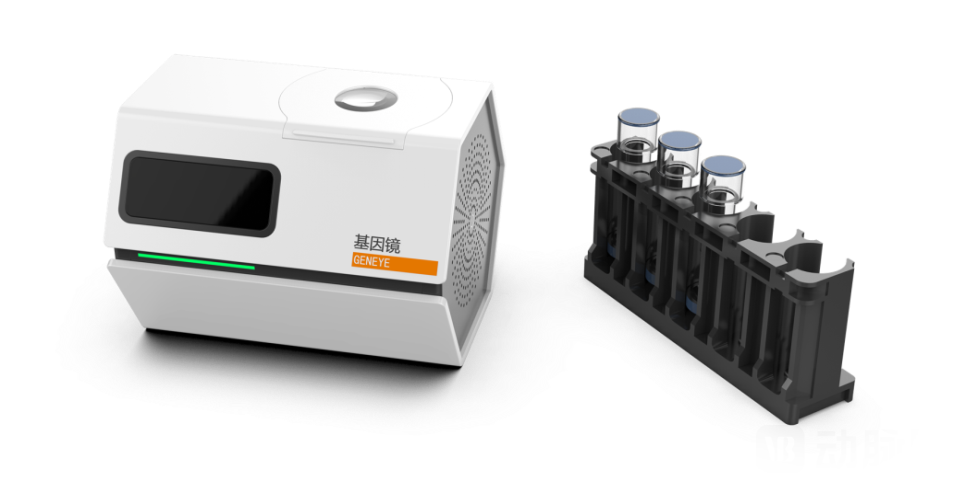
New ERA Technology Products and GENEYE®
Due to its excellent sensitivity and specificity, PCR technology is considered the ideal method for detecting pathogenic microorganisms at present. However, PCR technology requires sophisticated and expensive equipment, professional technicians, and has high requirements for laboratory environments and sample processing. The detection time can take up to two hours or even longer, making it difficult to meet the demand for rapid testing.
In recent years, the demand for rapid, precise, and convenient nucleic acid testing has become an urgent need in the industry.
Yu Jibin, CEO of Xian Da Gene, has over 20 years of experience in PCR amplification technology and genetic engineering. With profound technical and managerial expertise, he possesses a keen perception of the industry’s pain points and development trends.
During his graduate studies, Yu Jibin began experimenting with PCR-based gene synthesis. As early as 2002, while employed in the industry, he pioneered the establishment of an industrialized gene synthesis process based on PCR amplification in China. In 2005, he joined Nanjing GenScript as Vice President, overseeing production and R&D operations and becoming a key member of the company’s core management team. He led multiple business segments, including gene synthesis, protein engineering, antibody engineering, new drug screening, primer synthesis, and gene sequencing. During his ten-year tenure as a senior executive at GenScript, the company grew from a startup into the world’s largest PCR laboratory base and gene synthesis center.
He believes that,Underlying technological innovation is the key for enterprises to build differentiated competitiveness.
In 2017, Yu Jibin seized the emerging opportunities in the POCT industry to found XianDa Gene, with the aim of innovating rapid nucleic acid detection technologies. He assembled a core management team comprising molecular biology experts with extensive industrial management experience, enzymatic process specialists for molecular diagnostics, biopharmaceutical engineering experts, and medical device marketing professionals.
By leveraging advanced pharmaceutical technologies such as computer-aided molecular design, directed evolution, and affinity maturation, Xianda Gene has conducted multiple rounds of engineering and screening to optimize polymerases, endonucleases, and single-strand binding proteins essential for PCR and the autonomous amplification and replication of genetic material in organisms.New-generation isothermal amplification (New ERA) technology can amplify DNA/RNA by hundreds of millions of times within 5–8 minutes under constant temperature conditions. Combined with a unique self-circularizing structure of primers and probes, the entire detection process can be completed in approximately 10 minutes. Its sensitivity and specificity are comparable to those of conventional quantitative fluorescent PCR.
Meanwhile, the Xian Da Gene team also designedUltra-Large Detection Reaction Volume, although costs have increased,It offers significant advantages in terms of user operational convenience while also accommodating a larger number of samples.This is also one of the key factors enabling the simplification of the detection device. With a user-centric approach, ensuring a simple and smooth customer experience is the fundamental logic behind Xianda Gene’s product design.
Currently, the company has filed 19 patent applications, several of which have been granted, and it has three global PCT patent applications.
Yu Jibin has been honored with the titles of “Dongwu Sci-Tech Entrepreneurial Leading Talent” in Suzhou and “Gusu Innovation and Entrepreneurship Leading Talent.” The enterprise was selected for the “Gusu Sci-Tech Entrepreneurship Angel Plan” in 2018. In 2019, the company was recognized as a National Technology-Based Small and Medium-sized Enterprise. In 2020, it secured a project under the “Suzhou 2020 Science and Technology Development Plan” and completed a pre-A financing round worth tens of millions of RMB in the same year. The investor was Shenzhen Langrun Investment Co., Ltd., which has made in-depth strategic investments in the biopharmaceutical sector.
When designing products, the team has consistently focused on scalable manufacturing, addressing mass production and cost control from a manufacturing perspective. This approach differs from the product development mindset of European and American companies,Xianda Genetics focuses more on practicality, scalability, and cost-effectiveness, leveraging innovations in underlying genetic engineering technologies and other approaches to robustly ensure the rapidity, convenience, and precision of its products.
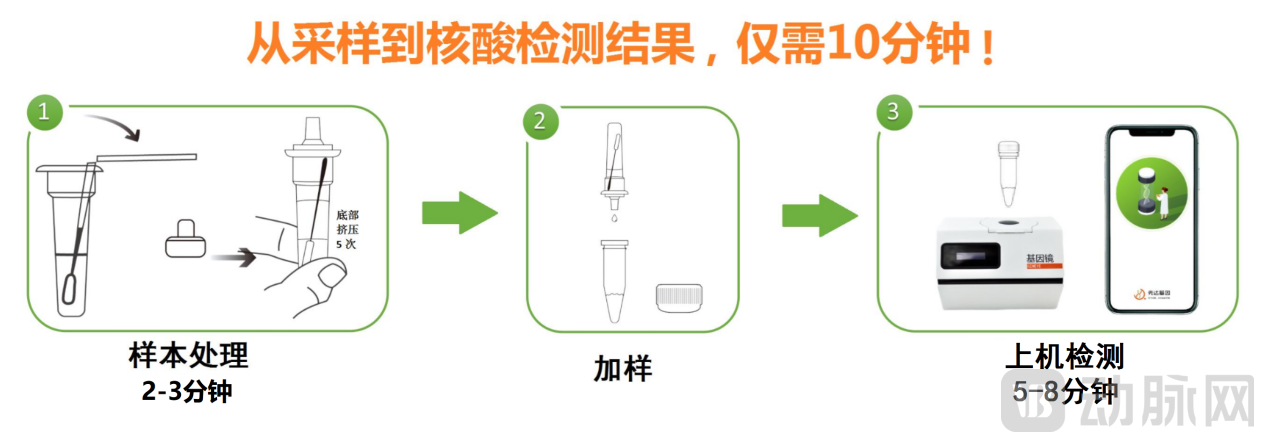
New ERA Nucleic Acid Testing Procedure
Home-based diagnosis refers to a model in which users can perform a series of procedures—including sample collection, testing, and report interpretation—at home without visiting healthcare facilities. This approach meets users’ needs for convenient, rapid, and private testing while conserving hospital medical resources.
Currently, common home-based diagnostic tests include blood glucose monitoring and early pregnancy detection. Home diagnostics have also demonstrated significant application value and broad development prospects in molecular diagnostic areas such as infectious disease testing and early cancer screening.
The global home diagnostics industry is experiencing rapid development. During the COVID-19 pandemic, the necessity of home-based testing gained widespread public recognition. Recently, the United States has successively approved multiple home-use COVID-19 testing products, further driving the growth of the home diagnostics sector.
For home-based diagnostic scenarios, in addition to the New ERA platform and its配套 mini fluorescence detector, Xianda Gene is actively exploring the commercial application of the Internet of Everything (IoE) in diagnostic science. The company has developed a companion “Gene Mirror” app to enable users to receive and store test results on their mobile phones.
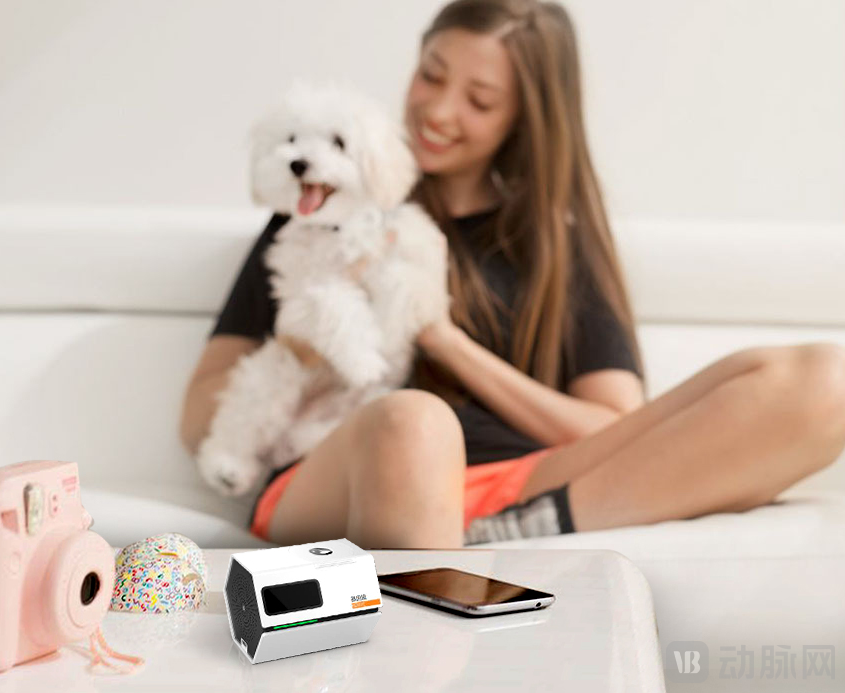
GENEYE® Micro Fluorescence Detector for Home Use
Envision a future scenario: upon waking in the morning, if users experience mild cold-like symptoms, they can use GENEYE® for testing. If the result indicates influenza A, the app will recommend nearby pharmacies or healthcare institutions for medication purchase and treatment.
Yu Jibin also stated, “For home diagnostic products, there is still a long way to go before they are truly implemented for home use, butIt is believed that with advancements in testing technologies, more high-quality home diagnostic products will emerge, driving rapid growth in the home diagnostics market and establishing it as an emerging trend in the field of in vitro diagnostics.”
The amplification reagents developed by the company have established scientific research collaborations with over a thousand domestic universities, research institutes, and diagnostic companies. Relevant diagnostic products are currently undergoing registration for National Medical Device Certification and CE marking to meet the diagnostic needs of healthcare institutions. Meanwhile, the company will continue to inject innovative strength into the industry with an open and win-win attitude, jointly promoting the vigorous development of the diagnostics sector!