

Hemodialysis Access Intervention Emerges as a High-Growth Frontier: Medtronic, BD, and Genetron Health Vie for a Share of China’s 700,000-Patient Market
Vascular interventional devices have consistently been the most dynamic segment of the medical device industry. Historically, coronary stents were the flagship product in this sector, with a market size exceeding RMB 10 billion. Following the implementation of centralized procurement for coronary stents, gross profit margins for manufacturers of high-value consumables have declined. As a result, more high-potential niche markets within China are being explored and developed.
What is the next high-growth niche market in the vascular interventional industry that cannot be missed? From the perspective of global medical device companies’ strategic layouts,The Hemodialysis Access Market in the Peripheral Vascular Sector May Be One of the Answers。
In September 2017, the peripheral drug-coated balloon Lutonix, from BARD (a nephrology giant acquired by BD), was approved by the U.S. FDA for the indication of “arteriovenous fistula stenosis,” marking the dawn of the drug-coated balloon era in interventional hemodialysis access management.
In July 2019, Medtronic’s In.Pact AV also received FDA approval for market launch, further solidifying the immense potential of drug-coated balloons in this field.According to Medtronic’s fiscal year 2021 annual report, drug-coated balloons for treating venous access stenosis in hemodialysis patients within the peripheral intervention segment became the primary growth driver for Medtronic in the second quarter of fiscal year 2020.
In the domestic market, there are already commercialized drug-coated balloon products for hemodialysis access. In 2020, Grand Pharma’s paclitaxel-eluting high-pressure shunt balloon dilation catheter, designed to address vascular access stenosis in hemodialysis patients, was approved for marketing in China, becoming the country’s first drug-coated balloon specifically indicated for hemodialysis access. This product was jointly developed by Grand Pharma and Cardionovum, which it acquired in 2015.
Hemodialysis access is not a well-known segment within vascular interventions, but with 700,000 hemodialysis patients in China, it has become a lucrative hotspot for vascular intervention investments. In the coming years, multiple drug-coated balloon products for hemodialysis access are expected to launch in the domestic market. What is hemodialysis access? Why has it become a goldmine for vascular interventions? Which companies in the Chinese market can capture a share of this sector? To address these questions, VCBeat (WeChat ID: vcbeat) conducted an analysis of this field.
Over 10% of China’s population suffers from chronic kidney disease (CKD), and patients who progress to end-stage renal disease (ESRD) primarily rely on renal replacement therapy to sustain life. For most ESRD patients, the main forms of renal replacement therapy are peritoneal dialysis (PD) and hemodialysis (HD). Currently, hemodialysis is the predominant modality for ESRD patients in most countries worldwide. According to data from the Chinese National Renal Data System (CNRDS), there are 700,000 patients undergoing hemodialysis in China. With the accelerating pace of population aging, the number of patients with chronic renal insufficiency is rising, leading to a surge in the hemodialysis patient population.
In hemodialysis therapy, the creation of an arteriovenous fistula is the preferred long-term and effective treatment option for patients.Hemodialysis requires venous puncture during each treatment session. Repeated punctures can lead to venous inflammation. To avoid this complication, physicians intentionally create an arteriovenous fistula (AVF), typically using adjacent arteries and veins in the arm. This procedure dilates the vein, facilitating easier needle insertion and increasing blood flow velocity. The increased blood flow reduces the risk of thrombus formation.
Arteriovenous fistulas directly divert arterial blood flow into the venous system. The significantly higher arterial pressure and blood flow cause the venous vessels to dilate and thicken, gradually undergoing arteriolization. This gradual transformation of the venous vessels is termed “maturation.” Only mature autogenous arteriovenous dialysis accesses are suitable for hemodialysis; otherwise, the venous vessels would be unable to withstand the hemodynamic changes during hemodialysis, leading to dialysis failure.
Autogenous arteriovenous fistula (AVF) and prosthetic arteriovenous graft (AVG) are currently the primary methods for constructing upper-extremity hemodialysis access. Once matured, AVFs offer the longest patency and the fewest complications. Therefore, AVF is currently the preferred vascular access for permanent hemodialysis.
Arteriovenous fistulas are known as the lifeline for hemodialysis patients, and this “lifeline” requires long-term maintenance. Common complications associated with arteriovenous fistulas during use include infection, formation of aneurysms or pseudoaneurysms, venous stenosis of the fistula, ischemic neuropathy, and thrombosis. Among these, stenosis is the most common complication of arteriovenous fistulas, with an incidence rate of 14%–42% in patients with chronic diseases.
Establishing and maintaining a well-functioning hemodialysis vascular access is essential for ensuring adequate hemodialysis.In the past, clinicians focused more on the creation of arteriovenous fistulas (AVFs), whereas now, AVF maintenance has become one of their key concerns.
This shift in clinical demand has also given rise to a promising market, with the number of interventional procedures for treating arteriovenous fistula stenosis in hemodialysis patients in China increasing from 7,700 cases in 2015 to 39,100 cases in 2019.In 2020, the volume of hemodialysis access maintenance surgeries accelerated to over 70,000 cases.This market holds immense potential. According to the prospectus of Joinn Medical, the number of interventional procedures for treating arteriovenous fistula stenosis in hemodialysis patients in China is estimated to reach 994,500 cases by 2030.
This means that the number of surgical procedures for treating AVF stenosis will reach nearly one million, on par with the current volume of PCI procedures. A procedure volume in the millions indicates that the treatment of AVF stenosis will become a significant niche segment within the vascular interventional device market.
Historically, establishing and maintaining effective hemodialysis access has been a major challenge. In recent years, rapid technological advancements in the creation and maintenance of hemodialysis access, both domestically and internationally—particularly in endovascular therapy—have injected new vitality into this field.
In the rapidly expanding market for hemodialysis access, drug-coated balloons are regarded as the mainstream product of the future.
The "Expert Consensus on Vascular Access for Hemodialysis in China (2nd Edition)," published in 2019, clearly states that interventions for arteriovenous fistula (AVF) stenosis include percutaneous transluminal angioplasty (PTA) and surgical procedures. The consensus indicates that balloon catheter selection may involve high-pressure balloons, ultra-high-pressure balloons, and specialized balloon catheters (such as wire-guided balloon catheters, cutting balloons, drug-eluting balloons, and scoring balloons).
In China, balloon angioplasty is currently the preferred treatment for stenosis of hemodialysis access. Conventional balloon angioplasty involves accessing a normal upper-extremity vessel, advancing the balloon to the diseased segment, and performing adequate dilation to relieve stenosis at the arteriovenous fistula anastomosis, thereby improving immediate blood flow. However, conventional balloon angioplasty still has many limitations.First, conventional balloon angioplasty is associated with a high rate of restenosis. Moreover, during balloon dilation, partial tearing of the neointimal tissue and the tunica media occurs, predisposing patients to subsequent venous intimal hyperplasia.
How to Address the Limitations of Plain Balloons? Drug-Coated Balloons Are Considered a Superior Option, Offering Better Long-Term Patency Rates. The drug on the surface of the balloon is eluted into the vessel wall, inhibiting cell proliferation and reducing intimal hyperplasia, while also avoiding permanent stent implantation. The benefits brought by drug-coated balloons are evident: in the trial group at Longhua Hospital Affiliated to Shanghai University of Traditional Chinese Medicine, China’s first arteriovenous fistula drug-coated balloon (APERTO OTW) achieved an intervention-free patency rate of 80% at 16 months, far exceeding the control group (where the intervention-free patency rate with plain high-pressure balloons was only 18% at 16 months).
Medical device companies worldwide have been actively developing a diverse range of drug-coated balloon (DCB) products for the hemodialysis vascular access market. Various technological combinations have already been developed for products treating arteriovenous fistula (AVF) stenosis, including high-pressure drug-coated balloons and scoring drug-coated balloons. High-pressure drug-coated balloons feature the dual advantages of precise drug delivery and high-pressure dilation. Scoring balloons, on the other hand, enhance the force applied to recalcitrant lesions during dilation through scoring wires on their surface, thereby improving the success rate of expansion.
With a large patient population, rapidly expanding market, and mature technologies with commercialized products, drug-coated balloon treatment for AVF stenosis has proven to be a high-potential market.VCBeat has compiled a list of key players and major products in the global market for arteriovenous fistula (AVF) stenosis treatment. In the field of AVF stenosis related to hemodialysis access, numerous companies have entered the space, including multinational giants such as Medtronic and BD (Becton, Dickinson and Company), as well as emerging vascular interventional innovators like Zhenchuang Tongqiao.
In the domestic market, only one drug-coated balloon for hemodialysis access is currently available, indicating that the market is still in its early stages. Market volume is expected to surge as more companies launch their products in the future.
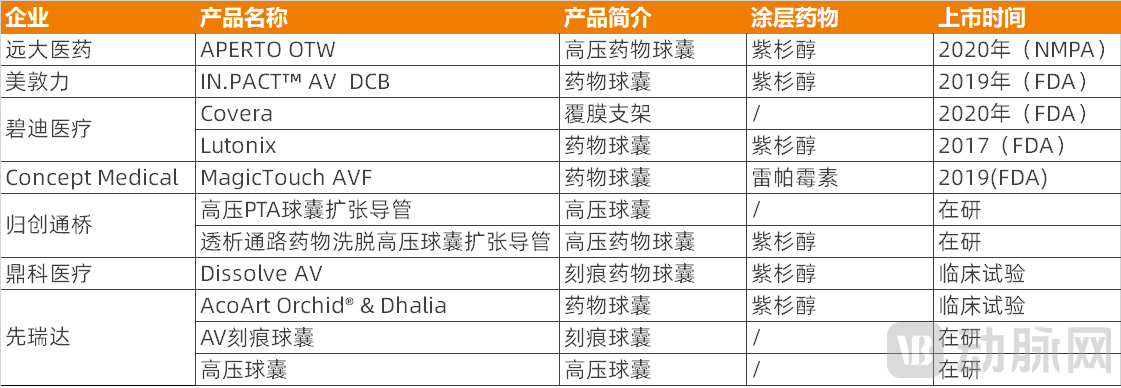
From the perspective of product characteristics, for vascular intervention companies covering multiple fields such as Medtronic and JetMed, the drug-coated balloons for hemodialysis access were developed by extending the indications of their lower-extremity drug-coated balloons.
Taking Viatron as an example, the drug-coated balloon (DCB) for hemodialysis access currently under development by Viatron is largely similar to its core product, the peripheral artery DCB. Minor improvements have been made during R&D to better suit this new indication. In addition to expanding the indications for its core products, Viatron also regards hemodialysis access as a key niche market and has optimized its products based on the specific characteristics of this indication.
Zhuangchuang Tongqiao’s drug-coated balloon for hemodialysis access features high-pressure capability. This is primarily because the pathology of stenotic lesions in arteriovenous fistulas differs from that of atherosclerosis; dense fibrosis in the stenotic venous segments or hyperplastic scar tissue at puncture sites makes some lesions difficult to fully dilate with conventional-pressure balloons. Compared with standard balloons, high-pressure balloons have a higher burst pressure and can dilate nearly all stenotic vessels.
Currently, the only drug-coated balloon available in the Chinese market is the APERTO OTW, jointly developed by Grand Pharma and Germany’s Cardionovum GmbH. It is foreseeable that the treatment of arteriovenous fistula (AVF) stenosis will become one of the key battlegrounds for participants in the drug-coated balloon market. In China, the prevalence of chronic kidney disease (CKD) is as high as 10.8%, affecting 130 million patients, among whom approximately 3 million suffer from end-stage renal disease (ESRD), severely impacting their quality of life. However, the overall dialysis treatment rate in China is only 14%, far below the 90% level seen in developed countries in Europe and the United States. The hemodialysis access market still holds substantial room for growth.
As the lifeline for hemodialysis patients, the market for drug-coated balloons (DCBs) in dialysis access is on the verge of explosive growth. On one hand, with heightened awareness among physicians and patients, endovascular therapy has become the mainstream treatment for dialysis access issues. On the other hand, more companies are recognizing the potential of this market. Drawing on experience from coronary and peripheral arterial interventions, they have developed a diverse array of products tailored to the specific characteristics of this indication and designed to address complex lesions. Supported by this robust product portfolio, the market is poised for rapid volume expansion. In the future, the dialysis access segment will gradually rise in prominence within the peripheral vascular field, becoming an unmissable niche market. Those who can dominate this golden track will secure the next major growth engine.
Reference: New Advances in the Construction and Maintenance of Hemodialysis Access — Chinese Journal of Practical Surgery
[Hot Article] Li Zhaohui: Clinical Study on High-Pressure Balloon Treatment Under Color Doppler Ultrasound Guidance for Stenosis of Autogenous Arteriovenous Fistulas for Hemodialysis — 365 Medical Network
【Jixian】AVS: Efficacy Analysis of Scoring Balloons in the Treatment of Refractory AVF Stenosis—BD Wai Zhou Xing